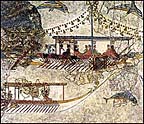
 Dr. Floyd W. McCoy, a University of Hawaii geologist who has studied the eruption of Thera for decades has proposed that it was much more violent than previously thought. During a field trip to Anafi, an island some 20 miles east of Thera, he found fresh cut roads had exposed layers of Thera ash up to 10 feet thick. Factoring in such evidence, Dr. McCoy calculated that Thera had a V.E.I. of 7.0 — what geologists call colossal and exceedingly rare. In the past 10,000 years only one other volcano has exploded with that kind of gargantuan violence: Tambora, in Indonesia, in 1816, It produced an ash cloud in the upper atmosphere that reflected sunlight back into space and produced the year without a summer. The cold led to ruinous harvests, hunger and even famine in the United States, Europe and Russia.
Dr. William B. F. Ryan, a geologist at Columbia's Lamont-Doherty Earth Observatory has woven such clues into a tantalizing but provisional theory on how distant effects might have slowly undone Crete. First, he noted that winds at low and high altitudes seem to have blown Thera's ash into distinct plumes — one to the southeast, toward Egypt and another heavier one to the northeast, toward Anatolia. Even if the changes wrought by Thera helped trees there, they apparently played havoc with delicate wheat fields.
Mursilis, a king of the Hittites, set out from Anatolia on a rampage, traveling between the plumes to strike Syria and Babylon and seize their stored grains and cereals. The subsequent collapse of Babylon into a dark age, Dr. Ryan said, also undid one of its puppets, the Hyksos, foreigners who ruled Egypt and traded with the Minoans.
He theorized that the new Egyptian dynasty had no love of Hyksos allies. So Minoan Crete, already reeling from Thera's fury, suffered new blows to its maritime trade.


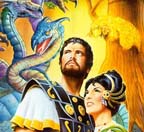 "After fiddling about in the mud and muck of northern Greece, retracing Jason's route as detailed in Apollonius of Rhodes' telling of the Argo's journey, and wandering the hills and valleys of Georgia, some smug historians punctured Jason's fable. Rather than a hero of epic proportions, he was probably just a trader sent to the eastern end of the Black Sea on a shopping trip. There, he bartered with the Georgians, a race of people who used - and still use - sheep fleeces to pan for gold. It was 'highly likely' that Jason was 'a diplomat, a bureaucrat' rather than a warrior, and that his trials at the court of King Aeetes involved trading negotiations, not hand-to-hand combat with the undead. Such were the pedestrian origins of an incredible myth. "
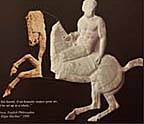 "A virtual exhibition, which shows how the Elgin Marbles would look if they were reunited, has opened in London. Marbles Reunited shows those sculptures removed from Greece 200 years ago by Lord Elgin next to those which remained in Athens.
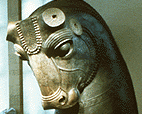 "One of the world’s great collections of antiquities from ancient Iraq will be on display at the University’s Oriental Institute, beginning Saturday, Oct. 18. The Edgar and Deborah Jannotta Mesopotamian Gallery, remodeled as part of an ongoing renovation project, will open with an exhibition devoted to the Oriental Institute Museum’s Mesopotamian collection. "
 As you know, I’ve been listening to Herodotus on my commute. Many of his descriptions of people and places are surprisingly accurate but I thought the Arabs who described how the Indians collected gold dust were playing a joke on him. He said he was told that there were ants the size of foxes that dug gold out of the ground. Men would approach these ferocious animals riding a female camel with a male camel tethered on each side. If the “ants” saw the men collecting the gold dust they would attack and the men would flee with their camels. The ants were so tenacious that they would persist in the chase. As the camels began to tire, the rider would loose one male and then the other male, presumably to be overtaken and consumed by the ants. Herodotus explained that the female camel’s motherly instincts would make her strive harder to escape the ants and return to her young.