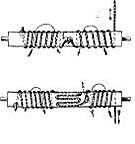
 Last Sunday I watched a wonderful series of programs about Ancient Discoveries. The first program focused on the Antikythera sometimes called the first computer, and discoveries by Archimedes and the often-overlooked contributions of Ctesibus. Ctesibus is probably most lauded for his work with the water clock.
"Ctesibus of Alexandria was the first to put wheels into the water clock. In so doing he added another chapter to the "romance of the wheel" and also made the clock run itself. Here was a float with a pointer the rise of which was controlled by water. Ctesibus fastened a cord to the float, ran the cord over a pulley and let the cord turn a wheel. The rising of the water supplied the motive power to keep it going, just as the flowing of water keeps water wheels turning in a stream. If a wheel was kept turning regularly by the rise of the water, a pointer on that wheel could be made to show the time on a clock face, much as the shadow marked it on the face of the dial. The old "water-thief" really looked a little like our modern clocks. Like them it marked the time, clicking it off by the turns of its wheel so that to those who stood and watched it turn, it seemed to be actually stealing away the time. Sometimes a tiny figure of a man with upraised arm was set as the pointer, that he might be a warning to all who saw him moving around the circle of the clock face. As he moved time was passing, slipping away into eternity."
This article also mentioned that Pompey the Great introduced water clocks into the Roman courts to manage the length of court pleadings:
"Clepsydras were used throughout the Roman world. They were expensive. If they were to keep time accurately their machinery had to be made very carefully and constantly kept in order. But for public buildings and squares and for rich private homes they were most useful. Pompey the Great, the Roman general who lived from 106 to 48 B.C., had these clocks put in the courts where the lawyers were given to endless speech making, "to stop their babblings." He may have taken the idea from the Athenian courts of justice where the "water-thief" was also used to limit the length of pleas. "The first water," says an ancient writer, Æschines, "was given to the accuser, the second to the accused, and the third to the judges." A special court official was charged with the duty of watching the clock and giving notice to the speakers."
Ctesibus also developed a number of war machines including "a catapult using two bronze springs in a vertical frame to provide the powerful pressure against the heel of each bow limb. An even more interesting concept was the use by Ctesibus of compressed-air springs: the heel of each bow limb, when the string was drawn back, would press against a bronze piston, which in turn would be pushed into a bronze cylinder, thus storing energy as compressed air."
The second program focused on the Roman physician Galen. Unfortunately, I was so tired I fell asleep and missed most of it. Hopefully it will be repeated and next time I’ll be ready with the video recorder!
The third program was about Heron of Alexandria. I thought this was such a coincidence because we had just been talking about Heron. Heron was famous throughout the ancient world for his automaton theaters--puppet theaters worked by strings, drums, and weights--automatic doors, and coin-operated machines. Heron’s intricate systems of spindles studded with pegs and wound with ropes used to propel his automatic theater is like an early version of computer programming. Being a technologist, I particularly enjoyed this part of the discussion and a recreation of his Nauplius theater which had scenes that changed automatically and "actors" that built ships and dolphins that leaped from the waves. Heron turned to the theater as an outlet for his creative energies after he found designing war machines was too limiting. In this program they demonstrated one of his war machine designs – the first "machine gun". A chain-driven ballista-like device that could fire multiple bolts.


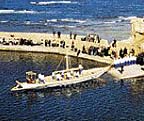 "Under the aegis of the culture ministry and the expert supervision of Vice-Admiral Apostolos Kourtis, the vessel has been constructed to be as exact a replica as possible of a Bronze Age Aegean vessel of about 1500BC. Ancient building methods have been observed and materials identical to those of antiquity have been used.
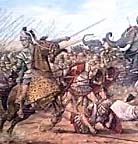 " 'When [Alexander] arrived before the walls of [Babylon],' Plutarch recorded, 'he saw a large number of ravens flying about and pecking one another, and some of them fell dead in front of him.'
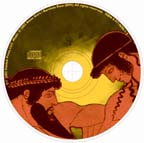 Combining archaeology, literature, theater and music, four artists from New York State have united their efforts to bring back to life the lost Greek myths of male love. Culminating four years of labor, they have released their work, titled 'Lovers’ Legends Unbound,' as a radio-drama genre production on audio-CD plus text with color illustrations of ancient art. The stories, painstakingly pieced together from ancient fragments and re-written by Andrew Calimach, have as protagonists characters we all thought we knew, but who reveal here a side censored out of popular literature ever since Roman times.
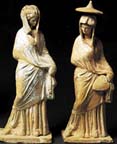 "Louvre visitors are now viewing displays of 240 statuettes of modestly draped and veiled matronly or maidenly figures found in thousands of graves from the era of Alexander the Great in cemeteries round the vanished hilltop city of Tanagra, about 20km east of Thebes in Viotia."
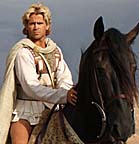 Oliver Stone's film depicting the life and conquests of Alexander the Great looks promising, at least from this production still.