"At the start of the fifth century AD, Copán was a modest village set in a fertile, mountainous valley on the eastern fringe of the Maya world. Within decades, the village embarked on a remarkable rise to become, at its zenith in the eighth century, among the most accomplished Maya cities in art, architecture, and astronomy.
The transfiguration's instigator was a man named Yax K'uk Mo."
"Despite their calendrical exactitude, the terse carvings are vague about Yax K'uk Mo's origin or where and by whom he was crowned. Like ancient Greece or Renaissance Italy, the Maya world consisted of independent city-states linked by trade and vying for hegemony. Conceivably, any one of the rival cities could have been Yax K'uk Mo's hometown and source of power."
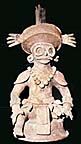
"Copánec artisans certainly depicted Yax K'uk Mo with Teotihuacáno trappings. This image shows the king wearing goggles that form part of a characteristically Teotihuacáno war helmet. And in his tomb, which was discovered in 1995, archaeologists found pottery from Teotihuacán."
"But the tomb also contained pottery from Tikal, a Maya city north of Copán, as well as pottery from Copán itself. As for the goggles, it's understandable that a local magnate would want, if only through symbols, to draw authority and legitimacy from the region's preeminent power."
"By analyzing isotope ratios in Yax K'uk Mo's teeth and bones, a team led by Jane Buikstra of the University of New Mexico has ruled out Teotihuacán as Yax K'uk Mo's place of birth and early childhood. Instead, it appears the king grew up in central Yucatán, the heart of the Maya world."
But the tomb also contained pottery from Tikal, a Maya city north of Copán, as well as pottery from Copán itself.
If you enjoyed this post, never miss out on future posts by following me by email!
 "Warlords and thieves are stripping bare a recent archaeological discovery described as 'the Pompeii of Central Asia' while the central government and Western scientists are powerless to intervene, authorities say."


 "Hisham Nessim, manager of Aqua Sun Resort, is giving tourists a chance to participate in solving the ancient mystery of the lost army of Persian king, Cambyses."