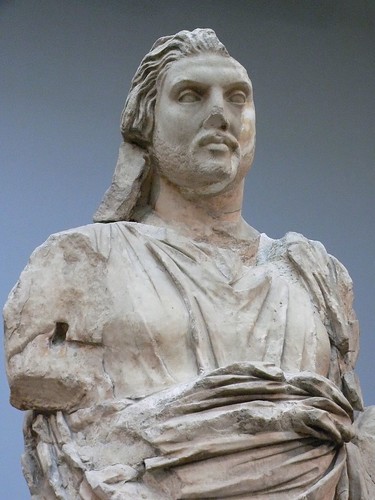
Until I visited the British Museum earlier this spring, I was not even aware that anything remained from the Mausoleum of Halicarnassus, one of the seven wonders of the ancient world. Therefore I was thrilled to see the wonderful statues of a very handsome King Mausollos and Queen Artemisia there.
See
my pictures!
So, the following article caught my eye:
The New Anatolian: "Main opposition Republican People's Party (CHP) Mugla Deputy Fahrettin Ustun has asked Culture and Tourism Minister Atilla Koc to take the initiative to get remaining sections of the Mausoleum, one of the Seven Wonders of the Ancient World, currently at the British Museum, back to Turkey. Ustun said that a similar request was made in the past as well, but it didn't bear any fruit, and told the following story:
King Mausolus' wife and sister built a mausoleum for the deceased ruler in 350 B.C. in Halicarnassus (modern-day Bodrum). According to the ancient Greek historian Pliny, the Mausoleum is the first example of its kind in Anatolia with a pyramidal roof and is about 50 meters high. The white marble used in the pyramid was brought from the island of Pharos, which lay at the mouth of the harbor of Alexandria, Egypt. On the top step of the pyramid stood lion monuments and at the summit of the whole mausoleum were statues of King Mausolus and Queen Artemisia in a chariot. But the Mausoleum was demolished probably in the large Anatolian earthquake of 1304. When the Knights of Rhodes arrived in Bodrum, they used the stones and pillars of the Mausoleum to build the Bodrum Castle.
British Ambassador to Istanbul Lord Stratford Canning asked Ottoman Sultan Abdulmecid (1823-1861) for permission to take to the United Kingdom the 13 reliefs that were used in the walls of the castle by the Knights of Rhodes."
Later, famous writer Cevat Sakir Kabaagacli (1890-1973), known as the Fisher of Halikarnas, sent a letter to Britain's Queen Elizabeth. Kabaagacli, a graduate of Oxford University, said that he was very sad that the Mausoleum pieces that were sent to the British Museum were kept in London's cold, foggy weather instead of their own natural atmosphere. He said that the pieces that were exhibited in London were built for Bodrum, and that their real beauty can only be seen when they are juxtaposed with the blue of the Bodrum sea, and so they shouldn't be taken out of the place where they truly belong.
The queen sent the letter to the director of the museum. A few months later, the director sent the following reply: "We've taken your suggestion very seriously. Indeed, their real value can be seen when together with blue. Therefore, we painted the hall in the museum where they are exhibited a Bodrum blue. Thank you very much for your interest."
If you enjoyed this post, never miss out on future posts by following me by email!

