Monday, August 19, 2013

New DVD offers salute to German war ace Günther Rall


I have been fascinated by aircraft and the adventurous men and women who have flown them since a very young age.  I have explored air museums from Cape Canaveral in Florida to the Huntsville Space and and Rocket Center in Huntsville, Alabama to Evergreen's Air and Space Museum near my home in McMinnville, Oregon.  So, it would be natural for me to be interested in a new DVD collection from Acorn Media about Günther Rall, one of Germany's most decorated air aces of WWII.

This particular DVD entitled "Germany's Last Ace" is part of the Military Channel series "Missions that Changed the War" narrated by Gary Senise.  The most unique aspect of this DVD is that it includes clips from an actual interview with Rall not long before his death at the age of 91 in 2009.  But despite his advanced age, Rall's recollections are clear and precise and bring his life and experiences as a combat pilot in WWII vividly to life.

List of Knight's Cross of the Iron Cross recip...
Knight's Cross of the Iron Cross recipient  Günther Rall (Photo credit: Wikipedia)
Günther Rall was born in Gaggenau, a small village in the Black Forest on 10 March, 1918.  His father was a merchant.  The economy was in a shambles after World War I so like many other businessmen, his father supported the economic reforms proposed by the newly formed Nazi party, although Rall points out that his father never became involved in politics and never joined the Nazi party.

Rall was a good student and participated in the Chrisitian Scouts program until he completed his schooling.  Then he joined the Wehrmacht and spent two years as an infantryman before he applied for officer's candidate training in 1936.  He was accepted into the War College in Dresden where a friend convinced him to join the Luftwaffe.  He was accepted and by 1938 had become a qualified pilot and commissioned as a Leutnant (Second Lieutenant).  Rall exclaims that the was sent to the French/German border with only two months of training.

Rall scored no victories during his first year in combat flying against British Spitfires and Hurricans, with Rall saying the British pilots were the toughest he ever faced.  Then, he scored his first air victory on May 12, 1940 when he shot down a Curtiss Hawk 75A fighter piloted by Czech Sgt. Chef Otto Hanzliceka, who was attacking a German reconnaissance aircraft.  This was to become the first of 275 air victories achieved during almost 800 combat missions, flying the Messerschmitt Bf 109 most of the time.

In the interview, Rall describes how the initial orders to fly bomber escort in tight formation was very unsuccessful because "you cannot dictate a fighter pilot's air space!"

Rall was eventually sent to Rumania to protect the Reich's precious oil fields from Russian bombers.  There he found terrible conditions for both the pilots and the mechanics that serviced their aircraft.
"The mechanics only had thin coveralls and no gloves", he exclaims "and the weather was brutally cold."  He went on to describe how the men lived in lice-ridden tents that offered little protection from the wind and freezing temperatures.  Then, as the war progressed Hitler launched his campaign against Russia called "Barbarossa" and Rall found himself ordered to fly three to five combat sorties a day.


At first the Russians flew badly outdated aircraft left over from the Spanish Civil War.  On the first day of the invasion, Rall said the Germans shot down over 1800 Russian piloted planes.  But as the war dragged on, the British gave the Russians American P47s that the British had received through the Lend-Lease program and more experienced Russian pilots began to deploy tactical strategies that were more effective during air combat.

After shooting down his 36th enemy aircraft, Rall himself was shot down, hard landing in a gully and breaking his back in three places.  Paralyzed on his right side, Rall explained that he was told by a German surgeon that he would never walk again, let alone fly.

Rall was shipped to Vienna to recuperate where his physicians, thinking he needed someone to encourage him, introduced him to a vivacious, young Dr. Hertha Schön.  The "prescription" worked wonders because after five months of rehabilitation he shed his full body cast and by August 1942 returned to the Russian front in time to fly in the hard fought battle of Kursk even though he had to strap his "lame leg" to the rudder pedal to fly the plane.

From August to November Rall claimed another 38 victories, bringing his total to 101. On 3 September 1942, Rall was awarded the Knight's Cross of the Iron Cross (Ritterkreuz des Eisernen Kreuzes). On 26 November 1942 he was given the Eichenlaub to his Ritterkreuz des Eisernen Kreuzes by Adolf Hitler personally. - Kaplan, Philip (2007). Fighter Aces of the Luftwaffe in World War II.

Heinrich Prinz zu Sayn-Wittgenstein and others...
Heinrich Prinz zu Sayn-Wittgenstein and others receiving the Knight's Cross of the Iron Cross (Photo credit: Wikipedia)
As Rall's air victories soared, first to 200 then to 250, each time he received his military honors personally from Adolf Hitler and in the interviews Rall describes his impressions of Hitler each time they met.  He describes how Hitler first appeared very confident with an impressive command of details of the developments on each front.  But as the war wore on, Hitler appeared less confident and ill-at-ease until at their last meeting when Rall received swords for his previously awarded Knight's Cross, Hitler was muttering mystically about the dark valleys ahead.  These personal observations are the true gems of this presentation.

Another thing that impressed me about this courageous officer was that he kept fighting valiantly despite dwindling fuel and supplies and even during a Gestapo investigation of his wife (he had married his doctor in 1943) who had Jewish friends that she had helped to escape to England.  Rall tells us that fortunately, the inquiries were quashed after he was awarded the swords but can you imagine how unnerving that would be for a pilot in the hair-trigger environment of air combat?

Of course when Rall was eventually transferred back to Germany to defend his homeland in the final stages of the war, he now flew against bomber fleets raining destruction upon many major cities and surely must have feared for his family even more so then, too.

It was then that he was shot down for the 8th and last time by American ace, Robert Rankin.  The DVD includes biographical backgrounds for both Rankin and his squadron commander Hubert Zemke as well as interview clips of Rankin and Zemke's son.

Rall survives a devastating infection resulting from the wounds he suffered in his last combat engagement to become a flight instructor.  Rall flew and studied several American planes that had fallen into the possession of the Luftwaffe to find their strengths and weaknesses and develop better strategies to combat them that he could teach his students.

"He flew the P-51 and was amazed at the luxury and quality of the American planes. He found they were spacious, heated, had armoured plate protection, and used materials and equipment that had been long unavailable to Germany. He explained that being unable to fly in combat probably saved his life at a time when Germany was totally outnumbered and the chances of staying alive were drastically dropping. " - Weal, John (2002). German Aces of the Russian Front.

After the war, Rall, almost unbelievably, could not find work and starts up a small woodcutting business.  But he eventually lands a job with Siemens before finally rejoining the military in 1956  as an engineer for the new Luftwaffe der Bundeswehr after the re-militarization of West Germany.  In April 1974, he is named a military attaché for NATO and retires in 1975 after achieving the rank of Generalleutnant.  Much of this DVD is based on his autobiography, Mein Flugbuch ("My Flightbook").

My main criticism of "Germany's Last Ace" centers around the producer's decision to surround the fascinating events of Rall's career with practically a complete mini-history of World War II.  Rather than enhancing the portrait of Rall, it serves to bury it in an overload of only distantly relevant information and hours of unrelated combat footage.  The division of the program into four separate episodes also results in the repetition of information in subsequent sections.  The resulting 3 hours running time should have been pared to only one or at most one and a half hours.

Recently, my husband and I have started watching a new series on the Military Channel entitled "Air Aces". Each tightly written 45-minute episode features a dramatized biography of one particular fighter pilot that includes little live action mini-dramas featuring professional actors interspersed with live reenactments and beautifully rendered CGI combat sequences created using state-of-the-art game engines like the one in Konami's "Birds of Steel" or Kalypso Media's "Air Conflicts".


Instead of hours of talking heads cut between often blurry vintage camera footage, we see the fear on the faces of ardent young men facing death rushing at them at hundreds of miles an hour captured in sharply detailed HD.  Their aircraft is as breathtaking as it was the day it rolled off the assembly line and when hit bursts into explosive showers of flame and smoke.  I was hooked on the series from the very first episode about the "Falcon of Malta", George Beurling.  (My father served aboard one of the U.S. Navy ships that were sent to supply Malta early in the war) I would love to see the series redo the profile of Günther Rall, to truly offer a worthy salute to this amazing individual.

Related articles
Enhanced by Zemanta
If you enjoyed this post, never miss out on future posts by following me by email!

Thursday, June 27, 2013

All About History magazine new release from Imagine Publishing

Add caption
I received an email about a new history magazine from Imagine Publishing entitled "All About History".  The publisher points out that this new magazine will provide a "dynamic alternative" to the more dry, academic approach of other history-themed magazines currently available.

Editor in Chief Dave Harfield said no other magazine on the market takes such an accessible and entertaining approach to the past. "History is rich, diverse and fascinating and that’s exactly what we strive to reflect in this new launch; well-crafted stories filled with accurate, well-researched fact and expert opinions.”

I took a quick look at the first issue and it includes a wide variety of subjects from a day with Lincoln to gamechanging events dating all the way back to ancient Greece.  So its scope appears to be quite broad.  

It's "heroes and villains" department sounds promising and offers up Rasputin as the first in the lineup.  Its "Eye Witness" department also looks interesting.  They begin with the JFK assassination but hopefully they will be able to dig up eye witness accounts from less publicized events as the publishing year progresses.

The magazine is available in digital format from Amazon.
Enhanced by Zemanta
If you enjoyed this post, never miss out on future posts by following me by email!

Wednesday, April 24, 2013

Review: She-Wolves: England's Early Queens (DVD series)


Women throughout history who have expressed any inkling of ambition have traditionally been disparaged by the world's predominantly paternalistic societies as either harlots or traitors to their own sex.  Britain's women who would rule were no different and branded as she-wolves by the men who sought to claim sovereignty even without the prerequisite royal blood line.  It is the lives of these women of Britain that are explored in Acorn Media's series "She-Wolves: England's Early Queens" based on a book of the same name by medieval scholar Dr. Helen Castor.  Castor produced the series for the BBC and serves as its host throughout the program.

In opening remarks, Castor points out that men rose to power by demonstrating their superiority in military leadership and prowess as warriors.  But women in the royal line of succession were often ignored or married off to males deemed unfit because of fragile health or mental instability so other powerful men could assert their rights to the royal succession.  To press their own claim or the claim of their offspring to the throne, queens were often forced to forge alliances with men who could just as easily thrust them aside once a battle was won.


Episode 1 examines the struggles of Matilda, daughter of Henry I, and Eleanor of Aquitaine, first a queen of France then wife of Henry II of England.  I was somewhat familiar with at least a basic outline of the events that transpired in the lives of these two women.

The war between Matilda and her usurping cousin Stephen of Blois has been the backdrop for a number of theatrical productions including the excellent miniseries "Pillars of the Earth" based on Ken Follett's book by the same name.  In fact the death of Matilda's brother aboard the infamous White Ship is the ultimate secret harbored by the evil villain of the story, Bishop Waleran Bigod, played superbly by Ian McShane.

Likewise, Eleanor of Aquitaine has been the subject of countless books and theatrical productions including the award-winning "Lion In Winter" with Eleanor played by none other than the legendary Katherine Hepburn.  Eleanor has been portrayed so heroically for centuries that I was surprised Castor approached her biography more matter-of-factly.

Based on the life sketched by Castor, I got the impression Eleanor may have been more personally ambitious than the ultimate romantic she is often portrayed to be.  Perhaps describing her as passionately ambitious would be a good combination instead.  When you examine her possible tryst with her warrior uncle in Antioch while on Crusade and married to King Louis VII of France,  then her aggressive pursuit of Henry II after she successfully obtains a dissolution of marriage, she hardly comes across as an icon of courtly love.
Then you learn she essentially betrays Henry when her sons (including Richard the Lionheart and the infamous King John of Robin Hood legend), tired of waiting for him to die so they can rule, revolt against their father.  How could I characterize her but to recognize that she appears to be someone who desired power above love (she virtually ruled England while her son Richard The Lionheart was away on Crusade) and was supremely opportunistic - much more deserving of the term she-wolf than I initially thought.


I found Episode 2 about Isabella of France and Margaret of Anjou even more fascinating.

As Castor detailed the unfortunate marriage of Isabella of France and Edward II, I couldn't help but picture the beautiful image of Sophie Marceau who played the role of Isabella in Mel Gibson's production of "Braveheart".  Of course this theatrical version of the Queen was rife with "creative license" since historians say Isabella and Edward II married three years after Braveheart was captured and executed. Isabella was also only 12 at the time of their marriage so she couldn't possibly have been a secret lover of William Wallace.  But it was the face of Marceau that I continued to envision as I listened to the trials of her difficult marriage.  Her husband, who preferred male companionship, gave his attentions, first, to Piers Gaveston, the first Earl of Cornwall, then Hugh Despenser the Younger.  In spite of this, Isabella somehow managed to produce four children (although there were rumors of queenly affairs).  Isabella's eldest, Edward III, ultimately became King of England.

The barons of England were as appalled by Edward's behavior as Isabella and were in constant plots to end his rule.  These efforts increased in earnest when Edward advanced his favorite Hugh Despenser the Younger.

Increasingly Edward had to rely on Isabella's French relatives to keep him in power.  But Edward's lover Despenser the Younger used his influence to confiscate Isabella's lands in England and even her household staff.  Then, when tensions rose between France and England and Isabella was sent to France to negotiate a settlement, she finally found love with Roger Mortimer, the first Earl of March, who had been exiled to France.  Together they raised and army, invaded England and deposed Edward II.  But, in a cruel twist of fate, Isabella's son did not like Mortimer and resented his influence so the prince ordered Mortimer's execution.  Edward III did not execute his mother but, like many noble women who displeased the men in power, Isabella ended her days in a nunnery.

I thought the biography of Isabella would be the most poignant but the story of Margaret of Anjou was even more heart rending.  Margaret was married to the son of the famous warrior king Henry V when she was only 15.  But unlike his warrior father, Henry VI was not only bookish and lacking a forceful personality, he suffered from severe and incapacitating mental illness -  hardly the warrior king needed for the ensuing War of the Roses.  So Margaret had to seek help from other powerful nobles to try to retain the throne for Henry so her son could ultimately inherit it.

Castor did not elaborate much about Henry VI's mental condition but I was intrigued so I researched it further.  Here are some of the speculations about the cause that I found:

"In 1453, at the age of 32, Henry VI began to exhibit signs of serious mental illness. By means of a "sudden fright" he entered into a trance-like state reacting to and recognising no one. Catatonic schizophrenia or depressive stupor have been suggested as a likely diagnosis. This was probably an inheritance from his grandfather, Charles VI of France, who himself suffered from bouts of schizophrenia, which is reported to have come on suddenly in 1392 when he was then aged 24, into which he then suffered relapses for the next 30 years. Charles VI's mother, Joanna de Bourbon, also exhibited signs of mental illness, as did various ancestors of hers, including Louis I, Duke of Bourbon, Peter I, Duke of Bourbon, Louis II, Duke of Bourbon." - English Monarchs

A physician from Albert Einstein College of Medicine agrees with the diagnosis of schizophrenia:

"At 31 he [Henry VI] had a sudden, dramatic mental illness in which he was mute and unresponsive. Before, he had been paranoid, grandiose, and indecisive. After, he was apathetic with deterioration of ability, drive, interest and self-care, and hallucinations and religious delusions. This illness, which is consistent with a diagnosis of schizophrenia, robbed Henry of his personality, his crown, his wife, his only son, and his life. It led to three decades of brutal fighting for the crown (the 'Wars of the Roses') that resulted in a new dynasty with a dramatic impact on the country: the Tudors, Henry VIII, and Elizabeth I and their descendants. - N. Bark, Did schizophrenia change the course of English history? The mental illness of Henry VI, abstract

During this period, though, Margaret gave birth to a son she named Edward.

"When the baby was shown to Henry, he remained immobile like a statue, looking upon the Prince only once, immediately casting down his eyes again; he took no notice and said no word. He didn’t even recognise his wife. The Royal physicians tried a series of drugs, purgatives, baths and bleedings, but their patient remained impassive. He wouldn’t wash or dress of his own account. Potions, syrups, laxatives, clysters and bloodletting followed. Henry’s head was shaved and purged “to rid the brain of its black bile and so restore the balance of the humours”. Still, Henry remained passive, and found difficulty in moving about without assistance." - J.N.W. Bos, Mad Monarchs: Henry VI of England,

When Henry began to fully recover in January 1454, he declared his son must have been conceived by the Holy Ghost, which did little to quell the rumors of his queen's unfaithfulness.  Things went from bad to worse when the king's regent, Richard Plantagenet, 3rd Duke of York, began organizing allies that would support his own, rather than the king's, right to the throne.  With the King essentially incompetent to defend himself, Margaret resorted to intrigue to put an end to this threat, conspiring to assassinate the duke on two different occassions.  Castor did not get into this much detail however.

Failing to put an end to her husband's rival, Margaret found herself at the head of the Lancastrian faction in her husband's stead at the First fateful Battle of St. Alban's where the Yorkists succeeded in routing the King's forces and imprisoned Henry VI.

Margaret's forces retaliated at the Battle of Wakefield and a Second Battle of St. Alban's where her husband was freed.  But other Lancastrian defeats followed and Margaret fled to France where she sought help from her cousin Louis XI.  Louis suggested an alliance with the Earl of Warwick and the Earl offered his daughter's hand in marriage to Margaret's son to seal the bargain.  But, upon returning to England, Warwick, although initially successful, fell at the Battle of Barnet leaving Margaret alone to lead the Lancastrian army at the Battle of Tewkesbury.  There, her forces were not only defeated but her beloved 17-year-old son was killed.

Her husband, Henry VI, upon hearing of his son's death died soon after.  Although the official story was Henry died of grief many suspected foul play.  To end all doubt, King George V had Henry's body exhumed in 1910.  A patch of light brown hair matted with blood was found still attached to his skull, confirming a violent end to his life.

Broken and defeated, Margaret was imprisoned until ransomed by Louis XI four years later.  She spent her remaining seven years as a poor relation to the King of France.  When I researched her biography, I noticed that this courageous "she-wolf"  suffered a final indignity during the French Revolution when rebels ransacked her tomb in Angers Cathedral and scattered her remains.


The last episode of "She-Wolves" focuses on the accesion of Lady Jane Grey, Mary Tudor (Mary I) and Elizabeth I following the death of Henry VIII.  I have watched quite a few films on the Tudors as well as studied the life of Henry VIII so I was familiar with most of the information Castor provided here.  However, I was under the assumption that Henry VIII's only son, Edward VI, was a sickly child eventually succumbing to a respiratory ailment at the tender age of  15 so had contributed little during his reign.  Castor pointed out that Edward was quite directly responsible for numerous Protestant reforms and personally developed a "devise of succession" that skipped over his half-sisters, the very Catholic Mary as well as Elizabeth, and granted ruling authority to his cousin, a very reticent 16-year-old Lady Jane Grey.  I had assumed all of this manipulation was the result of the influence of the King's regent, the  Duke of Northumberland.  But I guess that line of thinking was abandoned back in the 1970s.
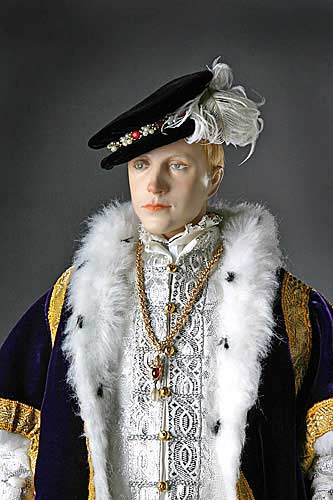
Mixed media portrait sculpture of Edward VI
by George Stuart.  Image courtesy of the
Historical Figures Foundation.

"For centuries, the attempt to alter the succession was mostly seen as a one-man-plot by the Duke of Northumberland. Since the 1970s, however, many historians have attributed the inception of the "devise" and the insistence on its implementation to the king's initiative Diarmaid MacCulloch has made out Edward's "teenage dreams of founding an evangelical realm of Christ", while David Starkey has stated that "Edward had a couple of co-operators, but the driving will was his". Among other members of the Privy Chamber, Northumberland's intimate Sir John Gates has been suspected of suggesting to Edward to change his devise so that Lady Jane Grey herself—not just any sons of hers—could inherit the Crown. Whatever the degree of his contribution, Edward was convinced that his word was law and fully endorsed disinheriting his half-sisters: "barring Mary from the succession was a cause in which the young King believed." - Edward VI, Wikipedia with citations 161-167

"She-Wolves" brought much needed attention to the role women have played in the history of Britain, even before the much glamorized rule of "Gloriana" (Elizabeth I).  Dr. Castor is to be applauded for the development of this series and its straightforward presentation that makes these women come alive for a 21st century audience.


Enhanced by Zemanta
If you enjoyed this post, never miss out on future posts by following me by email!