 In my latest series of lectures on ancient Egypt, Professor Brier applied his literary analysis method to the Exodus story. Here are some interesting points he makes:
Internal evidence:
The cities of Pithom and Ramses (Pi-Ramses) were real.
Bricks, not stones, were used to build storehouses.
Bricks were made with straw in Egypt but not in Canaan
Midwives were told to watch "between the two stones" for male Hebrew infants. In Egypt, women giving birth used birthing stools or stones so this was probably a reference to the Egyptian style of giving birth.
The name Moses is Egyptian not Hebrew. Iit means "birth" or "is born". Tuthmosis means the god Toth "is born".)
External evidence:
A Leiden Papyrus says "Distribute grain rations to the soldier and to the Apiru who transport stones to the great Pylon of Ramses". "Apiru" is used to describe tribal people of the desert and sounds somewhat like "Hebrew". This may be a reference to the Hebrews.
(I found a very interesting article by Rabbi Dovid Lichtman including this same reference: http://www.aish.com/societyWork/sciencenature/Archaeology_and_the_Bible_-_Part_2.asp. Since it is written by a rabbi, it may be subject to a lack of objectivity. However, I found the evidential statements intriguing--Much more coherent than the recent Discovery Channel program "Did Moses Exist?")
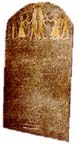
The Merneptah Stela from year 5 of Merneptahs reign (1207 BC) refers to Israel: "Canaan has been plundered into every sort of woe; Ashkelon has been overcome; Gezer has been captured. Yano'am was made nonexistent; Israel is laid waste, its seed is not." Brier points out that this is the earliest non-Biblical reference to Israel. Another thing he points out is that on the stella, foreign nations were denoted with a hieroglyph resembling three mountains (because most foreign countries had such mountains). But the reference to Israel does not include this determinative hieroglyph. He believes this indicates the Israelites were still a wandering people at the time the stela was carved and had not yet founded a nation.
Brier also asserts that counting backward from this time places the Exodus around year 20 of Ramses the Great's reign. Ramses first son, Amunhirkepshef, disappeared from the historical record about this time too although he was obviously a grown man not a young boy as depicted in DeMilles "Ten Commandments".
Brier does point out, however, that there could not have been 600,000 men not including families involved in the exodus since Egypt at that time only had a total population of just over 1 million. He thinks this aspect of the story was simply exaggerated over time. He says a more rational figure would be no more than 600 and maybe as few as 60.
He recommends Ernest S. Frerichs and Leonard H. Leskos Exodus: The Egyptian Evidence, Winona Lake, IN, 1997.
I also wondered about the finality of the statements on the Merneptah Stela. "Israel is laid waste, its seed is not". So why do traditionalist believe there is a continuity between later Israelite civilization and the Israel of Merneptahs time. I guess I'm not the only one as I found this interesting article on the subject: http://taddeo.ingentaselect.com/vl=2613509/cl=21/nw=1/fm=docpdf/rpsv/cw/brill/09272569/v8n1/s2/p8


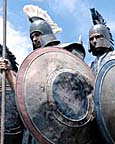 Well, I watched Helen of Troy part 1 Sunday night twice just to make sure I didnt miss anything. (It took my husband, who was casually reading the paper, an hour to figure out I was just watching the same program again!) Overall I found the program entertaining and noticed there was an attempt to at least follow some of the events in mythology. I didnt remember Theseus being killed by Pollux (and my web research confirmed my suspicion). I also didnt remember Paris being abandoned and raised by a shepherd but I checked on that and it is part of the myth. (This new grandmother must be getting senile!)
 The Petrie Museum in London, which owns one of the largest intact collections of Egyptian antiquities outside Egypt, received a grant worth more than $83 million. The museums collection, encompassing over 800,000 items including the worlds oldest dress, was built up by William Flinders Petrie, an archaeologist and the first Edwards professor of Egyptian archaeology and philology at the university. Petrie, who died in 1942, is referred to as the father of scientific archaeology.
 I am presently listening to The Teaching Company lecture "