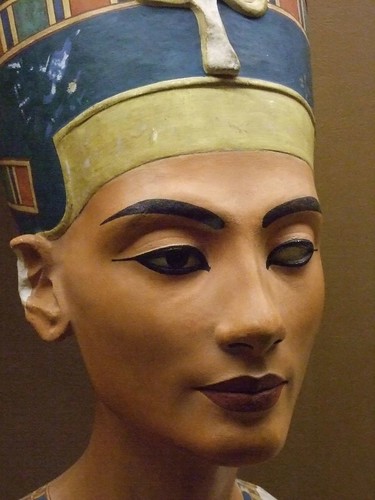
 I was catching up on some of my news alerts after returning from Italy and noticed two fascinating articles about the famed bust of Nefertiti. The first headline to startle me was a claim that the Nefertiti bust is a fake. Apparently, Swiss historian Henri Stierlin says, after studying the records surrounding the discovery of the bust, that it was produced in 1912 in efforts to study ancient pigments. He even names the artist - Gerardt Marks, who supposedly produced the work at the request of archaeologist Ludwig Borchardt.
[Image - a documented replica of the bust of Nefertiti displayed at the Rosicrucian Egyptian Museum in San Jose, California. Photo by Mary Harrsch]
However, Stierlin's "evidence" seems a little thin to me. First, he claims that the statue was never designed to have a left eye - it just isn't simply missing. "This is an insult for an ancient Egyptian who believed the statue was the person themself," Stierlin says. Perhaps he describes how he arrived at this conclusion in his paper.
Stierlin also observes that the shoulders of the work are cut vertically in the Art Nouveau-style of the early 20th century, not horizontally as is usually portrayed in ancient Egyptian art. Although this is an interesting observation, I can't help but wonder if the difference in style was the result of the shift in Egyptian art that occurred during the Amarna period and not a reflection of later art styles.
I thought his more compelling argument was the lack of documentation of the find by the original excavation team. Stierlin says this exquisite object was not mentioned at all in dig records. "[They] didn't even bother to supply a description, which is amazing for an exceptional work found intact!" he exclaimed.
He does admit, though, that the pigments have tested out as appropriately ancient.
From a political viewpoint, I can't help but wonder about the timing of this report. Egypt is demanding the return of the bust. If its authenticity is questioned, this would present a substantial legal obstacle to repatriation efforts. If it is, in fact, a German 20th-century sculpture, Egypt has no claim to it. The bust is so famous, though, the public will continue to flock to see it anyway - especially since dating of the stone underneath is not possible at this time - and its the tourist dollars the two governments are actually after.
Speaking of the stone underneath brings me to the next article about the bust I found quite interesting. A CT scan has revealed that the plaster features of the bust vary slightly from the actual carved stone bust within. I think she still ranks as one of the most beautiful profiles in the world though!
"Researchers in Germany have used a modern medical procedure to uncover a secret within one of ancient Egypt's most treasured artworks -- the bust of Nefertiti has two faces.A team led by Dr. Alexander Huppertz, director of the Imaging Science Institute at Berlin's Charite hospital and medical school, discovered a detailed stone carving that differs from the external stucco face when they performed a computed tomography, or CT, scan on the
bust.
The findings, published Tuesday in the monthly journal Radiology, are the first to show that the stone core of the statue is a highly detailed sculpture of the queen, Huppertz said.
"Until we did this scan, how deep the stucco was and whether a second face was underneath it was unknown," he said. "The hypothesis was that the stone underneath was just a support." - More: The Discovery Channel News
Update - It seems another researcher is questioning the authenticity of the Nefertiti bust based upon the content of the pigments used to adorn it:
The sculpture is composed of the so-called Amarna-mix, a blend of gypsum anhydride plaster applied on top of a limestone base. The material is named after Tel el-Amarna, a small city in central Egypt founded by Pharaoh Akhenaton in the 14th century B.C. That is also where the bust of his queen would be found in 1912.
"This special blend was unknown before 1912," said Simon says, which would mean that Borchardt and his contemporaries could not have known its exact composition. Currently, researchers are comparing material used in the Nefertiti bust with that utilized in statues of her husband, Akhenaton, and other artifacts from the Amarna period. A model of her husband is also currently in Berlin -- lying in storage in much worse condition. - More: Spiegel Online International

