Sunday, June 07, 2009

Islamic Art showcased in new exhibit in Madrid


This exhibit sounds fascinating. Unfortunately, I don't have time this year to travel to Spain to see it. But, I was excited to read that many of the items in it will be eventually housed in a new museum in Toronto, Canada! Some years ago I attended an exhibit of items from the Ottoman Empire at the Portland Art Museum. It was comprised mostly of ornamental weapons and manuscripts. This exhibit includes figural items to help refute the widespread misconception that animal or human motifs are prohibited in Islamic art. Although figural art is prohibited in buildings or objects related to religion, they were used profusely to adorn administrative or private structures or objects.

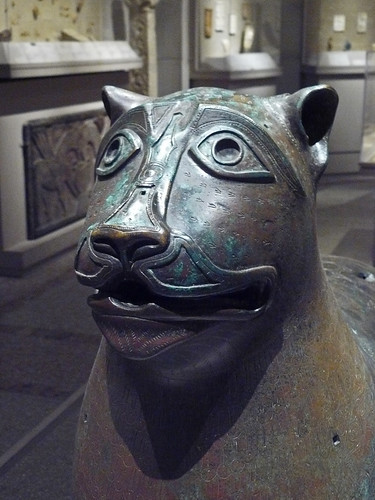
[Image - although not in the Madrid exhibit, this cast bronze lion in the collection of the Metropolitan Museum of Art in New York demonstrates a blending of Islamic, Byzantine and western artistic traditions. Originally gilded and inlaid, the lion was cast in 1000-1100 CE probably in South Italy. It is inscribed in Arabic in Kufic script. Photo by Mary Harrsch.]

I was particularly interested in the inclusion of art from the Mogul Empire. I watched an excellent program about the Moguls on the History Channel and have been reading quite a bit lately about the conquests of Genghis Khan and his successors. I also enjoyed the film, "Mongol". It is supposed to be the first installment of a trilogy and I look forward to the sequels. I regret that when I was in England again last summer I didn't have time to travel to Leeds to view the only remaining complete set of Mogul elephant armor in the world. Maybe it will be included in a traveling exhibit someday!

I encourage you to click on the link to the full article below. It is quite extensive and most informative!

The art, the history, the traditions and the geographies of the Islamic world from the Far East to the Iberian Peninsula are the subjects of the exhibition The Worlds of Islam in the Aga Khan Museum Collection. Organised by ”la Caixa” Social and Cultural Outreach Projects in association with the Aga Khan Trust for Culture, it contains some of the finest productions, not only of the Islamic sphere, but of universal art, with the common denominator of the Arabic language and the Muslim religion. The Aga Khan Museum Collection includes valuable and important pieces from the historical dynasties of the Muslim world. They describe the magnificence of the courts of the Abassids, Fatimids, Safavids or Moguls and show the ductility of Islamic art, capable of conveying a message, not always a religious one, adopting different styles and combining elements from different cultural traditions: from Roman to Persian, from Turkish to Chinese, from Mahgrebi to Hindu, transforming what it imitated and giving it a personality of its own.

The exhibition, which can be seen at CaixaForum Madrid until 6 September, presents a set of 190 objects spanning 1400 years of history and summarizing, in wood, stone, gold, bronze, ivory, glass, ceramic, fabric, parchment and paper, the finest artistic accomplishments of a world that stretched from ancient al-Andalus to India.

The exhibition presents the different Islamic dynasties, with their radiuses of territorial influence, which appeared in the wake of the dismembering of the Abbasid caliphate in the late 9th century: the Omeyas (al-Andalus), the Fatimids and the Mamelukes (Egypt), the Ottomans (Turkey), the Safavids and Qajars (Iran) and the Moguls (India). The Fatimid court was outstanding for its opulence, as some of the pieces of jewelry on show bear witness. The essential features of Islamic court culture are traced through a generic portrait of the profile of their sovereigns. Emphasis is placed on the high cultural level of the Islamic courts that were responsible for spreading knowledge of Ancient Greece to the West through their Arabic translations.

The exhibition also reflects some of the fundamental features of Islamic architecture, such as a capital in the Roman tradition with Islamic ornamental motifs, as well as carved wooden beams and doors. The outstanding examples of painting are to be found in the books illustrated with miniatures and the portraits of kings and sultans. - More: Artdaily.org
If you enjoyed this post, never miss out on future posts by following me by email!

Archaeologists uncover worker structures in Persepolis


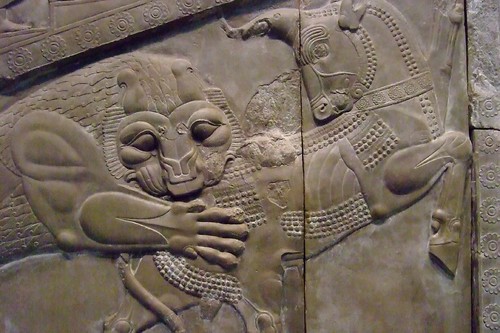
A joint Iranian-Italian archeological mission in Iran have found remains of the dwellings of some of the common people living in Persepolis. Persepolis was one of the five capitals of the Achaemenid Empire in ancient Persia. Its construction began in 520 BC under the Emperor Darius the Great. It was destroyed by fire during its occupation by the Macedonian forces of Alexander the Great two centuries later.

[Image - bas relief from the palace of Darius in Persepolis. Photo by Mary Harrsch]

In an interview with the “Tehran Times”, translated by the magazine “Archeologia Viva” (Giunti Editore), the Italian director of the mission, Pierfrancesco Callieri, professor of Archeology and Iranian Art History at the University of Bologna, affirmed that the new findings at the Persepolis site have furnished initial information on the city and on the neighborhoods where the common people lived. During the course of the excavations of the flat area at the foot of the Great Achaemenid Terrace and about 1 km from here, the team led by Professor Callieri discovered the first traces of a residential area which could correspond to the city of Mattezish, mentioned in the Elamite tablets in Persepolis. During the Achaemenid period (6th- 4th century BC), all the people working for the Imperial Court lived here, from functionaries to workers. Professor Callieri said that in one of the two excavation sites, “we localized a noteworthy structure, probably the walls of one of the building complexes of the city” instead in the other sites the archeologists localized “an artisan area with an oven and various waste ditches, surely connected to the work activities of the area as we found various ceramic pieces but also fragments of animal bones”. - Adnkronos.com
If you enjoyed this post, never miss out on future posts by following me by email!

Midstone Project sheds light on construction of Alexandria's Pharos Lighthouse


The Midstone Project has released information it has compiled about the construction materials used in the building of the Pharos Lighthouse of Alexandria. The research team has even traced the materials to their quarries of origin. This lengthy article also provides an excellent overview of the history of the lighthouse and descriptions of it provided by ancient travelers and scholars.

Since that time every archaeologist has dreamed of the resurrection of such a great monument. But can Alexandria's Pharos really be reconstructed in its original, glorious form?

This question has perplexed archaeologists and scientists. They do not really know the materials used in construction, nor the exact shape and height.

Three years ago, however, answers to these questions were made possible when Egypt participated in a three-year-long European Union project called the MIDSTONE. This project aimed at preserving ancient Mediterranean sites in terms of their ornamental and building stone through determining stone provenance to proposing conservation and restoration techniques. The MIDSTONE project proposes to contribute to the knowledge and conservation of three of the most important ancient sites in North Africa: Voluble in Morocco, Djemila in Algeria and the Alexandria lighthouse in Egypt. An atlas of the stones of every site will be also provided within the project.

This year the Atlas of the Stones of Alexandria Lighthouse is being presented in a three-day conference at Cairo University and the Bibliotheca Alexandrina.

Amr El-Tibi, the project coordinator, says the scientific objective of the project is to identify the stones of the lighthouse and determine their provenance in terms of the geographical area. The data and results obtained are being presented in an accessible form including photographs and maps, i.e. the Atlas.

El-Tibi explained that a detailed study of the blocks was performed to categorise megascopically the main types of stones related to the Pharos, and a first series of 32 samples was collected. As most of the stones related to the lighthouse were still under water, a second series of 35 samples was collected by divers from submerged architectonic blocks. The whole of the 67 archaeological samples were described megascopically and categorised in the laboratory in terms of their petrographic type of stone and physical chemical properties. Studies revealed that the Pharos was indeed composed of granite, greywacke limestone, fine to coarse-grained sandstones, marble and sandstones with dolomitic cement to sandy dolostone found at the basement of Qaitbay fort.

The stones derived from two quarries not far from Alexandria at Mexx and Abusir, as well as from quarries in Moqattam near Cairo; Samalut; Minya; and Drunka in Assiut; Serai and Tarawan.

Zahi Hawass, secretary-general of the Supreme Council of Antiquities )SCA), told Al-Ahram Weekly that he was very happy to introduce the results of this important project on the study of the stones of the Alexandria lighthouse. "This outstanding cooperative effort between the SCA and the European Union brought together teams from Egypt, France, Italy, Greece and Germany to identify and study remains of the lighthouse that are still at the site today," Hawass said.

He added that with the help of Empereur, who drew the attention to the location of the pieces lying submerged in the harbour of Alexandria, the team was able to classify the stone blocks that made up the remains of the lighthouse. One of the most interesting results, he said, was the identification of stones that they were able to match with the quarries from which they came. The provenance of the coarse-grained pink and grey granite blocks was from the quarries of Aswan, while pieces of greywacke were confirmed to have come from Wadi Hammamat. They also, Hawass said, succeeded in identifying the quarry in Greece from where the marble used in the lighthouse was obtained. - More: Al-Ahram Weekly Online


If you enjoyed this post, never miss out on future posts by following me by email!