Showing posts with label Persepolis. Show all posts

Friday, May 07, 2010

2300-year-old Egyptian noblewoman centerpiece of renovated Nelson-Atkins gallery

The burial treasures of a 2300-year-old Egyptian noblewoman named Meretites, which means "beloved of her father", is the centerpiece of the newly reopened Egyptian gallery at the Nelson-Atkins Museum of Art in Kansas City. Robert Cohon, curator of art of the ancient world at the Nelson-Atkins points out that the arrangement of the art and subtle lighting is intended to give the impression of a tomb without being frightening.

"We want children to come in here, and want to know more," Cohon said. They will see the inner coffin painted with a huge golden-faced, blue-haired Meretites, as well as the myriad Egyptian gods and goddesses there for her journey into the afterworld." 

"Egyptian art has been a surreptitious pleasure for so many," Cohon continues. "This may also be a child's first exposure to death."

I was so excited to read about the Nelson-Atkins $1.7 million renovation.  They sound like they have a wonderful ancient art collection that spans over 4,000 years and there is a chance I may be going to Kansas City in July. 

[Image courtesy of the Nelson-Atkins Museum of Art]

My husband expressed his wish to go to the Military Vehicles Preservation Association national conference that is being held in Kansas City this year.  Its still a little iffy, though, with the gas prices climbing towards $4 a gallon again.  If there wasn't a possibility that he would buy some vehicle or large part, we could take my little fuel-efficient Scion but if we're attending a MVPA event, we'll probably need to take my husband's truck in case he wants to drag something back to Oregon.  At least now I have as much motivation to go as he does!

In addition to the funerary art of  Meretites that was purchased from a German collection back in 2007, the Egyptian galleries includes stone portraits of famous kings and queens from Sesostris III to Ramses II, from Nefertiti to the Ptolemies.  The museum's website points out that none of their recent purchases are contested by Egypt so they won't be in danger of repatriation.

Their Near Eastern collection includes grave goods from kings and queens of Ur and sculptures from the Palace of Ashurnasirpal II in Nimrud as well as the ceremonial center of the Persian Empire, Persepolis.  It will be interesting to compare their artifacts to those on display at the Oriental Institute at the University of Chicago.

The museum's Roman collection apparently centers on works of art from the second century CE created during the reigns of the emperors Hadrian and Severus.  Their Greek collection mentions a sculpture of a young athlete.  I couldn't find an image of it but wonder if it is engaged in a particular sport or is more of a representation of a victorious youth?  

Steven Holl: The Nelson-Atkins Museum of Art Bloch Building  Funerary Art of Ancient Egypt  The Severans: The Roman Empire Transformed  Hadrian and the Triumph of Rome   Assyrian Reliefs from the Palace of Ashurnasirpal II: A Cultural Biography   Forgotten Empire: The World of Ancient Persia
If you enjoyed this post, never miss out on future posts by following me by email!

Sunday, June 07, 2009

Archaeologists uncover worker structures in Persepolis


A joint Iranian-Italian archeological mission in Iran have found remains of the dwellings of some of the common people living in Persepolis. Persepolis was one of the five capitals of the Achaemenid Empire in ancient Persia. Its construction began in 520 BC under the Emperor Darius the Great. It was destroyed by fire during its occupation by the Macedonian forces of Alexander the Great two centuries later.

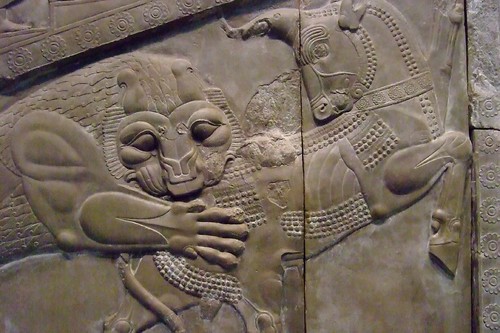
[Image - bas relief from the palace of Darius in Persepolis. Photo by Mary Harrsch]

In an interview with the “Tehran Times”, translated by the magazine “Archeologia Viva” (Giunti Editore), the Italian director of the mission, Pierfrancesco Callieri, professor of Archeology and Iranian Art History at the University of Bologna, affirmed that the new findings at the Persepolis site have furnished initial information on the city and on the neighborhoods where the common people lived. During the course of the excavations of the flat area at the foot of the Great Achaemenid Terrace and about 1 km from here, the team led by Professor Callieri discovered the first traces of a residential area which could correspond to the city of Mattezish, mentioned in the Elamite tablets in Persepolis. During the Achaemenid period (6th- 4th century BC), all the people working for the Imperial Court lived here, from functionaries to workers. Professor Callieri said that in one of the two excavation sites, “we localized a noteworthy structure, probably the walls of one of the building complexes of the city” instead in the other sites the archeologists localized “an artisan area with an oven and various waste ditches, surely connected to the work activities of the area as we found various ceramic pieces but also fragments of animal bones”. - Adnkronos.com
If you enjoyed this post, never miss out on future posts by following me by email!

Sunday, May 03, 2009

Digitized Persepolis tablets now online


In another example of application of HP's Polynomial Texture Mapping technology, the University of Chicago is digitizing thousands of cuneiform tablets from the Persian fortress at Persepolis. Apparently, hundreds of the images are now available online. The article includes a video but it must be HD as it was so choppy it was difficult to watch. I only have a 1.5 Mps DSL connection as I live out in the countryside.

High-resolution images of about 200 Persepolis Fortification texts are available on InscriptiFact, on the Web site of the West Semitic Research Project, http://www.inscriptifact.com. Several hundred more will be available soon.

Images of about 150 more Persepolis tablets, along with editions and analytical tools, will soon be released on the On-Line Cultural Research Environment, the archaeological and textual database and presentation application developed at the Oriental Institute and maintained by the Library (http://ochre.lib.uchicago.edu/index.htm).

These ancient tablets from the palaces of Persepolis include pieces of language and art from the center of the Persian Empire, all made when it extended from India and Central Asia to Egypt and the Mediterranean.

The tablets being digitized come from the Persepolis Fortification Archive, some 30,000 administrative tablets and fragments that Oriental Institute archaeologists recovered in 1933 at Persepolis, the ruined palaces where the kings of the ancient Persian Empire held court. Since 1936, they have been on loan from Iran to the Oriental Institute for analysis and recording.

“They were written, sealed and filed in a short span of time, between 509 and 493 B.C., in the middle of the reign of the Achaemenid Persian king Darius I,” Gil Stein, Director of the Oriental Institute, said. “The oldest Greek tragedy of Aeschylus, and the first Greek history of Herodotus tell us about the reign of Darius, but they don’t tell us anything like this. The administration that these documents record touched every level of society, from lowly workers through bureaucrats and governors to the royal family itself,” he said. - More: University of Chicago Chronicle


If you enjoyed this post, never miss out on future posts by following me by email!

Friday, October 26, 2007

Iran objects to Christie's plans to auction Persepolis bas relief


"Following Christie's announcement regarding its intention to sell a Persepolis artifact, the [Iranian] embassy voiced its objection in an official letter.

The letter says the bas-relief is a part of Iran's cultural heritage, and was stolen from Persepolis 30 years before the Islamic Revolution.

All Persepolis artifacts are part of the national cultural heritage of Iran; international conventions have banned stealing or illegally transferring items of a country's cultural heritage to other nations, the letter adds.

The Iranian embassy in London called on Christie's managers not to auction the Achaemenid bas-relief and to negotiate with Iran on the subject.

A stone carving of the head of a soldier belonging to ancient Persia's Apadana palace in Persepolis was scheduled to be auctioned in London on October 25th with the estimated value of 800,000 British pounds."

Followup:

"
Initial investigations revealed that the relief is part of the stairway of Apadana Palace in Persepolis complex which was sold in 1974 in an auction in New York and was bought by a private owner and kept for 30 years in her private collection in France. Later Iran was asked to provide the Court with the mold of the exact location of the Achamenid soldier bas-relief of Persepolis.

Yet in its latest session, the Court of London was not convinced by the documents presented by Iran and referred the case to the Appeal Court for a final verdict. " - Persian Journal


I think the refusal of the British court to recognize Iran's claim to the artifact is quite inappropriate. I guess I should have expected as much since the British are steadfastly refusing to return the Elgin Marbles to the Greeks either. The Persepolis relief is very much a part of Iran's cultural heritage and I would hate to see it sold again to another wealthy private collector to be used only to impress their friends!

If you enjoyed this post, never miss out on future posts by following me by email!