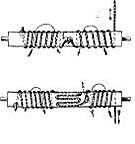
 Last Sunday I watched a wonderful series of programs about Ancient Discoveries. The first program focused on the Antikythera sometimes called the first computer, and discoveries by Archimedes and the often-overlooked contributions of Ctesibus. Ctesibus is probably most lauded for his work with the water clock.
"Ctesibus of Alexandria was the first to put wheels into the water clock. In so doing he added another chapter to the "romance of the wheel" and also made the clock run itself. Here was a float with a pointer the rise of which was controlled by water. Ctesibus fastened a cord to the float, ran the cord over a pulley and let the cord turn a wheel. The rising of the water supplied the motive power to keep it going, just as the flowing of water keeps water wheels turning in a stream. If a wheel was kept turning regularly by the rise of the water, a pointer on that wheel could be made to show the time on a clock face, much as the shadow marked it on the face of the dial. The old "water-thief" really looked a little like our modern clocks. Like them it marked the time, clicking it off by the turns of its wheel so that to those who stood and watched it turn, it seemed to be actually stealing away the time. Sometimes a tiny figure of a man with upraised arm was set as the pointer, that he might be a warning to all who saw him moving around the circle of the clock face. As he moved time was passing, slipping away into eternity."
This article also mentioned that Pompey the Great introduced water clocks into the Roman courts to manage the length of court pleadings:
"Clepsydras were used throughout the Roman world. They were expensive. If they were to keep time accurately their machinery had to be made very carefully and constantly kept in order. But for public buildings and squares and for rich private homes they were most useful. Pompey the Great, the Roman general who lived from 106 to 48 B.C., had these clocks put in the courts where the lawyers were given to endless speech making, "to stop their babblings." He may have taken the idea from the Athenian courts of justice where the "water-thief" was also used to limit the length of pleas. "The first water," says an ancient writer, Æschines, "was given to the accuser, the second to the accused, and the third to the judges." A special court official was charged with the duty of watching the clock and giving notice to the speakers."
Ctesibus also developed a number of war machines including "a catapult using two bronze springs in a vertical frame to provide the powerful pressure against the heel of each bow limb. An even more interesting concept was the use by Ctesibus of compressed-air springs: the heel of each bow limb, when the string was drawn back, would press against a bronze piston, which in turn would be pushed into a bronze cylinder, thus storing energy as compressed air."
The second program focused on the Roman physician Galen. Unfortunately, I was so tired I fell asleep and missed most of it. Hopefully it will be repeated and next time I’ll be ready with the video recorder!
The third program was about Heron of Alexandria. I thought this was such a coincidence because we had just been talking about Heron. Heron was famous throughout the ancient world for his automaton theaters--puppet theaters worked by strings, drums, and weights--automatic doors, and coin-operated machines. Heron’s intricate systems of spindles studded with pegs and wound with ropes used to propel his automatic theater is like an early version of computer programming. Being a technologist, I particularly enjoyed this part of the discussion and a recreation of his Nauplius theater which had scenes that changed automatically and "actors" that built ships and dolphins that leaped from the waves. Heron turned to the theater as an outlet for his creative energies after he found designing war machines was too limiting. In this program they demonstrated one of his war machine designs – the first "machine gun". A chain-driven ballista-like device that could fire multiple bolts.


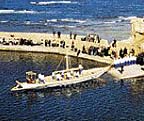 "Under the aegis of the culture ministry and the expert supervision of Vice-Admiral Apostolos Kourtis, the vessel has been constructed to be as exact a replica as possible of a Bronze Age Aegean vessel of about 1500BC. Ancient building methods have been observed and materials identical to those of antiquity have been used.
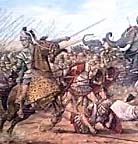 " 'When [Alexander] arrived before the walls of [Babylon],' Plutarch recorded, 'he saw a large number of ravens flying about and pecking one another, and some of them fell dead in front of him.'
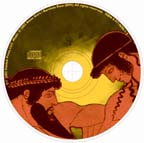 Combining archaeology, literature, theater and music, four artists from New York State have united their efforts to bring back to life the lost Greek myths of male love. Culminating four years of labor, they have released their work, titled 'Lovers’ Legends Unbound,' as a radio-drama genre production on audio-CD plus text with color illustrations of ancient art. The stories, painstakingly pieced together from ancient fragments and re-written by Andrew Calimach, have as protagonists characters we all thought we knew, but who reveal here a side censored out of popular literature ever since Roman times.
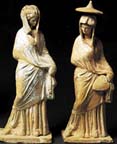 "Louvre visitors are now viewing displays of 240 statuettes of modestly draped and veiled matronly or maidenly figures found in thousands of graves from the era of Alexander the Great in cemeteries round the vanished hilltop city of Tanagra, about 20km east of Thebes in Viotia."
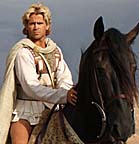 Oliver Stone's film depicting the life and conquests of Alexander the Great looks promising, at least from this production still.
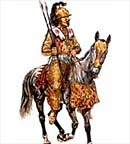 We have been discussing the historical accuracy of many classical sources on my Imperial Rome discussion group and it reminded me of the problems with some of the numbers Herodotus quotes in his "Histories".
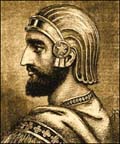 "The £50 million film,
 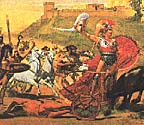 I was particularly interested to note that George Clooney may be the next Leonidas. I’ve heard rumors about Hollywood making “Gates of Fire” but hadn’t seen anything about it for months. Maybe there is hope for it yet. I was also interested to see that Essex’s book “Kleopatra” is being considered for the screenplay treatment as well. My sister bought me the book a couple of Christmases ago but it is still in my “to read” pile.
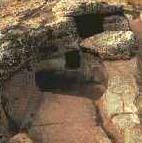 In the first of a series of articles that the Lebanaon newspaper, The Daily Star, will publish on an ongoing basis with the cooperation of the American Schools of Oriental Research, the leading North American scholarly body for the study of the ancient Middle East, Professor Larry G. Herr of Canadian University College describes ancient burials found in one of the few preserved dolmens in Jordan.
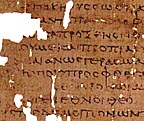 "Cyprus's national theater company, Thoc, plans a modern-day world premiere of Aeschylus's Trojan War story Achilles in Cyprus next summer. The play will then be performed in Cyprus and Greece.
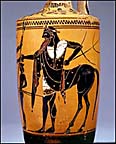 "The centaur, the mythic being with the body of a horse and the head and torso of a man, is the star of a new exhibit at the Princeton University Art Museum, but satyrs (part horse, rather than goat, in early Greek art), sphinxes (winged lions with human heads), sirens (half bird) and gorgons (who had serpentine hair) also have leading roles. Those we know by their proper names also have cameo parts, like the bull-headed Minotaur, the goat-man Pan and Typhon, the embodiment of wind and fire, who had wings and a serpent's lower body.
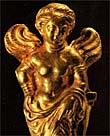 "The fate of the
 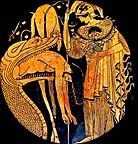 I saw an interesting program Sunday night on the Discovery Channel about the real Jason and the Argonauts. Apparently, Greek archaeologists have excavated what they think is the site of Jason’s city. Although ancient Colchis is believed to have had timber forts that have not survived to the present day, archaeologists excavating an early Greek colony dated to several centuries after the mythical journey in Georgia (ancient Colchis), speculate that it must have been preceeded by a much earlier interaction between the cultures that would coincide with the period that Jason’s quest supposedly took place.
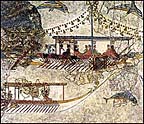 Dr. Floyd W. McCoy, a University of Hawaii geologist who has studied the eruption of Thera for decades has proposed that it was much more violent than previously thought. During a field trip to Anafi, an island some 20 miles east of Thera, he found fresh cut roads had exposed layers of Thera ash up to 10 feet thick. Factoring in such evidence, Dr. McCoy calculated that Thera had a V.E.I. of 7.0 — what geologists call colossal and exceedingly rare. In the past 10,000 years only one other volcano has exploded with that kind of gargantuan violence: Tambora, in Indonesia, in 1816, It produced an ash cloud in the upper atmosphere that reflected sunlight back into space and produced the year without a summer. The cold led to ruinous harvests, hunger and even famine in the United States, Europe and Russia.
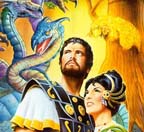 "After fiddling about in the mud and muck of northern Greece, retracing Jason's route as detailed in Apollonius of Rhodes' telling of the Argo's journey, and wandering the hills and valleys of Georgia, some smug historians punctured Jason's fable. Rather than a hero of epic proportions, he was probably just a trader sent to the eastern end of the Black Sea on a shopping trip. There, he bartered with the Georgians, a race of people who used - and still use - sheep fleeces to pan for gold. It was 'highly likely' that Jason was 'a diplomat, a bureaucrat' rather than a warrior, and that his trials at the court of King Aeetes involved trading negotiations, not hand-to-hand combat with the undead. Such were the pedestrian origins of an incredible myth. "
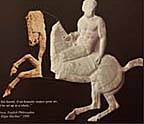 "A virtual exhibition, which shows how the Elgin Marbles would look if they were reunited, has opened in London. Marbles Reunited shows those sculptures removed from Greece 200 years ago by Lord Elgin next to those which remained in Athens.
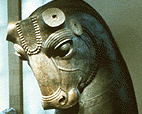 "One of the world’s great collections of antiquities from ancient Iraq will be on display at the University’s Oriental Institute, beginning Saturday, Oct. 18. The Edgar and Deborah Jannotta Mesopotamian Gallery, remodeled as part of an ongoing renovation project, will open with an exhibition devoted to the Oriental Institute Museum’s Mesopotamian collection. "
 As you know, I’ve been listening to Herodotus on my commute. Many of his descriptions of people and places are surprisingly accurate but I thought the Arabs who described how the Indians collected gold dust were playing a joke on him. He said he was told that there were ants the size of foxes that dug gold out of the ground. Men would approach these ferocious animals riding a female camel with a male camel tethered on each side. If the “ants” saw the men collecting the gold dust they would attack and the men would flee with their camels. The ants were so tenacious that they would persist in the chase. As the camels began to tire, the rider would loose one male and then the other male, presumably to be overtaken and consumed by the ants. Herodotus explained that the female camel’s motherly instincts would make her strive harder to escape the ants and return to her young.
 The 8th annual Mehregan festival will be held Oct 4 – 5 at the Orange County Fair& Exposition Center in Costa Mesa, California.
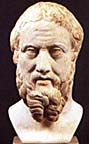 I’ve been listening to Herodotus on my commute. I found his “Egyptian digress” quite interesting. One thing he mentioned that was not discussed in my formal lectures about the work was the practice of delaying the embalming of female corpses to avoid having them violated. I wonder if Dr. Brier has ever noticed a difference in the quality of preservation observed in male and female mummies that would tend to support this statement.
 Eighty pit graves of warriors richly adorned in gold, carrying weapons and near their wives, who were also adorned with gold have been found in a 20-hectare necropolis near the ancient site of Archontiko in Macedonia. The ancient settlement was the most important urban center in the northern part of the ancient province of Bottiaia during the prehistoric and historical periods until the end of the 5th century BC, when Pella became the new capital of the Macedonian kingdom.
 I was very irritated by this article in the NY Times.
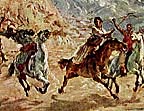 "'Don't give your son money,' Winston Churchill once advised parents. 'As far as you can afford it, give him horses. No one ever came to grief -- except honourable grief -- through riding horses. No hour of life is lost that is spent in the saddle. Young men have often been ruined through owning horses, or through backing horses, but never through riding them; unless of course they break their necks, which, taken at a gallop, is a very good death to die.'"
 "The study of childhood in ancient Greece can illuminate both what is universal and what is specific about child rearing, what effects this might have had on Greek civilization,” writes Jenifer Neils, the Ruth Coulter Heede Professor of Art History at Case Western Reserve University. Neils is cocurator of a new exhibition, Coming of Age in Ancient Greece: Images of Childhood from the Classical Past, with John Oakley, chair of classical studies at the College of William and Mary.
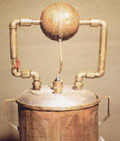 "Long before Galileo changed the course of history in the 1600s with his astronomical discoveries, ancient Greeks were calculating the circumference of the earth, gauging lunar eclipses, pumping water, making steam engines and even building toy automatons for lack of another purpose in pre-industrial antiquity.
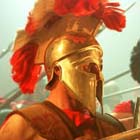 Explore "the birth of the unique Spartan social system. Militaristic, communal and disciplined, the state enforces eugenics and euthanasia. Priests decide which babies should live and which should be left to die. Seven-year-old boys are forced to fend for themselves on the harsh mountainside. Policed by secret spies, the society is supported by a nation of slaves. "
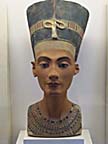 One of the members of our Imperial Rome discussion group mentioned the possibility that Akenaten turned to the Aten after Nefertiti died when she was not healed by his prayers to Amun. I don't think Akenaten blamed Amen-Ra for Nefertiti's death as she didn't die until well into the Amarna experiment when a plague swept through Egypt. Several of their daughters died at that time as well. (This was apparently concluded by scholars because records of the plague are known and Nefertiti disappears from the historical record at the same time.)
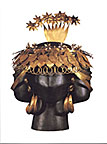 One of the members of my Historical Novel Society discussion list mentioned that she was working on a novel about ancient Sumer. This culture fascinates me, especially after I attended the "
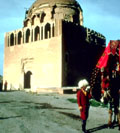 "Genghis Khan's hordes couldn't wipe out the great city at Merv even as they killed hundreds of thousands in their bloody wave of conquest. Centuries later, though, modern man's meddling with nature threatens to obliterate the once magnificent metropolis. "
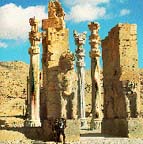 "While modern-day archaeologists rarely have to confront lava pits, animated stone statues or the undead, they increasingly contend with entire peoples, becoming the frontline troops in the clash of civilizations. As empires and superpowers fade, cultural, religious and nationalistic movements have been growing in strength — and they are looking to archaeology to give them the validation of history, said Philip Kohl, editor of the book Nationalism, Politics and the Practice of Anthropology."
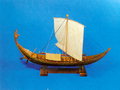 "In 2000, the Navy Museum of Crete decided to embark on an extremely challenging project: the reconstruction of a Minoan ship, the most ancient European seagoing craft.
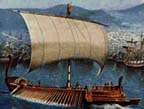 The question of the initial arrival of eastern Mediterranean sailors, such the Phoenicians, to the south of Iberia has been the subject of great debate for a long time. Until now, archaeological evidence has not confirmed the classical texts of the ancient writers that suggested an arrival at the end of the second millennium BC. But a bronze age burial site within a natural cavity inside of Bray's Cave now supports the ancient claims that early pre-colonial mariners did indeed reach the Strait of Gibraltar.
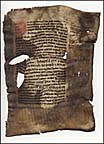 A medieval library consisting of over 2,000 volumes dating back to the 12th century and charred by an allied bombing raid on Chartres, France the evening of 26 May, 1944, may once more be studied by a new generation of scholars thanks to a new technology called multispectral imaging.
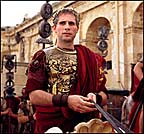 TNT's "Caesar" miniseries was much anticipated and although the history was "embellished" by Hollywood, I appreciated the effort. Of course members of my Imperial Rome group began to share their impressions as soon as Part 1 ended. One observation was that Sulla, played by an ancient Richard Harris, was only in his fifties when he returned to Rome with his legions. Well, not only was Richard Harris too old but the politics and personality of Sulla was all wrong as well. Sulla's "reforms" were intended to restore power to the Senate. He was not a "man of the people" in any stretch of the imagination. He was also ruthless and his proscriptions were brutal but he was not fickle or insane at the time he reentered Rome. He also didn't die while he was dictator and not in the bath (I think the screenwriter got his dictators mixed up). He retired and died about a year later from a liver disorder - probably cirrhosis from drinking too much as a remedy to his terrible skin condition that he contracted in the east. Of course, they also did not portray anything of this bisexual nature either.
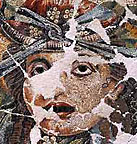 The birth of the Hellenistic period, when Greek culture began to spread far beyond its native territory, has long been set around 334 B.C. to 323 B.C., when Alexander and his troops began their 20,000-mile conquest, thundering from Macedonia south through what is now Syria, Lebanon, Israel and Egypt. The troops then set off for Persia and India. But, a University of California, Berkeley-led group of researchers, excavating the ancient town of Dor in Israel, is challenging the common history that credits the Macedonian king with initiating the spread of ancient Greek culture throughout the Middle East during his conquest of the region during the 4th century B.C.
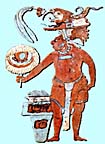 I saw an interesting program Friday night on the collapse of the Mayan civilization, "Ancient Apocalypse: The Fall of the Mayan Civilisation". Although I saw it on the Discovery Times Channel, it was apparently produced by the BBC. Remembering the devastating droughts of his childhood, Texas archaeologist, Dick Gill, theorized that drought caused the Mayan collapse. But he had quite a time getting other scholars to give his theory serious consideration. He combed historical records looking for references to drought and found such references not only in Spanish records of 1795 but even in a Mayan text that had escaped the Spanish conflagration. He also studied weather patterns and discovered that at the time of the Mayan collapse, there was evidence of unusually cold weather in the Arctic and northern Europe. Further investigation revealed that a high pressure system that normally remains in the central north Atlantic occasionally moved southwest. Each time this occurred, the Arctic would experience record cold and Central America would experience drought. The clincher came when a team of archaeologists from the University of Florida that were studying core samples from the bed of Lake Chichancanab in the Yucatan peninsula found evidence that in the ninth century the area experienced the driest period in 7,000 years.
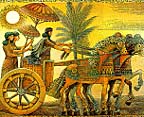 A German-led expedition has discovered what is thought to be the entire city of Uruk--including, where the Euphrates once flowed, the last resting place of its famous King. In the book--actually a set of inscribed clay tablets--Gilgamesh was described as having been buried under the Euphrates, in a tomb apparently constructed when the waters of the ancient river parted following his death.
 I found this very interesting website about the invasion of Gaul and Italy by Attila the Hun. It contained an interesting detail about the animosity between the Vandals and the Visigoths:
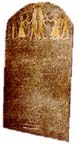 In my latest series of lectures on ancient Egypt, Professor Brier applied his literary analysis method to the Exodus story. Here are some interesting points he makes:
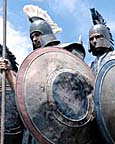 Well, I watched Helen of Troy part 1 Sunday night twice just to make sure I didnt miss anything. (It took my husband, who was casually reading the paper, an hour to figure out I was just watching the same program again!) Overall I found the program entertaining and noticed there was an attempt to at least follow some of the events in mythology. I didnt remember Theseus being killed by Pollux (and my web research confirmed my suspicion). I also didnt remember Paris being abandoned and raised by a shepherd but I checked on that and it is part of the myth. (This new grandmother must be getting senile!)
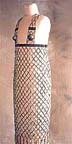 The Petrie Museum in London, which owns one of the largest intact collections of Egyptian antiquities outside Egypt, received a grant worth more than $83 million. The museums collection, encompassing over 800,000 items including the worlds oldest dress, was built up by William Flinders Petrie, an archaeologist and the first Edwards professor of Egyptian archaeology and philology at the university. Petrie, who died in 1942, is referred to as the father of scientific archaeology.
 I am presently listening to The Teaching Company lecture "
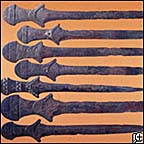 Apparently, swords dating back to 3000 B.C.E. have been discovered near Arslantepe in the Taurus mountains of the southeast Turkey. They were cast in one piece of a arsenic-copper alloy and three of them were decorated with inlaid silver.
 The best of Angus McBrides beautiful historical illustrations of the worlds most fearsome warriors including Rome and her enemies are featured in this new title published by Osprey. "Battle dress and arms are shown in unrivalled detail and brought to life in vivid scenes of fighting, pillaging and carousing. A full text commentary accompanies each piece of artwork, providing the background to the image and helping readers to get more out of each illustration."