Showing posts with label Olmec. Show all posts

Monday, February 22, 2021

Spotted cats: Mythological beasts of both the Old World and the New

 This unusual vase shows a human head of which all but the area of the eyes, nose, and mouth is enclosed in the head of an animal. The softness of the pelt is indicated by the way in which it tightly fits the human head. The small ears and spots are further animal attributes. It is difficult to identify the figure. It may possibly be a very Egyptianized interpretation of Herakles wearing the lion skin. - Metropolitan Museum of Art

This vessel caught my attention because it reminded me very much of ancient pre-Columbian American art.  All major Mesoamerican civilizations prominently featured a jaguar god, and for many, such as the Olmec, the jaguar was an important part of shamanism. The jaguar's formidable size, reputation as a predator, and its evolved capacities to survive in the jungle made it an animal to be revered. The Olmec and the Maya witnessed this animal's habits, adopting the jaguar as an authoritative and martial symbol, and incorporated the animal into their mythology. 

In the surviving Olmec archaeological record, jaguars are rarely portrayed naturalistically, but rather with a combination of feline and human characteristics. These feline anthropomorphic figures may range from a human figure with slight jaguar characteristics to depictions of shamanistic transformations in the so-called transformative pose, kneeling with hands on knees, to figures that are nearly completely feline.

One of the most prominent, distinctive, and enigmatic Olmec designs to appear in the archaeological record has been the "were-jaguar". Seen not only in figurines, the motif also may be found carved into jade "votive axes" and celts, engraved onto various portable figurines of jade, and depicted on several "altars".  The were-jaguar figure is characterized by a distinctive down-turned mouth with fleshy lips, and almond-shaped eyes.

The Maya, whose territory spanned the Yucatán Peninsula all the way to the Pacific coast of Guatemala, depicted gods with jaguar attributes as well.  The jaguar is said to have the ability to cross between worlds, and for the Maya daytime and nighttime represented two different worlds.  The living and the earth are associated with the day, and the spirit world and the ancestors are associated with the night. As the jaguar is quite at home in the nighttime, the jaguar is believed to be part of the underworld. Thus, Maya gods with jaguar attributes or garments are thought to have represented underworld gods. One such god is Xbalanque, one of the Maya Hero Twins who descended to the underworld, and whose entire body is covered with patches of jaguar skin. Another is God L, who is the primary lord of the underworld and often is shown with a jaguar ear or jaguar attire, and atop a jaguar throne.

This reverence for the jaguar carried forward to the much later Aztec civilization where their military elite were inducted into a unit dressed in jaguar regalia. To become a jaguar warrior, a member of the Aztec army had to capture a total of four enemies from battles. This was said to honor their gods in a way far greater than killing enemy soldiers on the battlefield. They also used spears and atlatls and fought with a wooden club studded with obsidian volcanic glass blades, called a macuahuitl. 

Jaguars, of course, were not known in the ancient Mediterranean world but the First Dynasty Egyptian deity Mafdet was often depicted wearing the skin of a cheetah.  She was associated with the protection of the king's chambers and other sacred places, and with protection against venomous animals, which were seen as transgressors against Maat.  She also represented the personification of legal justice.  It was said that Mafdet ripped out the hearts of wrong-doers, delivering them to the pharaoh's feet like cats that present humans with rodents or birds they have killed or maimed. During the New Kingdom, Mafdet was seen as ruling over the judgment hall in Duat where the enemies of the pharaoh were decapitated with Mafdet's claw.

During the reign of Tutankhamun, leopards were highly prized as symbols of royalty and divinity.  A leopard skin mantle or a cloth imitation of one was worn by the high priest during the opening of the mouth ceremony at royal burials.

Although a panther is often referred to as an attribute of the god Dionysus, the god was also depicted wearing leopard skin and using leopards as a means of transportation. In one myth, the god was captured by pirates but two leopards appear and rescue him.  

I find it interesting that cultures so far removed from each other wove their reverence for their respective spotted cats into their myths and religious practices. I can't help but wonder if the leopard-shrouded Greek figure of the 6th century BCE may have presided over one of the mystery religions as a similar priest in ancient America did.


Faience aryballos (oil flask) in the form of a head wearing an animal skin, 6th century B.C.E., East Greek, at the Metropolitan Museum of Art. 


An Aztec jaguar warrior created by GodotDraws on DeviantArt

Aztec jaguar warriors based on codex illustrations created by American miniaturist George S. Stuart. Photograph by Peter D'Aprix.

Aztec jaguar warriors based on codex illustrations created by American miniaturist George S. Stuart. Photograph by Peter D'Aprix.
If you enjoyed this post, never miss out on future posts by following me by email!

Sunday, May 17, 2020

The Olmecs: One of the earliest Mesoamerican cultures

The Olmecs were the earliest known major Mesoamerican civilization. Following a progressive development in Soconusco, they occupied the tropical lowlands of the modern-day Mexican states of Veracruz and Tabasco. It has been speculated that the Olmecs derived in part from the neighboring Mokaya or Mixe–Zoque cultures. The Olmec appeared to practice ritual bloodletting and played the Mesoamerican ballgame, hallmarks of nearly all subsequent Mesoamerican societies.

The antiquity of the Olmec civilization of ancient Mexico only became apparent with the advent of radiocarbon dating in the middle of the twentieth century. Olmec artists mastered an array of media and produced representations that range from refined miniatures in precious jadeite or wood, to monumental works in basalt. Now considered the first great sculptural tradition in the ancient Americas, these images remind us that naturalism is not necessarily the result of an evolution: Olmec sculptures often demonstrate a striking degree of physiognomic fidelity. Well known for their "colossal heads"—probably ruler portraits, carved from basalt boulders—Olmec sculptors also represented individuals on a smaller scale, such as these figures of both adults and children, the muscled arms and strong legs seemingly ready to spring into action.

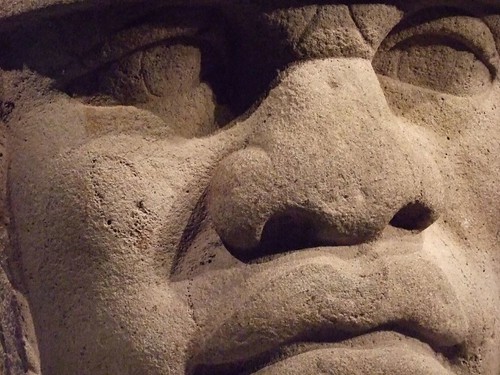
Colossal head from Monument 4 Veracruz Mexico Omec 1200-900 BCE Basalt photographed at the De Young Museum in San Francisco, California

Colossal head from Monument 4 Veracruz Mexico Omec 1200-900 BCE Basalt photographed at the De Young Museum in San Francisco, California

Crawling Baby Earthenware Olmec Culture 1200-900 BCE Mexico photographed at the De Young Museum in San Francisco, California

Seated baby holding a ball earthenware Olmec Culture 1200-900 BCE Veracruz Mexico photographed at the De Young Museum in San Francisco, California

Olmec Jadeite photographed at the Dallas Museum of Art, Dallas, Texas.

Seated and reclining hunchbacks Mexico Puebla Olmec style Early-Middle Formative Period 1000-500 BCE Ceramic photographed at the Dallas Museum of Art in Dallas, Texas.

Seated hollow Baby Mexico Veracruz Tenenexpan Gulf Coast Olmec Early Formative Period 1100-900 BCE Ceramic photographed at the Dallas Museum of Art in Dallas, Texas.

Seated ruler in ritual pose Mexico Puebla San Martin Texmelucan Highland Olmec culture Middle Formative Period 900-500 BCE Serpentine and cinnabar photographed at the Dallas Museum of Art in Dallas, Texas.

Seated figure Earthenware Olmec Culture 1200-900 BCE Mexico photographed at the Portland Art Museum in Portland, Oregon.

Baby Figure Mexico Olmec 12th-9th century BCE Ceramic photographed at the Metropolitan Museum of Art

Kneeling Bearded Figure 900–400 B.C.E. Olmec, Mexico, courtesy of the Metropolitan Museum of Art.

If you enjoyed this post, never miss out on future posts by following me by email!

Wednesday, May 19, 2010

Will 2700-year-old tomb link Olmec to Maya?

Researchers excavating a Zoque Indian site in Chiapa de Corzo have uncovered a 2700-year-old tomb of a dignatary and, perhaps, his wife inside the earliest pyramid found so far in MesoAmerica.

The tomb held a man aged around 50, who was buried with jade collars, pyrite and obsidian artifacts and ceramic vessels. Archaeologist Emiliano Gallaga said the tomb dates to between 500 and 700 B.C. Based on the layers in which it was found and the tomb's unusual wooden construction, "we think this is one of the earliest discoveries of the use of a pyramid as a tomb, not only as a religious site or temple," Gallaga said.

The body of a 1-year-old child was laid carefully over the man's body inside the tomb, while that of a 20-year-old male was tossed into the chamber with less care, perhaps sacrificed at the time of the burial.
The older man was buried with jade and amber collars and bracelets and pearl ornaments. His face was covered with what may have been a funeral mask with obsidian eyes. Nearby, the tomb of a woman, also about 50, contained similar ornaments.

The ornaments — some imported from as far away as Guatemala and central Mexico — and some of the 15 ceramic vessels found in the tomb show influences from the Olmec culture, long considered the "mother culture" of the region. - Fox News
Like many people of my generation, I was taught that the earliest culture to construct pyramids was the Maya.  But this find clearly illustrates native peoples that preceded the Mayans used monumental architecture for ritualistic purposes as well.

I found this interesting article that gives further background on the Zoque people.  It also points out that the earliest archaeological remains of "public architecture" was not in Central America at all but at Watsons Brake in northern Louisiana!

The appearance of ceramics in Mexico coincided with either the arrival of a new people or sudden fluorescence of an existing people around 1600 BC in the tepid lowlands of what is now the states of Vera Cruz and Tabasco, adjacent to the Gulf of Mexico.  They called themselves the Zoque. According to their own legends, they crossed the Gulf of Mexico in three great flotillas of giant canoes, to arrive in their new homeland. Three thousand years later the Aztecs called the inhabitants of this region, the Olmecs, which means “rubber people.”  It is not known if the builders of the ancient ceremonial complexes in Vera Cruz and Tabasco are one and the same as the people occupying the region in 1500 AD.  However, the process of making rubber by mixing the saps of an indigenous rubber tree and an indigenous vine seems to coincide with the arrival of the Zoque.  

Around 1400 BC the first large ceremonial complex appeared in the Zoque lands.  Known today by the Spanish name of San Lorenzo, it featured earthen mounds and geometric forms grouped around plazas. The theocratic elite lived near the ceremonial complex, but the commoners were dispersed in hamlets and farmsteads across a large expanse of territory.  It is quite likely that the farmers only lived in the same location as long as their soils remained fertile.  There was very little exposed stone in the region so all of the architecture was of wood, clay and earth.  The palace of the king or high priest has stone columns to support its roof, plus stone cisterns and steps. Any stone used in art, was imported from 80-150 miles away by river transportation. 
San Lorenzo was abandoned around 900 AD. - The Mesoamerican Connection by Richard Thornton, Examiner.com

Colossal head from Monument 4 Veracruz Mexico Omec 1200-900 BCE Basalt

 Mr. Thornton goes on to describe Zoque stone sculptures depicting men with beards led some people to jump to the erroneous conclusion that the Americas must have been initially settled by early Europeans based on this evidence.

[Colossal head from Monument 4 Veracruz Mexico Omec 1200-900 BCE Basalt.  Photographed by Mary Harrsch at the DeYoung Museum of Fine Art, San Francisco, CA]

The fact is that several indigenous peoples of the Western Hemisphere wore beards and even mustaches.  These include the tribes of the Northwest Pacific Coast, the Aztecs, and the Creeks of the Southeast.  The chroniclers of the de Soto Expedition (1539-1543) commented on an elderly Okonee (branch of Creeks) leader who had a beard down to his belly button. - The Mesoamerican Connection by Richard Thornton, Examiner.com
I have been privileged to see one of the more iconic Olmec stone sculptures of men wearing leather helmets at the DeYoung Museum of Fine Art in San Francisco.  The DeYoung has an excellent collection of early American Art and I would encourage you to put it on your agenda the next time you travel to the Bay Area.

Here's a slideshow of some of the wonderful art I photographed there several years ago:


Olmec Archaeology and Early Mesoamerica (Cambridge World Archaeology)   The Olmecs: America's First Civilization (Ancient Peoples and Places)   Mexico: From the Olmecs to the Aztecs, Sixth Edition
If you enjoyed this post, never miss out on future posts by following me by email!