An online magazine featuring articles about current archaeology and research into the art, literature, politics, warfare, entertainments, music, religion, cuisine and daily lives of inhabitants of the past other than those of the Greco-Roman period edited by a history enthusiast and technologist who is particularly interested in integrating technology and history education. For those who interacted with the Roman world, see "Roman Times."
During the early Bronze Age the Hatti, who were neither Semitic nor Indo-European, inhabited central Anatolia. They were actually distinct from the Hittite but as the Hittite expanded beginning about 2000 BCE, the Hatti were gradually absorbed into the Hittite political and social order.
The Hatti were organized in monarchical city-states. These states were ruled as theocratic kingdoms or principalities. Hatti regions of Anatolia came to be influenced by mighty Mesopotamian polities, in the form the Akkadian Empire (24th-22nd century BCE) and the succeeding Old Assyrian Empire (21st-18th century BCE), both of which set up trading colonies called karum, located throughout eastern and central Anatolia. During the first centuries of the 2nd millennium BCE, an Assyrian trade colony existed in the city of Hattush, and several Assyrian inscriptions mention the existence of local rulers (kings) of Hattush, also referring to their relations with other city-states in the region.
Fortunately, a few fragments of text in the language of the Hatti were discovered among the Hittite archives. Their language is now believed by some scholars to be related to the Northwest Caucasian language group.
The Hatti worshiped a mother goddess Kattahha (or Hannahanna) who gave birth to the storm-god Taru represented by a bull. The Hittites subsequently adopted much of the Hatti pantheon. Taru was adopted as Tarhunt and referred to as 'The Conqueror', 'The king of Kummiya', 'King of Heaven', and 'Lord of the land of Hatti.' His image was paraded through the streets at the festivals of Puruli in the spring, the Nuntarriyashas festival in the autumn, and the Ki Lam festival of the gate house.
The Puruli festival celebrates the battle between the dragon Illuyanka and the Storm God. Initially the Storm God is defeated by the serpent. The Storm God then goes to the Hatti goddess Inaras for advice. Having promised to sleep with a mortal named Hupasiyas in return for his help, she devises a trap for the dragon. She goes to him with large quantities of food and drink and entices him to drink his fill. Once drunk, the dragon is bound by Hupasiyas with a rope. Then the Storm God appears with the other gods and kills the dragon.
In an alternative version of the myth, the dragon takes the Storm God's eyes and heart when he initially vanquishes the Storm God. To avenge himself upon the dragon, the Storm God marries the daughter of a poor man. They have a son, who grows up and marries the daughter of the dragon Illuyanka. The Storm God tells his son to ask for the return of the Storm God's eyes and heart as a wedding gift and he does so. His eyes and heart restored, the Storm God goes to face the dragon Illuyanka once more. At the point of vanquishing the dragon, the Storm God's son finds out about the battle and realizes that he had been used for this purpose. He demands that his father take his life along with Illuyanka's and so the Storm God is forced to kill them both.
Standard with two long-horned bulls, 2300-2000 BCE, Hattian, now in the collections of the Metropolitan Museum of Art in New York City, image courtesy of the museum.
Vessel terminating in the forepart of a bull, Hittite, 14th-13th century BCE, Silver, now in the collections of the Metropolitan Museum of Art, image courtesy of the Museum and Wikimedia Commons.
Silver bull figure from Alacahöyük, 2300 BCE, now in the collections of the British Museum, image courtesy of Wikimedia Commons contributor Ollios.
Vase with bull protome, first quarter of 2nd millenium, now in the collections of the Museum of Anatolian Civilizations, courtesy of Wikimedia Commons contributor Homonihilis.
Ceremonial vessels in the shape of a team of sacred bulls made of baked clay, called Hurri (Day) and Seri (Night), Hittite Old Kingdom, 16th century BCE, Museum of Anatolian Civilizations, Ankara, Turkey, image courtesy of Wikimedia Commons contributor Georges Jansoone.
Depiction of the myth of the Sky God (in human form) killing the dragon Illuyankas, Neo-Hittites, 850-800 BCE, from the Lions Gate at Malitiya, now in the collections of the Museum of Anatolian Civilizations, Ankara, Turkey, image courtesy of Wikimedia Commons contributor Georges Jansoone.
If you enjoyed this post, never miss out on future posts by following me by email!
Researchers using ultraviolet-visible spectroscopy have discovered ancient Mesopotamian art, like classical art of Greece and Rome, was often brightly colored although studies have shown the number of colors used appears to be limited to shades of red and black.
"Red pigments consist almost entirely of haematite, black is either bitumen or a carbonized product. White is almost non-existent (white lead, gypsum), apart from rare cases where it is used as color lightener for the skin. We did not find either blue or green. It is difficult to judge whether this lack reflects an ancient reality or not. On statues, as well as in most wall paintings, pigments were hardly ever mixed. This seems to be a conscious choice, as mixing pigments is not technically difficult." - Astrid Nunn, Adjunct Professor for Near Eastern Archaeology (retired) at the University of Würzburg.
However, scholars noted distinct shifts in color intensity over time. Skin color in the third millennium was depicted as orange, yellowish brown, red brown, and brown but in the second millennium, there was a general change to bright red and red brown. By the first millennium, skin color became notably darkened.
Reading this, I couldn't help but wonder about any correlation between changes in skin tone depictions and recorded migrations and conquests by different groups. However, Professor Nunn does not mention any studies of that nature. However, she does point out that skin color was derived from a combination of realism mixed with artistic conventions and social determinants, which in turn are subject to symbolic meaning.
This is further complicated by the ancients descriptions of color including textures and other characteristics.
"Taking the materiality of colors (and not simply their hue and chroma) as a starting point enables us to understand why ancient terms that are translated as dazzling, shining, lustrous, brilliant and translucent, or, inversely, dark, poorly lit, dim and dull, must be considered a – positive or negative – color category," Nunn observes. "In Akkadian literature, red on the body, especially on the face, was very positive...However, in Sumerian and Akkadian texts, gods (in particular the sun god Utu), heroes and kings sport beards referred to as lapis lazuli. Thus these words also mean bright and shiny. Despite the reference to lapis lazuli (blue) being conceivable, the shininess of the beard was just as important as its hue."
Of course I have seen objects such as the bull-headed lyres recovered from the royal cemetery of Ur, dated to 2550-2450 CE, with beards literally made of lapis lazuli so describing beards in this way could have been quite precise if the statues of the gods were thought to represent the gods themselves.
Surprisingly, researchers found that even sculpture crafted of expensive, imported stone like diorite was often painted over, despite the lustrous beauty of the stone itself.
Millenium, Gypsum, that I photographed at University of Pennsylvania Museum of Archaeology and Anthropology in Philadelphia
Reconstructed color on the statue of a man with similar garment now in the Staatliche Museen zu Berlin, courtesy of Astrid Nunn.
Bull-headed lyre recovered from the royal cemetery of Ur, Iraq, 2550-2450 BCE, Gold, with Lapis Lazuli beard that I photographed at University of Pennsylvania Museum of Archaeology and Anthropology in Philadelphia
If you enjoyed this post, never miss out on future posts by following me by email!
This unusual vase shows a human head of which all but the area of the eyes, nose, and mouth is enclosed in the head of an animal. The softness of the pelt is indicated by the way in which it tightly fits the human head. The small ears and spots are further animal attributes. It is difficult to identify the figure. It may possibly be a very Egyptianized interpretation of Herakles wearing the lion skin. - Metropolitan Museum of Art
This vessel caught my attention because it reminded me very much of ancient pre-Columbian American art. All major Mesoamerican civilizations prominently featured a jaguar god, and for many, such as the Olmec, the jaguar was an important part of shamanism. The jaguar's formidable size, reputation as a predator, and its evolved capacities to survive in the jungle made it an animal to be revered. The Olmec and the Maya witnessed this animal's habits, adopting the jaguar as an authoritative and martial symbol, and incorporated the animal into their mythology.
In the surviving Olmec archaeological record, jaguars are rarely portrayed naturalistically, but rather with a combination of feline and human characteristics. These feline anthropomorphic figures may range from a human figure with slight jaguar characteristics to depictions of shamanistic transformations in the so-called transformative pose, kneeling with hands on knees, to figures that are nearly completely feline.
One of the most prominent, distinctive, and enigmatic Olmec designs to appear in the archaeological record has been the "were-jaguar". Seen not only in figurines, the motif also may be found carved into jade "votive axes" and celts, engraved onto various portable figurines of jade, and depicted on several "altars". The were-jaguar figure is characterized by a distinctive down-turned mouth with fleshy lips, and almond-shaped eyes.
The Maya, whose territory spanned the Yucatán Peninsula all the way to the Pacific coast of Guatemala, depicted gods with jaguar attributes as well. The jaguar is said to have the ability to cross between worlds, and for the Maya daytime and nighttime represented two different worlds. The living and the earth are associated with the day, and the spirit world and the ancestors are associated with the night. As the jaguar is quite at home in the nighttime, the jaguar is believed to be part of the underworld. Thus, Maya gods with jaguar attributes or garments are thought to have represented underworld gods. One such god is Xbalanque, one of the Maya Hero Twins who descended to the underworld, and whose entire body is covered with patches of jaguar skin. Another is God L, who is the primary lord of the underworld and often is shown with a jaguar ear or jaguar attire, and atop a jaguar throne.
This reverence for the jaguar carried forward to the much later Aztec civilization where their military elite were inducted into a unit dressed in jaguar regalia. To become a jaguar warrior, a member of the Aztec army had to capture a total of four enemies from battles. This was said to honor their gods in a way far greater than killing enemy soldiers on the battlefield. They also used spears and atlatls and fought with a wooden club studded with obsidian volcanic glass blades, called a macuahuitl.
Jaguars, of course, were not known in the ancient Mediterranean world but the First Dynasty Egyptian deity Mafdet was often depicted wearing the skin of a cheetah. She was associated with the protection of the king's chambers and other sacred places, and with protection against venomous animals, which were seen as transgressors against Maat. She also represented the personification of legal justice. It was said that Mafdet ripped out the hearts of wrong-doers, delivering them to the pharaoh's feet like cats that present humans with rodents or birds they have killed or maimed. During the New Kingdom, Mafdet was seen as ruling over the judgment hall in Duat where the enemies of the pharaoh were decapitated with Mafdet's claw.
During the reign of Tutankhamun, leopards were highly prized as symbols of royalty and divinity. A leopard skin mantle or a cloth imitation of one was worn by the high priest during the opening of the mouth ceremony at royal burials.
Although a panther is often referred to as an attribute of the god Dionysus, the god was also depicted wearing leopard skin and using leopards as a means of transportation. In one myth, the god was captured by pirates but two leopards appear and rescue him.
I find it interesting that cultures so far removed from each other wove their reverence for their respective spotted cats into their myths and religious practices. I can't help but wonder if the leopard-shrouded Greek figure of the 6th century BCE may have presided over one of the mystery religions as a similar priest in ancient America did.
Faience aryballos (oil flask) in the form of a head wearing an animal skin, 6th century B.C.E., East Greek, at the Metropolitan Museum of Art.
An Aztec jaguar warrior created by GodotDraws on DeviantArt
Aztec jaguar warriors based on codex illustrations created by American miniaturist George S. Stuart. Photograph by Peter D'Aprix.
Aztec jaguar warriors based on codex illustrations created by American miniaturist George S. Stuart. Photograph by Peter D'Aprix.
If you enjoyed this post, never miss out on future posts by following me by email!
While I was researching the Cypriot ear spirals yesterday, I noticed this bronze bust of a priest with silver inlaid eyes dated from the 3rd - 4th century CE at the Miho Museum. The museum identified it as late Roman but the museum's image had been shared on Flickr and I noticed that someone with the username eternal persia commented on the piece and insisted it was Sasanian. He/she pointed to the monogram on the hat, clothes, hair design and leaves that decorate the bust and insisted these are Sasanian elements.
Intrigued, I researched the item a little further. At first, most Sasanian portrait sculptures I reviewed were all bearded. Then I saw an image of a relief depicting Kartir, a high priest and vizier serving during the reigns of Shapur I, Hormizd I, Bahram I, and Bahram II. Not only is Kartir clean shaven, he sports the corkscrew curls and crested hat worn by the priest of the bust at the Miho Museum.
Some scholars think Kartir may have been a eunuch, due to being depicted without a beard in the Sasanian reliefs. He first appears in historical records in Shapur I's inscription at the Ka'ba-ye Zartosht, which was most likely created between 260–262 CE. Kartir is the only religious bureaucrat mentioned in the inscription. Shapur I, termed a "lukewarm Zoroastrian", was known for his tolerance towards other religions. Although admiring the teachings of his own religion and encouraging the Zoroastrian clergy, Shapur I allowed the Jews, Christians, Buddhists, and Hindus to freely practice their religion. He was also friendly towards the founder of Manichaeism, Mani, whom he allowed to preach freely and even to be an escort in his military expeditions.
Shapur I's religious practices seems to have been somewhat unusual, though, with animal sacrifice being made for the soul of the kings and queens of the Sasanian family. Kartir, who "abhorred animal sacrifice" was unable to stop Shapur I from performing them. Shapur I died in 270 CE, and was succeeded by Hormizd I, who gave Kartir clothes that were worn by the upper class including the cap and belt (kulāf ud kamarband) and appointed him as the chief priest (mowbed).
Hormizd I died the following year and Bahram I, who was never considered a candidate for succession of the throne by his father, ascended the throne with the aid of Kartir, whose authority and influence had greatly increased. Bahram I then made a settlement with his brother Narseh who he asked to give up his entitlement to the throne in return for the governorship of the important frontier province of Armenia, which was constantly the subject of war between the Roman and Sasanian Empires. Although Narseh held the title of Vazurg Šāh Arminān ("Great King of Armenia"), scholars think he probably still viewed Bahram I as a usurper.
Although previous Sasanian shahs had pursued a policy of religious tolerance towards the non-Zoroastrian minorities in the empire, with Bahram I's accession to the throne, and the rise of the authority of the Zoroastrian priesthood under the leadership of Kartir, this changed. When Mani, still the leader of the Manichaeists, arrived in the city of Gundishapur, Kartir and his cadre of Zoroastrian priest protested, viewing Mani as a threatening heterogeneous philosopher who presented an obscure perception of Zoroastrianism tainted by Jewish, Buddhist, and Christian ideas. Kartir pressured Bahram I to have Mani imprisoned and sentenced to death in 274 CE. Mani's death was followed by the persecution of his followers by Kartir and the Zoroastrian clergy, who used the persecution of religious minorities as a method to increase and spread their vast influence. With the backing of Bahram I, Kartir laid foundations for Zoroastrianism's adoption as the state religion.
When Bahram I died, his son viewed Kartir as a mentor and granted him the rank of grandee (wuzurgan), and appointed him as the supreme judge (dadwar) of the whole empire. Thereafter, Zorastrian priests were given the office of judge. Kartir's intolerance continued and his inscription at Ka'ba-ye Zartosht boasts that he "struck down" non-Zoroastrian minorities, although modern scholars point out that Jewish and Christian sources makes no mention of persecutions during this period.
When Bahram III succeeded his father, Bahram II, something changed, however, in Kartir's relationship with the royal family. Kartir inexplicably threw in his lot with Narseh and, along with a group of Sasanian nobles, supported Narseh's overthrow of Bahram III. But Narseh's reign marked the return to the policy of religious tolerance which had been practiced by his father, Shapur I, all those years ago, and Kartir finally fades from history.
Bust of a Priest with Silver Inlaid Eyes, Bronze and sliver, 3rd-4th century C.E., courtesy of the Miho Museum in Kyoto, Japan.
Relief of Kartir, the Zoroastrian high priest at Naqsh-e Rajab courtesy of Wikimedia Commons contributor درفش کاویانی.
If you enjoyed this post, never miss out on future posts by following me by email!
Assyrian inscriptions of Shalmaneser I (c. 1274 BCE) first mention Uruartri as one of the states of Nairi, a loose confederation of small kingdoms and tribal states in the Armenian Highlands in the thirteenth to eleventh centuries BCE which he conquered. It extended from northeastern Turkey into northwestern Iran with its cultural center around Lake Van. Its settlements were palace-fortresses that protected agricultural production and supported many crafts, especially an extensive metalworking industry.
The Nairi states were repeatedly subjected to further attacks and invasions by the Middle and Neo-Assyrian Empires. But Urartu, united under King Arame (860-843 BCE), reemerged in Assyrian language inscriptions in the ninth century BCE as a powerful northern rival to the Neo-Assyrian Empire. Urartologist Paul Zimansky speculated the Urartian ruling class were few in number and governed over an ethnically, culturally, and linguistically diverse population. This diversity may have extended to the royal line themselves who may have come from various ethnic backgrounds.
Although the Urartian capital was captured by the Assyrians during the reign of Shalmaneser III, Assyria fell into a period of temporary stagnation for decades during the first half of the 8th century BCE, which aided Urartu's growth. During sporadic periods of peace with Assyria, it is thought Urartu traded cattle, horses, iron, and wine. From cuneiform sources, it is known that in Urartu grew wheat, barley, sesame, millet, and emmer, and cultivated gardens and vineyards. Many regions of the Urartu state required artificial irrigation, which was organized by its rulers.
The art of Urartu is especially notable for fine lost-wax bronze objects: weapons, figurines, vessels including grand cauldrons that were used for sacrifices, fittings for furniture, and helmets. There are also remains of ivory and bone carvings, frescos, cylinder seals and of course pottery. Unfortunately, archaeology has produced relatively few examples of the jewelry made of precious metals that the Assyrians boasted of carrying off in great quantities from the Urartian city of Musasir in 714 BCE during the campaigns of Sargon II.
During this time the Urartian kingdom also suffered heavily from Cimmerian raids as well. but Urartu made peace with Assyria in 705 BCE when Sennacherib ascended the throne and Urartu entered a long period of development and prosperity. But when Cimmerians and Scythians resumed their attacks, Urartu became dependent on Assyria, like a vassal state. Inscriptions reveal Urartu's king Sarduri III (645-635 BCE) referred to Assyrian king Ashurbanipal as his "father" at this point.
Late during the 7th century BCE, Urartu was once again invaded by Scythians, this time accompanied by their allies—the Medes. In 612 BCE, the Median king Cyaxares the Great together with Nabopolassar of Babylon and the Scythians conquered Assyria after it had been irreversibly weakened by civil war. The Medes then took over the Urartian capital of Van in 590 BCE, effectively ending the sovereignty of Urartu.
Image: Part of a throne with deity on a bull, ca. late 8th–7th century B.C.E., Urartian, courtesy of the Metropolitan Museum of Art. This fragment, with the lower part of a figure standing along the flanks of a bull, was most likely part of a throne. From better-preserved examples, we know that the figure wore the horned crown of a deity. The whole would have been gilded. A throne and footstool supported by four deities and their animal companions would have been a potent symbol of the Urartian king's power.
If you enjoyed this post, never miss out on future posts by following me by email!
Despite rule by artistically sophisticated cultures including the Assyrians and the Egyptians, some Cypriots of the Archaic Period produced simple handmade figurines with crude faces, cylindrical bodies and plain clay trail or pellets to form hats, eyes, ears, etc., known as the snowman technique. Predominantly found in a sanctuary context, these models included not only priestesses and worshipers, but scribes, actors, musicians, mythological creatures, animals, and scenes of rural life.
"Male figurines (soldiers, horsemen, charioteers, worshipers) are usually associated with sanctuaries of male divinities. A characteristic example is the sanctuary of Ayia Irini on the northwest coast of Cyprus. Here, a huge number of terracotta figurines of various sizes (even life-size) were found placed around the altar. Dated in the Cypro-Archaic period (7th-6th c. BCE), they are considered dedications associated with a male divinity that seems to have been worshiped in more than one capacity."
"Female figurines were usually related to the cult of the Great Mother Goddess. The worship of a female fertility deity, possibly identified with Astarte (Ishtar), is attested in Cyprus dating from the Bronze Age. During the Geometric and Archaic periods, the Near Eastern Astarte merged with the local Aphrodite, who was venerated in Cyprus in large temples, such as those at Kition and Palaepaphos, as well as in numerous rural sanctuaries. There are several iconographic types, all related to ritual activities associated with the cult of a fertility deity: priestesses with hieratic garments, frequently holding powerful symbols of fertility, such as birds, flowers or fruits, worshippers with uplifted arms, musicians (tambourine and flute players), and ceremonial dancers. There is also a number of nude female figurines. This type had been extensively used in North Syria to depict Astarte but was rather strange to Cyprus, where female figures were almost always shown dressed. Female figurines are frequently found in graves, too, suggesting that the fertility goddess was also a symbol of regeneration." - Museum of Cycladic Art, Athens
Terracotta statuette of a man riding a donkey, ca. 600–480 B.C.E., Cypriot at the Metropolitan Museum of Art in New York. The man steadies two large jars that are fastened in front of him on either side of the animal's back. The jars are types that would hold wine or olive oil. The statuette captures what would have been a frequent sight, not only in ancient Cyprus but also for centuries thereafter.
Terracotta group: making flour, ca. 600–480 B.C.E., Cypriot, at the Metropolitan Museum of Art. The figure at the right is grinding grain in a quern with an elliptical stone. Her companion stands over a sieve that is probably set on a low wicker tray or basket. At the left end is a large shallow scoop. Vignettes of daily life, particularly the preparation of bread, are common among Cypriot terracottas of the Archaic period. They have come to light mainly in tombs. Courtesy of the Metropolitan Museum of Art.
Terracotta woman baking bread, ca. 600–480 B.C.E. Cypriot, , at the Metropolitan Museum of Art. In a representation known from only two examples, a woman is shown leaning over an oven and throwing the disks of dough onto the hot walls. The oven has a hole at the bottom for air to enter and a wide mouth at the Metropolitan Museum of Art.
Terracotta figurine tomb gift of a woman coverying her mouth 600-500 BCE, Cypriot, that I photographed at the Ashmolean Museum in Oxford.
Terracotta horse and rider tomb gift, Cypriot, 600-600 BCE, that I photographed at the Ashmolean Museum in Oxford.
If you enjoyed this post, never miss out on future posts by following me by email!
I was sent a link to an interesting post about 15 outstanding films that have been produced over the last half century about various aspects of medieval life. I was gratified to see that several of my favorites were featured including "El Cid", "The War Lord" and "A Knight's Tale" (hey, I, too, enjoy a little rock music with my knight movies!)
To this list we could add the film adaptation of Ken Follett's marvelous novel "Pillars of the Earth" recently broadcast on Starz.
You would think that a film about the construction of a cathedral would not be particularly action packed but Follett has set his story amid the violent turmoil of the period of English history known as The Anarchy.
I actually knew very little of the contention between Queen Maude and her cousin Stephen, both grandchildren of the famous (or infamous depending on your point of view) William the Conqueror. "Pillars of the Earth" did an excellent job of bringing me up to date on the treachery, betrayals and murders that earmarked their struggle for the throne of England.
The main plot of our story swirls around a conspiracy that involved the death of King Henry I's son, William, who drowned when the "White Ship" sank on a voyage between France and England. Although Follett's conspiracy is fictional, it does not contradict historical events as little is known about the cause of the sinking except speculation about a drunken crew and a race to catch up to the King's ship that disembarked earlier in the day:
Presumably the prospect of sailing aboard the latest and fastest addition to the Norman navy was a thrilling prospect, so William and his friends broke open a few casks of wine to celebrate. And then a few more. By the time the ship was ready to leave most of the passengers and crew were reasonably drunk. The bishop of Coutance who turned up with his entourage to bless the ship was greeted with derision and abuse and left in a hurry. It was at this point that Henry's nephew Stephen of Blois, made his excuses and left, either because a) he had an attack of diarrhoea or b) because of moral outrage at the shenanigans on board, a decision for which he was no doubt later extremely thankful.
Sometime before nightfall Henry left harbour leaving the White Ship behind. There is no clear evidence as to why the White Ship was delayed and did not leave with the rest of the fleet, but is likely that the inebriated state of the crew had something to with it. But by all accounts, it was a relatively calm night and ideal condition for the short seventy mile journey to Portsmouth when the White Ship finally left on the evening tide.
Now the passage out from Barfleur harbour was relatively straightforward so long as the pilot steered to the south, as to the north there were a series of dangerous rocks that became submerged at high tide. However, the fastest and most direct route home to Portsmouth was north and it seems that in his eagerness to catch up with the king, Fitz Stephen piloted the ship northwards and tried to 'cut the corner' a little too lightly, sailed too close to land and struck a rock, in all likelihood the rock known as the 'Quilleboeuf'.
Now fatally holed the White Ship sank, eventually becoming completely submerged with only her masts visible above the water. Although the Quilleboeuf rock stands only half a mile offshore, there was no medieval equivalent of the lifeboat or coastguard service, most of those aboard were drunk, it is very unlikely that any of them could swim and of course it was dark and there was naturally a general panic.
There was only one survivor, a butcher from Rouen named Berold who managed to climb up one of the masts and clung there all night until he was rescued the next morning by some fishermen. - The Tragedy of the White Ship
Follett takes this incident and weaves a totally plausible scenario around it complete with slighted bishop and single survivor.
King Henry I, a rather virile monarch who fathered at least twenty illegitimate sons, is left with only a legitimate daughter Maude to assume the throne upon his death. But, as one of the characters in the film so concisely rails "A bastard cannot inherit the throne and a woman is almost as bad!"
Henry dies in 1135 according to legend from eating a "surfeit of Lampreys" - eels - as he does in Follett's tale. The film makes it appear that Henry died almost immediately following the birth of his daughter's son, Henry II. In fact, he died two years later. The official cause of death was recorded as food poisoning but not of the intentional variety. I know when I saw the obvious poisoning in the film I wondered about the royal taster and if he was compromised by the plotters as well.
Terence Scully tells us in "The Art of Cookery in the Middle Ages" that a noble estate was hardly ever without a unicorn horn to assay both dining accouterments and prepared food for the presence of poison. Obviously the horn came from an elephant or a narwhal but was deemed invaluable so much so that it was recognized as a particularly thoughtful gift between noblemen.
"Before the prince came to table, the Linen-Keeper and Hall Porter had to do an assay for poison on the tablecloths by passing the unicorn horn over them. Both the tapestry which the Hall-Usher unrolled onto the prince's bench and the cushion on which he was to sit were similarly tested." - The Art of Cookery in the Middle Ages
The unicorn horn test was followed by tastings of all food, sauce and condiments in a highly ritualized procedure involving the Cook, the Saucer, the Hall Usher, the Hall Porter, the Pantler, the Carver, the Serving Valet, the First Master of the Household and finally the First Chamberlain.
"The Pantler then covered over all the dishes again, and a procession consisting of Usher, Master Pantler, the Princes Pages and Serving Valets (all of them bareheaded) formed up to bear the dishes safely into the hall. The Usher cleared the way to the prince's buffet and high table; the Master of the Household, from his post at the end of the table near the buffet, vigilantly watched that none of the dishes was tampered with." - The Art of Cookery in the Middle Ages
So, if Henry died as a result of intentional poisoning the plotters must have outright purchased the king's entire household! In any case, Stephen, with the support of the chauvinistic nobles and the church, seizes the throne and our characters are soon immersed in civil war.
We are not given much background on Maude in the film and she briefly appears first as an adoring child then later as a young mother determined to protect her son and secure his rightful inheritance.
Although referred to as Maude throughout the film, this "Empress of the Holy Roman Empire", granddaughter of William the Conqueror. So much royal blood flowed through her veins that its a wonder she wasn't purple, since through her mother's mother, she was descended from Edmund II "Ironside," Ethelred II "the Unready," Edgar "the Peaceable," Edmund I "the Magnificent," Edward I "the Elder" and Alfred "the Great."
Although Stephen sides often with the villains in this story, Maude is not necessarily a kind and merciful monarch either. (spoiler alert!) At one point when she discovers that Stephen has sent her a mere peasant boy as a hostage instead of his own son , she orders the innocent child slain anyway when Stephen breaks the truce and once more gathers his forces to oppose her. Her somewhat greedy nature also surfaces when she demands gold for granting market rights to Kingsbridge causing problems for Prior Phillip and his dedicated hard-working cathedral construction crew.
The historical Maude's penchant for gold is illustrated by the list of precious objects that she left to the Abbey at Bec-Hellouin :
Among the gifts Matilda gave to the Abbey at Bec-Hellouin were the above mentioned crowns and also another golden cross decorated with precious stones, two gospel books bound in gold and studded with gems, two silver-gilt censers, a silver incense box and spoon, a gold dish and a gold pyx for the Eucharist. There were three silver flasks, a ewer for holy water and a silver basin. Add to this two portable altars of marble mounted in silver and an ebony chest filled with relics. There were more textiles in the forms of holy vestments - chasubles, dalmatics, copes, and an imperial cloak belonging to herself, besprinkled with gold. All of the above list was donated in her lifetime. After she died, the abbey also received the ornaments she had used in her own private chapel. These included service books, a gold chalice and spoon, four chasubles, two tunics, two dalmatics, six copes, two of which were interwoven with silver, two silver censers and two boxes which were described as 'eggs of griffins'. The legs and claws gripping these 'eggs' were fashioned of silver.- Elizabeth Chadwick, Living the History
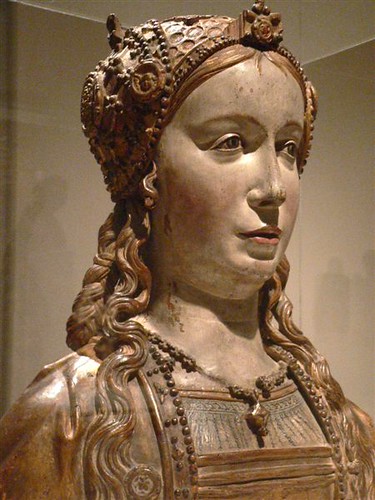
Chadwick points out that one of the most odd treasures that Maude acquired while married to the Holy Roman Emperor was a religious relic - purportedly the hand of Saint James.
A beautiful 16th century reliquary bust from
Flanders. Photographed at the Los Angeles
County Museum of Art by Mary Harrsch.
Thought to have originated with the Roman ancestor worship, the worship of relics - little bits of saints or other artifacts thought to be connected to Christ or his apostles - is documented as far back as the second century.
After the martyrdom of Polycarp, bishop of Smyrna, the Christians "took up his bones which are more valuable than refined gold and laid them in a suitable place where, the Lord willing, ...we may gather together in gladness and celebrate the anniversary of his martyrdom." During Diocletian's persecutions (303-311) relics of the martyrs were collected by their followers. The cult of the relics was criticized from its inception by purists who regarded it as pagan. Vigilantius in a dispute with St Jerome condemned the veneration of all inanimate objects such as the bodies of saints. Jerome responded by saying that the relics themselves were not worshipped but were an aid to the veneration of martyrs of undoubted holiness whose lives were a model to later generations. This debate between Vigilantius and Jerome is summarized by Thomas Aquinas in his Summa theologica:
Thomas Aquinas, Summa Theolgiae , 3a, 25, 6:
Now it is evident that we are bound to hold in veneration the saints of God as being members of Christ, sons and friends of God and our advocates with him. We are equally bound, therefore, memory of them, to accord due honor to any of their relics; and this is primarily true of their bodies, which were the temples and instruments of the Holy Spirit, dwelling and acting within them, and which are to be made like the body of Christ by glorious resurrection. It is for this reason that God himself grants honors to their relics by performing miracles when they are present....
...This was the argument of Vigilantius, cited by Jerome, "We are observing the introduction, under the guise of religion, of something not very different from a pagan ritual. These people can be seen kissing and adoring little piles of some kind of dust in tiny bottles, wrapped up in precious cloth." In rebuttal Jerome writes, "We do not venerate, by latria, that is, either the sun or moon or the angels; far less the relics of the martyrs. We pay honor to the martyr's relics only so that we may venerate him whose martyrs they are; we pay honor to the servants only so that the servants' honor may glorify their Lord." Accordingly, when we honor the relics of the saints we do not fall into the error of those pagans who offered divine worship to the dead. - Cult of the Relics, State University of New York, College at Oneonta.
The worship of relics was particularly virulent in England where it was used by Christian missionaries to replace veneration of the pagan pantheon:
The cult of the relics played a critical role in the missionary activities. The missionaries who converted northern Europe were dealing with people whose religion was fundamentaly pantheistic. To them it seemed that the entire world was inhabited and controlled by unseen powers; every tree had its own spirit, every pool its devil, every mountain its god. There was no distinction between the laws of nature and the laws of God. In accepting Christianity, pagans believed Christ's powers to be more potent than those their former gods. The converts expected the new God to intervene as often and as powerfully in nature as the old, and if He failed to do so they would frequently revert to their old beliefs. Gregory the Great recommended to Augustine of Canterbury that the cult of the saints and martyrs be presented to the English as the rival to pagan pantheism. - Cult of the Relics, State University of New York, College at Oneonta.
Like many other aspects of medieval life, author Ken Follett weaves relic worship into his plot revealing that the (fictional) Priory of Kingsbridge derives its income from pilgrims who come to worship its relic, the skull of St. Adolphus. (spoiler alert) When a fire destroys the priory and crushes the relic, the original is replaced with a skull plucked from the crypt to prevent loss of revenue, of course with a lot of soul searching by Prior Phillip. The substitute is later crushed when the new cathedral's first stone dome collapses but the novel's hero Jack comes up yet another object for pilgrims to lavish their meager savings upon.
Follett also portrays realistically how noble violence was a real and present danger that overshadowed peasant life during this period. The villains of the story, masterminded by the evil bishop Waleran Bigod, manipulate King Stephen into awarding the lands of Shiring Castle to them then attack Kingsbridge where the former Earl of Shiring's daughter and son have taken refuge.
People watching the program may wonder why King Stephen would permit one of his nobles to terrorize residents of another town. The bottom line is that the nobles maintained private armies that the king could call upon when needed. The king would not, therefore, interfere in a noble's business if it did not directly impact the king because the king, himself, did not control a standing army at that time.
Furthermore, medieval society gradually accepted and even honored violence as the church embraced violence in its prosecution of the Crusades:
After the fall of the Roman Empire, violence quickly became a main part of medieval society, used primarily to threaten and to gain land. However, as time went on this violence began to be understood in a different light, linking it to religion. Initially the only acceptable view of violence was when it was committed by saints upon those who would transgress the church, this view soon changed, with the advent of the Crusades. These series of wars transformed the image of violence into something positive, both in regards those who committed the violent acts and those who the acts were committed upon. The connection between religion and violence changed dramatically with the start of the Crusades. Instead of separating the two, Pope Urban II called for knights who were violent for the sake of violence to channel their ways into violence for a greater cause, primarily fighting to take back Holy Land from the Muslims who had originally taken it from the Byzantines. Immediately people began to see violent knights in a new light, and knights themselves began to change in regards to how they lived and how people understood their duties. - Religion and Violence in the Middle Ages by M. Rinn
A slideshow of armor I have photographed at museums around the world:
Professor Philip Daileader discusses noble violence at length in his excellent lecture series on the Middle Ages available from The Teaching Company. Sadly, things have not changed that much in the last thousand years. The powerful still enrich themselves at the expense of the powerless, although in a much more civilized guise! But back to our story...
Light streams into the nave of Yorkminster Cathedral
illuminating its beautifully vaulted ceiling. Photograph
by Mary Harrsch.
Of course, the cathedral is finally built despite all of these setbacks as well as various love triangles, and the villains are eventually subjected to their just rewards - a little more violently in the film than in the book. The cathedral is as beautiful as Tom Builder dreamed it would be. Although Kingsbridge is an imaginary structure, it was based on the real cathedral at Salisbury. I have not had the privilege of seeing that cathedral but was truly awestruck by Yorkminster in York, also built to admit as much light as possible, and it truly is the light that makes all the difference. I have seen St. Peter's in Rome, St. Paul's and Westminster Abbey in London and, of course, the famous cathedral of Notre Dame. But, although a spectacular example of the use of flying butresses, Notre Dame's interior is actually quite dark. With the light streaming into Yorkminster, it truly seemed to be an anteroom to heaven.
The end seems to come a little too swiftly in the final episode but maybe it only seemed that way because I did not want to relinquish my emotional connection to these marvelous characters. I think my favorite character in the series was actually Prior Phillip played magnificently by Matthew MacFadyen. His character was a fascinating blend of intelligence and piety with an honest recognition that he, too, suffered from a certain degree of ambition.
I was unfamiliar with Matthew MacFadyen's earlier work, as most of it has been in productions for UK audiences, although I see by his filmography on IMDB that he played the Sheriff of Nottingham in the new 2010 version of Robin Hood. Apparently, I'll have to watch it much more carefully when I get it on DVD next month! I wondered if Matthew was related to another of my favorite actors, Angus MacFadyen (Robert the Bruce in Braveheart) but apparently not.
Of course Rufus Sewell as Tom Builder was another favorite. I've been a big fan of Sewell since his outstanding portrayal of Agamemnon in the USA miniseries "Helen of Troy". Although that was seven years ago, Sewell's maturity has only increased his screen presence and sexual magnetism.
Ian McShane as the Bishop Waleran Bigod and Sarah Parish as Regan Hamleigh made truly despicable villains and the younger actors can look back on this project with just pride as their careers are sure to flourish in the future.
As for the list of outstanding films about the Middle Ages, though, I would add not only "Pillars of the Earth" but several more as well.
I was very surprised that the original list did not include at least one production of Sir Walter Scott's "Ivanhoe" that has been source material for a number of film productions including my favorite, a 1982 television mini-series starring Anthony Andrews, Sam Neill, James Mason and Olivia Hussey. I had been watching for it to come out on DVD for some years. Then last Christmas I finally saw it at a local discount store.
Although it does not deal directly with historical events, it does present the concepts of courtly love that developed during this period. I must admit, though, that I was totally mesmerized by Sam Neill as, I guess you would say, the villain Brian de Bois-Guilbert. If I had been Rebecca (Olivia Hussey), I would have accepted his proposal to run away with him!
I would also definitely add Ridley Scott's "Kingdom of Heaven" based on the siege of Jerusalem that took place during the Crusades of the 12th century. After all what nobler commandment has been issued from the silver screen but "Safeguard the helpless - even if it leads to your death!"
This year we were also treated to Ridley Scott's remake of "Robin Hood". I appreciated the inclusion of references to the Crusades and a reminder about the true nature and fate of Richard the Lionhearted as opposed to the glamorized legend portrayed in other versions of this classic tale. It's just too bad that there wasn't more screen chemistry between Russell Crowe and Cate Blanchette who played Marian the widow (not the Maid!)
If you don't subscribe to Starz but have a Netflix membership, you can watch "Pillars of the Earth" as an instant download using your computer, one of a half dozen different game consoles including the Wii and XBox, or a Roku internet streaming device.
An enhanced e-book edition of Ken Follett's novel is also available for the iPad on iTunes. The enhanced edition includes an interactive Character Tree, contextual video and still images blending into the ebook from the corresponding section of the Starz television series, Follett’s Multimedia Diary which contains his on-set impressions of bringing the book to the screen, interviews with the actors, director and producers, and music from the series.
If you enjoy listening to audio books on your commute or while exercising like I do, you can get an audio version of "Pillars of the Earth" from http://www.audible.com.
I found this article very interesting. I didn't realize that mosques have not always had minarets. According to Dr. Geoffrey King, an expert in Islamic art and archaeology at the School of Oriental and African Studies at the University of London and now academic director of the Abu Dhabi Islands Archaeological Survey, early mosques, in many cases, were simple structures of natural materials pointed towards Mecca.
[Image - Muraykhi mosque, dating back to the 1930s, is one of the 45 studied by the archaeological team. It has been restored as a heritage museum. Image courtesy of The National Centre for Documentation and Research]
“The minaret is a northern development out of Syria,” he says. “The first minarets were introduced when the Muslims got to Damascus and built the Great Mosque, using the old temple there and utilising the old Roman corner towers, making them into what became minarets. All the places that were influenced by the very old Arabian tradition have none; that means east Africa and Oman and those on Delma are the same.”
In all, Dr. King's team surveyed 45 mosques found on the islands.
"The simplest remains, built from small stones or slabs of beach rock, without roof or wall and ranging from one metre to 30 metres long, are impossible to date. Little more than defined spaces facing Mecca, they contained no dateable material – kept clean and certainly not used as sites for cooking or other household chores, they yielded none of the detritus of daily life.
What is certain, however, Dr King said, is that these sites echo the oldest Islamic tradition, dating back to the reported provisions for prayer made during the Prophet’s military expedition to Tabuk, in present-day north-west Saudi Arabia, in 630: “When they prayed, they just laid out some stones to face Mecca.” - More: The National
If you enjoyed this post, never miss out on future posts by following me by email!
I really need to plan a visit to the Onassis Cultural Center in New York. I wanted to see the exhibit about life in Sparta they hosted a couple of years ago but the Historical Novel Society conference I attended in Albany was scheduled too late. I'm afraid I won't get to see this excellent exhibit either as I'll be just back from Rome in March and would not have enough "recovery" time to turn around and attempt another trip to New York so soon.
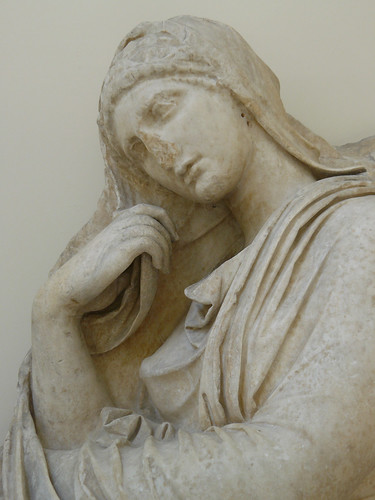
[Image - Although this sculpture of a mid-4th century BCE Attic woman from Acharnae Menidi discovered before 1827 is part of the permanent collection of the Metropolitan Museum of Art and is not part of the upcoming exhibit, it typifies the subtle grace and modesty depicted in sculpture of the period. This image is included in my Flickr image archive. I have licensed all images with Creative Commons for free non-commercial use with the attribution "Photo by Mary Harrsch". Any derivatives must also be shared in like manner]
The galleries of the Onassis Cultural Center in New York will be transformed into evocations of ancient Greek sanctuaries, each filled with artistic masterpieces assembled from international collections, for the major exhibition Worshiping Women: Ritual and Reality in Classical Athens. On view from December 10, 2008, through May 9, 2009, the exhibition brings together 155 rare and extraordinary archaeological objects in order to re-examine preconceptions about the exclusion of women from public life in ancient Athens. The story told by these objects, and experienced in the galleries, presents a more nuanced picture than is often seen, showing how women’s participation in cults and festivals contributed not only to personal fulfillment in Classical Greece but also to civic identity.
Among the treasures being brought to New York for the exhibition are marble statues of the goddesses Artemis and Athena (National Archaeological Museum, Athens); a white-ground vase with an image of Artemis, by the Pan Painter (State Hermitage Museum, Petersburg); a red-figure vase with an image of Iphigenia, the legendary heroine worshiped as a cult figure and seen as a model for priestesses (Museo Archeologico Nazionale, Ferrara); a vase showing the Trojan priestess Theano, another model for priestesses, receiving the Greek warriors who had come to recover Helen from Troy (Vatican Museums); and a limestone grave marker (conserved with support from the Onassis Foundation) carved with the image of a young woman in bridal costume, holding a votive offering (State Museums of Berlin). Interspersed with these and other exquisite artworks are archaeological objects that document the religious practices of Classical Athens and tell the complex story of women’s roles in that society.
Worshiping Women tells this story in three main chapters. “Goddesses and Heroines” introduces the principal female deities of Athens and Attica, in whose cults and festivals women were most actively engaged: Athena, Artemis, Aphrodite, and Demeter and her daughter Persephone. This first section also investigates the role of heroines, a special group of women believed to have lived in the distant past, who like Iphigenia became important figures of cult worship after their deaths.
The second chapter, “Women and Ritual,” explores the practice of ritual acts such as dances, libations, sacrifices, processions and festivals in which women were active in classical antiquity. Here the critical role of the priestess comes to light, specifically in her function as key-bearer for the temples of the gods.
In the final chapter, “Women and the Cycle of Life,” the exhibition explores how religious rituals defined moments of transition. Because the most important transition in a girl’s life was understood to be marriage, the wedding took on great significance, with its rituals depicted on a variety of vases associated with nuptial rites and wedding banquets. Death was another occasion on which Athenian women took on major responsibilities, such as preparing the deceased for burial and tending the graves of family members.
N.S. Gill's post about the exhibit in her "About Ancient History" blog included a link to a fascinating article about the ancient festival of Thesmophoria. An abstract:
Before the Thesmophoria festival itself, there was a preparatory night-time festival called the Stenia. At the Stenia women engaged in Aiskhrologia, insulting each other and using foul language. This commemorated Iambe's successful attempts to make the grieving mother Demeter laugh.
[This almost sounds like modern antics associated with male bonding!]
During the Stenia portion of the Thesmophoria women may have placed fertility objects, molded bread [in the shape of male genitals], pine cones and piglets, in a snake-filled chamber called a megaron.
The objects were later retrieved and ceremonially carried to an altar during a night time torch-lit procession commemorating Demeter's search for her kidnapped daughter Persephone. Aristophanes' comedic play Thesmophoriazusae tells the story of a man trying to infiltrate the Thesmophoria. Maybe Clodius of Roman fame got his idea to sneak into the celebration of the Bona Dea and seduce Julius Caesar's wife after reading the Thesmophoriazusae!
If you enjoyed this post, never miss out on future posts by following me by email!
In a dusty cave in Israel, archaeologists have unearthed a 12,000-year-old grave that they say may be the resting spot of one of the earliest known shamans. The grave contains the artfully arranged bones of a roughly 45-year-old woman as well as a collection of animal and human body parts, including a complete human foot, 50 tortoise shells, and bones from a wild boar, an eagle, and a leopard.
“What was unusual here was there were so many different parts of different animals that were unusual, that were clearly put there on purpose,” said researcher Natalie Munro…. This care along with the animal parts point to the grave belonging to both an important member of the society and possibly a healer called a shaman…. Such healers mediate between the human and spirit worlds, often summoning the help of animal spirits along their quests, according to the researchers [LiveScience].
In the study, published in the Proceedings of the National Academy of Sciences [subscription required], researchers describe the cemetery of a prehistoric Natufian settlement. The Natufian culture, which lasted from roughly 15,000 to 11,500 years ago, played a central role in the transition from foraging to farming and was the first known society to live in year-round settlements. Burials of the dead increased dramatically in number among the Natufians, indicating that these people assigned much symbolic importance to treatment of the dead [Science News].
The woman’s skeleton was separated from the other 26 burial sites found in the cave, and her grave was the only one lined with slabs of limestone. Ten large stones had been placed on her head, arms, and pelvis, perhaps to hold her body in a particular position, or because the community was trying to keep the shaman and her spirit inside the grave, [study coauthor Leore] Grosman said. It is likely that the 50 tortoises were brought live to the site and were eaten as part of a feast surrounding the burial, according to the researchers [Bloomberg].
I found this article about the history of the Easter celebration extremely interesting. I was aware that such holidays as Christmas had developed from pagan festivals surrounding the winter solstice but did not realize Easter was not a historical Christian celebration. I was also dismayed that, like many other doctrines of the church, the observance of Easter Sunday was enforced by the persecution of dissenters. An abstract:
"The name Easter is actually derived from the name of an ancient goddess. In Europe she was known as Ostara, the goddess of spring. The Phoenicians called her Astarte, and her name also appears on Assyrian monuments found by 19th-century archaeologist Sir Henry Austen Layard in excavations at Nineveh. The Assyrians and the Babylonians called her Ishtar; in fact, the Assyrian pronunciation of her name sounds just like the English word Easter.
For more than a thousand years before Jesus’ birth, a festival to this goddess was celebrated each spring to mark the budding of new life—the resurrection of nature after the dead of winter. It was a feast of regeneration. Throughout the inhabited world in ancient times, spring festivals and various related sex rituals honored the sun’s welcome rays as they once again imparted life and warmth.
Professing Christians in the second century and later saw Christ’s resurrection to new life as a parallel to these pagan spring rituals. Gradually they incorporated the customs surrounding worship of the spring goddess into Christianity in the festival we know as Easter.
But the acceptance of Easter as a celebration within traditional Christianity did not come easily. Indeed, much controversy surrounded its integration into the Christian calendar.
Historical references show that the early Christian Church did not observe Easter. In his book The Primitive Church, Maurice Goguel noted that “those Christians of Jewish origin continued to celebrate the Jewish feasts, particularly the Passover...”
"...During the second century, the paths of the congregations in the West, centered at Rome, began to diverge from those in Asia Minor.
The two groups generally agreed that Jesus Christ ate the Passover on the 14th day of Nisan. The Christians in Asia Minor, who made up what came to be referred to as the Eastern church, stuck to that date for partaking of the bread and wine that symbolized Christ’s suffering and death. However, as Fernand Mourret pointed out in his five-volume History of the Catholic Church, “the Christians of the West made a different calculation. In their opinion the purpose of the great Christian feast was the commemoration of Christ’s Resurrection.”
So the church in the West established Sunday as a memorial to the resurrection, discontinuing the observance of the Passover on Nisan 14. But in Asia Minor, the Passover continued to be observed on that day..."
"...In time Constantine became the Roman emperor. In 313 he issued a proclamation at Milan that came to be called the Edict of Toleration, or the Edict of Milan. It accepted Christianity as an official religion in the empire, with legal equality to other religions.
Over the next several years, the church further removed itself from its Jewish roots and inculturated itself within Roman society. It became a politicized religion of the state. But the congregations in the East and even in other parts of the vast Roman Empire still differed significantly in doctrine and practice. Constantine therefore convoked the first great ecumenical council at Nicea, in Asia Minor, in 325.
This was a major turning point. The emperor had already decreed that the day of the sun should be kept as a weekly day of rest. Now the Council of Nicea would determine the course of the church in other respects as well.
In his letter to all those throughout the empire who had not attended the Council of Nicea, Constantine wrote concerning the keeping of Easter: “It appeared an unworthy thing that in the celebration of this most holy feast we should follow the practice of the Jews. . . . Let us then have nothing in common with the detestable Jewish crowd. . . . It is most fitting that all should unite . . . in avoiding all participation in the perjured conduct of the Jews.” From such comments it appears that the adoption of Easter Sunday worship was motivated more by hatred toward the Jews than by love for Jesus Christ—Himself a Jew.
Without regard to the decisions rendered by Constantine and the Council of Nicea, many continued to observe the Passover. Eventually, however, Constantine issued an edict against all those whom he regarded as heretics, as recorded by Eusebius in his Life of Constantine. In the edict the emperor declared: “We have directed, accordingly, that you be deprived of all the houses in which you are accustomed to hold your assemblies: and our care in this respect extends so far as to forbid the holding of your superstitious and senseless meetings, not in public merely, but in any private house or place whatsoever.”
Since evening meetings were also banned, observing the Passover on the eve of Nisan 14 became increasingly difficult. As the politically organized church at Rome grew to great size and power, it gradually succeeded in stamping out the biblical teaching regarding the Passover as the memorial of Christ’s death. Easter Sunday thus became universally accepted within that church as the day when Christians should celebrate His resurrection.
We find, then, that in the early centuries of what is often called the Christian era, an unbridgeable gulf opened up between professing Christian churches and the apostolic Church Jesus founded. Nowhere does the New Testament command or even suggest that Christ’s resurrection should be commemorated on Easter Sunday or indeed on any day."
If you enjoyed this post, never miss out on future posts by following me by email!




 In a dusty cave in Israel,
