Showing posts with label ancient Egypt. Show all posts

Tuesday, May 11, 2010

Nilometer discovered along the Avenue of the Sphinxes

While working on the the restoration of the Avenue of the Sphinxes, a 2.7-km (1.7-mile) ancient processional roadway that connects the grand temples of Luxor and Karnak on the east bank of the Nile River built by Amenhotep III (1410-1372 B.C.), scientists have uncovered a 5th century Egyptian Christian church and a "nilometer," a structure used to measure the level of the Nile during floods.  The Nilometer is cylindrical and crafted of sandstone with New Kingdom (1569-1081 B.C.) clay vessels at its bottom.

[Image Courtesy of Egypt's Supreme Council of Antiquites (SCA).]

"The structure, 7 meters (23 feet) in diameter, was encircled by a spiral staircase descending into the Nile. The steps allowed for a quick reading of increase in water level, thus forecasting floods."  - Discovery News

In ancient times the Nile would overflow its banks between June and September.  The ancient Egyptians divided their year into three seasons with the period of inundation being one of the three.  Tax levels were set based on the quantity of the anticipated flood.  So, predicting the quantity of the inundation became a carefully guarded responsibility of select priests and many nilometers were enclosed in temples to exclude all but priests and Egyptian rulers.


The simplest nilometer was a marked vertical column submerged in the waters of the river.  A very ornate version of this design, built in 861 CE by the Abbasid caliph al-Mutawakkil, can still be seen on the island of Rhoda in central Cairo.

The second type used a a flight of stairs leading down into the water, with depth markings along the walls. The best known example of this kind can be seen on the island of Elephantine in Aswan.  [Image courtesy of Wikimedia Commons user Rajor]

The type found along the Avenue of the Sphinxes represents the third and most elaborate design that incorporated a cistern connected to the river by a channel.  Another example of this type can be seen at  the Temple of Kom Ombo north of Aswan


The Nilometer and the Sacred Soil: A Diary of a Tour Through Egypt, Palestine, and Syria    Global Treasures Kom Ombo Egypt   Amenhotep III: Perspectives on His Reign   Chronicle of a Pharaoh: The Intimate Life of Amenhotep III
If you enjoyed this post, never miss out on future posts by following me by email!

Friday, May 07, 2010

2300-year-old Egyptian noblewoman centerpiece of renovated Nelson-Atkins gallery

The burial treasures of a 2300-year-old Egyptian noblewoman named Meretites, which means "beloved of her father", is the centerpiece of the newly reopened Egyptian gallery at the Nelson-Atkins Museum of Art in Kansas City. Robert Cohon, curator of art of the ancient world at the Nelson-Atkins points out that the arrangement of the art and subtle lighting is intended to give the impression of a tomb without being frightening.

"We want children to come in here, and want to know more," Cohon said. They will see the inner coffin painted with a huge golden-faced, blue-haired Meretites, as well as the myriad Egyptian gods and goddesses there for her journey into the afterworld." 

"Egyptian art has been a surreptitious pleasure for so many," Cohon continues. "This may also be a child's first exposure to death."

I was so excited to read about the Nelson-Atkins $1.7 million renovation.  They sound like they have a wonderful ancient art collection that spans over 4,000 years and there is a chance I may be going to Kansas City in July. 

[Image courtesy of the Nelson-Atkins Museum of Art]

My husband expressed his wish to go to the Military Vehicles Preservation Association national conference that is being held in Kansas City this year.  Its still a little iffy, though, with the gas prices climbing towards $4 a gallon again.  If there wasn't a possibility that he would buy some vehicle or large part, we could take my little fuel-efficient Scion but if we're attending a MVPA event, we'll probably need to take my husband's truck in case he wants to drag something back to Oregon.  At least now I have as much motivation to go as he does!

In addition to the funerary art of  Meretites that was purchased from a German collection back in 2007, the Egyptian galleries includes stone portraits of famous kings and queens from Sesostris III to Ramses II, from Nefertiti to the Ptolemies.  The museum's website points out that none of their recent purchases are contested by Egypt so they won't be in danger of repatriation.

Their Near Eastern collection includes grave goods from kings and queens of Ur and sculptures from the Palace of Ashurnasirpal II in Nimrud as well as the ceremonial center of the Persian Empire, Persepolis.  It will be interesting to compare their artifacts to those on display at the Oriental Institute at the University of Chicago.

The museum's Roman collection apparently centers on works of art from the second century CE created during the reigns of the emperors Hadrian and Severus.  Their Greek collection mentions a sculpture of a young athlete.  I couldn't find an image of it but wonder if it is engaged in a particular sport or is more of a representation of a victorious youth?  

Steven Holl: The Nelson-Atkins Museum of Art Bloch Building  Funerary Art of Ancient Egypt  The Severans: The Roman Empire Transformed  Hadrian and the Triumph of Rome   Assyrian Reliefs from the Palace of Ashurnasirpal II: A Cultural Biography   Forgotten Empire: The World of Ancient Persia
If you enjoyed this post, never miss out on future posts by following me by email!

Friday, January 08, 2010

Ancient Leaded Egyptian Eyeliner found to trigger Immune Response!

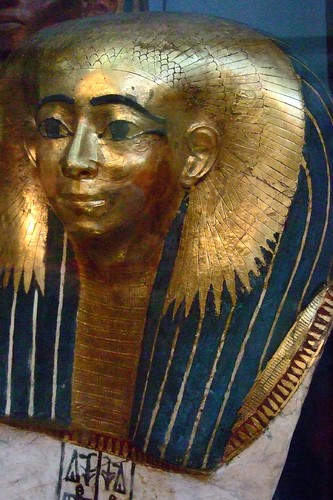
Gilded cartonnage mummy-mask of a lady of high rank early 18th dynasty 1500 BCE from Thebes EgyptA recent study by the [French] National Scientific Research Centre (CNRS) and Paris's


Pierre and Marie Curie University, along with the French Centre for Museum Restoration and Research says the quantities of lead used in ancient Egyptian eyeliner actually triggered the body's immune response and helped to protect the wearer's eyes from infection!

[Image: Gilded cartonnage mummy-mask of a lady of high rank early 18th dynasty 1500 BCE from Thebes Egypt.  Photographed at the British Museum by Mary Harrsch]

"To get these results, the team under Christian Amatore made use of laurionite, a lead chloride among the salts synthesised by ancient Egyptians, and noted its actions on an isolated cell of the skin with the help of ultramicroelectrodes, observing the super-production of a few dozen thousands of molecules of nitric oxide molecules. This stimulates the arrival of macrophages cells which clean the organism by eating living bacteria and various residual matter." - ANSAmed
If you enjoyed this post, never miss out on future posts by following me by email!

Sunday, December 20, 2009

U.N. to assist Egypt with planning for underwater museum in Alexandria


I see the United Nations has offered to assist Egypt with its plans for an underwater museum in Alexandria to showcase the remnants of the palace of Cleopatra found just offshore there.

From the artists' conceptions of the new facility it looks like it will be an architectural marvel in its own right! Architect Jacques Rougerie explained that the architectural elements are meant to evoke images of Nile feluccas and the maritime importance of the famous lighthouse that once stood here.  The museum will be situation near the new Library of Alexandria, a facilitiy that is projected to one day recapture the title of largest repository of knowledge in the world.

[Image courtesy of Jacques Rougerie Architect]

 Just this week they have raised a massive red granite pylon  weighing nine tons that formed part of the temple of Isis.  The temple complex stood right next to Cleopatra's mausoleum in the year 30 BC. Scholars think Cleopatra was not buried there though.  She was reportedly buried inland beside her husband Marc Antony.  There had been speculation earlier this year that their burial had been found but I haven't heard anything more about that excavation lately.


I wish the museum would be open when I visit Egypt but I don't think it will be finished by February 2011 when I plan to go there.  For more wonderful photos of the project, check out the National Geographic feature about it!

Cleopatra's Alexandria          Cleopatra's Palace:: In Search of a Legend
If you enjoyed this post, never miss out on future posts by following me by email!

Friday, January 23, 2009

Murals from Tomb of Nebamun featured in refurbished Egyptian Gallery at The British Museum

Although the ancient Egyptians stylized the human form, their naturalistic depictions of animals has always amazed me. The detail and vibrant color of the cattle in this fragment from the tomb of an Egyptian official named Nebamun, painted around 1350 BCE during the late 18th dynasty, is no exception. Acquired during the 1820s by the British Museum it has been carefully conserved over the last 10 years and is now featured in their recently rennovated Egyptian gallery. I wish it had been on display when I was there this past summer.

[Image courtesy of The British Museum]
"The alternating colours and patterns of cattle create a superb sense of animal movement. The artists have left out some of the cattle’s legs to preserve the clarity of the design. The herdsman is telling the farmer in front of him in the queue:

'Come on! Get away! Don’t speak in the presence of the praised one! He detests people talking …. Pass on in quiet and in order … He knows all affairs, does the scribe and counter of grain of [Amun], Neb[amun]’.

The name of the god Amun has been hacked out in this caption where it appears in Nebamun’s name and title. Shortly after Nebamun died, King Akhenaten (1352–1336 BC) had Amun’s name erased from monuments as part of his religious reforms."

If you enjoyed this post, never miss out on future posts by following me by email!

Saturday, November 08, 2008

C. David Claudon's Cleopatra Costume Site Interesting

I stumbled across C. David Claudon's Ceopatra Costume article while I was looking for a picture of Ramses II's girdle. I found it very interesting

The Cleopatra Costume on Stage and in Film


Perhaps one of the most well-known Egyptian pharaohs, Cleopatra VII Philopater ("father-lover") has captured the imaginations of countless artists and authors. In William Shakespeare's The Tragedie of Anthonie, and Cleopatra, (better known as Antony and Cleopatra), John Dryden's All for Love, Victorien Sardou's Cleopatra, George Bernard Shaw's Caesar and Cleopatra, and the numerous Cleopatra-peopled films of the twentieth century, each artist has invested his own period's interpretation in the lady. Any study of the costumes worn on the stage and screen by actresses playing Cleopatra VII first requires familiarity with what the Egyptian pharoah herself might have worn. To do this, the costumes described can be divided into two categories: those worn as "everyday" clothes and those worn for state or religious occasions.

The clothes worn as everyday dress were probably Hellenic Greek in origin, for Cleopatra was a Roman-sponsored monarch, whose Greek ancestors had ruled Egypt since the death of Alexander the Great. This Roman apparel, described by Barton (1961), was based on Greek dress. It consisted of an underdress of soft linen or silk (the tunica interior) and a long over-robe (the stola) of the same material. Over these two garments would be worn the palla, or draped outer-cloak.

Barton describes the range of color for this ensemble:

Colors mentioned in contemporary texts include scarlet, violet, mari-gold yellow, crocus yellow, hyacinth-purple (which would be nearer our modern shade than the Tyrian), rust, sea-green or blue, and green. Probably the tints of the garments themselves were fairly light and bright (not what we understand by "pastel," but stronger) and designs were applied in deeper tones. (p. 88)

On her feet, if she wore complete Roman garb, Cleopatra could wear either sandals (solae) for house-wear or shoes (calcei) if she went outdoors. Those shoes were made of leather and also varied in color from white to red, green or pale yellow.

- More

Technorati Tags: , , , , , ,
If you enjoyed this post, never miss out on future posts by following me by email!

Karanis target of 1st Archaeology Field for US Undergrads

http://www.egypttravelplans.com/larg%20pix/KaranisTextile.jpgFor the UCLA students, exploring the sprawling agricultural settlement that was Karanis and uncovering plant remains and animal bones from the fourth through sixth centuries is turning into the trip of a lifetime.
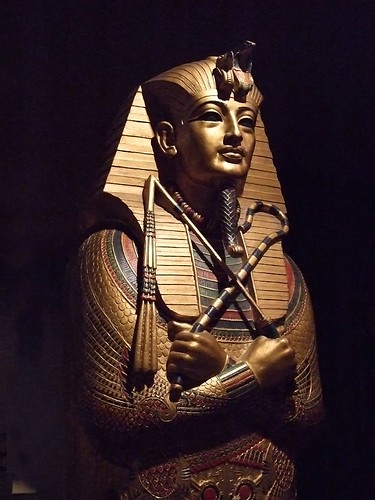
[Karanis textile]

Just two weeks into the dig, the field school has made some new discoveries.

"Based on dates in Greek papyri previously found at Karanis, the city was thought to have been abandoned in the fourth century … but the section we are working on dates from the fourth to the sixth centuries, which expands the occupation of Karanis by approximately two centuries," Wendrich said. "It certainly was rural, but it was also a large town, in which the inhabitants, mostly small landowners, created a comfortable life for themselves."

There are more mysteries to uncover, she added.

"One of the main mysteries is how the city inhabitants were provided with water," Wendrich said. "Karanis lies in the desert at the edge of the Fayum depression, and there were several canals that ran near the town. To date, six bath houses have been identified, but it is as yet unclear how the water from the canals reached the town."

Karanis is now believed to have been inhabited from 300 BC to the sixth century. The field school is uncovering plant remains, animal bones, textiles, basketry, leather and fragments of papyrus.

It's all part of the adventure of being in Egypt's first officially sanctioned field school for American undergraduates. See UCLA Egypt Archaeology blog for personal experiences.

Technorati Tags: , , , , , , ,
If you enjoyed this post, never miss out on future posts by following me by email!

Wednesday, August 06, 2008

DNA tests scheduled for King Tut's daughters


"Egyptian scientists are doing DNA tests on stillborn children found in the tomb of the Pharoah Tutankhamun in the hope of identifying their mother and grandmother, who may be the powerful queen Nefertiti, Egypt's chief archaeologist said on Wednesday.

Many scholars believe their mother to be Ankhesenamun, the boy king's only known wife. Ankhesenamun is the daughter of Nefertiti, renowned for her beauty.

The DNA tests and computerised tomography (CT) scans, to be performed at Cairo University, should be finished by December, Hawass said. Egypt has been trying to check the identity of all its royal mummies using DNA and CT scans. Tutankhamun's was one of the first mummies to be examined with the technology in 2005."

If you enjoyed this post, never miss out on future posts by following me by email!

Thursday, July 28, 2005

New King Tut exhibit explores Tut's lineage


I visited the new King Tut exhibit while I was there. I read that the major artifacts from his tomb would not be there but I felt a little sorry for some of the visitors who expected to see the spectacular golden death mask that was, of course, only being used to promote the exhibit but not really in it. Much of the exhibit was not from Tut's tomb but were funerary objects from his grandmother, grandfather, etc. However, some of the pieces I did enjoy viewing closely was Queen Tiye's carved golden sarcophagus, one of Queen Tiye's beautifully carved chairs, Tut's exquisite ceremonial dagger that was wrapped with his mummy, and one of his beautifully inlaid diadems.

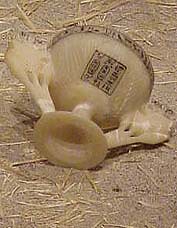
I was also gratified to note that the replicas of some of the artifacts I had seen in Las Vegas at the Luxor Hotel looked nearly identical to the real things - the double-handled alabaster lotus cup pictured at left, a tall alabaster unguent vase, and a cartouche-shaped storage chest among them.

If you enjoyed this post, never miss out on future posts by following me by email!