Showing posts with label civilization. Show all posts

Sunday, September 05, 2010

New research indicates Amazon supported advanced civilization

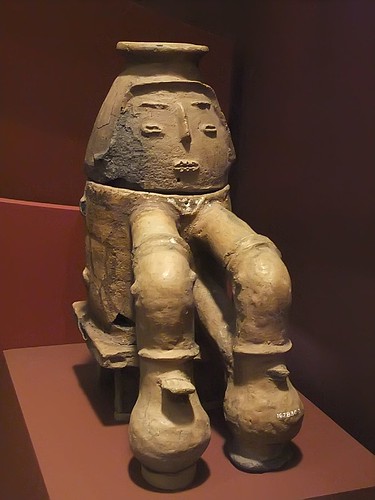
Amazonian Ceramic Figure from the state of
Amapa in Brazil 1200-1600CE.  Photographed at
the Field Museum in Chicago by Mary Harrsch.
New excavations and soil core analysis in Peru indicate that the Amazon ecosystem supported an advanced civilization at least as far back as 800 CE.  It always struck me as strange that an area that could support such a lush rainforest with its myriad of lifeforms could have been viewed as so unsuitable for human habitation in ancient times!

Along the Xingu, an Amazon tributary in Brazil, Michael Heckenberger of the University of Florida has found moats, causeways, canals, the networks of a stratified civilization that, he says, existed as early as A.D. 800. In Bolivia, American, German and Finnish archaeologists have been studying how pre-Columbian Indians moved tons of soil and diverted rivers, major projects of a society that existed long before the birth of Christ.

Many of these ongoing excavations follow the work of Anna C. Roosevelt. In the 1980s on Marajo Island, at the mouth of the Amazon, she turned up house foundations, elaborate pottery and evidence of an agriculture so advanced she believes the society there possibly had well over 100,000 inhabitants.

In some ways, the theory that the Amazon may have been a wellspring of civilization should come as no surprise in the 21st century. In a long perilous journey along Ecuador's Napo River in 1541, Spanish friar Gaspar de Carvajal, a chronicler of the European conquest, wrote of "cities that gleamed white," canoes that carried dozens of Indian warriors, "fine highways" and "very fruitful land."

Bits of colorful ceramics - matching that found elsewhere in the Amazon - seem to show that those who lived here were the Omaguas, the same people Gaspar de Carvajal encountered nearly 500 years before.  - Scientists find evidence discrediting theory Amazon was virtually unlivable by Juan Forero for the Washington Post

 Most of our documentation about the Omaguas was compiled by 17th century missionary Samuel Fritz.  By his time, the average Omagua settlement had been reduced to, on average, 28 plank houses with palm-thatched roofs where about 330 individuals, most members of an extended family, lived.


Men and women wore cloth garments. The men wore long sleeveless shirts that reached down to their knees. Women wore short wraparound skirts. The men usually left their shirts off because they got in the way. The clothes were usually painted with multicolor designs. Due to the Omaguas flattened foreheads they are easily distinguished from other Amazonian tribes. Fritz observed that shaping was done in infancy by “ applying to the [babies’] forehead a small board or wattle of reeds tied with a little cotton so as not to hurt them, and fastening them by the shoulders to a little canoe, which serves them for a cradle” (Meggers 125).

The spearthrower was the principle weapon for hunting, fishing, and gathering. It took the form of a flat board about 40 inches long and three fingers wide with a bone hook at the upper end to secure the projectile. The spear or arrow was about six feet long and had a point of bone or very hard wood which was sometimes detachable, permitting it to remain in the victim. To shoot the arrow is taken in the right hand, with which the spearthrower is held by its lower end, and placing the arrow against the hook, they launch it with such force and accuracy that they do not miss at fifty paces” ( Meggers 127). The shields used in warfare were the height of a man and made of basketry covered with cayman, manatee, or tapir hide. If there was no stone, turtle shells were used for axes and adzes.

Each village had a chief and all the villages in a province were united under one high chief who was described as “ a very great over lord.” - Nick Willaert, Minnesota State University at Mankato
 Smithsonian Atlas of the Amazon   Amazon (IMAX)   Ancient South America (Cambridge World Archaeology)  Empires in the Americas: A Journey Back in Time (Lost Treasures of the Ancient World)  
If you enjoyed this post, never miss out on future posts by following me by email!

Thursday, May 29, 2008

Siege of the Ivory Tower of Academia

I found this article disturbing in the sense that basically racist charges can be levied at a scholar simply because they criticize the scholarly integrity of a work that has an apparent racially-motivated agenda. I have encountered, what have been termed, Afrocentrists myself and have tried to point out to them that, although many of the ancient peoples along the Mediterranean coast were people of color (is that phrase politically correct anymore?) not all ancient people of the entire continent of Africa were sub-Saharan "black" in ethnicity including the Egyptians. I have heard Afrocentrist scholars try to claim Cleopatra, King Tut, Queen Hatsephut, and later, Hannibal, were all "black". In fact I came across some beautiful images of these historical personalities rendered as ethnically black on a website sponsored by Anhauser-Busch. But they overlook historically important facts such as Cleopatra's descent from Ptolemy Soter I, a half-brother of Alexander the Great of Macedon. Ptolemy not only took over the kingdom of Egypt but adopted the intrafamilial marriage practices of pharaonic tradition. Therefore, although its true historians are not sure who her mother was, by tradition she would have been another descendant of the Ptolemy dynasty.

Furthermore, Egyptian tomb paintings distinguish between the reddish skin of "Egyptians" and the black skin of "Nubians". Both King Tut and Queen Hatshepsut are rendered with reddish skin.

In addition, Hannibal was a descendant of a noble Phoenician family that colonized the area around Carthage. It is thought by some that there was some intermarriage with the local Berbers but Berbers are not ethnically "black" either.

There were some very effective Nubian pharaohs, though, that ruled Egypt during the 25th dynasty including King Kashta (745-742 BC),Piankhi (742-715 BC), Shabaka I (715-701 BC), Shakatak (701-689 BC), Taharka (680-664 BC), and Tanutamun (664-650 BC). These pharaohs were ethnically "black". So why do the Afrocentrists feel they must produce inaccurate works about some figures of ancient African history rather than focus on figures that fit their targeted ethnic profile and explore and publicize their lives instead?

As for the Greeks stealing their culture from the Egyptians, I find this a simplistic view of cultural exchange. Trade with other nations always provides the opportunities to exchange ideas and technologies. There is archaeological evidence that there was very early trade between the Minoans and Egyptians. I'm sure there was probably an active exchange of ideas as well as art (fragments of Minoan paintings have been found in Egypt) during this period. But the key word here is "exchange".

Furthermore, to frame Egypt, and through Egypt as Africa, as the source of all ancient knowledge is ludicrous since civilizations in the near East were just as ancient and contributed a great deal to so-called "western" civilizations like the Greeks. One such example is the Greek alphabet that scholars say was developed from the Phoenician alphabet. Another is the chariot that was introduced to the Egyptians by the Hyksos, originally from the near East.

Anyway, here's an abstract from the article I read:

"In 1993, Ms. Lefkowitz, a professor of classics at Wellesley, attended a lecture by Yosef ben-Jochannan, author of "Africa: Mother of Western Civilization." In his lecture, Mr. ben-Jochannan repeated the central claim of his book: that Aristotle had stolen his philosophy from the Egyptians, wholesale, a charge to which Ms. Lefkowitz's husband audibly answered from the audience, "Rubbish." Heated words were exchanged, and Mr. ben-Jochannan's defenders — primarily Ms. Lefkowitz's colleague Anthony Martin, whose courses feted Mr. ben-Jochannan's work — raised an alarm: A Jewish conspiracy against blacks was afoot, they charged, with Ms. Lefkowitz directing the protocols.

At the time of the incident, Ms. Lefkowitz was already on the radar of a number of Jewish-conspiracy theorists. She had reviewed — in the "conservative, Jewish-owned New Republic" (to use Mr. Martin's words) — a two-volume polemic against Greek civilization by Martin Bernal, a sociologist at Cornell. Mr. Bernal's work, "Black Athena," had alleged that classical scholars had not only failed to acknowledge the debt Greece owed Egypt, but that they were actively suppressing that debt (a conspiracy within a conspiracy, in other words). Her review was evidence enough that she, again in Mr. Martin's words, had dug in her heels against "Black progress."

Ms. Lefkowitz had actually gone easy on "Black Athena." And her husband's riposte was quite gentle itself. The charge, remember, was that Aristotle had hopped a boat from Athens, strolled into the library at Alexandria, grabbed a bunch of books, brought them back to Greece, and put his name on them. This is almost so unbelievable that it has to be true — but, alas, it isn't. First, there is no record of Aristotle ever having gone to Egypt. Maybe that evidence was suppressed? Perhaps — but there wasn't even a library in Alexandria for Aristotle to pillage during his lifetime. It wasn't built until at least 297 BCE; Aristotle died in 323 BCE. Even if he had wanted to steal the Egyptians' "Metaphysics," "Poetics," or "Politics," he wouldn't have been able to find them in Alexandria."

If you enjoyed this post, never miss out on future posts by following me by email!

Wednesday, September 12, 2007

Garamentes tunnel system watered early Libya

"Sometime before 1000 BCE, a group of nomads looked south of the narrow coastal strip and decided that if no one else was going to claim the desert, they would. They recognized that the sands and sun would kill anyone who deviated from a proscribed path of oases, and so determined that there was no need to use their resources in trying to defend a desert border; all they need to do was garrison the watering holes. In this manner – along a string of oases about 400 km long – the Garamentes were able to control the routes between Sudan and the Mediterranean coast, west to Mauritania, south to the Niger River, and eastward as far as Egypt.

Recent archaeology has shown the Garamentes from being far more than Herodotus' description of a tribe of numerous barbarians who were good at raising cattle; indeed, they became the Sahara's first culture to develop an urban civilization absent a perennial river – by 150 BCE, their capitol, Gerna (the modern Jarma Oasis) had a population or perhaps 4000, with another 6000 living in the immediate vicinity. Eight more major towns and numerous smaller settlements dotted their realm, and a decidedly city-based culture developed to exploit transiting caravans. According to some estimates, over 50,000 of their pyramidical stone tombs dot the landscape of their former territory.

Weird Historical Sidenote: For a glimpse into what the territory of the Garamedes looks like nowadays, check out this guy's photologue of a trip to Tassili National Park in Algeria. See if you can spot the petrified elephant.

img
They were able to accomplish all this by means of an ingenious system of more than 1600 kilometers of foggares (tunnels), dug down to subterranean aquifers and used to supply irrigation systems on the surface, and through an effective means of written communication. The Garamendes' Phoenecian-based alphabet is still in use by some Tarureg tribes today, have largely been preserved through the good offices of multiple generations of desert-dwelling women.

Their elaborate tunnel system made the Garamedes overly reliant upon slaves, which led to the old conquer-or-perish motif that we see played out so often through history. They warred for control of trade (and for profit) with the kingdoms surrounding them, be they Nubian, Egyptian, Carthaginian, Greek, or Roman. These latter sent several punitive expeditions into the lands of the Garamedes, but the desert proved unconquerable; finally, the Romans gave up and signed a lasting commercial and military agreement with them at the end of the 1st century CE."
If you enjoyed this post, never miss out on future posts by following me by email!

Friday, August 17, 2007

Ecological disaster being reconsidered as cause of Angkor's collapse

"Excavations are planned at Angkor to scour for more clues about ecological problems which led to the demise of Cambodia's great ancient city, an Australian archaeologist said Thursday.

"We have clear evidence now that Angkor was big enough to have caused environmental problems," Damian Evans said.

"But we need finer-grained detail to determine for sure how severe those problems were, and whether or not the local population was able to deal with them or not," said Evans, deputy director of the Greater Angkor Project at the University of Sydney.

His group published its findings in this week's online edition of Proceedings of the National Academy of Sciences.

They reveal that Angkor, during its zenith between the 9th and 14th centuries, was "the world's most extensive preindustrial low-density complex" and far larger than previously thought. It included an elaborate water management network encompassing nearly 1,000 square kilometers (390 square miles).

Extending rice fields to support a population of more than 1 million resulted in serious ecological problems, including deforestation, topsoil degradation and erosion.

The study's conclusions supported a theory in the early 1950s by Bernard-Philippe Groslier, a prominent French archaeologist, that the collapse of Angkor stemmed from over-exploitation of the environment.

The study produced a comprehensive digital mapping database detailing tens of thousands of individual features across nearly 3,000 square kilometers (1,160 square miles).

Previously, there were around 800 known temple sites in the mapped area, Evans said in an e-mail, adding that the number will likely be between 950 and 1,000 once results from the excavations have been verified on the ground."

If you enjoyed this post, never miss out on future posts by following me by email!