Showing posts with label funerary practices. Show all posts

Saturday, January 02, 2010

Will newly discovered Parthian tomb reveal Arsacid funerary customs?

A Parthian earthenware coffin has been found in the city of Ramshir in southern Iran.  Also known as the Arsacids, the Parthians ruled areas now in Iran, Iraq, Turkey, Armenia, Georgia, Azerbaidzhan, Turkmenistan, Afghanistan, Tajikistan, Pakistan, Syria, Lebanon, Jordan, Palestine and Israel. from 247 BCE - 224 CE.

Although no grave goods were mentioned in the article I read, archaeologists hope the discovery will reveal more information about Parthian funerary customs.
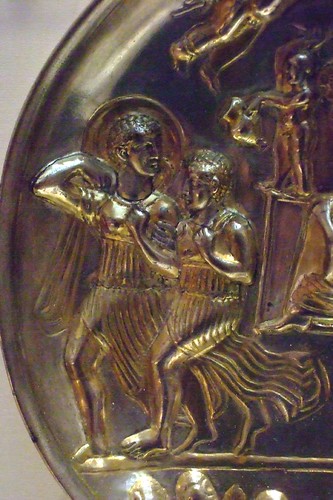
Silver Plate showing Dionysos either late Parthian or early Sasanian  2nd - 3rd century CE Afghanistan (1)

Because the Parthian Empire spread across so many diverse groups, it is difficult to define a single set of funerary practices.  There also appears to be distinctions based on social status.  Rulers and Parthian nobles appeared to be more influenced by Hellenistic Greek customs as demonstrated by coins of Mithradates I that depict the Greek Hero Herakles on the obverse side.  But scholars also point out that Zoroastrian beliefs were widespread as well.

[Image - Silver Plate showing Dionysos either late Parthian or early Sasanian  Period 2nd - 3rd century CE Afghanistan.  Photographed at the British Museum by Mary Harrsch]


"Ordinary villagers favoured fertility cults. Fire, streams and mountains were also revered, and horse sacrifice occurred. Burial practices included both inhumation (in royal circles) and exposure of human corpses. In the Parthian era all these beliefs and practices seem to have continued, although doubtless as previously with varying emphases being placed upon each component according to region and to section of the population, whether royalty, vassal monarchs, feudal lords, priests, townsfolk, villagers or nomads. - The Parthian Period by Malcolm A. R. Colledge

[Image - Bronze dragon believed to represent Zoroastrian spirit Ahriman Afghanistan 1st century CE.  Photographed at the British Museum by Mary Harrsch]

The article did not mention the discovery of any animal bones so this aspect may indicate the burial was of an individual from a higher social class.


As a student of Roman history, I first encountered the Parthians when reading about the defeat of Marcus Licinius Crassus at the battle of Carrhae.  I became even more intrigued with this culture when I saw some of their beautiful silver gilt rhytons at the Getty Villa like this one.
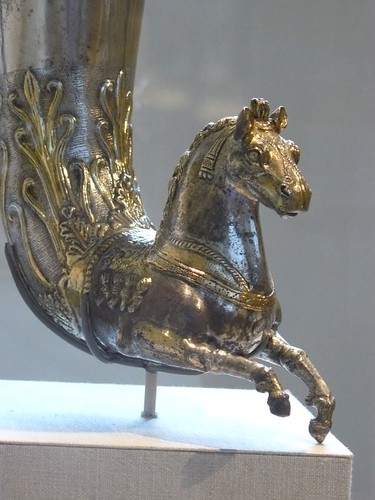

Silver-gilt rhyton for libations or drinking Greco-Parthian Hellenistic 2nd century BCE (2)
The Parthians proclaimed themselves to be philhellenes, as evidenced by coins minted by Mithradates I, and this work of art reflects these Hellenistic influences.  However, "friends" referred to trade and not to political relations as the Parthians spent much of the time defending themselves against the Seleucids, descendants of Alexander the Great's army who conquered much of Persia in the fourth century BCE.

However, when the Romans defeated the Seleucid ruler Antiochus, the Parthians swept in to fill the power void and soon experienced friction with the Romans themselves.


During this time, however, around 115 BCE, the Parthians also began to receive envoys from Chinese emperor Wu-ti of the Han Dynasty in China.  Then Parthian ruler, Mithradates II, negotiated with the Chinese over management of the Silk Road.


As I recently researched an extensive article for Heritage Key about the Han Dynasty, I found this information particularly fascinating, especially since most extant ancient sources about the Parthians has been written by their enemies in the west.  The Chinese found the Parthian culture on par with their own, discussing Parthian diplomatic and military activities in both the Hou Hanshu (Book of the Later Han) and the Records of the Grand Historian.  The Han emmisaries were received with much ceremony in the Arsacid court.  The Parthians also apparently cooperated with Han general Ban Chao in expeditions against the Xiongnu (the Chinese name for the Hun) to protect the valuable silk trade route.

Apparently, a Parthian noble was even instrumental in bringing translated Buddhist texts  to the Chinese.

"In 148 [CE], An Shigao arrived in China at the Han Dynasty capital of Luoyang, where he produced a substantial number of translations of Indian Buddhist texts and attracted a devoted community of followers. More than a dozen works by An Shigao are currently extant, including texts dealing with meditation, abhidharma, and basic Buddhist doctrines." - Wikipedia

The Age of the Parthians (Idea of Iran)   DEFEAT OF ROME IN THE EAST, THE: Crassus, the Parthians, and the Disastrous Battle of Carrhae, 53 BC  Mesopotamia and Iran in the Parthian and Sasanian Periods


If you enjoyed this post, never miss out on future posts by following me by email!

Friday, April 17, 2009

Stone sarcophagus and skeleton unearthed in Tibet


Again, I wish there had been an accompanying photo. This brief notice also did not include any speculation about the age or cultural period of the find. I did find references online to Tibetan funerary practices that said inhumation was the most common form of burial before Buddhism was introduced to Tibet, but after that sky burial became the most widely accepted funerary practice. Buddhism was first introduced in Tibet in 173 CE [Reference: Buddhism in Tibet] but supposedly had little impact at that time. I'm not sure what this website means by introduced because it goes on to say the appearance of the first Buddhist scripture did not occur until the 6th century CE and it goes on to say the scripture was not translated at that time. The first Buddhist monastery was erected in the ninth century after King Trisong Detsen officially declared Indian Buddhism and not Chinese Buddhism to be the religion of Tibet in 792 CE. If inhumation was abandoned somewhere between the 6th and 8th centuries, then the sarcophagus would predate that period at least.

I also found a fascinating discussion of ancient Tibetan royal burial practicies.

"... the funeral rituals of the tsenpos [early Tibetan kings] [are] closer to those of other Eurasian cultures - for example, the Scythians. We know quite a lot about the funerals of the Scythian kings because Herodotus wrote about them in the 5th century BC. Here’s what he wrote:

The tombs of their kings are in the land of the Gerrhi, who dwell at the point where the Borysthenes is first navigable. Here, when the king dies, they dig a grave, which is square in shape, and of great size. When it is ready, they take the king’s corpse, and, having opened the belly, and cleaned out the inside, fill the cavity with a preparation of chopped cypress, frankincense, parsley-seed, and anise-seed, after which they sew up the opening, enclose the body in wax, and, placing it on a wagon, carry it about through all the different tribes. On this procession each tribe, when it receives the corpse, imitates the example which is first set by the Royal Scythians; every man chops off a piece of his ear, crops his hair close, and makes a cut all round his arm, lacerates his forehead and his nose, and thrusts an arrow through his left hand.*

And as a commentator on Herodotus recently wrote: “The magnificent funerals of the Scythian kings have several parallels among Eurasian nomads of every age…” Indeed, restricting ourselves to the practices of cutting off the hair and self-laceration among mourners, we can easily pick out the following further examples. It was reported that at the funeral of Attila the Hun, mourners cut off their hair and made deep cuts in their faces. They kept the body in a ceremonial tent for a time before being buried. The Xiongnu (a nomadic empire that ruled northern China for a while in the 3rd and 4th centuries AD) buried their kings in large tombs, and plaits of hair have been found in some of those that have been excavated. The Khazars (around in the 7th-11th centuries) buried their dead in mausoleums near rivers, and at the funerals they beat drums, whistled and lacerated their faces. And so on

What we see again and again is the mourners cutting off their hair and lacerating their faces and bodies. This seems to me to be quite persuasive circumstantial evidence for rereading the Old Tibetan Chronicle in the same way. It also shows just how much the religion of the early Tibetan clans preserved the culture of their nomadic ancestors from the northern steppes. Other aspects of the tsenpo’s funerals which I haven’t mentioned here are also found among Eurasian nomadic peoples - like the long period elapsing between death and burial; the sacrifice of animals, especially white ones, and especially horses; and the killing and entombment of the king’s retainers.

I think all this helps us to see the early Tibetan religion (at least the myths and rituals surrounding the tsenpos) in the wider Eurasian cultural matrix shared by Scythians, Huns, Khazars, Turks, Mongols, and many more people of nomadic origin. - More: Early Tibet
News article:

A sarcophagus carved from stone, has been unearthed in Dongga Town, Lang County, southeastern Tibet's Nyingchi Prefecture, the prefecture's Cultural Relics Survey Team said.

The coffin was discovered in the course of building a road in the area. The frame and top of the stone coffin were made of bluish schist. The sarcophagus was 1.4 m long, 0.7 m wide, and 0.5 m tall. The tomb chamber was filled with cobblestones, sand and stones. A skeleton was also found in the chamber.- Tibet.news.cn


If you enjoyed this post, never miss out on future posts by following me by email!