Showing posts with label Zoroastrian. Show all posts

Saturday, January 02, 2010

Will newly discovered Parthian tomb reveal Arsacid funerary customs?

A Parthian earthenware coffin has been found in the city of Ramshir in southern Iran.  Also known as the Arsacids, the Parthians ruled areas now in Iran, Iraq, Turkey, Armenia, Georgia, Azerbaidzhan, Turkmenistan, Afghanistan, Tajikistan, Pakistan, Syria, Lebanon, Jordan, Palestine and Israel. from 247 BCE - 224 CE.

Although no grave goods were mentioned in the article I read, archaeologists hope the discovery will reveal more information about Parthian funerary customs.
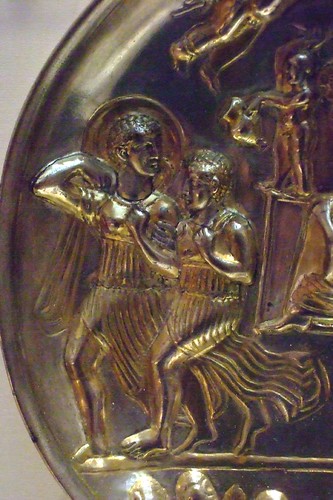
Silver Plate showing Dionysos either late Parthian or early Sasanian  2nd - 3rd century CE Afghanistan (1)

Because the Parthian Empire spread across so many diverse groups, it is difficult to define a single set of funerary practices.  There also appears to be distinctions based on social status.  Rulers and Parthian nobles appeared to be more influenced by Hellenistic Greek customs as demonstrated by coins of Mithradates I that depict the Greek Hero Herakles on the obverse side.  But scholars also point out that Zoroastrian beliefs were widespread as well.

[Image - Silver Plate showing Dionysos either late Parthian or early Sasanian  Period 2nd - 3rd century CE Afghanistan.  Photographed at the British Museum by Mary Harrsch]


"Ordinary villagers favoured fertility cults. Fire, streams and mountains were also revered, and horse sacrifice occurred. Burial practices included both inhumation (in royal circles) and exposure of human corpses. In the Parthian era all these beliefs and practices seem to have continued, although doubtless as previously with varying emphases being placed upon each component according to region and to section of the population, whether royalty, vassal monarchs, feudal lords, priests, townsfolk, villagers or nomads. - The Parthian Period by Malcolm A. R. Colledge

[Image - Bronze dragon believed to represent Zoroastrian spirit Ahriman Afghanistan 1st century CE.  Photographed at the British Museum by Mary Harrsch]

The article did not mention the discovery of any animal bones so this aspect may indicate the burial was of an individual from a higher social class.


As a student of Roman history, I first encountered the Parthians when reading about the defeat of Marcus Licinius Crassus at the battle of Carrhae.  I became even more intrigued with this culture when I saw some of their beautiful silver gilt rhytons at the Getty Villa like this one.
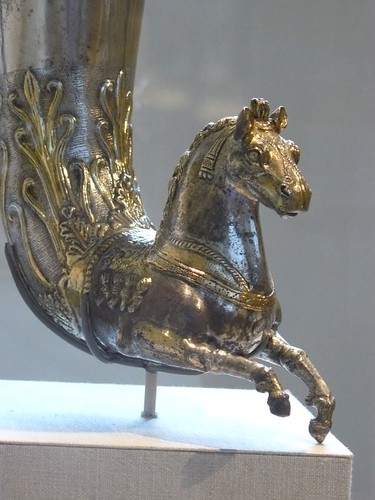

Silver-gilt rhyton for libations or drinking Greco-Parthian Hellenistic 2nd century BCE (2)
The Parthians proclaimed themselves to be philhellenes, as evidenced by coins minted by Mithradates I, and this work of art reflects these Hellenistic influences.  However, "friends" referred to trade and not to political relations as the Parthians spent much of the time defending themselves against the Seleucids, descendants of Alexander the Great's army who conquered much of Persia in the fourth century BCE.

However, when the Romans defeated the Seleucid ruler Antiochus, the Parthians swept in to fill the power void and soon experienced friction with the Romans themselves.


During this time, however, around 115 BCE, the Parthians also began to receive envoys from Chinese emperor Wu-ti of the Han Dynasty in China.  Then Parthian ruler, Mithradates II, negotiated with the Chinese over management of the Silk Road.


As I recently researched an extensive article for Heritage Key about the Han Dynasty, I found this information particularly fascinating, especially since most extant ancient sources about the Parthians has been written by their enemies in the west.  The Chinese found the Parthian culture on par with their own, discussing Parthian diplomatic and military activities in both the Hou Hanshu (Book of the Later Han) and the Records of the Grand Historian.  The Han emmisaries were received with much ceremony in the Arsacid court.  The Parthians also apparently cooperated with Han general Ban Chao in expeditions against the Xiongnu (the Chinese name for the Hun) to protect the valuable silk trade route.

Apparently, a Parthian noble was even instrumental in bringing translated Buddhist texts  to the Chinese.

"In 148 [CE], An Shigao arrived in China at the Han Dynasty capital of Luoyang, where he produced a substantial number of translations of Indian Buddhist texts and attracted a devoted community of followers. More than a dozen works by An Shigao are currently extant, including texts dealing with meditation, abhidharma, and basic Buddhist doctrines." - Wikipedia

The Age of the Parthians (Idea of Iran)   DEFEAT OF ROME IN THE EAST, THE: Crassus, the Parthians, and the Disastrous Battle of Carrhae, 53 BC  Mesopotamia and Iran in the Parthian and Sasanian Periods


If you enjoyed this post, never miss out on future posts by following me by email!

Thursday, October 30, 2008

Coping with Fear: The Truth About Hell by Edwin Black

This article was originally written at the turn of the millennium and has been reprinted from time to time since then. I imagine it surfaced again now since Halloween is fast approaching. However, I found it very interesting because it points out how mistranslations of original ancient text have found their way into modern religious conceptions of things as basic as heaven and hell. I suspect few of the traditional followers of these religions even realize some of the teachings that have become fundamental to the doctrines they profess have such less-than-divine origins.

Coping with Fear

The Truth About Hell

by Edwin Black

Israel Topics - HellBelow the Old City walls in Jerusalem there is a ravine that begins as a gentle, grassy separation between hills, but then quickly descends south into the rocky earth. Eventually, the ravine becomes a steep, craggy depth, scarred on the far side by shallow caves and pits that vaunt hollowed-out chambers and narrow crypts.

Until recent years, everywhere one could see the scorches and smolder from trash fires. Rivulets of urine trickled down from open sewers at the cliffs above, watering thorn bushes, weeds and unexpected clumps of grass among the outcroppings. One could smell the stench of decaying offal, the congealed stink of putrefied garbage, and the absorbed reek of incinerated substances seared into the rock face. Crows circled low. Worms and maggots slithered throughout.

Listen. Imagine. Some cannot help but hear the tormented screams of babies being burned alive, the macabre incantations of the idolatrous in gruesome celebration, the agonized cries of helpless victims, and every other echo of death and disconsolation that dwells here so pervasively that not even the centuries can silence them.

Welcome to Hell. The real Hell. This is Jerusalem's Gei Ben Hinnom, the Valley of the Sons of Hinnom. The Valley was named for an alien non-Semitic family, the Hinnom clan that predated the First Temple period and immediately established the locale as a place of abomination. Gei Ben Hinnom became Ge Hinnom (Valley of Hinnom, and eventually Gehenna in English or Gehennem in Arabic and Hebrew.

Those who walked through the Biblical "valley of the shadow of death" walked here. Images of unending torture and fire as punishment for a life of evil originated in this hideous acreage. The prophets always understood that Hell existed, not as a hidden, allegorical place deep beneath the ground maintained as a fable of fear. Hell is on Earth, just a short walk from the path of righteousness that leads to the Temple Mount.

Perhaps it is fitting that the path to Hell begins delightfully. In recent years, the northern and unoffensive length of the valley has become a zone of chic gentrification: exquisite townhomes, landscaped parks, a concert bowl at the Sultan's Pool, and movie theaters. But, as the ravine carves deeper and deeper between the rocky hills, and as it rounds the corners of Mt. Zion into East Jerusalem en route to the Arab village of Silwan, Gei Ben Hinnom conjoins with the Valley of the Kidron. Here it traverses a stretch of depth that has become a sort of urban no-man's-land in the struggle between Arab and Israeli. As land that defies political peace, this is the only part of the Valley that Arabs cannot improve and that Jews dare not.

Therefore, little has changed here for centuries. Still visible are the original, deep angular cuts into the flat scorched stone seating the infamous Tophet, created hundreds of years before Christ. Tophet altars are said to be named for the noisy drum that devotees of the mysterious Molech would beat to drown out the ghastly cries of children immolated in sacrifice before their own willing parents. In the black rapture of their misguided faith, mothers and fathers not only witnessed the sacrifice, but glorified the act. Beneath the ancient Tophet altars, one can still see foreboding square entryways barely big enough for a human torso to squeeze through. Within those dark depths lay a complex of carved-out crypts, as well as chambers for ritual preparation in honor of Molech.

Little is known about the god Molech. Some archaeologists, using Tophet models in Carthage, speculate that the Molech idol in Gei Ben Hinnom was equipped with outstretched cantilevered arms that extended a small platform upon which the innocent baby was tied. Slowly the platform would swivel toward the consuming flames as the baby shrieked in helpless agony. No wonder this most hideous place has repeatedly been the focus of Biblical wrath:

"He defiled Tophet, which is in the Valley of Ben Hinnom, so that no one would make a son or a daughter pass through fire as an offering to Molech." II Kings 23:10.

"Therefore the days are surely coming, says the Lord, when this place shall no more be called Tophet, or the Valley of the Sons of Hinnom, but the Valley of Slaughter." Jeremiah 19:16.

But how did a very authentic site of pagan abomination transmogrify into the concept of postmortuarial eternal punishment we call Hell? The tortuous course from reality on the ground to the murky mind of man has evolved along broken and jagged philosophical lines. Ironically, the concept of Hell developed less from the word of God, than by the mind of man. And its supposed physical locale was originally not in burning depths beneath the ground, but rather in a dark corner of heaven.- More

Technorati Tags: , , , , , , , , ,
If you enjoyed this post, never miss out on future posts by following me by email!