An ancient history resource article by Mary Harrsch © 2013
This morning one of my Facebook friends sent me a copy of a short article by Manolis J. Papagrigorakis, Philippos N. Synodinos, Angeliki Stathi, Chrysanthi L. Skevaki, and Levantia Zachariadouthat that suggested typhoid fever resulting from intentional bioterrorism on the part of the Spartans caused the great plague of Athens. Most of the evidence appeared to be based on historical precedent with authors pointing to the military siege of the city and an instance of deliberate contamination during the siege of Kirra (595-585 BCE) reported by Pausanius. There apparently was an analysis of ancient dental pulp from remains recovered from Athens and dated approximately to the time of the great plague that may have indicated traces of typhoid fever but another citation by the same researchers dated the same year was entitled "Insufficient phylogenetic analysis may not exclude candidacy of typhoid fever as a probable cause of the plague of Athens" so it sounded to me like the study was basically inconclusive.
I am much more convinced by the careful examination of the pathological symptoms by clinical pathologists attending the Historical Clinico-Pathologic Conference at the University of Maryland's School of Medicine in October 2000 who concluded it was most likely lice-borne typhus not water-borne typhoid that constituted the great plague of Athens.
These forensic physicians specifically discounted typhoid fairly early on in their analysis because of the description of an accompanying rash by Thucydides, a survivor of the pathogen. Thucydides describes a vivid red rash with pustules and ulcers (although there is some disagreement on the exact translation from the ancient Greek.) The pathologists point out that this symptom is "difficult to reconcile" with a diagnosis of Typhoid Fever. Likewise the rash is not consistent with a diagnosis of cholera, another disease related to contaminated water, either.
The complications reported by Thucydides among survivors seemed to be the clincher for Dr. Durack, the case presenter at the conference. Thucydides reports that survivors, like himself, often suffered from the residual effects of peripheral gangrene, blindness and/or amnesia. Dr. Durack pointed out that the bacteria that causes typhus frequently damage blood vessels. If the vessels where the damage occurs are in the brain, the survivor may experience amnesia or other symptoms of brain injury. If the vessels are damaged in the optic nerve, lingering blindness may result. If the disease causes severe vasculitis in the large vessels supplying the extremities during its course of infection, gangrene can develop. So, although we cannot be certain unless remains with intact pathogen can be identified, I think the clinical pathologists have my vote.
If you wish to read the original article that appeared in Volume 109 of the American Journal of Medicine (October 1, 2000), I digitized a copy of if here:
http://pages.uoregon.edu/mharrsch/medicalmysteries/Periclesmedicalstudy.pdf
Related articles
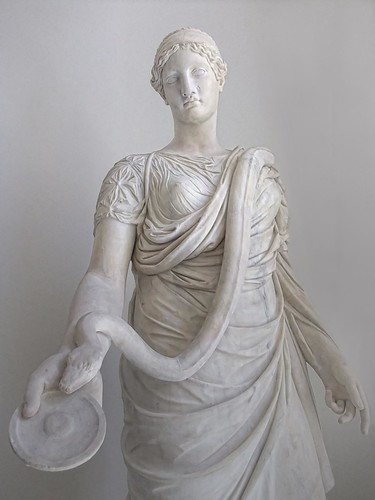 |
| The Hope Hygieia, goddess of health, feeding milk to a serpent 130-161 CE Roman copy of a 360 BCE Greek original unearthed in Ostia. Photographed at the Los Angeles County Museum of Art in Los Angeles, CA by Mary Harrsch ©2009 |
I am much more convinced by the careful examination of the pathological symptoms by clinical pathologists attending the Historical Clinico-Pathologic Conference at the University of Maryland's School of Medicine in October 2000 who concluded it was most likely lice-borne typhus not water-borne typhoid that constituted the great plague of Athens.
These forensic physicians specifically discounted typhoid fairly early on in their analysis because of the description of an accompanying rash by Thucydides, a survivor of the pathogen. Thucydides describes a vivid red rash with pustules and ulcers (although there is some disagreement on the exact translation from the ancient Greek.) The pathologists point out that this symptom is "difficult to reconcile" with a diagnosis of Typhoid Fever. Likewise the rash is not consistent with a diagnosis of cholera, another disease related to contaminated water, either.
 |
| Bust of Thucydides from the Pushkin Museum Image courtesy of Wikimedia Commons. |
If you wish to read the original article that appeared in Volume 109 of the American Journal of Medicine (October 1, 2000), I digitized a copy of if here:
http://pages.uoregon.edu/mharrsch/medicalmysteries/Periclesmedicalstudy.pdf
Related articles

 
|
 
|
 
|
 
|