An online magazine featuring articles about current archaeology and research into the art, literature, politics, warfare, entertainments, music, religion, cuisine and daily lives of inhabitants of the past other than those of the Greco-Roman period edited by a history enthusiast and technologist who is particularly interested in integrating technology and history education. For those who interacted with the Roman world, see "Roman Times."
The Middle Ages has attracted a lot of history enthusiasts and over 30,000 have gone on to relive this vibrant historical period by joining the Society for Creative Anachronism, an international organization dedicated to researching and re-creating the arts and skills of pre-17th-century Europe. I received an email from one of these young men, Euan Forrester, a talented photographer who produced an excellent video about medieval reenactment actitivities:
The “Known World” of the SCA consists of 19 kingdoms worldwide, each overseen by a royal court. Members, dressed in clothing of the Middle Ages and Renaissance, attend events which feature tournaments, royal courts, feasts, dancing, various classes, workshops and more.
By checking the SCA website, I learned that I resided in the kingdom of AnTir that encompasses Oregon, Washington and the northern tip of Idaho as well as British Columbia, Alberta, Saskatchewan, the Yukon, and the Northwest Territories. I am presently being ruled by King Savaric and Queen Dalla. I even discovered there is the Egil Skallagrimmson Memorial Tournament scheduled not far from my home May 22 - May 25, 2015 under the supervision of the baron of Adiantum.
Although I will probably only participate as a photographer (after all, my heart lies with the Roman Republic much earlier in history and I prefer a Roman gladius to a European long sword), I would definitely encourage anyone interested in the Middle Ages to check the SCA website for reenactment activities scheduled near you!
The producers of the excellent history DVD "She-Wolves: England's Early Queens", Athena Learning in association with RLJ Entertainment, have released another fascinating look at life in the Middle Ages entitled "Medieval Lives: Birth, Marriage, Death". Once again, Cambridge professor Helen Castor guides us through a wealth of information based on first person accounts from such sources as the Paston letters, a collection of over 1,000 documents kept as a family archive by three generations of the Paston family of Norwich.
In the first episode, I was surprised to learn that if a woman died in childbirth before the infant had emerged, the child was removed from the mother before burial because, although the mother had been baptized, the child had not and with the taint of Original Sin could not be buried in sanctified ground. I had never heard this before and Dr. Castor was quick to point out that this requirement was often ignored whenever possible.
For this reason, the church actually granted midwives the authority to baptize a child in the birthing chamber. If the midwife thought there was a real possibility the child would imminently die, they could perform the rite as soon as the head emerged in a last ditch effort to save the child's soul. If the mother died first, midwives were supposed to cut open the woman and extract the baby so it could be baptized, even if it would not ultimately survive.
Childbirth in the Middle Ages often involved the use of a birthing stool.
Medieval paintings and books, like the 12th century Trotula texts, based in part on the research of the ancient Greco-Roman physician, Galen, as well as newer Arabic medicine, illustrated the practice.
"In Antiquity, midwives (called, in Greek, maiai, and in Latin, obstetrices or more generically medicae) were the normative caretakers of both the gynecological and obstetrical needs of Greek and Roman women. Medical writers from at least the third century BCE to the sixth century CE composed texts specifically for midwives’ use, and there is ample evidence (such as inscriptions and artwork) that midwifery was professionalized in larger urban communities. Ancient writings on gynecology and obstetrics conceived of the ideal midwife as not simply literate and competent in medical theory, but as responsible for all disorders of the reproductive organs as well as routine assistance in childbirth. In the scope of her practice, at least, she was fully the equivalent of modern obstetrician/gynecologists and not simply a birth attendant." - Women and Gender in Medieval Europe, An Encyclopedia
But between the 6th and 13th centuries the literate midwife of antiquity disappeared and the task of aiding women in childbirth was relegated to neighbors and kinswomen, most without any training except experience. This changed somewhat when the church, concerned about the need for emergency baptism of a newborn, initiated a formal licensing process, first in France, then spreading throughout northern Europe and England.
When I looked up the Trotula texts, I found that, although the original texts were produced in Latin, by the 13th century, editions in Anglo-Norman and Old French were circulating. By the 14th and 15th centuries, there were translations in Middle English, German, Irish and Italian as well. If the popularity of these texts was not all attributable to purient male interest, this would indicate women must have been among the literate practitioners using the manuals since male physicians were not generally allowed in medieval birthing chambers until late in the 15th century.
Dr. Castor also mentioned that, in addition to the church-licensed midwives, objects made of black jet, amber or coral that were thought to have mystical properties were used in the birthing chamber, including parchment birthing girdles (belts) embellished with prayers.
In episode two, Dr. Castor moved to the next significant life event, marriage. Dr. Castor pointed out that medieval marriages before the 13th century amounted to little more than a declaration between a man and a woman that could occur anywhere, often in taverns or even out in the countryside. Witnesses were not required, although if one of the participants might want to contest the validity of the marriage at a later date, witnesses would make such a task easier.
Weddings in the Middle Ages were often a raucous affair held in the local tavern. A Peasant Wedding by Pieter Bruegel the Elder, 1566-1569. Image courtesy of Wikimedia Commons.
Parents of prospective brides and grooms would often negotiate the exchange of property if a marriage should take place and would arrange for couples to formally meet with the intention that a marriage was deemed suitable between them but parents could not force a marriage.
Parents of prospective couples would negotiate the property that was to be contributed to the bride and groom to help them establish their new household.
Royal marriages were usually arranged by diplomats so I was surprised to learn that the famous poet, Geoffry Chaucer, actually arranged the marriage between King Richard II and Anne of Bohemia. The negotiations took five years which was probably a good thing since Richard II was only ten years old when he ascended the throne.
The informal nature of marriages became a real problem in 1066 when William the Bastard, later known as William the Conqueror, was recognized as the son and heir of Robert I, Duke of Normandy, even though his mother, Robert's mistress, was a daughter of a tanner. When William's first cousin once removed, Edward the Confessor, died childless, William became a claimant to the throne of England. Of course, William invaded England and became King after defeating King Harold II at the battle of Hastings.
William the Conqueror was able to overcome his illegitimate birth to become the King of England because his father, the Duke of Normandy formally recognized him as his son.
Image courtesy of Wikimedia Commons.
Although legates from Pope Alexander II ceremonially crowned William during the Easter court of 1070, giving the church's "seal of approval" to William's reign, the church recognized the danger in having such important matters as succession reliant upon such a casual relationship. By the 12th century, the church produced and distributed missales that prescribed correct marriage rituals including the practice of calling the banns, a proclamation about an impending marriage so anyone could raise issues of canonical or civil legal impediments to the marriage. The banns had to be announced on three successive holy days with at least one weekday in between. The binding of women's hands during the marriage ceremony was also prohibited and the ceremony itself had to be one of reverence - obviously not a bawdy affair in a tavern!
As consumation of a marriage was grounds for disputing its legitimacy, the church implemented the "putting to bed" ceremony whereby a priest would proceed with the couple to the site of the marriage bed and sanctify the bed before the couple was left to "perform their duty".
15th century woodcut depicting a bishop blessing the marriage bed of a newly married couple. Image courtesy of Wikipedia.
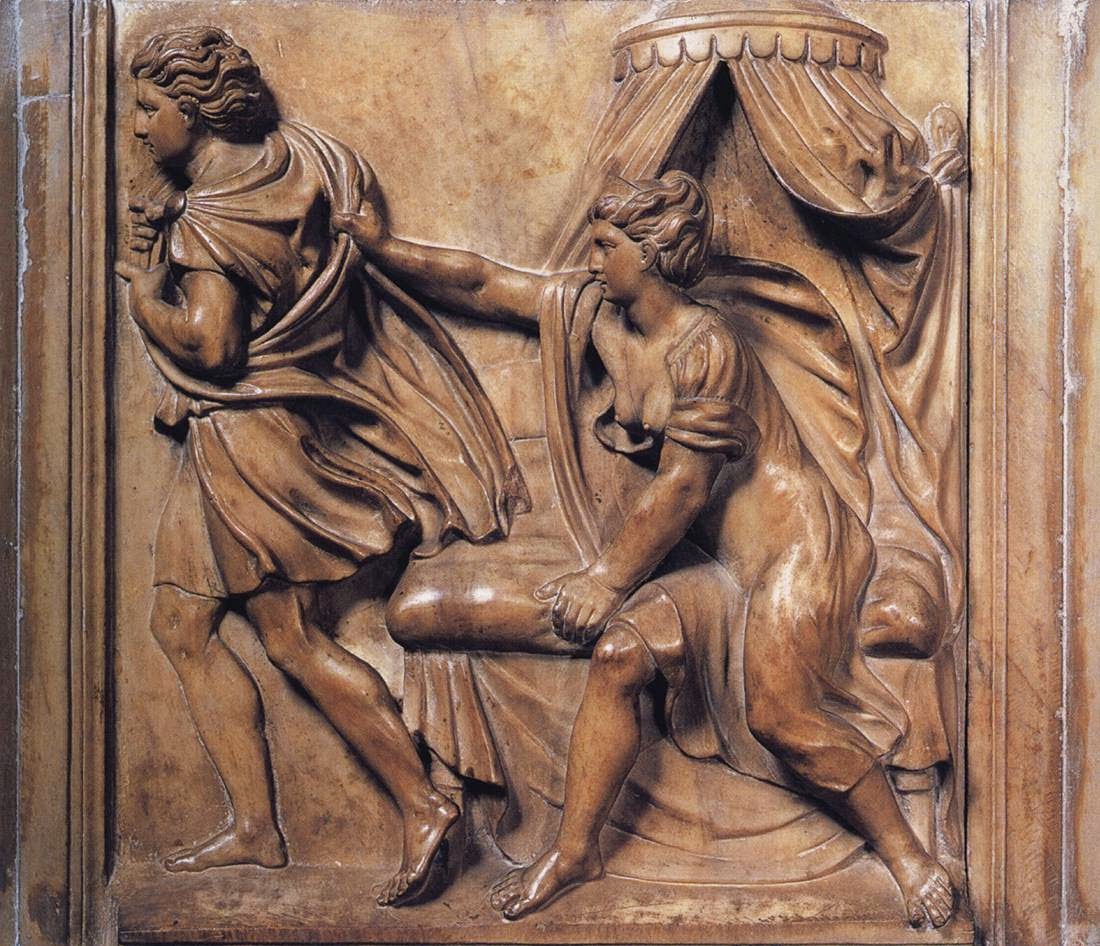
At this point, the church's position of sex being a necessary evil for procreation transformed into a viewpoint where sex was considered a compulsory requirement of marriage. The church declared that neither partner in a marriage could withhold sex if it was requested. Hmmm...I wonder how they enforced that!
Where the church once viewed sex as a necessary evil, in the
12th century the church proclaimed sex as compulsory for
married couples. Sculpture by Properzia de Rossi, female
Renaissance artist.
Castor also described the medieval marriage ceremony in which both the groom and bride were covered with a veil. After the ceremony the priest would kiss the groom who was then allowed to kiss the bride.
Again the Paston letters provided insight into the actual practice of marriage in an upper class family. Margaret Paston, a member of the first generation of the nouveau riche family, had a daughter named Marjorie who fell in love with the son of one of their estate bailiffs (overseers). Of course this marriage was considered totally inappropriate to Margaret who banished Marjorie's love interest from the estate. But Marjorie claimed the couple were married having privately pledged their love to each other. Margaret appealed to the bishop of Norwich. I was surprised to learn that the bishop actually sided with the couple despite Margaret's wealthy influence.
Fresco depicting a bedroom scene circa 1320 CE
So if marriage was so easy to declare, how easy was it to dissolve? Not very, apparently. Dr. Castor gives a number of examples from the historical record, not the least included the attempts of the exasperated King Henry VIII in his quest for a male heir. Although Henry VIII tried to prove his marriage to Queen Catherine of Aragon, his brother Arthur's widow, was invalid because he was too closely related, the list of reasons the church would consider also included a finding that one of the two partners in a marriage was already married (due to an informal declaration), was insane or that the husband was impotent. Husbands who were charged with impotency had to submit to the ministrations of a court appointed panel of prostitutes.
After 17 years of marriage, Henry VIII asked for an
annulment from his first wife, Catherine of Aragon, claiming
the marriage was invalid because he had married his brother's
widow. In medieval law, a marriage extended the familial
relationship to all family members of both marriage partners.
Therefore Catherine would have been viewed as Henry's
sister. Catherine claimed her first marriage was never
consumated so such a relationship had never existed.
Surprisingly, adultery was not grounds for annullment. Dr. Castor explains the case of Edward IV's physician who was a blatant (and public) philanderer. Although the wife called witness after witness, many soldiers and physicians on campaign with the adulterer, the church granted only a decree granting the wife the right to live apart from him and, I assume, obtain financial support from him for her separate household. They were still considered married and could not officially marry anyone else.
The last episode of the series dealt with what constituted a "good death" in the medieval world. Much of this segment discusses the ramifications of the official introduction of the concept of purgatory in the 12th century. Although prayers to assist the dead in their journey to the afterlife have been performed since ancient times, the recognition of a more formalized practice that includes provisions in wills for the cost of ongoing prayer performance was a doctrinal innovation at that time.
A medieval vision of assisting souls in purgatory with indulgences
I was aware of the sale of indulgences, a document granting a petitioner a defined period of forgiveness of sin, as a means for the Church to obtain wealth in the late Middle Ages. But I was unaware that the introduction of the concept of purgatory led to the wealthy leaving huge bequests to establish and/or maintain chantries where clerics would officially perform the prescribed prayers to aid the deceased wealthy in the newly defined transitory location.
I was also surprised to learn that King Henry VII, known as a tight-fisted miser, left huge sums in his will to the college of priests at Westminster Abbey to say masses "forever" for his soul. This massive transfer of wealth eventually triggered King Henry VIII's dissolution of the monasteries to recapture much of his kingdom's treasure.
At least one beneficial development followed, however. Hospitals were built as part of this effort to ensure that one's soul would speed through purgatory. Medieval hospitals not only cared for the sick but fed the poor as well and gave the common people an opportunity to demonstrate their piety. One loaf of bread given to the poor was equivalent to helping one soul in purgatory.
At Henry VII's funeral a nobleman dressed in
the king's armor rode into Westminster Abbey
and right up to the high altar. There he dismounted
As in the episode on marriage, Dr. Castor described medieval funerary rites. The most dramatic funeral service again involved King Henry VII. Dr. Castor said a nobleman dressed in Henry VII's finest armor rode into Westminster Abbey right up to the high altar. There he removed the armor and offered it to god. Henry VII may have ruled through fear and blackmail but he definitely knew how to make a classy exit!
The DVD is lavishly illustrated with beautiful closeups of stained glass, paintings, tapestry and sculpture and is definitely a valued addition to my collection of history DVDs. It is scheduled for general release on August 26, 2014.
I was sent a link to an interesting post about 15 outstanding films that have been produced over the last half century about various aspects of medieval life. I was gratified to see that several of my favorites were featured including "El Cid", "The War Lord" and "A Knight's Tale" (hey, I, too, enjoy a little rock music with my knight movies!)
To this list we could add the film adaptation of Ken Follett's marvelous novel "Pillars of the Earth" recently broadcast on Starz.
You would think that a film about the construction of a cathedral would not be particularly action packed but Follett has set his story amid the violent turmoil of the period of English history known as The Anarchy.
I actually knew very little of the contention between Queen Maude and her cousin Stephen, both grandchildren of the famous (or infamous depending on your point of view) William the Conqueror. "Pillars of the Earth" did an excellent job of bringing me up to date on the treachery, betrayals and murders that earmarked their struggle for the throne of England.
The main plot of our story swirls around a conspiracy that involved the death of King Henry I's son, William, who drowned when the "White Ship" sank on a voyage between France and England. Although Follett's conspiracy is fictional, it does not contradict historical events as little is known about the cause of the sinking except speculation about a drunken crew and a race to catch up to the King's ship that disembarked earlier in the day:
Presumably the prospect of sailing aboard the latest and fastest addition to the Norman navy was a thrilling prospect, so William and his friends broke open a few casks of wine to celebrate. And then a few more. By the time the ship was ready to leave most of the passengers and crew were reasonably drunk. The bishop of Coutance who turned up with his entourage to bless the ship was greeted with derision and abuse and left in a hurry. It was at this point that Henry's nephew Stephen of Blois, made his excuses and left, either because a) he had an attack of diarrhoea or b) because of moral outrage at the shenanigans on board, a decision for which he was no doubt later extremely thankful.
Sometime before nightfall Henry left harbour leaving the White Ship behind. There is no clear evidence as to why the White Ship was delayed and did not leave with the rest of the fleet, but is likely that the inebriated state of the crew had something to with it. But by all accounts, it was a relatively calm night and ideal condition for the short seventy mile journey to Portsmouth when the White Ship finally left on the evening tide.
Now the passage out from Barfleur harbour was relatively straightforward so long as the pilot steered to the south, as to the north there were a series of dangerous rocks that became submerged at high tide. However, the fastest and most direct route home to Portsmouth was north and it seems that in his eagerness to catch up with the king, Fitz Stephen piloted the ship northwards and tried to 'cut the corner' a little too lightly, sailed too close to land and struck a rock, in all likelihood the rock known as the 'Quilleboeuf'.
Now fatally holed the White Ship sank, eventually becoming completely submerged with only her masts visible above the water. Although the Quilleboeuf rock stands only half a mile offshore, there was no medieval equivalent of the lifeboat or coastguard service, most of those aboard were drunk, it is very unlikely that any of them could swim and of course it was dark and there was naturally a general panic.
There was only one survivor, a butcher from Rouen named Berold who managed to climb up one of the masts and clung there all night until he was rescued the next morning by some fishermen. - The Tragedy of the White Ship
Follett takes this incident and weaves a totally plausible scenario around it complete with slighted bishop and single survivor.
King Henry I, a rather virile monarch who fathered at least twenty illegitimate sons, is left with only a legitimate daughter Maude to assume the throne upon his death. But, as one of the characters in the film so concisely rails "A bastard cannot inherit the throne and a woman is almost as bad!"
Henry dies in 1135 according to legend from eating a "surfeit of Lampreys" - eels - as he does in Follett's tale. The film makes it appear that Henry died almost immediately following the birth of his daughter's son, Henry II. In fact, he died two years later. The official cause of death was recorded as food poisoning but not of the intentional variety. I know when I saw the obvious poisoning in the film I wondered about the royal taster and if he was compromised by the plotters as well.
Terence Scully tells us in "The Art of Cookery in the Middle Ages" that a noble estate was hardly ever without a unicorn horn to assay both dining accouterments and prepared food for the presence of poison. Obviously the horn came from an elephant or a narwhal but was deemed invaluable so much so that it was recognized as a particularly thoughtful gift between noblemen.
"Before the prince came to table, the Linen-Keeper and Hall Porter had to do an assay for poison on the tablecloths by passing the unicorn horn over them. Both the tapestry which the Hall-Usher unrolled onto the prince's bench and the cushion on which he was to sit were similarly tested." - The Art of Cookery in the Middle Ages
The unicorn horn test was followed by tastings of all food, sauce and condiments in a highly ritualized procedure involving the Cook, the Saucer, the Hall Usher, the Hall Porter, the Pantler, the Carver, the Serving Valet, the First Master of the Household and finally the First Chamberlain.
"The Pantler then covered over all the dishes again, and a procession consisting of Usher, Master Pantler, the Princes Pages and Serving Valets (all of them bareheaded) formed up to bear the dishes safely into the hall. The Usher cleared the way to the prince's buffet and high table; the Master of the Household, from his post at the end of the table near the buffet, vigilantly watched that none of the dishes was tampered with." - The Art of Cookery in the Middle Ages
So, if Henry died as a result of intentional poisoning the plotters must have outright purchased the king's entire household! In any case, Stephen, with the support of the chauvinistic nobles and the church, seizes the throne and our characters are soon immersed in civil war.
We are not given much background on Maude in the film and she briefly appears first as an adoring child then later as a young mother determined to protect her son and secure his rightful inheritance.
Although referred to as Maude throughout the film, this "Empress of the Holy Roman Empire", granddaughter of William the Conqueror. So much royal blood flowed through her veins that its a wonder she wasn't purple, since through her mother's mother, she was descended from Edmund II "Ironside," Ethelred II "the Unready," Edgar "the Peaceable," Edmund I "the Magnificent," Edward I "the Elder" and Alfred "the Great."
Although Stephen sides often with the villains in this story, Maude is not necessarily a kind and merciful monarch either. (spoiler alert!) At one point when she discovers that Stephen has sent her a mere peasant boy as a hostage instead of his own son , she orders the innocent child slain anyway when Stephen breaks the truce and once more gathers his forces to oppose her. Her somewhat greedy nature also surfaces when she demands gold for granting market rights to Kingsbridge causing problems for Prior Phillip and his dedicated hard-working cathedral construction crew.
The historical Maude's penchant for gold is illustrated by the list of precious objects that she left to the Abbey at Bec-Hellouin :
Among the gifts Matilda gave to the Abbey at Bec-Hellouin were the above mentioned crowns and also another golden cross decorated with precious stones, two gospel books bound in gold and studded with gems, two silver-gilt censers, a silver incense box and spoon, a gold dish and a gold pyx for the Eucharist. There were three silver flasks, a ewer for holy water and a silver basin. Add to this two portable altars of marble mounted in silver and an ebony chest filled with relics. There were more textiles in the forms of holy vestments - chasubles, dalmatics, copes, and an imperial cloak belonging to herself, besprinkled with gold. All of the above list was donated in her lifetime. After she died, the abbey also received the ornaments she had used in her own private chapel. These included service books, a gold chalice and spoon, four chasubles, two tunics, two dalmatics, six copes, two of which were interwoven with silver, two silver censers and two boxes which were described as 'eggs of griffins'. The legs and claws gripping these 'eggs' were fashioned of silver.- Elizabeth Chadwick, Living the History
Chadwick points out that one of the most odd treasures that Maude acquired while married to the Holy Roman Emperor was a religious relic - purportedly the hand of Saint James.
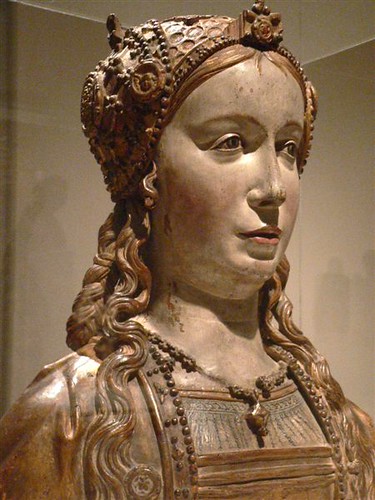
A beautiful 16th century reliquary bust from
Flanders. Photographed at the Los Angeles
County Museum of Art by Mary Harrsch.
Thought to have originated with the Roman ancestor worship, the worship of relics - little bits of saints or other artifacts thought to be connected to Christ or his apostles - is documented as far back as the second century.
After the martyrdom of Polycarp, bishop of Smyrna, the Christians "took up his bones which are more valuable than refined gold and laid them in a suitable place where, the Lord willing, ...we may gather together in gladness and celebrate the anniversary of his martyrdom." During Diocletian's persecutions (303-311) relics of the martyrs were collected by their followers. The cult of the relics was criticized from its inception by purists who regarded it as pagan. Vigilantius in a dispute with St Jerome condemned the veneration of all inanimate objects such as the bodies of saints. Jerome responded by saying that the relics themselves were not worshipped but were an aid to the veneration of martyrs of undoubted holiness whose lives were a model to later generations. This debate between Vigilantius and Jerome is summarized by Thomas Aquinas in his Summa theologica:
Thomas Aquinas, Summa Theolgiae , 3a, 25, 6:
Now it is evident that we are bound to hold in veneration the saints of God as being members of Christ, sons and friends of God and our advocates with him. We are equally bound, therefore, memory of them, to accord due honor to any of their relics; and this is primarily true of their bodies, which were the temples and instruments of the Holy Spirit, dwelling and acting within them, and which are to be made like the body of Christ by glorious resurrection. It is for this reason that God himself grants honors to their relics by performing miracles when they are present....
...This was the argument of Vigilantius, cited by Jerome, "We are observing the introduction, under the guise of religion, of something not very different from a pagan ritual. These people can be seen kissing and adoring little piles of some kind of dust in tiny bottles, wrapped up in precious cloth." In rebuttal Jerome writes, "We do not venerate, by latria, that is, either the sun or moon or the angels; far less the relics of the martyrs. We pay honor to the martyr's relics only so that we may venerate him whose martyrs they are; we pay honor to the servants only so that the servants' honor may glorify their Lord." Accordingly, when we honor the relics of the saints we do not fall into the error of those pagans who offered divine worship to the dead. - Cult of the Relics, State University of New York, College at Oneonta.
The worship of relics was particularly virulent in England where it was used by Christian missionaries to replace veneration of the pagan pantheon:
The cult of the relics played a critical role in the missionary activities. The missionaries who converted northern Europe were dealing with people whose religion was fundamentaly pantheistic. To them it seemed that the entire world was inhabited and controlled by unseen powers; every tree had its own spirit, every pool its devil, every mountain its god. There was no distinction between the laws of nature and the laws of God. In accepting Christianity, pagans believed Christ's powers to be more potent than those their former gods. The converts expected the new God to intervene as often and as powerfully in nature as the old, and if He failed to do so they would frequently revert to their old beliefs. Gregory the Great recommended to Augustine of Canterbury that the cult of the saints and martyrs be presented to the English as the rival to pagan pantheism. - Cult of the Relics, State University of New York, College at Oneonta.
Like many other aspects of medieval life, author Ken Follett weaves relic worship into his plot revealing that the (fictional) Priory of Kingsbridge derives its income from pilgrims who come to worship its relic, the skull of St. Adolphus. (spoiler alert) When a fire destroys the priory and crushes the relic, the original is replaced with a skull plucked from the crypt to prevent loss of revenue, of course with a lot of soul searching by Prior Phillip. The substitute is later crushed when the new cathedral's first stone dome collapses but the novel's hero Jack comes up yet another object for pilgrims to lavish their meager savings upon.
Follett also portrays realistically how noble violence was a real and present danger that overshadowed peasant life during this period. The villains of the story, masterminded by the evil bishop Waleran Bigod, manipulate King Stephen into awarding the lands of Shiring Castle to them then attack Kingsbridge where the former Earl of Shiring's daughter and son have taken refuge.
People watching the program may wonder why King Stephen would permit one of his nobles to terrorize residents of another town. The bottom line is that the nobles maintained private armies that the king could call upon when needed. The king would not, therefore, interfere in a noble's business if it did not directly impact the king because the king, himself, did not control a standing army at that time.
Furthermore, medieval society gradually accepted and even honored violence as the church embraced violence in its prosecution of the Crusades:
After the fall of the Roman Empire, violence quickly became a main part of medieval society, used primarily to threaten and to gain land. However, as time went on this violence began to be understood in a different light, linking it to religion. Initially the only acceptable view of violence was when it was committed by saints upon those who would transgress the church, this view soon changed, with the advent of the Crusades. These series of wars transformed the image of violence into something positive, both in regards those who committed the violent acts and those who the acts were committed upon. The connection between religion and violence changed dramatically with the start of the Crusades. Instead of separating the two, Pope Urban II called for knights who were violent for the sake of violence to channel their ways into violence for a greater cause, primarily fighting to take back Holy Land from the Muslims who had originally taken it from the Byzantines. Immediately people began to see violent knights in a new light, and knights themselves began to change in regards to how they lived and how people understood their duties. - Religion and Violence in the Middle Ages by M. Rinn
A slideshow of armor I have photographed at museums around the world:
Professor Philip Daileader discusses noble violence at length in his excellent lecture series on the Middle Ages available from The Teaching Company. Sadly, things have not changed that much in the last thousand years. The powerful still enrich themselves at the expense of the powerless, although in a much more civilized guise! But back to our story...
Light streams into the nave of Yorkminster Cathedral
illuminating its beautifully vaulted ceiling. Photograph
by Mary Harrsch.
Of course, the cathedral is finally built despite all of these setbacks as well as various love triangles, and the villains are eventually subjected to their just rewards - a little more violently in the film than in the book. The cathedral is as beautiful as Tom Builder dreamed it would be. Although Kingsbridge is an imaginary structure, it was based on the real cathedral at Salisbury. I have not had the privilege of seeing that cathedral but was truly awestruck by Yorkminster in York, also built to admit as much light as possible, and it truly is the light that makes all the difference. I have seen St. Peter's in Rome, St. Paul's and Westminster Abbey in London and, of course, the famous cathedral of Notre Dame. But, although a spectacular example of the use of flying butresses, Notre Dame's interior is actually quite dark. With the light streaming into Yorkminster, it truly seemed to be an anteroom to heaven.
The end seems to come a little too swiftly in the final episode but maybe it only seemed that way because I did not want to relinquish my emotional connection to these marvelous characters. I think my favorite character in the series was actually Prior Phillip played magnificently by Matthew MacFadyen. His character was a fascinating blend of intelligence and piety with an honest recognition that he, too, suffered from a certain degree of ambition.
I was unfamiliar with Matthew MacFadyen's earlier work, as most of it has been in productions for UK audiences, although I see by his filmography on IMDB that he played the Sheriff of Nottingham in the new 2010 version of Robin Hood. Apparently, I'll have to watch it much more carefully when I get it on DVD next month! I wondered if Matthew was related to another of my favorite actors, Angus MacFadyen (Robert the Bruce in Braveheart) but apparently not.
Of course Rufus Sewell as Tom Builder was another favorite. I've been a big fan of Sewell since his outstanding portrayal of Agamemnon in the USA miniseries "Helen of Troy". Although that was seven years ago, Sewell's maturity has only increased his screen presence and sexual magnetism.
Ian McShane as the Bishop Waleran Bigod and Sarah Parish as Regan Hamleigh made truly despicable villains and the younger actors can look back on this project with just pride as their careers are sure to flourish in the future.
As for the list of outstanding films about the Middle Ages, though, I would add not only "Pillars of the Earth" but several more as well.
I was very surprised that the original list did not include at least one production of Sir Walter Scott's "Ivanhoe" that has been source material for a number of film productions including my favorite, a 1982 television mini-series starring Anthony Andrews, Sam Neill, James Mason and Olivia Hussey. I had been watching for it to come out on DVD for some years. Then last Christmas I finally saw it at a local discount store.
Although it does not deal directly with historical events, it does present the concepts of courtly love that developed during this period. I must admit, though, that I was totally mesmerized by Sam Neill as, I guess you would say, the villain Brian de Bois-Guilbert. If I had been Rebecca (Olivia Hussey), I would have accepted his proposal to run away with him!
I would also definitely add Ridley Scott's "Kingdom of Heaven" based on the siege of Jerusalem that took place during the Crusades of the 12th century. After all what nobler commandment has been issued from the silver screen but "Safeguard the helpless - even if it leads to your death!"
This year we were also treated to Ridley Scott's remake of "Robin Hood". I appreciated the inclusion of references to the Crusades and a reminder about the true nature and fate of Richard the Lionhearted as opposed to the glamorized legend portrayed in other versions of this classic tale. It's just too bad that there wasn't more screen chemistry between Russell Crowe and Cate Blanchette who played Marian the widow (not the Maid!)
If you don't subscribe to Starz but have a Netflix membership, you can watch "Pillars of the Earth" as an instant download using your computer, one of a half dozen different game consoles including the Wii and XBox, or a Roku internet streaming device.
An enhanced e-book edition of Ken Follett's novel is also available for the iPad on iTunes. The enhanced edition includes an interactive Character Tree, contextual video and still images blending into the ebook from the corresponding section of the Starz television series, Follett’s Multimedia Diary which contains his on-set impressions of bringing the book to the screen, interviews with the actors, director and producers, and music from the series.
If you enjoy listening to audio books on your commute or while exercising like I do, you can get an audio version of "Pillars of the Earth" from http://www.audible.com.


 The producers of the excellent history DVD "She-Wolves: England's Early Queens", Athena Learning in association with RLJ Entertainment, have released another fascinating look at life in the Middle Ages entitled "Medieval Lives: Birth, Marriage, Death". Once again, Cambridge professor