Showing posts with label Mycenaean. Show all posts

Friday, June 18, 2021

Mycenaean gold "seal" rings with Minoan-style iconography

 When the so-called "Griffin Warrior" was discovered near the Palace of Nestor in Pylos, the young man who died around 1500 BCE was buried with some 2,000 objects, including silver cups, beads made of precious stones, ivory combs, a sword and four intricately decorated solid gold rings. Archaeologists Shari Stocker and Jack Davis from the University of Cincinnati that excavated the warrior's burial think these grave goods provided evidence that Mycenaean culture recognized and appreciated Minoan culture more than previously believed, especially the gold rings. Made of multiple sheets of gold, the rings depict detailed scenes including bull leaping and iconography such as sun symbols and mythological genii creatures from Minoan mythology.  

Originally the rings were thought to have probably been crafted on Crete where they were used to seal documents or indicate ownership of goods or other objects and pillaged in warfare. But, after extensive study, Stocker and Davis have expressed their opinion that these items were probably not plunder but examples of exchanged ideas and the adoption of certain aspects of Minoan culture including religious concepts and symbols of political power.

Cynthia W. Shelmerdine of the University of Texas, an expert on the Bronze Age in the Aegean, observes, "These things clearly have a power connection…[and] fits with other evidence that the elites on the mainland are increasingly closely connected to the elites on Crete whether or not the rings were used in the Minoan way for sealing objects.”

"The elite of Pylos at this time knew what these symbols and objects meant.  The Griffin Warrior was not simply imitating the Minoan world but he was a part of it, just as he was a part of the Mycenaean world.  His burial serves as a testimony that the transition between the two eras was neither abrupt nor concrete, but that the process was much more complex. There was a time, at least in Pylos, where the two cultures seemingly blended and coexisted." - Uncovering Pylos, The Archaeological Institute of America.

Gold Mycenaen Seal Ring with two female figures with raised arms praying by a shrine or altar. The branches on either side of the central structure may indicate that the ritual is related to seasonal cycles and fertility, end of 15th century BCE, now in the NAM Athens. I photographed this ring at "The Greeks: From Agamemnon to Alexander the Great" exhibit at the Chicago Field Museum.

Mycenaean gold signet ring depicting a man with a branch approaching a building with a goat behind him intended for sacrifice 1500 BCE NAM Athens. I photographed this ring at "The Greeks: From Agamemnon to Alexander the Great" exhibit at the Chicago Field Museum.

Gold ring from grave IV of grave circle A at Mycenae 1500-1200 BCE courtesy of Wikimedia Commons contributor Schuppi

National Archaeological Museum of Athens, NAMA 240: Gold ring from grave IV of grave circle A at Tiryns, 1500-1200 BCE courtesy of Wikimedia Commons contributor Schuppi.


Archea Nemea, Corinthia, Greece: Mycenaean Gold Signet Ring MN 1005 showing a chariot. Part of the Repartriated Mycenaean Treasure of the Mycenaean cemetery of Aidonia in the Archaeological Museum of Nemea courtesy of Wikimedia Commons contributor Schuppi.

Archea Nemea, Corinthia, Greece: Mycenaean Gold Signet Ring MN 1006 showing two woman holding flowers. Part of the Repartriated Mycenaean Treasure of the Mycenaean cemetery of Aidonia in the Archaeological Museum of Nemea courtesy of Wikimedia Commons contributor Schuppi

Mycenaean gold seal ring, two lions tied to a pillar, said to be from Mycenae, 1700-1400 BCE, Ashmolean Museum, Oxford, courtesy of Wikimedia Commons contributor Zde

A ring with a hunting scene from the Minoan and Mycenaean culture, around 1400 BCE. Gold, Historical Museum of Serbia. Inv. No. 50/A, courtesy of Wikimedia Commons contributor M Todorovic

Gold ring with relief: Sitting Goddess and procession of seahorses. Mycenaean Late Bronze Age. Tiryns, 15th cent. BCE. National Archaeological Museum of Athens N 6208, courtesy of Wikimedia Commons contributor Zde.


If you enjoyed this post, never miss out on future posts by following me by email!

Monday, January 25, 2021

The Mycenaean Dendra Panoply

In May 1960 Swedish archaeologists discovered the earliest example of a beaten bronze cuirass at Dendra, dated to the end of the fifteenth century BCE (Late Helladic IIIA - about 1400 BCE). It forms part of the Late Helladic Dendra Panoply, which consists of fifteen separate pieces of bronze sheet, held together with leather thongs, that encased the wearer from neck to knees. 

The panoply was found in tomb 12 of the Dendra necropolis and had been partially plundered at some point.  But in addition to the squashed armor, archaeologists were able to recover pottery fragments, a silver toggle pin (probably used to fasten an item of clothing), a bronze oinochoe (jug), as well as various other objects of bronze, including at least one knife and a dagger, a bronze mirror, a gold-plated ring, fragments of a silver cup, fragments of boar's tusk and a pair of swords inlaid with gold and ivory.

The panoply, when restored, was found to include a back and breast plate and six bronze plates, three in front and three behind along the bottom edge of the cuirass. A throat guard protected the wearer's neck and two triangular pieces were attached to the front of the breast plate to further protect the chest. The panoply also included two shoulder guards, two pieces of bronze to protect the the upper arms, a single greave and forearm guard.  Other bronze fragments were also found that may have been the remains of a second greave and forearm guard although classicist Diane Fortenberry argued that single greaves were used to indicate rank in Mycenaean Greece.

My first impression on seeing the panoply was that it resembled remnants of a robot from "Lost in Space." I couldn't visualize a Mycenaean warrior staggering around the battlefield in that armor! Although it is dated to about 100 years before the Trojan War, can you imagine Achilles fighting in it?

Apparently, my reaction has been shared by other scholars as well.  Some scholars tried to rationalize its use as armor worn by a chariot-mounted warrior.  Joost Crouwel observes,

"While it is certainly difficult to visualize a warrior thus equipped marching to and from a battlefield in the Greek summer, it is equally difficult to see him as fighting in a chariot. If we look at contemporary oriental armour, we see that the corselets worn by Asiatic and Egyptian chariot crews are long, flexible, short-sleeved tunics, covered with many scales of bronze or leather. This type of armour […] is much less cumbersome than the Dendra panoply."

Crouwell points out that the warrior wearing the Dendra panoply would not have fought with a bow as stretching a bow would have been extremely difficult, but used  a sword, dagger or thrusting spear, close range weapons which are rendered practically useless from a moving chariot.  Instead, Crouwel suggests the Dendra warrior may have been driven to the battlefield by a charioteer where he dismounted and fought as a swordsman, as evidenced by the two swords included in the grave goods. Piotr Taracha agrees and even points out that the warrior may have fought with two swords, even though there were skeletal remains of another male buried in the tomb as well.

Although we have only this one complete panoply to date, armor of similar type appears as an ideogram on Linear B tablets from Knossos, Pylos, and Tiryns and fragmentary armor of a similar type  was recovered in Thebes in 1964. No examples of such metal armor predate the Late Helladic II period and it disappears from the archaeological record at the end of Late Helladic IIA or beginning of Late Helladic IIB (about 1300 BCE) before reappearing briefly during the Dark Ages following the fall of Mycenaean palaces about 1200 BCE.

Read more about it:

https://www.ancientworldmagazine.com/articles/encased-bronze-panoply-mycenaean-tomb-dendra/

The Mycenaean Dendra Panoply found in tomb 12 of the Dendra necropolis dating to the end of 15th century BCE now in the Archaeological Museum of Nafplion (sometimes called Nafplio or Nauplion) courtesy of Wikimedia Commons contributor Schuppi.

Mycenaean warrior wearing Dendra-type armor, 1400-1200 BCE, by artist Christian Jégou.

Mycenaean warrior wearing Dendra-type armor, 1400-1200 BCE, by artist Christos Giannopoulos.

Ajax, wearing Dendra-type armor, heaves a large boulder at Hector's shield. by artist Peter Connolly

Mycenaean warrior wearing Dendra-type armor, 1400-1200 BCE, by artist Giuseppe Rava

Mycenaean warrior wearing Dendra-type armor, 1400-1200 BCE, by artist Giuseppe Rava

Mycenaean warrior wearing Dendra-type armor, 1400-1200 BCE, courtesy of Lāwāgetās, @ArcGreek on Twitter.

Mycenaean warrior wearing Dendra-type armor as envisioned by artist Bizfuzz on DeviantArt.

Historical reenactor wearing Dendra-type armor courtesy of Pinterest.

If you enjoyed this post, never miss out on future posts by following me by email!

Sunday, May 24, 2009

Will Underwater Excavation of Pavlopetri Provide Clues to Greek Dark Ages?

When I read about the underwater excavation and survey of Pavlopetri, a Mycenaen village submerged off the southern tip of Greece, I wondered if the team might find some clues to the Greek Dark Ages in the remnants of this Mycenaen settlement.

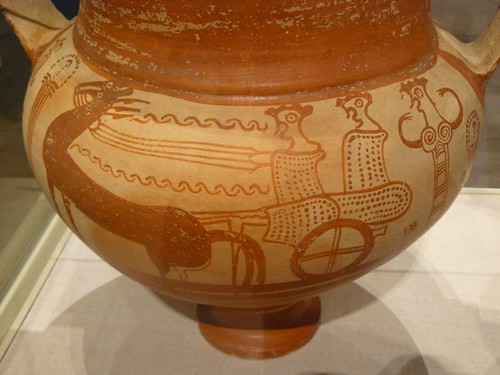
[Image: Terracotta chariot krater Helladic Mycenaean Late Helladic IIIB 1300-1230 BCE in the collection of the Metropolitan Museum of Art. Photo by Mary Harrsch]

The article says pottery dates abruptly stop at 1180 BCE which is significant as this marks the boundary period between the late Bronze Age and the period referred to as the Greek Dark Ages. Evidence that the city was not rebuilt would point to some kind of natural cataclysm of tremendous proportions. I immediately thought about the eruption of Thera but two studies reported in 2006 seem to support a much older date for that particular catastrophe:

"One study, led by archaeologist Sturt Manning at Cornell University, dated wood and seed samples collected from Akrotiri.

Another study, led by geologist Walter Friedrich of the University of Aarhus in Denmark, uses a single branch to pinpoint the time of death for an olive tree believed to have been buried alive during the eruption.

Together, the two studies strongly suggest an eruption date of somewhere between 1660 and 1600 B.C. - More: Fox News

This later cataclysm, however, could have been part of an earthquake "storm" that rippled along the Mediterranean's eastern plate boundary in subsequent centuries.

The BBC seems to dismiss the possibility that earthquake storms could have been that devastating:

Most controversial is the theory that an earthquake storm may have been responsible for the abrupt physical and political collapse of Aegean Bronze Age world around 1200 BC. Some geologists and archaeologists point out that most of the ancient cities that fell at that time lie along the plate-boundary of the eastern Mediterranean and show signs of destruction typical of earthquakes. It supports a view that a storm of earthquakes successively ‘unzipped’ the plate boundary, so weakening the cities along the way that they were left vulnerable militarily, inviting attacks from opportunistic neighbours.

Earthquakes have frequently been used by historians and archaeologists as convenient explanations for cataclysmic destructions and abandonments. But earthquakes rarely wipe out entire cities, let alone entire regions. More often, seismic shocks leave cities as jumbles of ruined, damaged and intact buildings, encouraging their inhabitants not to flee but to stay and rebuild their houses and livelihoods. It is a pattern that we see in modern earthquake disasters, and there is little sign that human nature was any different in the past. - More: Journeys From The Centre of the Earth, BBC, Open2.net

However, this generalization does not seem to take into account the evidence from Pavlopetri that its people did not rebuild in the 12th century BCE or evidence from excavations at Sagalassos that their citizens abandoned their city after Arab raids and a catastophic quake in the 7th century CE (As coincidence would have it, I just viewed a film about the excavations at Sagalassos at the Archaeology Channel International Film Festival two days ago). On the contrary, these examples from the archaeological record seem to lend substance to the "earthquake and subsequent military vulnerability" theory as a reasonable causal hypothesis for such epochs of cultural decline.

The researchers are using a new sonar scanning technique that sounds like it will yield as detailed of images as a laser scanner.

"'We're using scanning sonar', which has been developed by an offshore engineering company [Kongsberg Mesotech in Vancouver, Canada, a subsidiary of Kongsberg Maritime, headquartered in Norway]. Their equipment does the same thing a terrestrial laser scanner would do, only using acoustic signals. It can take thousands of points over a couple of minutes and also take photorealistic impressions, so we could produce three-dimensional models using this equipment. Until now, sonar hasn't been able to produce as accurate a survey as terrestrial techniques. But if it does deliver everything it is supposed to, it could completely revolutionize underwater archaeology. Getting decent plans quickly is often a problem, and we often use measuring tapes and lines — which is effective, but time-consuming." - More: NatureNews

If you enjoyed this post, never miss out on future posts by following me by email!

Sunday, March 16, 2008

Mycenaen-era beehive tomb found on Lefkada


Road works on the western Greek island of Lefkada have uncovered - and partially destroyed - an important tomb with artifacts dating back more than 3,000 years, officials said on Wednesday.

The find is a miniature version of the large, opulent tombs built by the rulers of Greece during the Mycenaean era, which ended around 1100 B.C. Although dozens have been found in the mainland and on Crete, the underground, beehive-shaped monuments are very rare in the western Ionian Sea islands, and previously unknown on Lefkada.

The discovery could fuel debate on a major prehistoric puzzle - where the homeland of Homer's legendary hero Odysseus was located.

"This is a very important find for the area, because until now we had next to no evidence on Mycenaean presence on Lefkada," excavator Maria Stavropoulou-Gatsi told The Associated Press.
She said the tomb contained several human skeletons, as well as smashed pottery, two seal stones, beads made of semiprecious stones, copper implements and clay loom weights. It appeared to have been plundered during antiquity.

With a diameter of 9 feet, the tomb is very small compared to others, such as the Tomb of Atreus in Mycenae, which was more than 46 feet across and built of stones weighing up to 120 tons. But it could revive scholarly debate on the location of Odysseus' Ithaca mentioned in Homer's poems - which are believed to be loosely based on Mycenaean-era events. While the nearby island of Ithaki is generally identified as the hero's kingdom, other theories have proposed Lefkada or neighboring Kefallonia.
If you enjoyed this post, never miss out on future posts by following me by email!

Sunday, June 24, 2007

Four Mycenaean Tombs Found Intact Near Olympia


"Greek archaeologists have uncovered four intact tombs some 30 centuries old.

The four tombs date from the Mycenaean period (1450 BC to 1050 BC) and are reported to contain many objects such as toys, ceramics, and figurines.

The find was made near Olympia in the Peloponnese region in an area that had been excavated in the 1960s and the end of the 1990s.

One of the tombs found by a team headed by archaeologist Olympia Bikatou was apparently that of a child and held toys, images of protecting deities, and an effigy of the mother, a woman clasping a child.

Bikatou told a seminar at Olympia that her team had found ceramics in the form of boxes, alabaster pots, and amphorae, some of which had four handles, "which give a complete picture of a Mycenaean ceramics workshop."

One of the objects was a flask showing Cypriot influence, suggesting that there were links with the island.

One piece of an amphora has a design showing a body displayed on a stretcher carried by four men, which according to Bikatou, "is the only scene of this type in Mycenaean iconography."
If you enjoyed this post, never miss out on future posts by following me by email!