Showing posts with label archaeologist. Show all posts

Wednesday, August 06, 2008

Bulgaria Archeologists Unearth 1900-Year-Old Thracian Chariot

"A team of Bulgarian archeologists has discovered a unique, fully preserved four-wheeled Thracian chariot, which is more than 1900 years old.

The discovery was made close to the village of Borisovo, Yambol District in southeast Bulgaria by a team of the Archeological Institute of the Bulgarian Academy of Sciences.

The expedition is led by the leading Bulgarian archeologist Daniela Agre. The chariot is unique because it is the only one found in Bulgaria in the very way the ancient Thracians laid it in the tomb of a wealthy aristocrat.

It also has a very complicated construction, and all artifacts found in its trunk are fully preserved including pottery and glass vessels.

The skeletons of two horses drawing the chariot and a dog, who were murdered ritually during the funeral 1900 years ago are also fully preserved. The horse bow of the chariot has a small metal panther on its top, which resembles the symbol of the Jaguar automobile.

According to Daniela Agre, the chariot dates back to the time of the Roman Emperor Trajan, when Thrace was already a Roman province but many Thracian aristocrats had preserved their privileges and were serving in parts of the Roman army.

She explained there was a major north-south Thracian road in what is today southeast Bulgaria, and that the whole region was extremely rich in invaluable archeology objects."
If you enjoyed this post, never miss out on future posts by following me by email!

Saturday, February 09, 2008

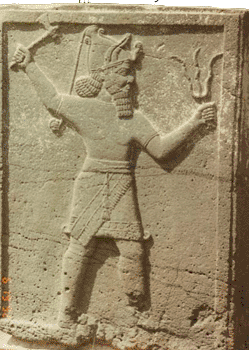
Karatepe seldom visited World Heritage site in Turkey


"Sometimes known as Aslantaş, the Lion Stone, Karatepe has an advantage for the visitor over many of the larger, more frequented sites. Troy, for example, is famously complex. The earliest remains date back to 3600 B.C., but it was a thriving city and part of the Roman Empire as late as A.D. 300. This breadth of history is fascinating but bewildering -- is this section of city wall I'm looking at Bronze Age, Hellenistic, Classical Greek -- or Roman? Karatepe's delight is that its history is so succinct. Confined to the ninth and eighth centuries B.C., archaeologists have found nothing either pre or post dating this brief period. Before you visit Karatepe, you may well know next to nothing about the so-called Neo-Hittite people who built and occupied this beautiful, wooded hilltop 1,800 years ago. But the site's very simplicity gently draws you and insistently tugs you to find out more.

So, who were the Neo-Hittites? The "golden age" of the Hittite Empire, centered around the imperial "capital" at Hattuşa, on the Anatolian plateau east of Ankara, lasted from around 1800 to 1200 B.C. On its collapse, the lands of the former empire dissolved into a number of independent city-states. These smaller entities are now termed Neo-Hittite. One of these was centered on the fertile Çukurova Plain around Adana. In the eighth century, its ruler was a king called Azatiwatas. He clearly thought he was special, as an inscription carved into the back of a statue found on the site reveals:

I am indeed Azitawatas,

The blessed of the sun, the servant of the Storm-God….

The Storm-God made me father and mother to the city of Adanawa,

And I developed the city of Adanawa,

And I enlarged the land of Adanawa, both to the west and to the east,

And in my days the city of Adanawa had prosperity,

Satiety and comfort, and I filled the arsenals of Pahara,

I added horse upon horse, shield upon shield,

Army upon army, all for the Storm-God and the Gods….

I brought prosperity to my race….

I built mighty fortresses on all my borders…

The last line quoted above is pertinent to the site. It seems Karatepe was one of the outlying fortresses built by the rulers of Adanawa (Adana) to protect their borders. Although formidable, the wall of the Toros Mountains to the north was not impregnable. From that direction wild people, such as the Scythians, posed a threat. Ironically, though, it was the Assyrians from the southeast who brought about the end the Neo-Hittite kingdoms around 700 B.C.

Karatepe then, was a citadel. Around a kilometer in circumference, its walls ran in an irregular oval around the top of a hill, which dominated the valley of the Ceyhan River. The lower courses of wall were stone, the upper mud brick. The citadel was entered by one of two T-shaped gates piercing, respectively, the southwestern and northeastern walls. Both were reached by sloping ramps and protected by flanking towers. The walk up to the southwest gate from the parking lot half a kilometer below is delightful, with the rough track dappled by sunlight, birds chattering away in the mixed woodland and the fierce heat of this part of Turkey tempered by altitude, shade and breeze. Occasional views across the soft, undulating foothills and the blue waters of the Aslantaş reservoir are beautiful..."

"...in 1947 excavations commenced. Over the next few years the wonders of Karatepe were slowly revealed -- the walls, the gateways, statues of a sphinx, lions and the magnificent statue of the Hittite storm-god Tarhunzas, astride a pair of bulls. Perhaps most evocative are the relief carvings which show scenes from mythology, war and everyday life. Thanks to the dedication of [archaeologist Halet] Çambel, all these statues and carvings have remained in situ, as they were in the days of Azatiwatas, and not carted off to the museum in Ankara..."

"...Derided by some as crude and primitive, the relief carvings have a charm and vibrancy, which helps us to imagine the people who lived here as ordinary human beings. The relief of a man on a chair is the king, but he is touchingly ordinary, sitting there with a meat patty in one hand, reaching out greedily for more. One relief shows a woman suckling a child beneath a date palm, others show musicians, sailors and warriors, hunters and servants.

It will probably only take you a couple of hours to wander around Karatepe, but everything you see is remarkable. The Semitic and hieroglyphic "writing," liberally scrawled over the carvings, enabled linguists to crack the Hittite code -- making them Turkey's own Rosetta Stone."

If you enjoyed this post, never miss out on future posts by following me by email!

Friday, February 08, 2008

Pre-Zeus Altar discovered on Mount Lykaion

"Before Zeus hurled his first thunderbolt from Olympus, the pre-Greek people occupying the land presumably paid homage and offered sacrifices to their own gods and goddesses, whose nature and identities are unknown to scholars today.

The University of Pennsylvania Museum of Archaeology and Anthropology

MYSTERY RELIGION From left, Dan Diffendale, Dr. Arthur Rhon and Arvey Basa at Mount Lykaion’s altar of Zeus.

But archaeologists say they have now found the ashes, bones and other evidence of animal sacrifices to some pre-Zeus deity on the summit of Mount Lykaion, in the region of Greece known as Arcadia. The remains were uncovered last summer at an altar later devoted to Zeus.

Fragments of a coarse, undecorated pottery in the debris indicated that the sacrifices might have been made as early as 3000 B.C., the archaeologists concluded. That was about 900 years before Greek-speaking people arrived, probably from the north in the Balkans, and brought their religion with them..."

If you enjoyed this post, never miss out on future posts by following me by email!

Friday, August 17, 2007

Greek archaeologists to excavate Alexander's outpost in Kuwait


"Greek government experts are going to Failaka - a Gulf outpost of Alexander's army, now governed by Kuwait.

The island's bullet-holed buildings tell of a conflict still fresh in people's memories - Saddam Hussein's brief occupation of Kuwait in the early 1990s.

Beneath the sun-baked sands of Failaka, archaeologists hope to unearth the secrets of an earlier conquest - a settlement established by Alexander's general, Nearchus, in the 4th Century BC.

The excavations will focus on the ruins of an ancient citadel and cemetery, the general secretary of the Greek culture ministry, Christos Zahopoulos, told the BBC News website.

Earlier work by French archaeologists has uncovered the remnants of a temple to Artemis, the Greek goddess of hunting, as well as several Greek coins and idols." - BBC News

If you enjoyed this post, never miss out on future posts by following me by email!

Tuesday, August 14, 2007

Tomb of Ancient Athlete Found In Bulgaria

"A team of Bulgarian archaeologists unearthed Tuesday an ancient stone tomb, dated back to the 4th century BC, Darik News reported.

The team, lead by Krastina Panayotova, stumbled upon the tomb during the annual archaeological excavations on the Harmani beach of the Black Sea town of Sozopol.

A man, probably an athlete, had been buried in the tomb because the team found an object used by athletes in antiquity.

Just a day earlier the archaeologists came upon the grave of another man, probably a gambler. The grave was full of dice, backgammon pieces and coins.

Last week the same team unearthed a tomb of a citizen, who lived in the ancient city of Apollonia, which is today's Sozopol.

The team of Krastina Panayotova is working on the Harmani beach of Sozopol, a site which archaeologist have been exploring for many years now.

Sozopol is one of the oldest towns on Bulgarian Thrace's Black Sea coast. The first settlement on the site dates back to the Bronze Age. Undersea explorations in the region of the port reveal relics of dwellings, ceramic pottery, stone and bone tools from that era. Many anchors from the second and first millennium BC have been discovered in the town's bay, a proof of active shipping since ancient times.

The town, at first called Antheia, was colonized by Anaximander. The name was soon changed to Apollonia, on account of a temple dedicated to Apollo in the town, containing a famous colossal statue of the god by Calamis, 30 cubits high, transported later to Rome by Lucullus and placed in the Capitol. At various times, Apollonia was known as Apollonia Pontica (that is, Apollonia on the Black Sea, the ancient Pontus Euxinus) and Apollonia Magna."
If you enjoyed this post, never miss out on future posts by following me by email!

Wednesday, July 25, 2007

Hidden City Found Beneath Alexandria | LiveScience


Hidden City Found Beneath Alexandria: "The legendary city of Alexandria was founded by Alexander the Great as he swept through Egypt in his quest to conquer the known world.

Now scientists have discovered hidden underwater traces of a city that existed at Alexandria at least seven centuries before Alexander the Great arrived, findings hinted at in Homer's Odyssey and that could shed light on the ancient world.

Alexandria was known to have developed from a settlement known as Rhakotis, or Râ-Kedet, vaguely alluded to as a modest fishing village of little significance by some historians. Seven rod-shaped samples of dirt gathered from the seafloor of Alexandria's harbor now suggest there may have been a flourishing urban center there as far back at 1000 B.C."
If you enjoyed this post, never miss out on future posts by following me by email!

Sunday, July 22, 2007

Jinsha excavation continues to yield relics


"The construction site in the western suburbs of Chengdu, in Sichuan Province, looked much like any other. It all started when a bulldozer driver heard a scraping sound as his machine bit deep into the ground: he struck a collection of golden, jade and bronze objects. Workers and passersby snapped up the treasures and scurrying off. Those too late to get anything, disgruntled, report the find to the police. And that''s how, in February 2001, the world learned about the relics of a mysterious 3,000-year-old Jinsha kingdom in the mountains of southwest China.

"Jinsha culture is unique, quite different from cultures in other parts of China, but is scarcely mentioned by Chinese historians," said Zhu Zhangyi, a veteran archaeologist in Sichuan and deputy-curator of the Jinsha Museum. "The harsh geography made it difficult for outsiders to enter the kingdom and so it was able to preserve its endemic culture."

Police have been able to recover most of the relics purloined from the construction site -- about 100 items in all, but no one can confidently claim that they have recovered everything.

In the past six years, the site has yielded up about 6,000 gold, jade, bronze and stone artifacts, tens of thousands of pottery items and also hundreds of elephant tusks. Gold fever

Jinsha means ''gold sand''. True to its name, the site has proved extraordinarily rich in gold relics.

"Chinese people typically use gold as jewellery -- earrings, bracelets or necklaces -- but Jinsha people used gold for sacrificial purposes. They made gold masks, gold headware and strange, horn-shaped objects in finely worked gold," said Sun Hua, an archaeologist from Beijing University.

Two relics in particular showcase their technical prowess.

One is a round foil bearing images of the Sun and of four flying birds. The gold foil is only about 0.02 cm thick, the width of a piece of paper, 12.5 cm in diameter and 94 percent pure. Some people have speculated that the twelve lights around the Sun represent the twelve months and the four flying birds the four seasons. "It''s just speculation. No one can say for sure what the pictures really mean," Zhu said, "but we do know that the ancient kingdom worshipped the Sun and birds."

Others have said that ancient Chinese may have believed that the Sun is carried from east to west on the backs of birds. The sun and birds appear on many Jinsha relics. The piece, dubbed the Sun and the Immortal Birds, has since become a logo for Chinese cultural heritage protection.

Another important piece of gold ware is a gold mask, discovered in February 2007. The mask was probably worn by sorcerers who communicated with divine forces.

It is 19.5 cm wide, 11 cm long, 0.04 cm thick and weighs 46 grams.
Gold masks were not common in China at that time, but widely used in Egypt and the Middle East.
If you enjoyed this post, never miss out on future posts by following me by email!

Golden mask found in Bulgarian tomb

I really MUST visit Bulgaria!

"Archaeologists have unearthed a 2 400-year-old golden mask in an ancient Thracian tomb in south-eastern Bulgaria, scholars announced on Monday.

The mask was discovered over the weekend by a team of archaeologists excavating near the village of Topolchane, 290km east of the capital, Sofia. Its discovery, archaeologists said, indicates a Thracian king was buried in the tomb.

It was found together with a solid gold ring engraved with a Greek inscription and with the design of a bearded man in a timber-lined Thracian grave.

Team leader professor Georgi Kitov said that they also found a silver rhyton, silver and bronze vessels, pottery and funerary gifts.

"These finds confirm the assumption that they are part of the lavish burial of a Thracian king," said professor Margarita Tacheva, who was also on the dig.

"The artifacts belonged to a Thracian ruler from the end of the 4th century BC who was buried here," Kitov added."
If you enjoyed this post, never miss out on future posts by following me by email!

Sunday, June 24, 2007

Four Mycenaean Tombs Found Intact Near Olympia


"Greek archaeologists have uncovered four intact tombs some 30 centuries old.

The four tombs date from the Mycenaean period (1450 BC to 1050 BC) and are reported to contain many objects such as toys, ceramics, and figurines.

The find was made near Olympia in the Peloponnese region in an area that had been excavated in the 1960s and the end of the 1990s.

One of the tombs found by a team headed by archaeologist Olympia Bikatou was apparently that of a child and held toys, images of protecting deities, and an effigy of the mother, a woman clasping a child.

Bikatou told a seminar at Olympia that her team had found ceramics in the form of boxes, alabaster pots, and amphorae, some of which had four handles, "which give a complete picture of a Mycenaean ceramics workshop."

One of the objects was a flask showing Cypriot influence, suggesting that there were links with the island.

One piece of an amphora has a design showing a body displayed on a stretcher carried by four men, which according to Bikatou, "is the only scene of this type in Mycenaean iconography."
If you enjoyed this post, never miss out on future posts by following me by email!

Thursday, June 14, 2007

Former Greek Royal Residence Yields Ancient Treasures

More than 200 ancient items and 300 paintings were found inside sealed containers in a royal stable and in the basement of the main residence at Tatoi, some 25 kilometres (15 miles) northwest of the Greek capital, culture ministry officials said during a media tour of the site on Tuesday.

"It's a real treasure hunt, we are in the process of removing these marvellous items from boxes stacked in disorderly heaps," restoration supervisor Nikos Minos told AFP.

A team of 21 archaeologists and restorers started work at the crumbling, 19th-century estate three months ago as part of a bid to catalogue its contents before restoration work starts to find a new role for the site.

The collection includes the bronze helmet of an ancient Greek soldier, ancient glasswork including a perfume vial from Roman times, idols and clay vessels -- among them a 2,700-year-old painted jug bearing the form of a horseman, found intact to the amazement of archaeologists.

If you enjoyed this post, never miss out on future posts by following me by email!