Showing posts with label Turkey. Show all posts

Sunday, September 05, 2010

Citing a need for new theoretical perspectives, Hodder lowers the boom on researchers at Çatalhöyük

My avatar examines murals in the dwellings of virtual Çatalhöyük in
Second Life.
After writing a comprehensive article about virtual Çatalhöyük in Second Life for Heritage Key, I was naturally drawn to the following article and surprised by Dr. Hodder's announcement:

Researchers finishing the dig season at Turkey’s Çatalhöyük—a 9500-year-old site famed for its art and symbolism at the dawn of agriculture—got a big shock last week. Stanford University archaeologist Ian Hodder, who has directed excavations since 1993, told the heads of the dig’s specialty labs that they would be asked to step down beginning in 2012, when publication of current work will be completed.

“It has been a really remarkable team,” Hodder says. But, “I have felt over recent years that the project was getting comfortable with itself and so not challenging each other or me or the assumptions that we were all taking for granted.”  - Science Insider
The Leopard's Tale: Revealing the Mysteries of Catalhoyuk   The Goddess and the Bull: Catalhoyuk--An Archaeological Journey to the Dawn of Civilization   Çatalhöyük 'TRT Arsiv Serisi' (DVD)   The Neolithic Revolution in the Near East: Transforming the Human Landscape
If you enjoyed this post, never miss out on future posts by following me by email!

Monday, August 25, 2008

Ancient city in western Turkey waits to be unearthed

An ancient city in western Turkey, discovered by smugglers of
ancient artifacts at an illegal excavation six years ago and recovered
with soil by officials, now waits to be unearthed.


Local officials asked archaeologists to dig the region in Saruhanli
town of the western province of Manisa to bring to light the ancient
city which is thought to be dated from around 3rd or 4th century B.C.


"Six years ago, smugglers found a few pieces of historical artifacts
at an illegal dig here. There were mosaics of a stag's head among them.
But no researches have been carried out since then," Suleyman Cinar,
mayor of the village of Buyukhanli in the region, said.


"We believe that there is an ancient Roman city hidden beneath the soil," he said.


Cinar also said the city could be the outskirts of the nearby
ancient city of Sardis, the capital of the ancient kingdom of Lydia
where the first money was coined in history."

If you enjoyed this post, never miss out on future posts by following me by email!

Saturday, March 29, 2008

Bata Shoe Museum Offers Glimpse of Footwear from Antiquity


I have never heard of this Canadian museum or these unique ancient vessels!

"The Bata Shoe Museum has several examples of a very rare and unusual artifact from the ancient Near East, ceramic containers made in the shape of boots with upturned toes.

These ceramic boot vessels appear geographically from northwestern Iran to central Turkey between the years 1800 – 800 BCE.

They can also be compared to contemporary booted pouring vessels from the same regions, and later boot-shaped amphora of the Greeks and Etruscans.

Footwear had many symbolic meanings in the ancient world as is indicated in literary, legal and religious texts. In Mesopotamia, shoes were evoked in both curses and blessings, and the Bible describes the use of footwear as a legal symbol of ownership.

Some of the few clearly archaeologically excavated examples of ceramic boot vessels come from what appear to be funerary contexts, suggesting a deeper ritualistic purpose for them. "
If you enjoyed this post, never miss out on future posts by following me by email!

Saturday, February 09, 2008

Karatepe seldom visited World Heritage site in Turkey


"Sometimes known as Aslantaş, the Lion Stone, Karatepe has an advantage for the visitor over many of the larger, more frequented sites. Troy, for example, is famously complex. The earliest remains date back to 3600 B.C., but it was a thriving city and part of the Roman Empire as late as A.D. 300. This breadth of history is fascinating but bewildering -- is this section of city wall I'm looking at Bronze Age, Hellenistic, Classical Greek -- or Roman? Karatepe's delight is that its history is so succinct. Confined to the ninth and eighth centuries B.C., archaeologists have found nothing either pre or post dating this brief period. Before you visit Karatepe, you may well know next to nothing about the so-called Neo-Hittite people who built and occupied this beautiful, wooded hilltop 1,800 years ago. But the site's very simplicity gently draws you and insistently tugs you to find out more.

So, who were the Neo-Hittites? The "golden age" of the Hittite Empire, centered around the imperial "capital" at Hattuşa, on the Anatolian plateau east of Ankara, lasted from around 1800 to 1200 B.C. On its collapse, the lands of the former empire dissolved into a number of independent city-states. These smaller entities are now termed Neo-Hittite. One of these was centered on the fertile Çukurova Plain around Adana. In the eighth century, its ruler was a king called Azatiwatas. He clearly thought he was special, as an inscription carved into the back of a statue found on the site reveals:

I am indeed Azitawatas,

The blessed of the sun, the servant of the Storm-God….

The Storm-God made me father and mother to the city of Adanawa,

And I developed the city of Adanawa,

And I enlarged the land of Adanawa, both to the west and to the east,

And in my days the city of Adanawa had prosperity,

Satiety and comfort, and I filled the arsenals of Pahara,

I added horse upon horse, shield upon shield,

Army upon army, all for the Storm-God and the Gods….

I brought prosperity to my race….

I built mighty fortresses on all my borders…

The last line quoted above is pertinent to the site. It seems Karatepe was one of the outlying fortresses built by the rulers of Adanawa (Adana) to protect their borders. Although formidable, the wall of the Toros Mountains to the north was not impregnable. From that direction wild people, such as the Scythians, posed a threat. Ironically, though, it was the Assyrians from the southeast who brought about the end the Neo-Hittite kingdoms around 700 B.C.

Karatepe then, was a citadel. Around a kilometer in circumference, its walls ran in an irregular oval around the top of a hill, which dominated the valley of the Ceyhan River. The lower courses of wall were stone, the upper mud brick. The citadel was entered by one of two T-shaped gates piercing, respectively, the southwestern and northeastern walls. Both were reached by sloping ramps and protected by flanking towers. The walk up to the southwest gate from the parking lot half a kilometer below is delightful, with the rough track dappled by sunlight, birds chattering away in the mixed woodland and the fierce heat of this part of Turkey tempered by altitude, shade and breeze. Occasional views across the soft, undulating foothills and the blue waters of the Aslantaş reservoir are beautiful..."

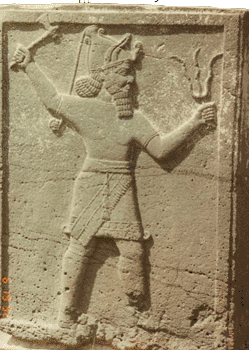
"...in 1947 excavations commenced. Over the next few years the wonders of Karatepe were slowly revealed -- the walls, the gateways, statues of a sphinx, lions and the magnificent statue of the Hittite storm-god Tarhunzas, astride a pair of bulls. Perhaps most evocative are the relief carvings which show scenes from mythology, war and everyday life. Thanks to the dedication of [archaeologist Halet] Çambel, all these statues and carvings have remained in situ, as they were in the days of Azatiwatas, and not carted off to the museum in Ankara..."

"...Derided by some as crude and primitive, the relief carvings have a charm and vibrancy, which helps us to imagine the people who lived here as ordinary human beings. The relief of a man on a chair is the king, but he is touchingly ordinary, sitting there with a meat patty in one hand, reaching out greedily for more. One relief shows a woman suckling a child beneath a date palm, others show musicians, sailors and warriors, hunters and servants.

It will probably only take you a couple of hours to wander around Karatepe, but everything you see is remarkable. The Semitic and hieroglyphic "writing," liberally scrawled over the carvings, enabled linguists to crack the Hittite code -- making them Turkey's own Rosetta Stone."

If you enjoyed this post, never miss out on future posts by following me by email!

Tuesday, October 02, 2007

The Trauma of Macedonian Resettlement in Turkey in 1924

I came across this article about a documentary film that sounded quite compelling. As the article says, the story finds echoes in all the displaced communities of the world today:

"Last weekend a documentary film had its premiere in Mustafapaşa. Emine Yıldırım’s “Yastığım Taş, Yorgunum Taş” (My Pillow was a Stone, My Quilt was a Stone) tells the story of the arrival of the Macedonians in what was once the small Cappadocian town of Sinasos. It was 1924, the year of the population exchange, when all the “Greeks” in Turkey and the “Turks” in Greece were forced to change places. However, some of the so-called Greeks were really Macedonians, caught up in a politics that saw them as no more than pawns in a settling of ancient scores.

The film was shown in a 19th century medrese which had recently become a vocational high school. The conference room was filled to capacity and there was a buzz of anticipation as people took their seats, clutching their cups of tea and plates of dry biscuits. Then the lights were dimmed and suddenly the locals were coming face-to-face with themselves on the big screen.

It was a magical experience to watch and listen to their reactions. “Our mahalle (neighborhood),” I heard people whisper, and “Look, that’s so-and-so.” One particular woman, who played a big part in the film, was sitting immediately in front of me. In her şalvar and yemeni, she was the sort of country woman who would not normally expect people to pay her much attention and yet here she was, with the camera caressing her every gesture, her every word. Her face, as she watched herself, was a picture.

Of course the story unfolding on the screen was equally gripping. It was the tale of a group of people forced to sail all the way down the Aegean and around the Mediterranean to Mersin, knowing only that they were going to Anatolia but not what that was going to mean. On arrival they found themselves abandoned in a rocky landscape where, as one woman so poignantly put it, the stones even served as their bedding. An audible gasp ran round the room when one man explained how, with winter coming and no money or means to make any, the newcomers were forced to rip down the magnificent wooden ceilings of the old Greek houses and burn them as firewood.

We saw a list of the names of the incomers, we saw their children starting school without a word of Turkish and, later, we saw one man laboriously compiling a Turkish-Macedonian dictionary while his neighbors explained how the third generation of Macedonian Mustafapaşalıs no longer understood what their parents were saying if they reverted to the old language.

It was the thought-provoking story of one community’s struggle to make a new life in a strange country, but at the same time it was a story which finds echoes in all the displaced communities of the world today."

If you enjoyed this post, never miss out on future posts by following me by email!

Wednesday, August 01, 2007

Museums in Izmir, Turkey drawing thousands of tourists


With the rising popularity of cruise line tourism, more people are visiting the archeological, ethnographical, historical arts and Atatürk museums in İzmir.

The İzmir Archeology Museum was established on a 500-square-meter area in Bahribaba Park in 1984. In this four-floor museum, the exhibition is organized in sections. Ceramic and precious artifacts are on the upper floor, stone statues, busts and portraits are on the middle floor, and while the ground floor is reserved for the administration, the basement is used as a storage room. There are 58,788 items on display in the museum and in its garden.

The Ethnography Museum is also located in Bahribaba Park. The museum building was constructed in the 19th century in neoclassical style on a sloped terrace. The building was used as the St. Roch Hospital in 1983, and was converted into a care-house for poor Christian families by the French in 1845.

The Selçuk Museum is another notable museum in İzmir. Museum officials point out that many tourists, especially those who come to the region on cruise line tours, have been visiting the Ephesus Museum, St. John’s Basilica and the ancient city of Ephesus in greater numbers since April 2007.

If you enjoyed this post, never miss out on future posts by following me by email!