Showing posts with label Roman. Show all posts

Saturday, February 13, 2021

Bust of a Priest with Silver Inlaid Eyes: Roman or Sasanian?

While I was researching the Cypriot ear spirals yesterday, I noticed this bronze bust of a priest with silver inlaid eyes dated from the 3rd - 4th century CE at the Miho Museum.  The museum identified it as late Roman but the museum's image had been shared on Flickr and I noticed that someone with the username eternal persia commented on the piece and insisted it was Sasanian.  He/she pointed to the monogram on the hat, clothes, hair design and leaves that decorate the bust and insisted these are Sasanian elements.

Intrigued, I researched the item a little further.  At first, most Sasanian portrait sculptures I reviewed were all bearded.  Then I saw an image of a relief depicting Kartir, a high priest and vizier serving during the reigns of Shapur I, Hormizd I, Bahram I, and Bahram II. Not only is Kartir clean shaven, he sports the corkscrew curls and crested hat worn by the priest of the bust at the Miho Museum.

Some scholars think Kartir may have been a eunuch, due to being depicted without a beard in the Sasanian reliefs. He first appears in historical records in Shapur I's inscription at the Ka'ba-ye Zartosht, which was most likely created between 260–262 CE. Kartir is the only religious bureaucrat mentioned in the inscription. Shapur I, termed a "lukewarm Zoroastrian", was known for his tolerance towards other religions. Although admiring the teachings of his own religion and encouraging the Zoroastrian clergy, Shapur I allowed the Jews, Christians, Buddhists, and Hindus to freely practice their religion. He was also friendly towards the founder of Manichaeism, Mani, whom he allowed to preach freely and even to be an escort in his military expeditions.

Shapur I's religious practices seems to have been somewhat unusual, though, with animal sacrifice being made for the soul of the kings and queens of the Sasanian family. Kartir, who "abhorred animal sacrifice" was unable to stop Shapur I from performing them. Shapur I died in 270 CE, and was succeeded by Hormizd I, who gave Kartir clothes that were worn by the upper class including the cap and belt (kulāf ud kamarband) and appointed him as the chief priest (mowbed).

Hormizd I died the following year and Bahram I, who was never considered a candidate for succession of the throne by his father, ascended the throne with the aid of Kartir, whose authority and influence had greatly increased. Bahram I then made a settlement with his brother Narseh who he asked to give up his entitlement to the throne in return for the governorship of the important frontier province of Armenia, which was constantly the subject of war between the Roman and Sasanian Empires.  Although Narseh held the title of Vazurg Šāh Arminān ("Great King of Armenia"), scholars think he probably still viewed Bahram I as a usurper.

Although previous Sasanian shahs had pursued a policy of religious tolerance towards the non-Zoroastrian minorities in the empire, with Bahram I's accession to the throne, and the rise of the authority of the Zoroastrian priesthood under the leadership of Kartir, this changed. When Mani, still the leader of the Manichaeists, arrived in the city of Gundishapur, Kartir and his cadre of Zoroastrian priest protested, viewing Mani as a threatening heterogeneous philosopher who presented an obscure perception of Zoroastrianism tainted by Jewish, Buddhist, and Christian ideas. Kartir pressured Bahram I to have Mani imprisoned and sentenced to death in 274 CE. Mani's death was followed by the persecution of his followers by Kartir and the Zoroastrian clergy, who used the persecution of religious minorities as a method to increase and spread their vast influence.  With the backing of Bahram I, Kartir laid foundations for Zoroastrianism's adoption as the state religion.

When Bahram I died, his son viewed Kartir as a mentor and granted him the rank of grandee (wuzurgan), and appointed him as the supreme judge (dadwar) of the whole empire.  Thereafter, Zorastrian priests were given the office of judge. Kartir's intolerance continued and his inscription at  Ka'ba-ye Zartosht boasts that he "struck down" non-Zoroastrian minorities, although modern scholars point out that Jewish and Christian sources makes no mention of persecutions during this period.

When Bahram III succeeded his father, Bahram II, something changed, however, in Kartir's relationship with the royal family.  Kartir inexplicably threw in his lot with Narseh and, along with a group of Sasanian nobles, supported Narseh's overthrow of Bahram III. But Narseh's reign  marked the return to the policy of religious tolerance which had been practiced by his father, Shapur I, all those years ago, and Kartir finally fades from history. 

Bust of a Priest with Silver Inlaid Eyes, Bronze and sliver, 3rd-4th century C.E., courtesy of the Miho Museum in Kyoto, Japan.


Relief of Kartir, the Zoroastrian high priest at Naqsh-e Rajab courtesy of Wikimedia Commons contributor درفش کاویانی.


If you enjoyed this post, never miss out on future posts by following me by email!

Sunday, September 05, 2010

3000 year-old gold bracelets unearthed on the Isle of Thanet

Gold bracelets, nearly 3,000 years old, are among more than 10,000 items unearthed during construction on the East Kent Access Road on the Isle of Thanet between Ramsgate and Sandwich (UK).  150 archaeologists supported by 91 volunteers are conducting the excavation of prehistoric burial monuments, Iron Age enclosures and a village whose inhabitants would have experienced the Roman invasion .

Simon Mason, Kent County Council’s principal archaeological officer, found the bracelets, dating back to around 700BC.  It is thought they were child­ren’s bracelets that may have been buried as a worship offering. They were found together, one pushed inside the other.

There is evidence of a Bronze Age settlement on the find site, and five hoards of bronze objects of a similar age have been found in the same area.

“With all the thousands of everyday objects we have dug up they are really helping to shed new light on the lives of prehistoric, Roman and Saxon people in Thanet.” [Mason said]  - Allister Hagger, Express.co.uk
*Image courtesy of Express

Roman Britain and Early England: 55 B.C.-A.D. 871 (Norton Library History of England)   An Imperial Possession: Britain in the Roman Empire, 54 BC - AD 409 (Penguin History of Britain)   Roman Invasion of Britain   The Ancient Celts   The World of the Celts   The Anglo-Saxons (Penguin History)   Saxons, Vikings, and Celts: The Genetic Roots of Britain and Ireland
If you enjoyed this post, never miss out on future posts by following me by email!

Saturday, November 08, 2008

Ancient Apulian treasures to be returned to Italy

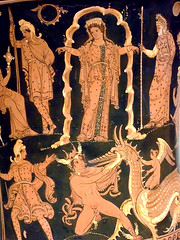
Ritual Water Jar (loutrophoros) with Perseus Battling the Sea Monster Greek made in Apulia South Italy 340-330 BCE TerracottaSwitzerland will return 4,400 Roman artifacts to Italy which were seized from a Basel art dealer and were probably stolen from illegal digs, the SDA news agency reported on Thursday.

[Vases, like this example of an Apulian loutrophoros (ritual war jar) depicting Perseus battling a sea monster, are among the treasures seized in a raid on Basel art dealer]

The objects include vases, statues, mosaics and bronze items from pre-Christian times which were found in the Basel warehouse of an Italian art dealer as part of an investigation launched in 2001 on Italy's request.

"We felt like we had been transported back to ancient Rome," the SDA agency quoted investigator Mario Plachesi as saying.

After 80 officers worked for months to catalogue the items - most of which are likely from Apulia in southern Italy - the Swiss authorities are now handing them back. A further 1,400 artifacts, probably from Greece, were also found in the warehouse but will stay in Basel.


Technorati Tags: , , , , , , , ,
If you enjoyed this post, never miss out on future posts by following me by email!

Monday, August 25, 2008

Ancient city in western Turkey waits to be unearthed

An ancient city in western Turkey, discovered by smugglers of
ancient artifacts at an illegal excavation six years ago and recovered
with soil by officials, now waits to be unearthed.


Local officials asked archaeologists to dig the region in Saruhanli
town of the western province of Manisa to bring to light the ancient
city which is thought to be dated from around 3rd or 4th century B.C.


"Six years ago, smugglers found a few pieces of historical artifacts
at an illegal dig here. There were mosaics of a stag's head among them.
But no researches have been carried out since then," Suleyman Cinar,
mayor of the village of Buyukhanli in the region, said.


"We believe that there is an ancient Roman city hidden beneath the soil," he said.


Cinar also said the city could be the outskirts of the nearby
ancient city of Sardis, the capital of the ancient kingdom of Lydia
where the first money was coined in history."

If you enjoyed this post, never miss out on future posts by following me by email!

Thursday, June 19, 2008

Ancient Jewelry Unearthed in Temple of Sun near Bulgaria's Sliven

"The archaeologist team of Bulgaria's Georgi Kitov has unearthed precious jewels, dating back from second or third century in Drumeva Mound near the Town of Sliven, the manager of the expedition himself announced.

The scientists found golden earrings, silver bracelets and three bronze rings in a Roman brick tomb of woman, buried in the mound.

A mourning bronze coin was discovered in the mouth of the skeleton and there was clay beads round its neck, the deputy-head of the group, Nikolay sirakov, revealed.

Drumeva Mound was girded with a stone wall, which showed it probably was a temple of the sun, Doctor Kitov said few days ago in an interview for Darik Radio." - Novonite.com
If you enjoyed this post, never miss out on future posts by following me by email!

Friday, May 16, 2008

Greek Chic


Finally, it looks like Greek fashion that lends elegance and femininity to the human form is making a come-back! I have been so tired of the trampy look favored by students on so many college campuses I was considering coming to work dressed for a "toga party" to demonstrate how flattering fashions from the ancient world could be!

"It has travelled all the way from the shores of the Aegean sea... and the portals of time. The flowing, graceful robes worn by the Ancient Greeks and their Goddesses are inspiring the current fashion scene.

It's a look that is all about elegance and femininity.

All the top designers have gone overboard for the look that adorned the curves of Aphrodite, the love goddess who rose from the waves.

Stunning Greek-inspired gowns by Versace, Alberta Ferretti and the label everyone who is anyone is currently going crazy over, Marchesa, have graced the A-listers on many a red carpet in recent months."
If you enjoyed this post, never miss out on future posts by following me by email!

Wednesday, April 16, 2008

A brief history of sheep domestication


A concise and interesting article about the history of domesticated sheep:

"The animal [sheep] originated in central Asia 10,000 years ago, valued for their wool and meat. The earliest sheep growers used their fleece as a kind of tunic, but it wasn't until 3,500 B.C. man learned how to spin wool.

Sheep and wool spread to Europe between 3,000 B.C. and 1,000 B.C., traveling mainly through ancient Greece. Over the next 1,000 years, Greeks, Romans and Persians contributed to improvements in sheep breeds. The Romans were also responsible for the spread of sheep to North Africa and Europe.

As far as sheep in England go, the Romans established a woolen manufacturer in Winchester as early as A.D. 50. This commodity is closely interwoven with the history of England. Legend has it the first sheep were brought to the island by the Phoenicians some time between 800 and 500 B.C. From these sheep came the meat-producing or "mutton" types, as contrasted with breeds raised primarily for wool.

In 1337, King Edward III-known as the "royal wool merchant"-forbade the continued exportation of wool from England because he wanted to give the industry a jolt. This it did, because by 1660, wool textile exports were two-thirds of England's foreign commerce.

Sheep were introduced to America when Columbus made his famous voyage in 1493, including sheep among his livestock he took to Cuba and Santo Domingo. In 1519, when Cortez began the expedition which could open Mexico and the western United States, he took with him the offspring of Columbus' sheep as a walking food supply.

After the pilgrims landed at Plymouth Rock, they bought 40 sheep from the Dutch on Manhattan Island. By 1664, the sheep population had grown to 100,000.

As settlers moved west during the 1800s, they took with them flocks of sheep from the eastern seaboard. Most of these sheep were of English breeding, more suited to producing lamb than wool."
If you enjoyed this post, never miss out on future posts by following me by email!

Monday, March 24, 2008

Easter co-opted pagan festival of Spring


I found this article about the history of the Easter celebration extremely interesting. I was aware that such holidays as Christmas had developed from pagan festivals surrounding the winter solstice but did not realize Easter was not a historical Christian celebration. I was also dismayed that, like many other doctrines of the church, the observance of Easter Sunday was enforced by the persecution of dissenters. An abstract:

"The name Easter is actually derived from the name of an ancient goddess. In Europe she was known as Ostara, the goddess of spring. The Phoenicians called her Astarte, and her name also appears on Assyrian monuments found by 19th-century archaeologist Sir Henry Austen Layard in excavations at Nineveh. The Assyrians and the Babylonians called her Ishtar; in fact, the Assyrian pronunciation of her name sounds just like the English word Easter.

For more than a thousand years before Jesus’ birth, a festival to this goddess was celebrated each spring to mark the budding of new life—the resurrection of nature after the dead of winter. It was a feast of regeneration. Throughout the inhabited world in ancient times, spring festivals and various related sex rituals honored the sun’s welcome rays as they once again imparted life and warmth.

Professing Christians in the second century and later saw Christ’s resurrection to new life as a parallel to these pagan spring rituals. Gradually they incorporated the customs surrounding worship of the spring goddess into Christianity in the festival we know as Easter.

But the acceptance of Easter as a celebration within traditional Christianity did not come easily. Indeed, much controversy surrounded its integration into the Christian calendar.

Historical references show that the early Christian Church did not observe Easter. In his book The Primitive Church, Maurice Goguel noted that “those Christians of Jewish origin continued to celebrate the Jewish feasts, particularly the Passover...”

"...During the second century, the paths of the congregations in the West, centered at Rome, began to diverge from those in Asia Minor.

The two groups generally agreed that Jesus Christ ate the Passover on the 14th day of Nisan. The Christians in Asia Minor, who made up what came to be referred to as the Eastern church, stuck to that date for partaking of the bread and wine that symbolized Christ’s suffering and death. However, as Fernand Mourret pointed out in his five-volume History of the Catholic Church, “the Christians of the West made a different calculation. In their opinion the purpose of the great Christian feast was the commemoration of Christ’s Resurrection.”

So the church in the West established Sunday as a memorial to the resurrection, discontinuing the observance of the Passover on Nisan 14. But in Asia Minor, the Passover continued to be observed on that day..."

"...In time Constantine became the Roman emperor. In 313 he issued a proclamation at Milan that came to be called the Edict of Toleration, or the Edict of Milan. It accepted Christianity as an official religion in the empire, with legal equality to other religions.

Over the next several years, the church further removed itself from its Jewish roots and inculturated itself within Roman society. It became a politicized religion of the state. But the congregations in the East and even in other parts of the vast Roman Empire still differed significantly in doctrine and practice. Constantine therefore convoked the first great ecumenical council at Nicea, in Asia Minor, in 325.

This was a major turning point. The emperor had already decreed that the day of the sun should be kept as a weekly day of rest. Now the Council of Nicea would determine the course of the church in other respects as well.

In his letter to all those throughout the empire who had not attended the Council of Nicea, Constantine wrote concerning the keeping of Easter: “It appeared an unworthy thing that in the celebration of this most holy feast we should follow the practice of the Jews. . . . Let us then have nothing in common with the detestable Jewish crowd. . . . It is most fitting that all should unite . . . in avoiding all participation in the perjured conduct of the Jews.” From such comments it appears that the adoption of Easter Sunday worship was motivated more by hatred toward the Jews than by love for Jesus Christ—Himself a Jew.

Without regard to the decisions rendered by Constantine and the Council of Nicea, many continued to observe the Passover. Eventually, however, Constantine issued an edict against all those whom he regarded as heretics, as recorded by Eusebius in his Life of Constantine. In the edict the emperor declared: “We have directed, accordingly, that you be deprived of all the houses in which you are accustomed to hold your assemblies: and our care in this respect extends so far as to forbid the holding of your superstitious and senseless meetings, not in public merely, but in any private house or place whatsoever.”

Since evening meetings were also banned, observing the Passover on the eve of Nisan 14 became increasingly difficult. As the politically organized church at Rome grew to great size and power, it gradually succeeded in stamping out the biblical teaching regarding the Passover as the memorial of Christ’s death. Easter Sunday thus became universally accepted within that church as the day when Christians should celebrate His resurrection.

We find, then, that in the early centuries of what is often called the Christian era, an unbridgeable gulf opened up between professing Christian churches and the apostolic Church Jesus founded. Nowhere does the New Testament command or even suggest that Christ’s resurrection should be commemorated on Easter Sunday or indeed on any day."
If you enjoyed this post, never miss out on future posts by following me by email!

Al-Muzawaka necropolis reopened to the public

Following 16 years of closure to the public, the Al-Muzawaka necropolis in Dakhla Oasis will soon be back on the tourists track, reports Nevine El-Aref

Click to view caption
From top: restoration works in Al-Muzawaka tombs

Restorers and archaeologists have been working on the Roman necropolis to clean, consolidate and restore the tombs, which are embraced within a rocky, table-top mound. The 300 tombs are gouged out of the rock, all unpainted tombs except for two. These, the tombs of Petosiris and Sadosiris, are certainly the most interesting, with walls vividly- painted with scenes combining ancient Egyptian and Roman deities at one time. The tombs were discovered in 1972 by Egyptian archaeologist Ahmed Fakhry, who because of the paintings called them Al-Muzawaka.

The walls of Petosiris's tomb are painted with fair-haired, Roman- nosed figures in Pharaonic poses, curly-haired angels. On the ceiling is a zodiac with a bearded Janus figure. The owner of the tomb is also featured on the back right-hand corner, standing on a turtle and holding aloft a snake and fish -- a curious amalgam of Egyptian and Graeco-Roman symbols.

The wall paintings of Sadorisis's tomb show the deceased in positions with various deities: before Anubis while his heart is weighed; before Osiris while he is judged; and with Janus looking back on the deceased's life and forward into the hereafter.

Harvesting scenes are depicted in both tombs, as well as some agricultural products of the oasis such as grapes and olives.

While the other tombs in the necropolis are unpainted, they were found still with embalmed corpses. The most intriguing of these is one of a young girl with pronounced painted genitals.

If you enjoyed this post, never miss out on future posts by following me by email!

Saturday, January 05, 2008

All the world's an ancient Greek or Roman stage for Whitman Professor Thomas Hines

A scholar after my own heart - Professor Hines is photographing as many Greek and Roman theaters as possible and making an archive of his information available through a website at Whitman. I see he finances his activities with grants from such organizations as the National Institute for the Humanities. I guess I need to learn how to do that as my archive on Flickr is funded by my own vacation leave, equipment, and funds for airline tickets and meals and lodging.


Last year, Associate Professor of Theatre Thomas Hines of Whitman College received a gratifying and fairly astonishing e-mail from an excited Argentine businessman who’d decided to restore an old mas, a traditional house in Provence. He wanted Hines to know that the Whitman College professor’s online archive of ancient theaters had inspired him to build a Roman theater in the backyard of the property.

The man had found Hines’ trove of information on Whitman’s Web site. Since 2001, Hines has visited 43 Greek and Roman theaters in three countries, taken tens of thousands of photographs and compiled The Ancient Theatre Archive: A Virtual Reality Tour of Ancient Greek and Roman Theatre Architecture.

Hines’ Web site receives more than a thousand hits a day from visitors across the globe. "There are people visiting the site to write papers or to travel," he said. "People pick from it what they want, and everyone is taking something different and doing something new."

One recent shopper was an official from the Direcção Geral das Artes, the ministry of arts in Portugal. He wanted to use several of Hines’ photographs, particularly the Hellenistic theater in Epidaurus, in a national campaign to promote the arts. Hines was happy to oblige. "I was struck by the idea that this could inspire some grade school kid in Portugal to do something with theater," he said.

Thomas Hines (right)

Hines’ ongoing Web project grew out of his desire to provide his own students with a more complete picture of ancient theaters. The success of his initial study - the Roman theater in Ostia Antica, Italy - inspired him to pursue others. As the projects accrued, Hines’ international audience grew.

“When I conceived of the project, I used a model in my mind of an exhibit in a museum," he said. "An intuitive, self-guided tour. I used my skills as a teacher as well as my knowledge of theater."

Hines’ site features thorough surveys, including basic fact sheets, detailed studies, travel guides, directions, a glossary of Greek and Roman theater terminology, and Hines’ own hand-drawn maps and panoramic images. Viewers can take virtual tours of the theaters, zooming in to study them in as much detail as they wish.

Hines, whose set designs have complemented several Harper Joy Theatre productions at Whitman, has even included his own travel accounts in the virtual tour mix. "Today I followed in the footsteps of Alexander the Great, but unlike him, I managed to conquer the city of Termessos," reads one entry from June 2003. "I was luckier than Alex - I had a Fiat, a paved road, and the cranky Termessians were all dead."

The Web site, Hines allows, is no substitute for the real thing. "What’s lacking is the travel experience: meeting people, seeing the setting, the food, the way people treat you, the views, the smells. All of that is beyond anything a book or camera could capture."

Nonetheless, Hines’ site links viewers with some immediacy to a distant past. “Theater is an ephemeral art form," he said. "We have no way of attending an ancient Greek or Roman play, but we still have this one, very large, tangible artifact. This will let people know these places are out there, and that it’s OK to go."

If you enjoyed this post, never miss out on future posts by following me by email!

Saturday, December 29, 2007

Elamite-era artifacts languishing in vermin-infested Shush Castle


How terrible! This is a prime example of a cache of ancient art that needs to be at least photographed and indexed before these priceless items are lost to the world forever!

"About 90,000 archaeological artifacts are being stored in appalling conditions in the underground storerooms of Shush Castle which is located in Shush, near the ancient sites of Susa in Khuzestan Province.

“The storerooms are not only humid but are inhabited by snakes, scorpions, and insects such as termites,” an informed source, who preferred to remain anonymous, told the Persian service of IRNA on Tuesday. “The artifacts belong to various periods of Iran’s history,” the informer added. According to the report, many of the items have never been on public display.

Artifacts which were discovered by the French archaeologist Roman Ghirshman in the 1940s are among the relics languishing in the gloomy cellars. A large number of the secreted objects had been carefully salvaged from the Elamite-era sites of Khuzestan over the past decades. The only action that has been taken for the protection of the relics was carried out by ancient inscriptions expert Abdolmajid Arfaei, who sprayed the storerooms with insecticide last year. "


Image: Kneeling Bull Figure, Proto-Elamite, 3000-2800 BCE, southwest Iran (Courtesy Bostonia, Summer 2004, Boston University)
If you enjoyed this post, never miss out on future posts by following me by email!

Monday, December 17, 2007

Jordan Valley excavation team sought

With their findings on the mountain Tall adh-Dhahab (West) in the Jabbok Valley the archeologist Thomas Pola could substantiate one assumption: everything points to the fact that the building remains from the Hellenistic and Roman era, found in 2006, were part of a yet unknown monumental building of Herod the Great (73-4 BC).

This assumption is based on the floors of one of the discovered peristyle yards (yards enclosed by continuous columns) which the archeologists were able to excavate. Prof. Pola sees the parallels with the architecture of Herod’s West Jordan Alexandreion as prove that there also was a monumental building of Herod the Great on the plateau of the mountain Tall adh-Dhahab. That would mean that in addition to his reign over the West Jordan Land, the Jewish king had a security system with which he could have controlled the ancient long-distance traffic in the middle Jordan Valley and the access ways to the plateau of the East Jordan Land.

Above that, the team of Prof. Pola for the first time discovered a layer from the late Bronze Age or the Early Iron Age on a natural terrace directly underneath the plateau. The ruins of a tower from the city wall at least show three building phases. “On the level of the oldest building phase we took samples from a burnt layer. A C14-analysis carried out by Prof. Manfred Bayer (Physics at TU Dortmund) showed that the charcoal originates from the time 1300 to 1000 BC. At this location we will continue to work in 2008.”

Finally Prof. Pola’s team discovered the purpose of the monumental military facility half way up the mountain: it is a casemate wall. It is supposed to have been finished in Roman times. This is yet another argument for the identification of the mountain with the stronghold Amathous mentioned in the ancient world. The historian Josephus (37 to 100 AD) described Amathous as the biggest stronghold in the East Jordan Land.

Even reworking the campaign 2006 revealed a sensation: the carve-drawings which had been discovered by Dr. Batereau-Neumann, a sponsor of the project, at that time, were dated to the ninth or tenth century by the internationally renowned specialist for Middle East iconography, Prof. Othmar Keel (Universität Freiburg). According to him the two pictures, the head of a lioness and the fragment of a cultural scene, belong together. The sensation: they point to the existence of a temple on the mountain plateau in the New-Assyrian time.
If you enjoyed this post, never miss out on future posts by following me by email!

Wednesday, August 01, 2007

Museums in Izmir, Turkey drawing thousands of tourists


With the rising popularity of cruise line tourism, more people are visiting the archeological, ethnographical, historical arts and Atatürk museums in İzmir.

The İzmir Archeology Museum was established on a 500-square-meter area in Bahribaba Park in 1984. In this four-floor museum, the exhibition is organized in sections. Ceramic and precious artifacts are on the upper floor, stone statues, busts and portraits are on the middle floor, and while the ground floor is reserved for the administration, the basement is used as a storage room. There are 58,788 items on display in the museum and in its garden.

The Ethnography Museum is also located in Bahribaba Park. The museum building was constructed in the 19th century in neoclassical style on a sloped terrace. The building was used as the St. Roch Hospital in 1983, and was converted into a care-house for poor Christian families by the French in 1845.

The Selçuk Museum is another notable museum in İzmir. Museum officials point out that many tourists, especially those who come to the region on cruise line tours, have been visiting the Ephesus Museum, St. John’s Basilica and the ancient city of Ephesus in greater numbers since April 2007.

If you enjoyed this post, never miss out on future posts by following me by email!

Thursday, June 14, 2007

Former Greek Royal Residence Yields Ancient Treasures

More than 200 ancient items and 300 paintings were found inside sealed containers in a royal stable and in the basement of the main residence at Tatoi, some 25 kilometres (15 miles) northwest of the Greek capital, culture ministry officials said during a media tour of the site on Tuesday.

"It's a real treasure hunt, we are in the process of removing these marvellous items from boxes stacked in disorderly heaps," restoration supervisor Nikos Minos told AFP.

A team of 21 archaeologists and restorers started work at the crumbling, 19th-century estate three months ago as part of a bid to catalogue its contents before restoration work starts to find a new role for the site.

The collection includes the bronze helmet of an ancient Greek soldier, ancient glasswork including a perfume vial from Roman times, idols and clay vessels -- among them a 2,700-year-old painted jug bearing the form of a horseman, found intact to the amazement of archaeologists.

If you enjoyed this post, never miss out on future posts by following me by email!