Showing posts with label ancient history. Show all posts

Wednesday, August 11, 2010

Cao Cao's tomb to open to visitors in September 2010

I see that the Chinese are planning a new exhibit around the newly discovered tomb of the Chinese warlord Cao Cao (Three Kingdoms Period (208-280 CE)

The planned area for the temporary exhibition is 787 square meters, and the floor space is about 700 square meters, with the total length of the visitors' corridor standing at 291 meters, according to Xu Huiqian, governor of Anyang County.  - People's Daily Online
I became really interested in the Han Dynasty while researching an article for Heritage Key, "Mad, Bad and Dangerous Women of the Han: The Shocking Story of Lady Dai".  I was even more intrigued after watching John Woo's classic epic "Red Cliff" (the full length international version).


"Red Cliff" is based on the 800,000 word Chinese historical epic "Romance of the Three Kingdoms".  Although it is a novel, it is said to be about 70% history, 30% fiction.  Written during the early Ming Dynasty when Cao Cao was viewed unfavorably, "Romance of the Three Kingdoms" portrays him as the novel's villain.  Cao Cao actually accomplished a number of favorable achievements, however.  He not only united northern China but implemented agricultural and education programs that helped the people recover from a devastating famine brought on by a plague of locusts in 194 CE.  His programs also raised the standard of living for many people and supported the development of intellectually gifted individuals.  Cao Cao himself was skilled in poetry and martial arts and considered quite strategically astute.  He authored a number of military manuals.

Although the discovery of Cao Cao's tomb was reported by archaeologists in December 2009, the tomb had been discovered and robbed by tomb raiders quite some time before then.  Authorities only learned of its location after tablets surfaced in the antiquities market bearing inscriptions of "King Wu of Wei", the title conferred on Cao Cao after his death.

At least by the time the authorities were led to the site, it still contained 250 artifacts including weapons, armor, and pottery, the remains of a man in his 60s, and the bones of two women in their 50s and 20s, thought to be Cao Cao's wife and her female servant. Some scholars fear that some of the artifacts found within the tomb may have been planted by enterprising antiquities dealers, however.

I hope to travel to China in the next few years so, although I won't be able to see the current exhibit opening next month, hopefully I will be able to at least visit the tomb site.

The Establishment of the Han Empire and Imperial China (Greenwood Guides to Historic Events of the Ancient World)   The Early Chinese Empires: Qin and Han (History of Imperial China)   Red Cliff International Version - Part I & Part II
If you enjoyed this post, never miss out on future posts by following me by email!

Thursday, July 15, 2010

"Chasing Mummies" amateurish reality drivel

The trailers I watched for the new History Channel series "Chasing Mummies" piqued my interest and the "Show me the mummy" play on words brought a smile to my lips.  But I'm afraid I was sadly disappointed in at least the first episode that aired Wednesday.

The camera work was amateurish, there appeared to be no formal script and Dr. Hawass was presented as irascible and supremely arrogant.  I cannot understand why so many reality show producers think that rudeness and unprofessional outbursts make a show entertaining.  My husband often watches "Ax Men" and several "Ax Men" copycats and I've gotten to the point that I just go off in the other room because the men depicted on these programs are so grossly rude and unprofessional to their co-workers, even when they are family members.  Much of the swearing and bluster appears to be "put on" for the camera and I hope that is the case in "Chasing Mummies" because I wouldn't work under these conditions if it was the last job available on the planet.

This weekend the History Channel is rerunning an excellent program about how the Indiana Jones movies have inspired so many people to want to learn more about history and in some cases even become archaeologists.  The producers of "Chasing Mummies" should watch this program and try to emulate it to impart the love of history and archaeology that I know Dr. Hawass truly possesses. 


Dr. Hawass is actually a very gifted author.  I've read his book on the Valley of the Golden Mummies and enjoyed it immensely.  I was especially intrigued by the passage describing his paranormal experience with a pair of mummies who had been removed from their original tomb for study and who appeared to communicate with him in nightmares expressing their grief at being separated from their other family members.


The Lost Tombs of Thebes: Ancient Egypt: Life in Paradise   Secrets from the Sand: My Search for Egypt's Past   Hidden Treasures of Ancient Egypt: Unearthing the Masterpieces of the Egyptian Museum in Cairo   Tutankhamun: The Golden King and the Great Pharaohs   Mummies And The Wonders of Ancient Egypt   Silent Images: Women in Pharaonic Egypt   Valley of the Golden Mummies: The Greatest Egyptian Discovery Since Tutankhamun
If you enjoyed this post, never miss out on future posts by following me by email!

Wednesday, November 11, 2009

Cambyses Lost Persian Army Found In The Sahara!


What a wonderful discovery! Two Italian archaeologist have found what appears to be the lost army of Persian King Cambyses in the Sahara desert. I learned about this cataclysmic event when I listened to Professor Elizabeth VanDiver's Teaching Company lecture series on Herodotus: The Father of History. It was the first lecture series from the Teaching Company that I had ever heard and I was mesmerized! I now have dozens of their lectures under my belt and about a dozen on my "to be heard" shelf in my library.

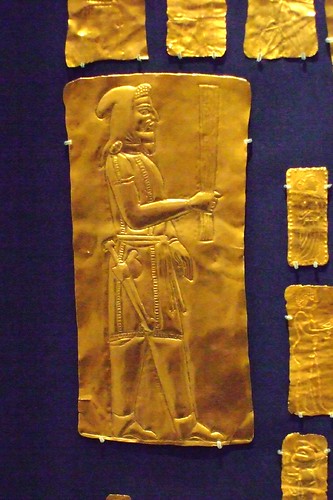
[Image: Gold ornaments from the Oxus Treasure depicting Persian warrior 5th-4th century BCE. Photographed at the British Museum by Mary Harrsch]

The article compared the discovery with Schlieman's discovery of Troy and I would have to agree and it is so exciting to have it occur in my own lifetime! How gratifying to culminate 13 years of research with such a marvelous discovery!

"A pair of Italian archaeologists have uncovered bronze weapons, a silver bracelet, an earring and hundreds of human bones in the vast desolate wilderness of the Sahara desert. Twin brothers Angelo and Alfredo Castiglioni are hopeful that they've finally found the lost army of Persian King Cambyses II.

According to the Greek historian Herodotus, Cambyses II and his armies were buried by a cataclysmic sandstorm in 525 B.C. He wrote, "a wind arose from the south, strong and deadly, bringing with it vast columns of whirling sand, which entirely covered up the troops and caused them wholly to disappear."

Now the discovery of these artifacts points towards an answer to this millennias-old mystery: The Castiglioni brothers studied ancient maps and came to the conclusion that Cambyses' army did not take the caravan route most archaeologists believe they used." - More: New American

If you enjoyed this post, never miss out on future posts by following me by email!

Saturday, September 26, 2009

Han Dynasty Mawangdui Excavation Exhibit Makes Last Stop in Santa Barbara

I wish this exhibit had been open when I was down in Los Angeles last month. Although Lady Dai, one of the best preserved mummies in the world and the Mwangdui tomb's famous occupant won't be on display (she is carefully conserved and housed at the Hunan Provincial Museum in Changsha), 70 objects of exquisite lacquerware, a 2,000 year-old silk robe worn by Lady Dai, a medical text written on delicate silk fabric and finely detailed figurines of household servants and muscians found among more than 3,000 artifacts discovered when the tomb was originally unearthed in 1971 are showcased in the exhibit.

[Image - Wooden figurines of musicans playing reed wind instruments called yus and plucked-string zithers (178-145 BCE). Image courtesy of the Santa Barbara Museum of Art]

The Han Dynasty period, 206 BCE - 220CE, considered one of the most important periods in Chinese history, included the invention of paper and construction of the Silk Road that eventually would lead to trade with the Roman Empire. It was founded by a rebel peasant leader named Liu Bang, who would become the Emperor Gaozu.

Reading the records of the grand historian of the Han Dynasty, I couldn't help but notice a parallel between the relationship of Liu Bang and Xiao He, a local man of letters, who would later become his prime minister, and Octavian (Caesar Augustus) and his general Marcus Agrippa, although the roles were somewhat reversed. In the case of the Han emperor Liu Bang (Gaozu), the emperor was the military strategist while his minister, Xiao He, was the man behind the scenes who raised money and recruits. In the case of Augustus, his general/admiral Marcus Agrippa was the military mind who engineered Octavian's victories while Octavian supplied the money and recruits. In each case, however, neither Xiao He nor Marcus Agrippa ever moved to challenge their liege lord. Each became wealthy and powerful in their own right and their support was crucial to the success of each emperor's reign. But each man seemed to be satisfied to be the man behind the scenes rather than the man holding the wolf's ears (so to speak).

Liu Bang, the only emperor besides Zhu Yanzhang, the founder of the Ming Dynasty, that rose from a modest background, also possessed a healthy dose of common sense that served him well in the administration of a contentious collection of fiefdoms formed after the fragmentation of the Qin empire. I particularly like the story related by the grand historian about how Liu Bang handled an angry mob of his generals who were dismayed by Liu Bang's promotion of his minister, Xiao He, to the first position in his court.

"The king of Han, now emperor, considered that Xiao He had achieved the highest merit and hence enfeoffed him [gave him a fief] as marquis of Zan with the revenue from a large number of towns. But the other distinguished officials objected, saying, “We have alI buckled on armour and taken up our weapons, some of us fighting as many as I00 or more engagements, the least of us fighting twenty or thirty. Each, to a greater or lesser degree, has engaged in attacks upon cities or seizures of of territory. And yet Xiao He, who has never campaigned on the sweaty steeds of battle, but only sat here with brush and ink deliberating on questions of state instead of fighting, is awarded a position above us. How can this be?"
'Gentlemen,' the emperor asked, 'do you know anything about hunting?'
'We do,' they replied.
'And do you know anything about hunting dogs?' 
'We do.'
'Now in a hunt,' the emperor said, 'it is the dog who is sent to pursue and kill the beast but the one who unleashes the dog and points out the place where the beast is hiding is the huntsman. You, gentlemen, have only succeeded in capturing the beast, and so your achievement is that of hunting dogs. But it is Xiao He who unleashed you and polnted out the place,and his achievement is that of the huntsman.' - Records of the grand historian: Han dynasty by Ch’ien Ssu-Ma, Burton Watson

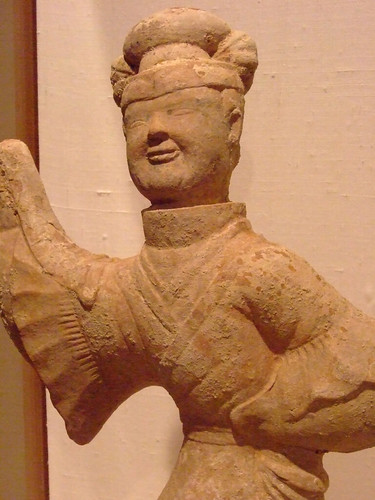
If you have a chance to see the Han exhibit in Santa Barbara, don't forget to explore the museum's excellent permanent Asian art exhibit. It, too, contains some beautiful artifacts from the Han period like this figurine of a female dancer and musician playing a Qin zither from Sichuan province (25 -220 CE) that I photographed there.
If you enjoyed this post, never miss out on future posts by following me by email!

Tuesday, July 21, 2009

Youtube video of Thracian treasures of Bulgaria breathtaking!

While I was on YouTube looking for a video about Macedonian tombs I came across this video that gives a wonderful overview of the spectacular Thracian treasures that have been unearthed in Bulgaria. I hope to visit Bulgaria one day and see these wonders for myself!

If you enjoyed this post, never miss out on future posts by following me by email!

Seventeen 5th century BCE tombs unearthed in Macedonia

This discovery sounds exciting and very unique. I wish the article had included some pictures. The discovery of the gold chest plate embossed with a sun is particularly interesting. I wonder if the sun resembles the so-called Vergina sun found on a gold casket in the royal tombs discovered by Manolis Andronikos.

This YouTube video includes images of several Macedonian tomb sites and artifacts discovered within them including the gold casket embossed with the Vergina sun. It gets a little political towards the end though. My inclusion of it here is merely for illustrative purposes and does not imply any agreement with any political statements made within it.


Macedonian archaeologists have discovered 17 tombs dating from the 5th century BC in Ohrid, southwestern Macedonia, local media reported Monday. In one tomb, archaeologists found bones of a 15-year-old girl with a unique funeral mask made up of thin gold eye-covers, gold plate for the mouth and a plaque with an engraved sun placed on her chest. "This kind of a mask is unique for the Balkans. Several gold plates were found in Aegean region, but this kind of combination in one grave is unknown," Pasko Kuzman, head of the Macedonian Department for Cultural Heritage, was quoted as saying. Jewelry, golden chains and objects made from amber were also found in the graves. - More: EarthTimes
If you enjoyed this post, never miss out on future posts by following me by email!

Sunday, May 03, 2009

Luwian hieroglyphs near ancient Antioch shed light on "Dark Age"


I have been intrigued by the so-called "Dark Age" that engulfed the eastern Mediterranean since I first learned about it in Archaeology 101 many years ago. I know there has been much speculation about the cause of the collapse of many Bronze Age cultures like the Mycenaeans and the Minoans ranging from the effects of volcanic eruptions and resulting tsunamis to pandemics and marauding tribal societies from the Asian steppes. But researchers involved in the Tayinat Archaeological Project say their findings indicate a continuity of many civilizations across this cultural chasm.

An ancient temple in Turkey has been found filled with broken metal, ivory carvings, and stone slabs engraved with a dead language [Luwian]. The find is casting new light on the "dark age" that was thought to have engulfed the region from 1200 to 900 B.C.

Written sources from the era—including the Old Testament of the Bible, Greek Homeric epics, and texts from Egyptian pharaoh Ramses III—record the transition from the Bronze Age to the Iron Age as a turbulent period of cultural collapse, famine, and violence.

But the newfound temple suggests that may not have been the case, say archaeologists from the University of Toronto's Tayinat Archaeological Project, led by Timothy Harrison.

"We're beginning to find new archaeological evidence that there was a continuation of writing traditions, as well as cultural and political continuity from the Bronze Age into this Iron Age period," Harrison said.- More: National Geographic News

Like the early University of Chicago excavations in 1935 & 1938, the largest number of inscriptions have been Luwian hieroglyphs.

The Chicago excavations produced an extensive corpus of Akkadian, Aramaic and Neo-Hittite (or Luwian) inscriptions. Luwian hieroglyphic inscriptions accounted for the largest number, a total of 85 fragments, 32 of which have been shown to come from seven distinct monumental inscriptions. One of these, comprised of six basalt fragments, had formed part of a colossal statue of a figure seated on a throne. Although the precise provenience of the statue remains unclear, the inscription makes reference to Halpa-runta-a-s(a), very possibly the same Neo-Hittite ruler who is listed as having paid tribute to Shalmaneser III in the mid-9th century BCE.

If this historical correlation is correct, it provides a possible date for the remainder of the Luwian hieroglyphic inscriptions found at the site, and raises the possibility of isolating the Building Period, and cultural horizon, in which these monumental objects were erected.

With only a few exceptions, all of the fragments appear to have been found in the fill or foundation trenches of structures dating to the Second Building Period; in other words, in secondary and tertiary contexts. Moreover, all but one of the inscriptions (an altar piece in obvious secondary reuse in Building II) clearly had been smashed and destroyed intentionally before being discarded. The Halparuntas inscription, therefore, would appear to date the Luwian epigraphic remains at Tell Ta‘yinat to the mid-ninth century or earlier, while their stratigraphic context places this material in the First Building Period.

The Tayinat Archaeological Project’s primary aim is to assemble archaeological data from the central settlement at Tell Ta’yinat of a succession of prominent, historically-attested Bronze and Iron Age polities for comparison with existing data sets from comparable contexts (e.g. domestic, residential, administrative, or public) at rural village sites in the region. This explicitly regional approach, still relatively rare in Near Eastern Archaeology, is designed to facilitate multiple levels of analysis, and to produce the multivariate data needed to engage in more systematic investigations of the complex social, economic and political institutions developed by the first urban communities to emerge in this part of the world.

Tell Ta’yinat forms a large low-lying mound located 45 kilometres west of Antakya (ancient Antioch) in Southeastern Turkey. The Chicago excavations uncovered the remains of several large palaces (called bit hilani), a temple (famously compared with Solomon's temple), and numerous beautifully carved stone reliefs and sculptures demonstrated that the site preserves a lengthy settlement history that spans the Early Bronze (ca 3000 2000 BCE) and Iron Age(ca. 1200 550 BCE) periods. In addition, the Expedition discovered numerous inscriptions (in Luwian/Neo Hittite, Neo-Assyrian and Aramaic), which helped to identify the site as ancient Kunulua, capital of the Neo Hittite/Aramaean Kingdom of Patina/Unqi. - More: Tayinat Archaeological Project.

[Image: Tayinat Lions - Hittite, courtesy http://www.anadolugizemi.com/]
If you enjoyed this post, never miss out on future posts by following me by email!