Showing posts with label discovery. Show all posts

Friday, January 08, 2010

Possible Discovery of Lost Army of King Cambyses II Makes Top Ten List of 2009


I see the possible discovery of the lost army of King Cambyses II of Persia made the Brit's top ten list of archaeological discoveries of 2009.  I truly hope the brothers Castiglioni are able to prove their claim.  It would be almost as exciting as Schliemann's  discovery of Troy!  The Castiglioni shouldn't be too discouraged by scholarly naysayers.  They didn't believe Schliemann either!!

 [Image:  Cambyses at Pelusium]


The complete list:

1.  The Staffordshire Hoard  (7th century Anglo Saxon stash of gold weapons, jewelry, etc.)
2.  Bone Flute and Erotic Figurine at Hohle Fels (Germany)
3.  Bronze Age Burial Cist at Forteviot (Scotland)
4.  The Lost City of Bathonea (Turkey)
5.  The Stirling Hoard (of gold neck torcs - Scotland)
6.  World's Oldest Flax Fibres (Republic of Georgia)
7.  Earliest Evidence of Chemical Warfare (Dura Europos, Syria)  
8.  Ida - the 47-million-year-old fossil thought to be the missing link in human evolution (Germany) 
9.  The Emperor's Private Amphitheatre at Portus (Italy)
10. The Lost Army of Cambyses II of Persia (Siwa Oasis, Egypt) 

The Lost Army of Cambyses   The Staffordshire Hoard   The Discovery of Dura-Europos 
 
If you enjoyed this post, never miss out on future posts by following me by email!

Wednesday, November 18, 2009

Gold, Silver and Bronze Vessels found in burial near chariot discovery


Marvelous discoveries of ancient Thracian treasures continue in Bulgaria. I truly hope I can see some of these finds some day. Apparently these antiquities were uncovered close to the site where a completely intact bronze-embellished Thracian chariot was found in September 2007.

While looking for an image of the finds I stumbled across this marvelous blog about ancient Bulgaria that provided a number of images of the chariot excavation including this one.

"In October and November 2009, archaeologist Veselin Ignatov’s team found a burial tomb of dated back to the end of 1st century and beginning of 2nd century AD, located outside of the village of Karanovo, in southern Bulgaria.

The finds at the lavish Thracian tomb include gold rings, silver cups and vessels coated with gold and clay vessels. Those include two silver cups with images of love god Eros, and a number of other ornate silver and bronze vessels." - More: Sofia News Agency

The precious items once belonged to an aristocrat descended from the ruling elite of the Odrysian Kingdom (5th -3rd century BCE).

According to the Greek historians Herodotus and Thucydides, a royal dynasty emerged from among the Odrysian tribe in Thrace around the end of the 5th century BCE, which came to dominate much of the area and peoples between the Danube and the Aegean for the next century. Later writers, royal coin issues, and inscriptions indicate the survival of this dynasty into the early first century CE, although its overt political influence declined progressively first under Persian, Macedonian, later Roman, encroachment. Despite their demise, the period of Odrysian rule was of decisive importance for the future character of south-eastern Europe, under the Roman Empire and beyond. - Wikipedia
[Image - Golden mask of 4th century BCE Thracian King discovered near Topolchene in 2007. Courtesy of News.bg]

The Odrysians built roads to develop trade and built a powerful army, at one point numbering over 150,000 men.

Under the Odrysians Greek became the language of administrators and of nobility and the Greek Alphabet was adopted; Greek customs and fashions contributed to the recasting of east Balkan society.The nobility adopted Greek fashions in dress, ornament and military equipment, spreading it to the other tribes.

In the 4th century BC, the kingdom split itself in three smaller kingdoms, of which one, with the capital at Seuthopolis survived the longest. During the Hellenistic era it was subject at various times to Alexander the Great, Lysimachus, Ptolemy II, and Philip V, and was at one time overrun by the Celts, but usually maintained its own kings. During the Roman era its Sapaean rulers were clients of Rome until Thrace was annexed as a Roman province in 46 AD. - Wikipedia


If you enjoyed this post, never miss out on future posts by following me by email!

Wednesday, November 11, 2009

Cambyses Lost Persian Army Found In The Sahara!


What a wonderful discovery! Two Italian archaeologist have found what appears to be the lost army of Persian King Cambyses in the Sahara desert. I learned about this cataclysmic event when I listened to Professor Elizabeth VanDiver's Teaching Company lecture series on Herodotus: The Father of History. It was the first lecture series from the Teaching Company that I had ever heard and I was mesmerized! I now have dozens of their lectures under my belt and about a dozen on my "to be heard" shelf in my library.

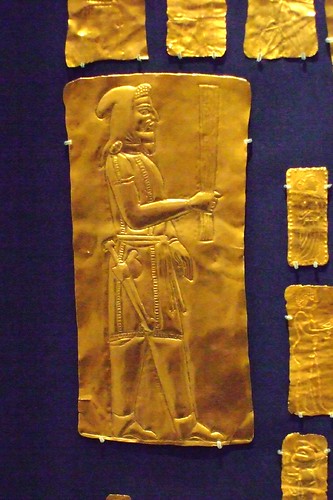
[Image: Gold ornaments from the Oxus Treasure depicting Persian warrior 5th-4th century BCE. Photographed at the British Museum by Mary Harrsch]

The article compared the discovery with Schlieman's discovery of Troy and I would have to agree and it is so exciting to have it occur in my own lifetime! How gratifying to culminate 13 years of research with such a marvelous discovery!

"A pair of Italian archaeologists have uncovered bronze weapons, a silver bracelet, an earring and hundreds of human bones in the vast desolate wilderness of the Sahara desert. Twin brothers Angelo and Alfredo Castiglioni are hopeful that they've finally found the lost army of Persian King Cambyses II.

According to the Greek historian Herodotus, Cambyses II and his armies were buried by a cataclysmic sandstorm in 525 B.C. He wrote, "a wind arose from the south, strong and deadly, bringing with it vast columns of whirling sand, which entirely covered up the troops and caused them wholly to disappear."

Now the discovery of these artifacts points towards an answer to this millennias-old mystery: The Castiglioni brothers studied ancient maps and came to the conclusion that Cambyses' army did not take the caravan route most archaeologists believe they used." - More: New American

If you enjoyed this post, never miss out on future posts by following me by email!

Thursday, December 18, 2008

Has "Timeline" been realized at some point in the future?

This article caught my attention. I enjoyed the late Michael Crichton's book "Timeline" and liked the movie as well although it could have been improved by casting someone besides Paul Walker in one of the leading roles. At least Gerard Butler pretty much made up for that. I considered it purely science fiction though. But this discovery of a 100-year old watch in a 400-year old sealed tomb makes one pause. Perhaps we are going to crack the time travel mystery in the future after all!

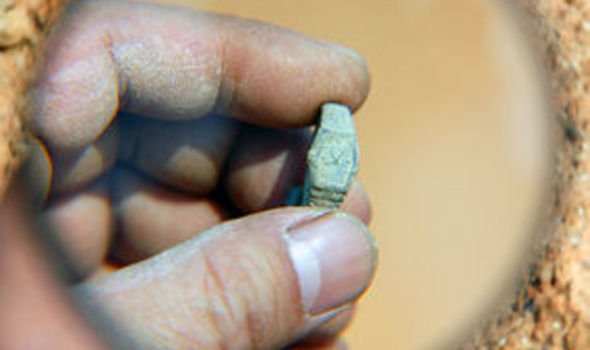
[Photo by Europics]

ARCHAEOLOGISTS are stumped after finding a 100-year-old Swiss watch in an ancient tomb that was sealed more than 400 years ago.

The real-life tomb raiders were the first visitors to the Ming dynasty grave in Shangsi, southern China, since its occupant's funeral.

Inside they discovered a miniature watch encrusted in mud and rock in the shape of a ring marked 'Swiss', as reported by the Austrian Times.

Jiang Yanyu, former curator of the Guangxi Museum, said: "When we tried to remove the soil wrapped around the coffin, suddenly a piece of rock dropped off and hit the ground with metallic sound.

"We picked up the object, and found it was a ring. After removing the covering soil and examining it further, we were shocked to see it was a watch."
If you enjoyed this post, never miss out on future posts by following me by email!

Saturday, December 06, 2008

Unlooted Chachapoyan city discovered in the Andes

http://lh5.ggpht.com/nomadextraveler/RjDFPFrYWxI/AAAAAAAAAaU/zb6BHWd1gM4/JCP+148.jpgArchaeologists are examining a recently discovered, exceptionally
well-preserved city carved into the Andes mountains by the ancient
Peruvian Chachapoya tribe.According to the Daily Telegraph, local hikers were the first to
stumble upon the city ruins, covering close to 12 acres of a
mountainside in Peru’s northern Amazon.
When the hikers arrived, they found a nearly 500-meter high waterfall
surrounded by lush jungle scenery, and buildings set upon the face of a
cliff. The city’s remoteness has protected it from looters,
leaving “ceramics and undisturbed burial sites” intact.


“We suspect that the ancient inhabitants used this as a lookout
point from where they could spot potential enemies,” said
Archaeologist Benedicto Pérez Goicochea to the Daily Telegraph. - Finding Dulcinea

The Chachapoyas, also called the Warriors of the Clouds, were an Andean people living in the cloud forests of the Amazonas region of present-day Peru. The Incas conquered their civilization shortly before the arrival of the Spanish in Peru. When the Spanish arrived in Peru in the 16th century, the Chachapoyas were one of the many nations ruled by the Inca Empire. Their incorporation into the Inca Empire had not been easy, due to their constant resistance to the Inca troops.

Since the Incas and the Spanish conquistadors
were the principal sources of information on the Chachapoyas, unbiased
first-hand knowledge of the Chachapoyas remains scarce. Writings by the
major chroniclers of the time, such as El Inca Garcilaso de la Vega,
were based on fragmentary second-hand accounts. Much of what we do know
about the Chachapoyas culture is based on archaeological evidence from
ruins, pottery, tombs and other artifacts.

The chronicler Pedro Cieza de León offers some picturesque notes about the Chachapoyas:

"They are the whitest and most handsome of all the people that I have seen in Indies,
and their wives were so beautiful that because of their gentleness,
many of them deserved to be the Incas' wives and to also be taken to
the Sun Temple (...) The women and their husbands always dressed in woolen clothes and in their heads they wear their
llautos, which are a sign they wear to be known everywhere."

Cieza adds that, after their annexation to the Inca Empire, they adopted customs imposed by the Cuzco-based Inca.

The name Chachapoya is in fact the name that was given to
this culture by the Inca; the name that these people may have actually
used to refer to themselves is not known. The meaning of the word Chachapoyas may have been derived from sacha-p-collas, the equivalent of "colla people who live in the woods" (sacha = wild p = of the colla = nation in which Aymara is spoken). Some believe the word is a variant of the Quechua construction sacha puya, or people of the clouds. - Wikipedia


If you enjoyed this post, never miss out on future posts by following me by email!

Tuesday, October 02, 2007

King Tut's Tomb Yields a Few More Discoveries

"A team of Egyptian archaeologists, led by antiquities supremo Zahi Hawass, made the discovery in the Valley of the Kings in the ancient city of Thebes, the modern-day Luxor, in southern Egypt.

"The eight baskets contained large quantities of doum fruits, which have been well preserved," Mr Hawass said in a statement.

The fruit baskets are each 50 centimetres high, the antiquities department said.

The sweet orange-red fruit, also known as the gingerbread fruit, comes from the doum palm, a native of southern Egypt, and was traditionally offered at funerals.

Twenty pear-shaped containers, one metre in height and bearing Tutankhamun's official seal were also discovered."

If you enjoyed this post, never miss out on future posts by following me by email!

Sunday, July 22, 2007

Golden mask found in Bulgarian tomb

I really MUST visit Bulgaria!

"Archaeologists have unearthed a 2 400-year-old golden mask in an ancient Thracian tomb in south-eastern Bulgaria, scholars announced on Monday.

The mask was discovered over the weekend by a team of archaeologists excavating near the village of Topolchane, 290km east of the capital, Sofia. Its discovery, archaeologists said, indicates a Thracian king was buried in the tomb.

It was found together with a solid gold ring engraved with a Greek inscription and with the design of a bearded man in a timber-lined Thracian grave.

Team leader professor Georgi Kitov said that they also found a silver rhyton, silver and bronze vessels, pottery and funerary gifts.

"These finds confirm the assumption that they are part of the lavish burial of a Thracian king," said professor Margarita Tacheva, who was also on the dig.

"The artifacts belonged to a Thracian ruler from the end of the 4th century BC who was buried here," Kitov added."
If you enjoyed this post, never miss out on future posts by following me by email!