Showing posts with label Bulgaria. Show all posts

Thursday, March 11, 2010

Wooden Stake in Starosel Tomb dates structure to reign of Odyrisan King Amatokos II

A wooden stake unearthed in the ancient Thracian burial mound known as Starosel Tomb in Bulgaria last summer has helped Bulgarian archaeologists to date the construction to the reign of the Thracian King Amatokos II, a monarch of the 4th century Odrysian state.  The Odrysians were a powerful Thracian tribe that ruled an area that extended from modern Bulgaria all the way to western Turkey in the valley of the Hebrus River from the 5th to 3rd century BCE.

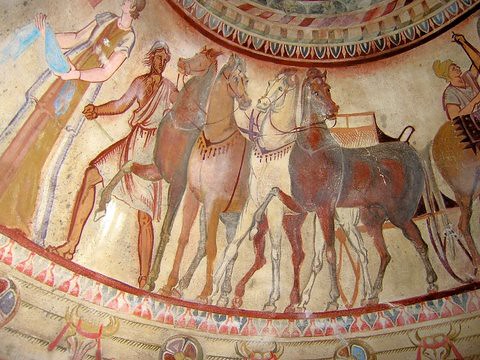
[Image of fresco from Thracian tomb in Kazanluk, Bulgaria courtesy of Peter Ashton]

Xenophon tells us the Odrysians raced horses and drank heavily after the burial of a warrior while later Roman writer Tacitus adds that the Odrysians frequently used gifts as a diplomatic strategy to get things done.

The radio carbon dating analysis carried out in Heidelberg, Germany, in the laboratory of Dr. Bernd Krommer, have shown that the stake was burned in the period after 358 BC, when the temple was constructed, and the earth was heaped on top of it to form a burial mound.

The analysis of the lab research and of the events which happened at that time have given archaeologist Ivan Hristov grounds to conclude that the temple in the village of Starosel, in the so called Chetinyova Mound, and the nearby Thracian ruler’s residence under Mount Kozi Gramadi were built during the reign of the Thracian King Amatokos II (359-351 BC), of the Thracian Odrysian state (5th-3rd century BC.

The family coat of arms of King Amatokos was a doubleheaded ax, or a labrys. Symbols of a labrys were discovered on several items around Starosel, including Thracian coins.

Before Dr. Hristov’s analysis, the researchers of Ancient Thrace believed that the Starosel tomb and underground temple complex were built by King Sitalces (445-424 BC), the third ruler of the Odrysian State. - Novinite.com
The Gold of Thrace   The Odrysian Kingdom of Thrace: Orpheus Unmasked (Oxford Monographs on Classical Archaeology)   Thracian Language and Greek and Thracian Epigraphy   Scythian and Thracian (Ashmolean Handbooks)   The Thracians 700 BC-AD 46 (Men-at-Arms)
If you enjoyed this post, never miss out on future posts by following me by email!

Wednesday, November 18, 2009

Gold, Silver and Bronze Vessels found in burial near chariot discovery


Marvelous discoveries of ancient Thracian treasures continue in Bulgaria. I truly hope I can see some of these finds some day. Apparently these antiquities were uncovered close to the site where a completely intact bronze-embellished Thracian chariot was found in September 2007.

While looking for an image of the finds I stumbled across this marvelous blog about ancient Bulgaria that provided a number of images of the chariot excavation including this one.

"In October and November 2009, archaeologist Veselin Ignatov’s team found a burial tomb of dated back to the end of 1st century and beginning of 2nd century AD, located outside of the village of Karanovo, in southern Bulgaria.

The finds at the lavish Thracian tomb include gold rings, silver cups and vessels coated with gold and clay vessels. Those include two silver cups with images of love god Eros, and a number of other ornate silver and bronze vessels." - More: Sofia News Agency

The precious items once belonged to an aristocrat descended from the ruling elite of the Odrysian Kingdom (5th -3rd century BCE).

According to the Greek historians Herodotus and Thucydides, a royal dynasty emerged from among the Odrysian tribe in Thrace around the end of the 5th century BCE, which came to dominate much of the area and peoples between the Danube and the Aegean for the next century. Later writers, royal coin issues, and inscriptions indicate the survival of this dynasty into the early first century CE, although its overt political influence declined progressively first under Persian, Macedonian, later Roman, encroachment. Despite their demise, the period of Odrysian rule was of decisive importance for the future character of south-eastern Europe, under the Roman Empire and beyond. - Wikipedia
[Image - Golden mask of 4th century BCE Thracian King discovered near Topolchene in 2007. Courtesy of News.bg]

The Odrysians built roads to develop trade and built a powerful army, at one point numbering over 150,000 men.

Under the Odrysians Greek became the language of administrators and of nobility and the Greek Alphabet was adopted; Greek customs and fashions contributed to the recasting of east Balkan society.The nobility adopted Greek fashions in dress, ornament and military equipment, spreading it to the other tribes.

In the 4th century BC, the kingdom split itself in three smaller kingdoms, of which one, with the capital at Seuthopolis survived the longest. During the Hellenistic era it was subject at various times to Alexander the Great, Lysimachus, Ptolemy II, and Philip V, and was at one time overrun by the Celts, but usually maintained its own kings. During the Roman era its Sapaean rulers were clients of Rome until Thrace was annexed as a Roman province in 46 AD. - Wikipedia


If you enjoyed this post, never miss out on future posts by following me by email!

Tuesday, July 21, 2009

Youtube video of Thracian treasures of Bulgaria breathtaking!

While I was on YouTube looking for a video about Macedonian tombs I came across this video that gives a wonderful overview of the spectacular Thracian treasures that have been unearthed in Bulgaria. I hope to visit Bulgaria one day and see these wonders for myself!

If you enjoyed this post, never miss out on future posts by following me by email!

Wednesday, August 06, 2008

Bulgaria Archeologists Unearth 1900-Year-Old Thracian Chariot

"A team of Bulgarian archeologists has discovered a unique, fully preserved four-wheeled Thracian chariot, which is more than 1900 years old.

The discovery was made close to the village of Borisovo, Yambol District in southeast Bulgaria by a team of the Archeological Institute of the Bulgarian Academy of Sciences.

The expedition is led by the leading Bulgarian archeologist Daniela Agre. The chariot is unique because it is the only one found in Bulgaria in the very way the ancient Thracians laid it in the tomb of a wealthy aristocrat.

It also has a very complicated construction, and all artifacts found in its trunk are fully preserved including pottery and glass vessels.

The skeletons of two horses drawing the chariot and a dog, who were murdered ritually during the funeral 1900 years ago are also fully preserved. The horse bow of the chariot has a small metal panther on its top, which resembles the symbol of the Jaguar automobile.

According to Daniela Agre, the chariot dates back to the time of the Roman Emperor Trajan, when Thrace was already a Roman province but many Thracian aristocrats had preserved their privileges and were serving in parts of the Roman army.

She explained there was a major north-south Thracian road in what is today southeast Bulgaria, and that the whole region was extremely rich in invaluable archeology objects."
If you enjoyed this post, never miss out on future posts by following me by email!

Thursday, June 19, 2008

Ancient Jewelry Unearthed in Temple of Sun near Bulgaria's Sliven

"The archaeologist team of Bulgaria's Georgi Kitov has unearthed precious jewels, dating back from second or third century in Drumeva Mound near the Town of Sliven, the manager of the expedition himself announced.

The scientists found golden earrings, silver bracelets and three bronze rings in a Roman brick tomb of woman, buried in the mound.

A mourning bronze coin was discovered in the mouth of the skeleton and there was clay beads round its neck, the deputy-head of the group, Nikolay sirakov, revealed.

Drumeva Mound was girded with a stone wall, which showed it probably was a temple of the sun, Doctor Kitov said few days ago in an interview for Darik Radio." - Novonite.com
If you enjoyed this post, never miss out on future posts by following me by email!

Friday, May 16, 2008

Bulgarian Tomb Inscriptions Reveal Importance of Thracian King


Professor Konstantin Boshnakov from Sofia University "St. Kliment Ohridski" announced Friday that two unique inscriptions that he recently discovered in the Thracian tomb in the Bulgarian town of Kazanluk reveal the importance of Thracian King Roygos.

"In the last year, Boshnakov conducted the first in Bulgaria testing in the Kazanluk tomb to search for inscriptions.

The two inscriptions that he found on the walls of the tomb about three meters above the floor state: "Kodzimases painted" and "Roygos, Son of Sevt".

The inscriptions provide new invaluable information about the history of Ancient Thrace casting light on the names of two previously only vaguely known figures.

The name of the Thracian ruler Roygos had been known only from the coins minted at his time. The Bulgarian archeologists and historians thought he was an insignificant regional ruler in what is today southeast Bulgaria.

After Boshnakov's findings, it is now certain that Roygos was not only an important Thracian king in 4th-3rd century B.C. but also the son of the founder of the Thracian capital Sevtopolis King Sevt III."
If you enjoyed this post, never miss out on future posts by following me by email!

Saturday, December 22, 2007

"Private Collectors" of Thracian art denying cultural history to the world


This kind of article just breaks my heart to think of all of the beautiful artifacts just stored and jealously hoarded by a single collector.

According to a new study conducted by the Bulgarian Center for the Study of Democracy, as many as 250,000 people may be involved in illegal racketeering. Some are even brazen enough to put their pieces on show. The most controversial is casino king Vassil Bozhkov, 51, nicknamed "The Skull", who, in addition to countless gambling houses in Sofia, also runs the popular betting agency Eurofootball. He has already survived one assassination attempt, while one of his closest business partners was killed by a gunman.

In his private life, the millionaire indulges in a very specialized passion: He has collected hundreds of Roman, Greek and Thracian works of art and his coin collection is one of the most extensive in the country.

To coincide with Bulgaria's admission into the EU, Bozhkov was invited to exhibit a number of examples of his collection in the EU Parliament in Brussels; he even obtained funding for the exhibition from the Bulgarian Culture Ministry. In the eyes of Vassil Nikolov, the Bozhkov exhibition was "the fruit of grave-robbing." Nikolov was not only the long-time director of the Institute of Archaeology and Museum in Sofia, but was also president of the state committee responsible for every single archaeological dig that took place in the country. Without his signature, not even the smallest shovelful of historical earth could be moved -- or at least not officially.

But unofficially is a different story: "There is not a single dig site or historical monument in the country," says Nikolov, "that has never been looted."

"The looters have the most up-to-date technology and good off-road vehicles. They are very mobile and extremely well informed," says Sofian archaeologist Nikolai Markov. "Our rivals are certainly no amateurs and their modus operandi points to criminal gangs at work."

Volodia Velkov heads a 30-person specialist unit responsible for the fight against the organized robbery and trafficking of archaeological treasures. "In the area surrounding ancient settlements, local crews are hired for a few Lev to dig up whatever's there. It's a well-paid job for anyone who would otherwise be living in poverty," explains Velkov. Anything they find is then given to middlemen who try to get the valuable booty across the border as quickly as possible.

Velkov says that most buyers of the ancient treasures are abroad, for instance in Germany or Austria. According to German investigators, a battery of shady antique dealers who also deal in stolen goods from the Balkans has set up shop in Munich in recent years. Bulgaria, even more than Italy or Greece, is currently the most important supplier of valuable artifacts from the ancient world, says Neil Brodie, Research Director of the Illicit Antiquities Research Center in Cambridge, England.

Bulgarian experts have even on occasion discovered suspected stolen goods in the catalogs of international auction houses. Last year, for example, Christie's in London had a rare Byzantine silver bowl from the 12th century, richly decorated with striking hunting motifs, on sale. The piece was valued at $645,000. "
If you enjoyed this post, never miss out on future posts by following me by email!
Tuesday, August 07, 2007

Citizen of Ancient Apollonia discovered in Sozopol Bulgaria

Novonite.com: Archaeologists from the Bulgaria's National History Museum have unearthed a tomb of a citizen, who lived in the ancient city of Apollonia, which is today's Black Sea town of Sozopol.

The team of Krastina Panayotova is working on the Harmani beach of Sozopol, a site which archaeologist have been exploring for many years now. During regular excavations Panayotova's team stumbled upon the tomb.

When the scientist opened it they found many pottery, the skeleton of a man, who lived some 2,500 years ago and a huge ceramic bowl with an inscription in ancient Greek.

The bowl has been already taken for a thorough expertise and a team of linguists was called to decipher the inscription. When this is done, the Head of the Museum Bozhidar Dimitrov hopes the scientists will get a further understanding of Apollonia Pontica - the first democratic state in the lands of today's Bulgaria.

The interesting thing for this artefact is that it was unearthed in the family part of the necropolis, where Histiyani, the tyrant of Milet, was buried.
If you enjoyed this post, never miss out on future posts by following me by email!

Sunday, July 22, 2007

Golden mask found in Bulgarian tomb

I really MUST visit Bulgaria!

"Archaeologists have unearthed a 2 400-year-old golden mask in an ancient Thracian tomb in south-eastern Bulgaria, scholars announced on Monday.

The mask was discovered over the weekend by a team of archaeologists excavating near the village of Topolchane, 290km east of the capital, Sofia. Its discovery, archaeologists said, indicates a Thracian king was buried in the tomb.

It was found together with a solid gold ring engraved with a Greek inscription and with the design of a bearded man in a timber-lined Thracian grave.

Team leader professor Georgi Kitov said that they also found a silver rhyton, silver and bronze vessels, pottery and funerary gifts.

"These finds confirm the assumption that they are part of the lavish burial of a Thracian king," said professor Margarita Tacheva, who was also on the dig.

"The artifacts belonged to a Thracian ruler from the end of the 4th century BC who was buried here," Kitov added."
If you enjoyed this post, never miss out on future posts by following me by email!

Sunday, June 24, 2007

Royal frieze unearthed in Bulgaria

More exciting finds in Bulgaria!

The Bulgarian archaeologists Daniela Agre and Deyan Dichev, who are leading the Strandzha expedition, unearthed a royal frieze near the village of Golyam Dervent. Dichev and Agre were researching a dolmen (dolmens were the first Thracian tombs) when they noticed a frieze of intertwined zoomorphic and geometrical elements carved on the entrance of the tomb. The most interesting part of the discovery is the double-axe (labris) - a symbol of power in the Thracian society - placed inside a circle. The labris has lots of additional ornamentation on it, Dichev said. The frieze includes the images of snakes, which were the symbol of the king in the Thracian religious beliefs.

Archaeologists have also discovered a Mycenaean bronze sword cap in an ancient Thracian sanctuary in Bulgaria. The artifact was unearthed in the sanctuary, which is situated in between ten rock tombs in Arda River valley near the village of Dolno Cherkovishte. The marble cap has once been put at a bronze sword haft and was among the gifts, presented by the Thracians at the sanctuary more than 1,300 years ago. "The find dates from 15th century BC and it is typical for the Mycenaean armament," the archaeologist Georgi Nihrizov explained.

http://www.novinite.com/view_news.php?id=81791
If you enjoyed this post, never miss out on future posts by following me by email!

Thursday, June 14, 2007

Image of Labyrinth found in Bulgarian tomb


Bulgarian archaeologists have found an image of the legendary labyrinth of King Minos, the Bulgarian National Radio reported.

The exclusive find was unearthed near the village of Golyam Derven last week.

The team of Professor Daniela Agre, who are doing excavation works in the area, stumbled upon the unique artefact while researching a an ancient Thracian tomb's entrance stone.

The labyrinth image, which is carved on the slate, is perfectly preserved.

The legendary labyrinth was considered a just a myth from the Greek mythology until the exclusive finding. According to the legends, King Minos ordered the construction of the labyrinth to keep inside the monstrous Minotaur.
If you enjoyed this post, never miss out on future posts by following me by email!