A history resource article by Mary Harrsch © 2014
I see that the facimile of King Tutankhamun's tomb has been completed in Luxor and will be officially opened to the public on May 1, 2014:
"The exact facsimile of the Tomb of Tutankhamun has been installed underground in a building next to Carter’s House, at the entrance to the Valley of the Kings and is due to be officially opened on 30th April 2014. The public opening will be 1st May 2014.
The facsimile, made by Factum Arte, Madrid is the most accurate large-scale facsimile to be made to date. This is the culmination of many years work and is an important milestone in the approach to responsible heritage management and the use of advanced technology in the promotion of sustainable tourism.
It has been made with the full support of the Egyptian Ministry of Tourism, the Minister of State for Antiquities and with the backing of the European Union. The facsimile is a gift to the people of Egypt from Factum Foundation. It is housed in an underground building designed by the Tarek Waly Centre: Heritage and Architecture, Cairo.
The work has involved the development of advanced 3D technologies for recording the tombs and
perfecting the method to replicate them. It is the first stage of a larger project that involves the
creation of facsimiles of the Tombs of Seti I and Nefertari – both currently closed to the general
public." - Factum Foundation for Digital Technology in Conservation
Although I always prefer to see original artifacts and historical sites when I can, I certainly understand the need for such reproductions. I wish there had been a reproduction of the Grotte de Niaux available when I tried to visit it last spring on my trip to southern France. The Grotte de Niaux is billed as the last prehistoric cave with cave art that is open to the public. But it really isn't "open" to the public either. You must attempt to book a reservation days ahead and it will only be granted if French schools don't already have it booked up.
Here's an excerpt from My Trip Journal about my attempts to see the Grotte de Niaux while visiting southern France in May 2013:
I may never have the opportunity to visit southern France again so this experience was particularly discouraging. There may have been a reproduction of the caves at the Museum of Prehistoric Art if I could have convinced my traveling companions to visit it. At least I would have had my memories of it rather than a hair-raising climb to a site where we were refused admission.
For those of you who won't be traveling to Egypt anytime soon, you can see a remarkable reproduction of rock cut tombs near Beni Hasan, Egypt built from 2100 to 1100 BCE at the Rosicrucian Egyptian Museum in San Jose, California. (You can view my other images of the Rosicrucian Egyptian Museum here.)
There is also a reproduction of Tutankhamun's Tomb and artifacts now on display at Union Station in Kansas City, MO. From Kansas City, the exhibit will move to The San Diego Natural History Museum where it will be on display from October 11, 2014 - April 26, 2015. I hope to catch the exhibit in Kansas City when I drive to the east coast to watch my oldest grandson graduate from high school in June. Yep, I'm a grand-mummy!
Related articles
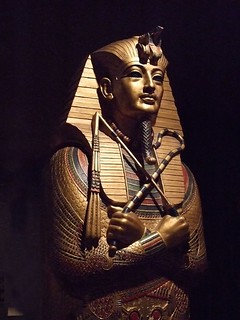 |
| Replica of King Tutankhamun's Mummy Case at the Rosicrucian Egyptian Museum (Photo credit: Mary Harrsch © 2006) |
I see that the facimile of King Tutankhamun's tomb has been completed in Luxor and will be officially opened to the public on May 1, 2014:
"The exact facsimile of the Tomb of Tutankhamun has been installed underground in a building next to Carter’s House, at the entrance to the Valley of the Kings and is due to be officially opened on 30th April 2014. The public opening will be 1st May 2014.
The facsimile, made by Factum Arte, Madrid is the most accurate large-scale facsimile to be made to date. This is the culmination of many years work and is an important milestone in the approach to responsible heritage management and the use of advanced technology in the promotion of sustainable tourism.
It has been made with the full support of the Egyptian Ministry of Tourism, the Minister of State for Antiquities and with the backing of the European Union. The facsimile is a gift to the people of Egypt from Factum Foundation. It is housed in an underground building designed by the Tarek Waly Centre: Heritage and Architecture, Cairo.
The work has involved the development of advanced 3D technologies for recording the tombs and
perfecting the method to replicate them. It is the first stage of a larger project that involves the
creation of facsimiles of the Tombs of Seti I and Nefertari – both currently closed to the general
public." - Factum Foundation for Digital Technology in Conservation
Although I always prefer to see original artifacts and historical sites when I can, I certainly understand the need for such reproductions. I wish there had been a reproduction of the Grotte de Niaux available when I tried to visit it last spring on my trip to southern France. The Grotte de Niaux is billed as the last prehistoric cave with cave art that is open to the public. But it really isn't "open" to the public either. You must attempt to book a reservation days ahead and it will only be granted if French schools don't already have it booked up.
Here's an excerpt from My Trip Journal about my attempts to see the Grotte de Niaux while visiting southern France in May 2013:
"We found the Museum of Prehistoric Art first which looked fascinating but my traveling companions didn't want to spend time there so regretfully I can't describe its exhibits. We checked the map then continued on to the road pointing to the cave. As we turned off, the road became narrower and narrower and climbed higher and higher until we were clinging to the sheer rock face of a cliff on one side with a drop off of several thousand feet on the other. The views were spectacular but really made your heart pound! We finally turned a sharp corner and found a huge parking area where a big tour bus sat parked. I couldn't believe that bus had actually traversed the road we had just climbed!
 |
| Reproduction of a prehistoric cave painting of a horse. Photographed at the San Diego Museum of Man by Mary Harrsch © 2006 |
Unfortunately, we learned that entry to the cave was restricted to no more than 20 people at a time to minimize the damage to the paintings from human respiration and today all entries were booked up by school groups. What a disappointment! I had read in the guide book about the 20 person limit per group and the recommendation to obtain an entry ticket and time before going up there but we thought it was only a recommendation. Believe me, it is a requirement!! Furthermore, if you want a tour in English there is only one each day at 1 p.m.
Although I have seen beautiful reproductions of cave paintings at the Museum of Man in San Diego, I would have loved to have seen the actual paintings in situ. Niaux is said to have paintings of horses, bison and prehistoric ibex from the Magdalénien era."
I may never have the opportunity to visit southern France again so this experience was particularly discouraging. There may have been a reproduction of the caves at the Museum of Prehistoric Art if I could have convinced my traveling companions to visit it. At least I would have had my memories of it rather than a hair-raising climb to a site where we were refused admission.
 |
| Reproduction of rock cut tombs near Beni Hasan, Egypt built from 2100 to 1100 BCE at the Rosicrucian Egyptian Museum in San Jose, California. Photographed by Mary Harrsch © 2006 |
There is also a reproduction of Tutankhamun's Tomb and artifacts now on display at Union Station in Kansas City, MO. From Kansas City, the exhibit will move to The San Diego Natural History Museum where it will be on display from October 11, 2014 - April 26, 2015. I hope to catch the exhibit in Kansas City when I drive to the east coast to watch my oldest grandson graduate from high school in June. Yep, I'm a grand-mummy!
Related articles