An online magazine featuring articles about current archaeology and research into the art, literature, politics, warfare, entertainments, music, religion, cuisine and daily lives of inhabitants of the past other than those of the Greco-Roman period edited by a history enthusiast and technologist who is particularly interested in integrating technology and history education. For those who interacted with the Roman world, see "Roman Times."
Although the most common ancient Egyptian head rests found by archaeologists consist of a stand with an upper curved section to support the head and single or multiple supports attached to a fixed base, rare folding New Kingdom examples have also been discovered, featuring sculptures of Bes. Frequently represented on furniture, Bes was a household god who was often depicted as a lion. He was also a protective deity, and in this role he would safeguard the sleeping or the deceased against enemies with a ferocious growl like that indicated on his face in these examples.
While usually shown without any cushion to soften the hard surface on which the head lies, some headrests have been found that still have soft cloth wrapped around them, so they may not have been as uncomfortable as the bare rests suggest. The ancient Egyptians tended to view death as an eternal kind of sleep – as a result, many of the headrests found in Egyptian tombs were inscribed with the owner’s name and epithets. Archaeologists think some of the more ornate head rests, like those found in the tomb of the Pharaoh Tutankhamun, depicted a religious association with the solar cult, since an individual lowered their head onto the head rest at night and arose from it in the morning.
Folding neck rest with depiction of Bes from the tomb of Pharaoh Tutankhamun, ivory, New Kingdom, 18th dynasty courtesy of touregypt.net, Folding neck rest with depiction of Bes,
New Kingdom, 1552-1069 BCE,
Folding neck rest with depiction of Bes, New Kingdom, 1552-1069 BCE, wood, in the collections of The Louvre courtesy of Hervé Lewandowski
Headrest from the tomb of King Tutankhamun with the base of the headrest depicting two “lions of the horizon”, while the god Shu holds up the head’s cup, in the same manner as is seen in the Book of the Dead where the solar barque rests on a stand.
Courtesy of Wikimedia Commons contributor Jon Bodsworth.
If you enjoyed this post, never miss out on future posts by following me by email!
I see that the facimile of King Tutankhamun's tomb has been completed in Luxor and will be officially opened to the public on May 1, 2014:
"The exact facsimile of the Tomb of Tutankhamun has been installed underground in a building next to Carter’s House, at the entrance to the Valley of the Kings and is due to be officially opened on 30th April 2014. The public opening will be 1st May 2014.
The facsimile, made by Factum Arte, Madrid is the most accurate large-scale facsimile to be made to date. This is the culmination of many years work and is an important milestone in the approach to responsible heritage management and the use of advanced technology in the promotion of sustainable tourism.
It has been made with the full support of the Egyptian Ministry of Tourism, the Minister of State for Antiquities and with the backing of the European Union. The facsimile is a gift to the people of Egypt from Factum Foundation. It is housed in an underground building designed by the Tarek Waly Centre: Heritage and Architecture, Cairo.
The work has involved the development of advanced 3D technologies for recording the tombs and
perfecting the method to replicate them. It is the first stage of a larger project that involves the
creation of facsimiles of the Tombs of Seti I and Nefertari – both currently closed to the general
public." - Factum Foundation for Digital Technology in Conservation
Although I always prefer to see original artifacts and historical sites when I can, I certainly understand the need for such reproductions. I wish there had been a reproduction of the Grotte de Niaux available when I tried to visit it last spring on my trip to southern France. The Grotte de Niaux is billed as the last prehistoric cave with cave art that is open to the public. But it really isn't "open" to the public either. You must attempt to book a reservation days ahead and it will only be granted if French schools don't already have it booked up.
Here's an excerpt from My Trip Journal about my attempts to see the Grotte de Niaux while visiting southern France in May 2013:
"We found the Museum of Prehistoric Art first which looked fascinating but my traveling companions didn't want to spend time there so regretfully I can't describe its exhibits. We checked the map then continued on to the road pointing to the cave. As we turned off, the road became narrower and narrower and climbed higher and higher until we were clinging to the sheer rock face of a cliff on one side with a drop off of several thousand feet on the other. The views were spectacular but really made your heart pound! We finally turned a sharp corner and found a huge parking area where a big tour bus sat parked. I couldn't believe that bus had actually traversed the road we had just climbed!
Unfortunately, we learned that entry to the cave was restricted to no more than 20 people at a time to minimize the damage to the paintings from human respiration and today all entries were booked up by school groups. What a disappointment! I had read in the guide book about the 20 person limit per group and the recommendation to obtain an entry ticket and time before going up there but we thought it was only a recommendation. Believe me, it is a requirement!! Furthermore, if you want a tour in English there is only one each day at 1 p.m.
Although I have seen beautiful reproductions of cave paintings at the Museum of Man in San Diego, I would have loved to have seen the actual paintings in situ. Niaux is said to have paintings of horses, bison and prehistoric ibex from the Magdalénien era."
I may never have the opportunity to visit southern France again so this experience was particularly discouraging. There may have been a reproduction of the caves at the Museum of Prehistoric Art if I could have convinced my traveling companions to visit it. At least I would have had my memories of it rather than a hair-raising climb to a site where we were refused admission.
For those of you who won't be traveling to Egypt anytime soon, you can see a remarkable reproduction of rock cut tombs near Beni Hasan, Egypt built from 2100 to 1100 BCE at the Rosicrucian Egyptian Museum in San Jose, California. (You can view my other images of the Rosicrucian Egyptian Museum here.)
There is also a reproduction of Tutankhamun's Tomb and artifacts now on display at Union Station in Kansas City, MO. From Kansas City, the exhibit will move to The San Diego Natural History Museum where it will be on display from October 11, 2014 - April 26, 2015. I hope to catch the exhibit in Kansas City when I drive to the east coast to watch my oldest grandson graduate from high school in June. Yep, I'm a grand-mummy!
I see the committee presently overseeing Egyptian antiquities is planning to re-erect a dismantled replica tomb of King Tutankhamun, placing it beside the former residence of
Howard Carter opens the innermost shrine of King Tutankhamen's tomb near Luxor, Egypt which one of carter's water boy discovered. (Photo credit: Wikipedia)
discoverer Howard Carter on Luxor's west bank. The replica, built between 2009 and 2012 by Madrid-based Factum Arte, was constructed using 3D scanners to accurately capture the structural features of the tomb.
It was one of three tombs reconstructed as part of a project to provide an alternative to tourists when the tombs of Tutankhamun, Nefertari and Set I are closed to the public in 2014 because of damage from the respiration of the high number of visitors each tomb receives.
The project was apparently delayed by the recent civil unrest. I had always hoped to travel to Egypt and see Tutankhamun's tomb for myself but it is looking more and more unlikely as the social upheaval there continues and travel becomes increasingly difficult for me due to health issues.
At least I had a chance to explore a life-sized replica of an Egyptian rock cut tomb when I visited the Rosicrucian Egyptian Museum in San Jose, California in 2006. The replica is a composite of tombs of Egyptian governors and nobles discovered near Beni Hasan, Egypt and were built from 2100 to 1100 BCE.
The Rosicrucian Egyptian Museum also exhibits one of only three known remains of Apis Bulls in the world. The Apis bull, a black beast with distinct markings, was the most important of all the sacred animals in Egypt and his worship, instituted by Raneb in the Second Dynasty, began in Memphis about 2740 BCE. The bull was thought to serve as an intermediary between humans and the great god Ptah (later Osiris).
Anyway, if, like me, you can't make it to Egypt anytime soon, maybe you can visit the Rosicrucian Egyptian Museum in San Jose, CA instead or, at least, for the time being. If you'd like to see more of the marvelous artifacts and museum-quality reproductions on display there, check out my image set on Flickr. Related articles
I see that my friends from Heritage Key got a chance to travel to Manchester, England to see the Tutankhamun: His Tomb and His Treasures' exhibition. When I first heard about this exhibition, I emailed the organizers and asked if it was scheduled for any appearances in the United States but unfortunately, they said no. I was really disappointed because I think people here would find it so interesting to view one of history's most important archaeological discoveries in the context that Howard Carter explored in 1922.
I was so relieved to hear the exhibit would not be discarded as I had enjoyed touring the exhibit every time I visited Las Vegas until my last visit in September 2008. The quality of the replicas is so good that when I attended the current King Tut exhibit when it was displayed at the Los Angeles County Museum of Art, I saw several of the actual items whose replicas I had seen in the Luxor Hotel exhibit and must honestly say if the real item and the replica had been displayed side by side I would not have been able to point out the original.
Here's a slideshow of the items I saw in Las Vegas:
Each week I check the latest releases available instantly from Netflix and today I was thrilled to see that a number of great history titles from National Geographic are now available to add to your instant queue.
Alexander the Great: The man behind the legend:
Other titles include: Egypt: Quest for Eternity and Egypt: Lost Tombs. I also noticed that the excellent PBS series Greece: Crucible of Civilization has also been added to the list of programs available for instant download.
Also, while I was up on YouTube looking for these clips I noticed that the new National Geographic program "The Silver Pharaoh" is available in three installments up on YouTube. Here's the clip for part 1:
The tomb of 21st century pharaoh Psusennes I was originally discovered in 1940 in the remains of the ancient city of Tanis by French archaeologist Professor Pierre Montet. Psusennes I was the third king of the Twenty-first dynasty of Egypt who ruled between 1047 – 1001 BC.
The intact tomb yielded treasures comparable to those found in the tomb of King Tutankhamun.
"fingers and toes had been encased in gold stalls, and he was buried with gold sandals on his feet. The finger stalls are the most elaborate ever found, with sculpted fingernails. Each finger wore an elaborate ring of gold and lapis lazuli or some other semiprecious stone." - Egyptian Mummies: Unraveling the Secrets of an Ancient Art By Bob Brier
But, the discovery was overshadowed by the start of World War II. With the exception of a cursory autopsy of the badly decomposed remains of the king, treasures from the find have unbelievably been virtually ignored for the past 70 years until now.
As I watched the program I was fascinated to learn that Psusennes I was the fourth son of the High Priest of Amun in Karnak, who became pharaoh during Egypt's last dark intermediate period. The high priests of Amun, once thwarted in their lust for power by the "heretic" pharaoh Akhenaten (read about the Amun vs. Re/Aten rivalry in my recent review of Michelle Moran's novel "Nefertiti") apparently finally succeeded in their ultimate quest to take over the Egyptian state three hundred years after the fall of Amarna (Akhetaten).
The silver sarcophagus of 21st dynasty pharaoh Psusennes I.
Image courtesy of National Geographic.
I also found the description of the extra craftsmanship needed to produce a silver sarcophagus rather than a gold one very interesting. Psusennes I did have a gold death mask like Tutankhamun but the outer coffin was silver, a once scarce and costly metal in Egypt that had become more plentiful at the time because of international trade. In my opinion, it is as exquisite as Tut's gold one.
Forensic portrait of Pharaoh Psusennes I in his later years.
Image courtesy of National Geographic.
Of course he is depicted as a young man on his coffin but in fact was probably over 80 years old at the time of his death. A couple of days ago I wrote about the wonderful forensic 3D artwork of Elisabeth Daynès. (See next post below). This program included a forensic artist's 2D rendering of Psusennes I in his later years based on his skull and lack of teeth.
I don't think I would have wanted to cross this king. He looks like he was the model for faces of the mummies who have appeared in old Hollywood horror flicks!
"Egyptian scientists are doing DNA tests on stillborn children found in the tomb of the Pharoah Tutankhamun in the hope of identifying their mother and grandmother, who may be the powerful queen Nefertiti, Egypt's chief archaeologist said on Wednesday.
Many scholars believe their mother to be Ankhesenamun, the boy king's only known wife. Ankhesenamun is the daughter of Nefertiti, renowned for her beauty.
The DNA tests and computerised tomography (CT) scans, to be performed at Cairo University, should be finished by December, Hawass said. Egypt has been trying to check the identity of all its royal mummies using DNA and CT scans. Tutankhamun's was one of the first mummies to be examined with the technology in 2005."
If you enjoyed this post, never miss out on future posts by following me by email!
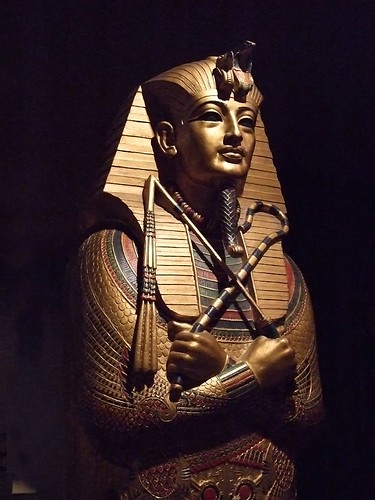
I see London is welcoming the latest King Tut exhibit in grand style. I saw the exhibit when it was in Los Angeles and found several of the items displayed particularly interesting, especially one of King Tut's diadems and one of his ceremonial daggers. I must admit, however, to being a bit disappointed as the exhibit was advertised as being roughly equivalent to the first King Tut exhibit in the US back in the 1960s. However, this exhibit was composed mostly of artifacts belonging to the pharaoh's extended family and few items actually came from the famous tomb. I thought it was particularly misleading to advertise the exhibit with huge images of the famous gold death mask when the mask is not part of the exhibit. Oh well, maybe someday I'll get to see the original in the Cairo Museum.
"Londoners welcomed a 25ft Egyptian god to the capital today. Passers-by watched the extraordinary sight of the enormous, five-tonne golden Anubis statue travelling up the Thames on the back of a cargo ship.
Tower Bridge was raised to make way for the ancient Egyptian jackal-headed God of the Dead as it was transported to its new position in Trafalgar Square.
The statue travelled from the US, where a three-year touring exhibition of Tutankhamun's treasures has recently closed. The Anubis installation in central London marks the forthcoming opening of Tutankhamun And The Golden Age Of The Pharaohs at the O2 Bubble, the first exhibition to be held at the venue.
Some 265,000 tickets have already been sold or reserved. The exhibition, which will include more than 130 treasures that are all between 3,000 and 5,000 years old, opens on November 15 and continues until August 30, 2008."
If you enjoyed this post, never miss out on future posts by following me by email!




+AF+TOPAZ+EXPOSURE+CORRECTION+PHOTO+POP.jpg)
+AF+TOPAZ+PHOTO+POP.jpg)