Showing posts with label festival. Show all posts

Thursday, December 25, 2008

Onassis Cultural Center to host Worshiping Women: Ritual and Reality in Classical Athens


I really need to plan a visit to the Onassis Cultural Center in New York. I wanted to see the exhibit about life in Sparta they hosted a couple of years ago but the Historical Novel Society conference I attended in Albany was scheduled too late. I'm afraid I won't get to see this excellent exhibit either as I'll be just back from Rome in March and would not have enough "recovery" time to turn around and attempt another trip to New York so soon.

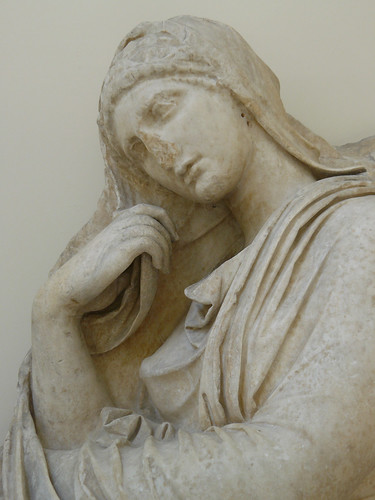
[Image - Although this sculpture of a mid-4th century BCE Attic woman from Acharnae Menidi discovered before 1827 is part of the permanent collection of the Metropolitan Museum of Art and is not part of the upcoming exhibit, it typifies the subtle grace and modesty depicted in sculpture of the period. This image is included in my Flickr image archive. I have licensed all images with Creative Commons for free non-commercial use with the attribution "Photo by Mary Harrsch". Any derivatives must also be shared in like manner]

The galleries of the Onassis Cultural Center in New York will be transformed into evocations of ancient Greek sanctuaries, each filled with artistic masterpieces assembled from international collections, for the major exhibition Worshiping Women: Ritual and Reality in Classical Athens. On view from December 10, 2008, through May 9, 2009, the exhibition brings together 155 rare and extraordinary archaeological objects in order to re-examine preconceptions about the exclusion of women from public life in ancient Athens. The story told by these objects, and experienced in the galleries, presents a more nuanced picture than is often seen, showing how women’s participation in cults and festivals contributed not only to personal fulfillment in Classical Greece but also to civic identity.

Among the treasures being brought to New York for the exhibition are marble statues of the goddesses Artemis and Athena (National Archaeological Museum, Athens); a white-ground vase with an image of Artemis, by the Pan Painter (State Hermitage Museum, Petersburg); a red-figure vase with an image of Iphigenia, the legendary heroine worshiped as a cult figure and seen as a model for priestesses (Museo Archeologico Nazionale, Ferrara); a vase showing the Trojan priestess Theano, another model for priestesses, receiving the Greek warriors who had come to recover Helen from Troy (Vatican Museums); and a limestone grave marker (conserved with support from the Onassis Foundation) carved with the image of a young woman in bridal costume, holding a votive offering (State Museums of Berlin). Interspersed with these and other exquisite artworks are archaeological objects that document the religious practices of Classical Athens and tell the complex story of women’s roles in that society.

Worshiping Women tells this story in three main chapters. “Goddesses and Heroines” introduces the principal female deities of Athens and Attica, in whose cults and festivals women were most actively engaged: Athena, Artemis, Aphrodite, and Demeter and her daughter Persephone. This first section also investigates the role of heroines, a special group of women believed to have lived in the distant past, who like Iphigenia became important figures of cult worship after their deaths.

The second chapter, “Women and Ritual,” explores the practice of ritual acts such as dances, libations, sacrifices, processions and festivals in which women were active in classical antiquity. Here the critical role of the priestess comes to light, specifically in her function as key-bearer for the temples of the gods.

In the final chapter, “Women and the Cycle of Life,” the exhibition explores how religious rituals defined moments of transition. Because the most important transition in a girl’s life was understood to be marriage, the wedding took on great significance, with its rituals depicted on a variety of vases associated with nuptial rites and wedding banquets. Death was another occasion on which Athenian women took on major responsibilities, such as preparing the deceased for burial and tending the graves of family members.

N.S. Gill's post about the exhibit in her "About Ancient History" blog included a link to a fascinating article about the ancient festival of Thesmophoria. An abstract:

Before the Thesmophoria festival itself, there was a preparatory night-time festival called the Stenia. At the Stenia women engaged in Aiskhrologia, insulting each other and using foul language. This commemorated Iambe's successful attempts to make the grieving mother Demeter laugh.

[This almost sounds like modern antics associated with male bonding!]

During the Stenia portion of the Thesmophoria women may have placed fertility objects, molded bread [in the shape of male genitals], pine cones and piglets, in a snake-filled chamber called a megaron.

The objects were later retrieved and ceremonially carried to an altar during a night time torch-lit procession commemorating Demeter's search for her kidnapped daughter Persephone. Aristophanes' comedic play Thesmophoriazusae tells the story of a man trying to infiltrate the Thesmophoria. Maybe Clodius of Roman fame got his idea to sneak into the celebration of the Bona Dea and seduce Julius Caesar's wife after reading the Thesmophoriazusae!

If you enjoyed this post, never miss out on future posts by following me by email!

Monday, March 24, 2008

Easter co-opted pagan festival of Spring


I found this article about the history of the Easter celebration extremely interesting. I was aware that such holidays as Christmas had developed from pagan festivals surrounding the winter solstice but did not realize Easter was not a historical Christian celebration. I was also dismayed that, like many other doctrines of the church, the observance of Easter Sunday was enforced by the persecution of dissenters. An abstract:

"The name Easter is actually derived from the name of an ancient goddess. In Europe she was known as Ostara, the goddess of spring. The Phoenicians called her Astarte, and her name also appears on Assyrian monuments found by 19th-century archaeologist Sir Henry Austen Layard in excavations at Nineveh. The Assyrians and the Babylonians called her Ishtar; in fact, the Assyrian pronunciation of her name sounds just like the English word Easter.

For more than a thousand years before Jesus’ birth, a festival to this goddess was celebrated each spring to mark the budding of new life—the resurrection of nature after the dead of winter. It was a feast of regeneration. Throughout the inhabited world in ancient times, spring festivals and various related sex rituals honored the sun’s welcome rays as they once again imparted life and warmth.

Professing Christians in the second century and later saw Christ’s resurrection to new life as a parallel to these pagan spring rituals. Gradually they incorporated the customs surrounding worship of the spring goddess into Christianity in the festival we know as Easter.

But the acceptance of Easter as a celebration within traditional Christianity did not come easily. Indeed, much controversy surrounded its integration into the Christian calendar.

Historical references show that the early Christian Church did not observe Easter. In his book The Primitive Church, Maurice Goguel noted that “those Christians of Jewish origin continued to celebrate the Jewish feasts, particularly the Passover...”

"...During the second century, the paths of the congregations in the West, centered at Rome, began to diverge from those in Asia Minor.

The two groups generally agreed that Jesus Christ ate the Passover on the 14th day of Nisan. The Christians in Asia Minor, who made up what came to be referred to as the Eastern church, stuck to that date for partaking of the bread and wine that symbolized Christ’s suffering and death. However, as Fernand Mourret pointed out in his five-volume History of the Catholic Church, “the Christians of the West made a different calculation. In their opinion the purpose of the great Christian feast was the commemoration of Christ’s Resurrection.”

So the church in the West established Sunday as a memorial to the resurrection, discontinuing the observance of the Passover on Nisan 14. But in Asia Minor, the Passover continued to be observed on that day..."

"...In time Constantine became the Roman emperor. In 313 he issued a proclamation at Milan that came to be called the Edict of Toleration, or the Edict of Milan. It accepted Christianity as an official religion in the empire, with legal equality to other religions.

Over the next several years, the church further removed itself from its Jewish roots and inculturated itself within Roman society. It became a politicized religion of the state. But the congregations in the East and even in other parts of the vast Roman Empire still differed significantly in doctrine and practice. Constantine therefore convoked the first great ecumenical council at Nicea, in Asia Minor, in 325.

This was a major turning point. The emperor had already decreed that the day of the sun should be kept as a weekly day of rest. Now the Council of Nicea would determine the course of the church in other respects as well.

In his letter to all those throughout the empire who had not attended the Council of Nicea, Constantine wrote concerning the keeping of Easter: “It appeared an unworthy thing that in the celebration of this most holy feast we should follow the practice of the Jews. . . . Let us then have nothing in common with the detestable Jewish crowd. . . . It is most fitting that all should unite . . . in avoiding all participation in the perjured conduct of the Jews.” From such comments it appears that the adoption of Easter Sunday worship was motivated more by hatred toward the Jews than by love for Jesus Christ—Himself a Jew.

Without regard to the decisions rendered by Constantine and the Council of Nicea, many continued to observe the Passover. Eventually, however, Constantine issued an edict against all those whom he regarded as heretics, as recorded by Eusebius in his Life of Constantine. In the edict the emperor declared: “We have directed, accordingly, that you be deprived of all the houses in which you are accustomed to hold your assemblies: and our care in this respect extends so far as to forbid the holding of your superstitious and senseless meetings, not in public merely, but in any private house or place whatsoever.”

Since evening meetings were also banned, observing the Passover on the eve of Nisan 14 became increasingly difficult. As the politically organized church at Rome grew to great size and power, it gradually succeeded in stamping out the biblical teaching regarding the Passover as the memorial of Christ’s death. Easter Sunday thus became universally accepted within that church as the day when Christians should celebrate His resurrection.

We find, then, that in the early centuries of what is often called the Christian era, an unbridgeable gulf opened up between professing Christian churches and the apostolic Church Jesus founded. Nowhere does the New Testament command or even suggest that Christ’s resurrection should be commemorated on Easter Sunday or indeed on any day."
If you enjoyed this post, never miss out on future posts by following me by email!