Tuesday, May 11, 2010

Nilometer discovered along the Avenue of the Sphinxes

While working on the the restoration of the Avenue of the Sphinxes, a 2.7-km (1.7-mile) ancient processional roadway that connects the grand temples of Luxor and Karnak on the east bank of the Nile River built by Amenhotep III (1410-1372 B.C.), scientists have uncovered a 5th century Egyptian Christian church and a "nilometer," a structure used to measure the level of the Nile during floods.  The Nilometer is cylindrical and crafted of sandstone with New Kingdom (1569-1081 B.C.) clay vessels at its bottom.

[Image Courtesy of Egypt's Supreme Council of Antiquites (SCA).]

"The structure, 7 meters (23 feet) in diameter, was encircled by a spiral staircase descending into the Nile. The steps allowed for a quick reading of increase in water level, thus forecasting floods."  - Discovery News

In ancient times the Nile would overflow its banks between June and September.  The ancient Egyptians divided their year into three seasons with the period of inundation being one of the three.  Tax levels were set based on the quantity of the anticipated flood.  So, predicting the quantity of the inundation became a carefully guarded responsibility of select priests and many nilometers were enclosed in temples to exclude all but priests and Egyptian rulers.


The simplest nilometer was a marked vertical column submerged in the waters of the river.  A very ornate version of this design, built in 861 CE by the Abbasid caliph al-Mutawakkil, can still be seen on the island of Rhoda in central Cairo.

The second type used a a flight of stairs leading down into the water, with depth markings along the walls. The best known example of this kind can be seen on the island of Elephantine in Aswan.  [Image courtesy of Wikimedia Commons user Rajor]

The type found along the Avenue of the Sphinxes represents the third and most elaborate design that incorporated a cistern connected to the river by a channel.  Another example of this type can be seen at  the Temple of Kom Ombo north of Aswan


The Nilometer and the Sacred Soil: A Diary of a Tour Through Egypt, Palestine, and Syria    Global Treasures Kom Ombo Egypt   Amenhotep III: Perspectives on His Reign   Chronicle of a Pharaoh: The Intimate Life of Amenhotep III
If you enjoyed this post, never miss out on future posts by following me by email!

Friday, May 07, 2010

2300-year-old Egyptian noblewoman centerpiece of renovated Nelson-Atkins gallery

The burial treasures of a 2300-year-old Egyptian noblewoman named Meretites, which means "beloved of her father", is the centerpiece of the newly reopened Egyptian gallery at the Nelson-Atkins Museum of Art in Kansas City. Robert Cohon, curator of art of the ancient world at the Nelson-Atkins points out that the arrangement of the art and subtle lighting is intended to give the impression of a tomb without being frightening.

"We want children to come in here, and want to know more," Cohon said. They will see the inner coffin painted with a huge golden-faced, blue-haired Meretites, as well as the myriad Egyptian gods and goddesses there for her journey into the afterworld." 

"Egyptian art has been a surreptitious pleasure for so many," Cohon continues. "This may also be a child's first exposure to death."

I was so excited to read about the Nelson-Atkins $1.7 million renovation.  They sound like they have a wonderful ancient art collection that spans over 4,000 years and there is a chance I may be going to Kansas City in July. 

[Image courtesy of the Nelson-Atkins Museum of Art]

My husband expressed his wish to go to the Military Vehicles Preservation Association national conference that is being held in Kansas City this year.  Its still a little iffy, though, with the gas prices climbing towards $4 a gallon again.  If there wasn't a possibility that he would buy some vehicle or large part, we could take my little fuel-efficient Scion but if we're attending a MVPA event, we'll probably need to take my husband's truck in case he wants to drag something back to Oregon.  At least now I have as much motivation to go as he does!

In addition to the funerary art of  Meretites that was purchased from a German collection back in 2007, the Egyptian galleries includes stone portraits of famous kings and queens from Sesostris III to Ramses II, from Nefertiti to the Ptolemies.  The museum's website points out that none of their recent purchases are contested by Egypt so they won't be in danger of repatriation.

Their Near Eastern collection includes grave goods from kings and queens of Ur and sculptures from the Palace of Ashurnasirpal II in Nimrud as well as the ceremonial center of the Persian Empire, Persepolis.  It will be interesting to compare their artifacts to those on display at the Oriental Institute at the University of Chicago.

The museum's Roman collection apparently centers on works of art from the second century CE created during the reigns of the emperors Hadrian and Severus.  Their Greek collection mentions a sculpture of a young athlete.  I couldn't find an image of it but wonder if it is engaged in a particular sport or is more of a representation of a victorious youth?  

Steven Holl: The Nelson-Atkins Museum of Art Bloch Building  Funerary Art of Ancient Egypt  The Severans: The Roman Empire Transformed  Hadrian and the Triumph of Rome   Assyrian Reliefs from the Palace of Ashurnasirpal II: A Cultural Biography   Forgotten Empire: The World of Ancient Persia
If you enjoyed this post, never miss out on future posts by following me by email!

Thursday, March 11, 2010

Wooden Stake in Starosel Tomb dates structure to reign of Odyrisan King Amatokos II

A wooden stake unearthed in the ancient Thracian burial mound known as Starosel Tomb in Bulgaria last summer has helped Bulgarian archaeologists to date the construction to the reign of the Thracian King Amatokos II, a monarch of the 4th century Odrysian state.  The Odrysians were a powerful Thracian tribe that ruled an area that extended from modern Bulgaria all the way to western Turkey in the valley of the Hebrus River from the 5th to 3rd century BCE.

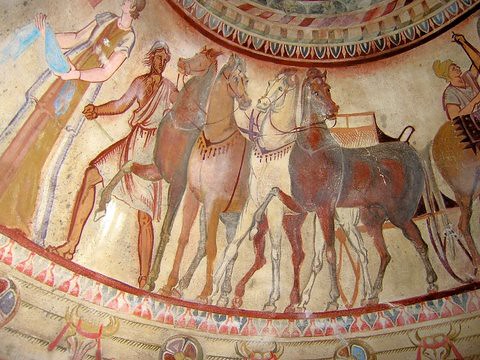
[Image of fresco from Thracian tomb in Kazanluk, Bulgaria courtesy of Peter Ashton]

Xenophon tells us the Odrysians raced horses and drank heavily after the burial of a warrior while later Roman writer Tacitus adds that the Odrysians frequently used gifts as a diplomatic strategy to get things done.

The radio carbon dating analysis carried out in Heidelberg, Germany, in the laboratory of Dr. Bernd Krommer, have shown that the stake was burned in the period after 358 BC, when the temple was constructed, and the earth was heaped on top of it to form a burial mound.

The analysis of the lab research and of the events which happened at that time have given archaeologist Ivan Hristov grounds to conclude that the temple in the village of Starosel, in the so called Chetinyova Mound, and the nearby Thracian ruler’s residence under Mount Kozi Gramadi were built during the reign of the Thracian King Amatokos II (359-351 BC), of the Thracian Odrysian state (5th-3rd century BC.

The family coat of arms of King Amatokos was a doubleheaded ax, or a labrys. Symbols of a labrys were discovered on several items around Starosel, including Thracian coins.

Before Dr. Hristov’s analysis, the researchers of Ancient Thrace believed that the Starosel tomb and underground temple complex were built by King Sitalces (445-424 BC), the third ruler of the Odrysian State. - Novinite.com
The Gold of Thrace   The Odrysian Kingdom of Thrace: Orpheus Unmasked (Oxford Monographs on Classical Archaeology)   Thracian Language and Greek and Thracian Epigraphy   Scythian and Thracian (Ashmolean Handbooks)   The Thracians 700 BC-AD 46 (Men-at-Arms)
If you enjoyed this post, never miss out on future posts by following me by email!