Wednesday, November 18, 2009

Gold, Silver and Bronze Vessels found in burial near chariot discovery


Marvelous discoveries of ancient Thracian treasures continue in Bulgaria. I truly hope I can see some of these finds some day. Apparently these antiquities were uncovered close to the site where a completely intact bronze-embellished Thracian chariot was found in September 2007.

While looking for an image of the finds I stumbled across this marvelous blog about ancient Bulgaria that provided a number of images of the chariot excavation including this one.

"In October and November 2009, archaeologist Veselin Ignatov’s team found a burial tomb of dated back to the end of 1st century and beginning of 2nd century AD, located outside of the village of Karanovo, in southern Bulgaria.

The finds at the lavish Thracian tomb include gold rings, silver cups and vessels coated with gold and clay vessels. Those include two silver cups with images of love god Eros, and a number of other ornate silver and bronze vessels." - More: Sofia News Agency

The precious items once belonged to an aristocrat descended from the ruling elite of the Odrysian Kingdom (5th -3rd century BCE).

According to the Greek historians Herodotus and Thucydides, a royal dynasty emerged from among the Odrysian tribe in Thrace around the end of the 5th century BCE, which came to dominate much of the area and peoples between the Danube and the Aegean for the next century. Later writers, royal coin issues, and inscriptions indicate the survival of this dynasty into the early first century CE, although its overt political influence declined progressively first under Persian, Macedonian, later Roman, encroachment. Despite their demise, the period of Odrysian rule was of decisive importance for the future character of south-eastern Europe, under the Roman Empire and beyond. - Wikipedia
[Image - Golden mask of 4th century BCE Thracian King discovered near Topolchene in 2007. Courtesy of News.bg]

The Odrysians built roads to develop trade and built a powerful army, at one point numbering over 150,000 men.

Under the Odrysians Greek became the language of administrators and of nobility and the Greek Alphabet was adopted; Greek customs and fashions contributed to the recasting of east Balkan society.The nobility adopted Greek fashions in dress, ornament and military equipment, spreading it to the other tribes.

In the 4th century BC, the kingdom split itself in three smaller kingdoms, of which one, with the capital at Seuthopolis survived the longest. During the Hellenistic era it was subject at various times to Alexander the Great, Lysimachus, Ptolemy II, and Philip V, and was at one time overrun by the Celts, but usually maintained its own kings. During the Roman era its Sapaean rulers were clients of Rome until Thrace was annexed as a Roman province in 46 AD. - Wikipedia


If you enjoyed this post, never miss out on future posts by following me by email!

Wednesday, November 11, 2009

Cambyses Lost Persian Army Found In The Sahara!


What a wonderful discovery! Two Italian archaeologist have found what appears to be the lost army of Persian King Cambyses in the Sahara desert. I learned about this cataclysmic event when I listened to Professor Elizabeth VanDiver's Teaching Company lecture series on Herodotus: The Father of History. It was the first lecture series from the Teaching Company that I had ever heard and I was mesmerized! I now have dozens of their lectures under my belt and about a dozen on my "to be heard" shelf in my library.

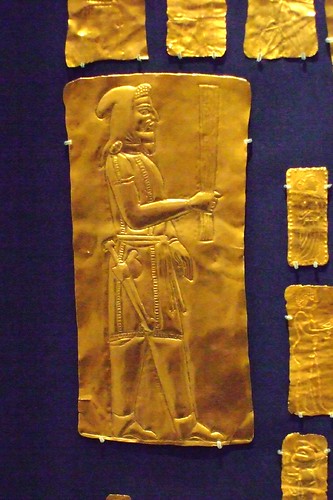
[Image: Gold ornaments from the Oxus Treasure depicting Persian warrior 5th-4th century BCE. Photographed at the British Museum by Mary Harrsch]

The article compared the discovery with Schlieman's discovery of Troy and I would have to agree and it is so exciting to have it occur in my own lifetime! How gratifying to culminate 13 years of research with such a marvelous discovery!

"A pair of Italian archaeologists have uncovered bronze weapons, a silver bracelet, an earring and hundreds of human bones in the vast desolate wilderness of the Sahara desert. Twin brothers Angelo and Alfredo Castiglioni are hopeful that they've finally found the lost army of Persian King Cambyses II.

According to the Greek historian Herodotus, Cambyses II and his armies were buried by a cataclysmic sandstorm in 525 B.C. He wrote, "a wind arose from the south, strong and deadly, bringing with it vast columns of whirling sand, which entirely covered up the troops and caused them wholly to disappear."

Now the discovery of these artifacts points towards an answer to this millennias-old mystery: The Castiglioni brothers studied ancient maps and came to the conclusion that Cambyses' army did not take the caravan route most archaeologists believe they used." - More: New American

If you enjoyed this post, never miss out on future posts by following me by email!

Thursday, October 22, 2009

Fighting Crickets and other imperial activities in the virtual Forbidden City


Last week I spent an entire day exploring the virtual Forbidden City that was created as a joint project between IBM and the Palace Museum in Rome. I found the rendered architecture breathtaking and learned a great deal about Chinese history and court life during the Ming and Qing dynasties.

[My avatar dressed as a woman of the Qing dynasty imperial court will help an Imperial Guard with his archery practice]

In addition to the environment itself, there were objects that could be examined like the golden "Dragon Throne" in the Hall of Supreme Harmony and the magnificent bronze guardian lions and xiehi, mythical beasts who understand human language and will impale the evil with their single horn.

I also enjoyed observing scenes of court life like the emperor reviewing petitions (referred to as memorials), eating a 20-course meal with a eunuch taster standing by with a silver spoon, and posing for a portrait that was being rendered by a court artist while the emperor's children played about him.

[Image: Learning to play weiqi from a wise master of the game]

Program developers even included interactive activities like helping an Imperial guardsman practice archery, training and fighting crickets and learning to play weiqi (GO).

The environment could be expanded even further to encompass a wealth of additional history-learning activities. I went up on the accompaying website and posted suggestions for a Chinese cooking module that could be added to the hall where visitors watch the emperor eating a meal. I think it would be fun for visitors to be able to challenge each other to a game of weiqi. I also think it would be interesting to add an application similar to the iPhone's "Brushes" program that would let visitors try their own hand at painting the emperor or scenes or people they see within the virtual palace. A "Brushes" like application could also be used in a caligraphy lesson or writing poetry.

[Image: Imperial Gardens in the virtual Forbidden City]

I also suggested having more animated scenes of other cultural activities like presentations of plays, music recitals or poetry readings or a hall where visitors can go and listen to Chinese philosophers. My editor at Heritage Key asked me if I could suggest a topic for a machinama presentation using the virtual environment and I told him I thought it would be really fascinating for visitors to watch an imperial wedding using the Hall of Supreme Harmony as the backdrop as this is the building where imperial weddings were held during the Ming dynasty.

I would encourage everyone to visit the virtual Forbidden City for yourselves. You will need to download a client that interacts with the server-based virtual environment. The system requirements are 2 Gb of Ram Memory and a Pentium 4 2.4GHz+ or AMD 2400xp+ processor and 2 Gb of free space on your hard drive. It requires a minimum Network Speed of 768 Kbits/sec and is designed for a minimum resolution of 1280x1024, 32-bit True Color. Of course you'll also need a video card capable of 3D.

I actually ran the environment with a workstation with only 1 Gb of Ram and it worked fine. My biggest problem was with my network speed. I live in the country and only have a DSL connection with a maximum of 1.5 Mps. This would appear on the surface to be satisfactory but in reality I must not have been getting the maximum speed as I had problems with my machine freezing for a few seconds while the data was buffered. I read in the troubleshooting guide that there is a way to configure your local client so it only renders surrounding buildings based on your current location but I didn't experiment with that.

I actually wrote a full review of my experience for Heritage Key illustrated with a series of screen shots. If you are particularly interested in Chinese history, I also wrote an article for Heritage Key entitled Conspiring Concubines and Desperate Divas: Women and Power Politics in the Han Dynasty as well.
If you enjoyed this post, never miss out on future posts by following me by email!