Showing posts with label DNA. Show all posts

Sunday, May 03, 2009

Ancient selective breeding reveals intelligent design?


The headline for an article in New Science really caught my eye - "Ancient Breeders Show Intelligent Design". With all of the excitement over the 200th anniversary of the publication of the "Origin of Species" and after watching a program on PBS about the recent legal battle between proponents of Intelligent Design and biology teachers in New Jersey, I couldn't help but do a double take, fearing a political coup at the headquarters of this online scholarly publication. As it turns out it was just a writer's effort to garner attention, as the piece was quite scientific.

Researchers have shown that, in the case of horses, DNA evidence points to coat coloration manipulation through breeding practices after the horse was domesticated about 5500 years ago. The study involved 89 equine fossils ranging in age from 42,000 years ago to medieval times and in location from Spain to China.

A similar study of ancient sheep fossils by researchers at the University of Glasgow showed that ancient sheepherders in Iraq and Iran began selecting sheep who shed their coats less often and developed shorter horns about 6,000 years ago.

When I was in high school my science project focused on genetic coloration in mice so I always find this kind of thing fascinating.

[Image: The Gute sheep originate from the horned sheep that have been kept in open pasture on the island of Gotland from ancient times. The population was almost extinct in the beginning of the 1940´s, after which the remaining horned sheep were collected and the flock started to increase in numbers. The sheep are hardy and well adapted to the island climate. Traditional use is for production of both meat and wool. The colour varies from light grey to nearly black. Both the rams and ewes are horned with short tails. The wool is double coated with underwool and guard hair and is mostly used for making carpets and souvenirs. The average live weight of rams is 75 kg and of ewes 50 kg. The mean litter size is 1.4 lambs at birth. The present population size is around 5,500 sheep and is increasing (year 2000).
See also Breeds of Livestock, sheep breeds.

Local name: Gutefår
References:
Sven Jeppsson, Jordbruksverket, 551 82, Jönköping, Sweden.
Photographs:
Jordbruksverket, 551 82, Jönköping, Sweden.

Courtesy of North Shed website]

If you enjoyed this post, never miss out on future posts by following me by email!

Saturday, January 03, 2009

Study shows Nasca trophy heads home grown


Just like the Carthaginians, who in time of crisis sacrificed their own children, the Nasca turned to their own people for ritual sacrifice to ensure a plentiful harvest. I wonder why, though, the Nasca followed this practice instead of sacrificing war prisoners like the surrounding Incas? Perhaps, also like the Carthaginians, they preferred commerce and trade to conquest of their neighbors - or simply chose to focus their efforts on other aspects of social development rather than the maintenance of warriors that could triumph over their more warlike neighbors.

[Image - Nasca double-spouted jar depicting bird with trophy head, courtesy of the British Museum]

"In South America’s ancient Nasca culture, some local folk literally lost their heads so that everyone else might fill their bellies. The Nasca obtained trophy heads, human skulls modified in various ways and intended to spur successful farming, from their own people, not from foreigners slain in battles and raids as was practiced by the Inca and other prehistoric societies of that region, a new study finds.

Earlier analyses of paintings on Nasca pottery had suggested that members of this culture believed that the taking of trophy heads provided supernatural power needed for crop growth. Since the first Nasca trophy heads were discovered nearly 100 years ago, scientists have debated whether these items came from vanquished enemies or from local individuals thought to represent venerated Nasca ancestors...

...The finding comes from an analysis of the diet-related substances that had collected and remain in the teeth of unearthed Nasca trophy heads. Comparing these substances with those in the teeth of skeletons known to be from Nasca individuals shows that one set of trophy heads came from the Nasca themselves rather than from outsiders, Knudson’s team reports in a paper published online December 11 in the Journal of Anthropological Archaeology.

Such data can’t yet pinpoint the geographic origins of the people whose heads became Nasca trophy heads, nor can the data rule out the possibility that the trophy heads were acquired in fights between local Nasca groups, remarks anthropologist William Isbell of Binghamton University in New York. “We can’t draw any final conclusions from this new study, but the results make it more likely that these severed heads were ancestors and not enemies,” Isbell says...

...Nasca sites of various ages have yielded more than 150 trophy heads, often found in caches of as many as 48 skulls, in graves as offerings to the dead and in public buildings. Most trophy skulls come from men, but some are from women and teenagers.

Knudson and her colleagues studied 16 trophy heads found at six Nasca sites by the late anthropologist Alfred Kroeber in 1925 and 1926. All the heads had been modified in the same way, with a hole drilled in the forehead for a carrying cord. Many Nasca trophy heads contain comparable forehead holes. Kroeber’s finds are kept at The Field Museum in Chicago.

Biochemical profiles of tiny amounts of tooth enamel taken from these trophy heads were compared to corresponding data for 13 intact Nasca skeletons that had already been excavated from either of three Nasca cemeteries. The scientists measured levels of key forms of strontium, oxygen and carbon in the ancient teeth, which were compared to baseline levels of these substances in rock formations, water, plants and small animals throughout the Nasca region.

Signature ratios of different forms of strontium, oxygen and carbon reflect where a person lived and what types of foods he or she consumed.

Overall, teeth from the trophy heads and from the comparison group displayed no substantial differences in the ratios of these substances. " - Science News
Apparently, an as yet unpublished mitochondrial DNA study by Kathleen Forgey of Indiana University Northwest in Gary points to a similar conclusion.
If you enjoyed this post, never miss out on future posts by following me by email!

Tuesday, August 12, 2008

DNA Analysis Suggests No Interbreeding With Neanderthals


"The mystery of what killed off the Neanderthals about 30,000 years ago comes a step closer to being solved with a study suggesting that they formed a tiny population that had been teetering on the brink of extinction.

Neanderthals first appeared in Europe at least 300,000 years ago but they disappeared after the arrival of anatomically modern humans, Homo sapiens, who first arrived in Europe 50,000 years ago. This has led to speculation about whether the Neanderthals interbred with the new arrivals to form a hybrid population that became submerged in the human gene pool, or were instead wiped out by them, either through competition for resources or by violence.

The latest evidence, an analysis of DNA recovered from a 38,000-year-old fossilised thigh bone, suggests the Neanderthals did not interbreed with modern humans but were eradicated by them.

DNA extracted from an adult Neanderthal man who lived near caves in what is now Croatia also revealed that the Neanderthals in Europe probably never numbered more than 10,000 individuals at any one time – a precariously small population size.

The new evidence about the demise of the Neanderthals comes from the complete sequence of DNA within tiny cellular structures known as mitochondria. This mitochondrial DNA is maternally inherited and is easier to isolate from ancient bones than the conventional DNA found within the cell nucleus.

The scientists repeatedly decoded the mitochondrial DNA from the 38,000-year-old Neanderthal bone 35 times to make sure that they had the correct genetic sequence, so that they could use it as an accurate comparison against the mitochondrial DNA of modern humans and chimpanzees – man's closest living relative

"For the first time, we've built a sequence from ancient DNA that is essentially without error," said Richard Green, who led the investigation at the Max Planck Institute for Evolutionary Anthropology in Leipzig, Germany.

"It is still an open question for the future whether this small group of Neanderthals was a general feature, or was this caused by some bottleneck in their population size that happened late in the game," said Dr Green.

Archaeological evidence shows that Neanderthals and anatomically modern humans, known as Cro-Magnon man, occupied the same habitats and sites at overlapping periods of time but there is no hard evidence that there was any direct contact between the two last species of humans to share living space.

"There's no proof that they saw each other, only that they inhabited the same place at about the same time but I think it's likely that they came across one another," said Adrian Briggs, a researcher at the Max Planck Institute, who was part of the study.

"What we've done is confirm that the mitochondrial DNA of Neanderthals and modern humans was so different that it forms powerful evidence that there was very little if any interbreeding between the two species," said Dr Briggs.

"We have also got tantalising evidence that the Neanderthals formed a small population and we can only speculate as to what happened to them. Small population sizes are always more prone to extinction and they have a greater chance of something going wrong."

Speculation about who the Neanderthals were, and what happened to them, has raged ever since the first Neanderthal skull was excavated from the Neander Valley, near Düsseldorf, in 1856.

It is now generally agreed that they were not the direct ancestors of modern humans but a side-branch on man's extensive family tree. However, some anthropologists have clung to the belief that they must have interbred with humans at some stage in their history, which means that there is a little bit of Neanderthal in us all.

However, a number of DNA studies, including the latest published in the journal Cell, have found little to support that theory. Whenever it has been possible to analyse the sequence of heavily degraded DNA fragments extracted from Neanderthal bone, it shows that the genetic variation lies well outside the variation seen in modern humans.

The latest study suggests, for instance, that the Neanderthals last shared a common ancestor with modern humans some 660,000 years ago – long before the emergence in Africa of Homo sapiens as a distinct species about 100,000 years ago.

However, the scientists who carried out the study emphasised that their work cannot as yet completely rule out the possibility that there was some limited, small-scale interbreeding between Neanderthals and modern humans, at some place between the Caucasus and western Europe – the geographic range of the Neanderthals.

One of the best bits of evidence in support of that idea emerged about a decade ago when scientists found the skeleton of a young boy who had died about 25,000 years ago in what is now Spain. His thick-set features suggested he was hybrid of Neanderthal and Cro-Magnon – but other scientists believed he was just an unusually stocky lad."...More

If you enjoyed this post, never miss out on future posts by following me by email!

Wednesday, August 06, 2008

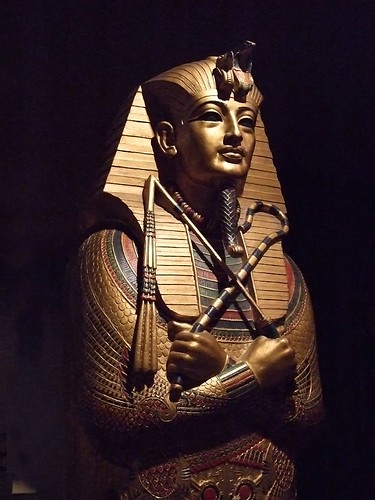
DNA tests scheduled for King Tut's daughters


"Egyptian scientists are doing DNA tests on stillborn children found in the tomb of the Pharoah Tutankhamun in the hope of identifying their mother and grandmother, who may be the powerful queen Nefertiti, Egypt's chief archaeologist said on Wednesday.

Many scholars believe their mother to be Ankhesenamun, the boy king's only known wife. Ankhesenamun is the daughter of Nefertiti, renowned for her beauty.

The DNA tests and computerised tomography (CT) scans, to be performed at Cairo University, should be finished by December, Hawass said. Egypt has been trying to check the identity of all its royal mummies using DNA and CT scans. Tutankhamun's was one of the first mummies to be examined with the technology in 2005."

If you enjoyed this post, never miss out on future posts by following me by email!

Wednesday, July 02, 2008

Oregon Find Points to West Coast Occupation Older Than Clovis


"What archaeologist Dennis Jenkins found in the Paisley Caves in south central Oregon may turn on its head the theory of how and when the first people came to North America.

Many scientists believe humans first came to this continent 13,000 years ago across a land bridge from Asia and they started the so-called Clovis culture. But Jenkins says they may have been living in these caves 1,000 years earlier, toward the end of the last ice age.

In 2002, he and his students at the University of Oregon began excavating the caves looking for proof. They discovered 14,000-year-old camel bones and signs they'd been butchered by humans. And then, they found artifacts of the humans themselves.

Coprolites are an archeology term for fossilized feces. Jenkins says they're from humans, and they're more than 14,000 years old.

Jenkins and his colleagues took their new evidence, the coprolites, to the university lab to see if modern science could offer more answers. They found the coprolites reflected a human diet.

"Here we have bone, some hair, vegetation, material. Those are all good indicators that it's a human coprolite," Jenkins observed.

Carbon dating showed three of the coprolites, and the animal bones found with them were 14,300 years old. And DNA tests showed six samples with distinct markers of ancient Native Americans.

We found little tiny threads that were .04 millimeters, I mean, so tiny they're as small as the threads in your shirt. Clearly, people were sewing their clothing, form-fitting clothing just like we have, shirts, pants, those kinds of things, perhaps moccasins.

The coprolites show they ate desert parsley, which grows six inches under the ground.

"The fact that they were exploiting that plant just like the Native Americans of this region were doing at later times tells us that they were very well-adapted to their environment. These were not explorers. These were people who were living in this area. They were at home here."

The early humans would have had to come by boat to the Pacific coast and then traveled inland through a strip of warmer swampland. Early peoples are thought to have arrived in Australia by boat, but it's a new idea for America."


If you enjoyed this post, never miss out on future posts by following me by email!

Friday, May 30, 2008

Authentic Viking DNA retrieved


"Although “Viking” literally means “pirate,” recent research has indicated that the Vikings were also traders to the fishmongers of Europe. Stereotypically, these Norsemen are usually pictured wearing a horned helmet but in a new study published in the journal PLoS ONE this week, Jørgen Dissing and colleagues from the University of Copenhagen, investigated what went under the helmet; the scientists were able to extract authentic DNA from ancient Viking skeletons, avoiding many of the problems of contamination faced by past researchers.

Using freshly sampled material from ten Viking skeletons from around AD 1,000, from a non-Christian burial site on the Danish island of Funen, Dissing and colleagues showed that it is indeed possible to retrieve authentic DNA from ancient humans.

Wearing protective suits, the researchers removed the teeth from the jaw at the moment the skeletons were unearthed when they had been untouched for 1,000 years. The subsequent laboratory procedures were also carefully controlled in order to avoid contamination.

Analysis of the Viking DNA showed no evidence of contamination with extraneous DNA, and typing of the endogenous DNA gave reproducible results and showed that these individuals were just as diverse as contemporary humans. A reliable retrieval of authentic DNA opens the way for a valuable use of prehistoric human remains to illuminate the genetic history of past and extant populations."

If you enjoyed this post, never miss out on future posts by following me by email!

Wednesday, September 12, 2007

One Third Maltese share Phoenician DNA


A Lebanese genetic scientist who has been following the genetic footprint of the ancient Phoenician civilisation across the Mediterranean for the last five years has found that close to one-third of modern-day Maltese share a genetic link with the ancient Phoenicians.

Thirty per cent of DNA samples taken from Malta have been found to share a common and ancient genetic marker, known as the J2 haplogroup, with the Phoenician civilisation, which had colonised Malta for much of the first millennium BC.

Research carried out by Lebanese geneticist Dr Pierre Zalloua has shown that while a relatively high degree of Spaniards and Tunisians also share the marker, the Maltese population had a predominantly high proportion.

The research project, funded by a $1 million grant from National Geographic’s Committee for Research and Exploration, issued its preliminary results in October 2004 and was famously the subject of a National Geographic Magazine focus that year.

The project, led by Dr Zalloua and research partner National Geographic Emerging Explorer Spencer Wells, has been under way for some five years.

The Phoenicians, who occupied the narrow coastal strip in the Levant today known as Lebanon, created the first trade routes circumnavigating the Mediterranean, and colonised Malta and Gozo – naming them “Melita” and “Gaulos” respectively.

The genetic marker identifying individuals as descendants of the ancient Levantines has also been found in Lebanese, Syrian and Palestinian samples – in and near the Phoenician homeland – as well as in other areas colonised by the Phoenicians such as the Iberian Peninsula and Tunisia.

The J2 haplogroup genetic marker, according to dating techniques used by Dr Zalloua, is approximately 12,000 years old, give or take 5,000 years, and researchers are confident it originates in the Levant.
If you enjoyed this post, never miss out on future posts by following me by email!