Showing posts with label paleontology. Show all posts

Monday, October 18, 2010

At last! Recognition for 3D Reconstruction Artists

Elisabeth Daynès at her studio in Paris working at the coloration of Paranthropus boisei male (2.5 million years B.P. discovered in Tanzania) made on the cast of the skull OH5 © 2006 Photographe P.Plailly Image courtesy of The French Technology Press.
I have been fascinated by the processes, both physical and virtual, that have been developed to reconstruct ancient faces from forensic remains since I saw my very first glimpse of the reconstructed face of a long dead person back in the 1990s. Now I see a prize has been conceived to recognize the efforts of 3D artists engaged in the production of art related to the science of paleontology, named the John J. Lanzendorf PaleoArt Prize. The prize is divided into five categories: Scientific Illustration, 2-Dimensional Art, 3-Dimensional Art and National Geographic Digital Modeling and Animation Award.
This year's 3-D art prize, awarded on October 13, 2010, was presented to paleoartist Elisabeth Daynès.
Neanderthal male - 60 000 years B.P. – made on the basis of the cast of the
skull discovered in the cave of Shanidar – Iraq
© 2009 Photo S. Plailly
. Image
courtesy of
French Technology Press.
 With hundreds of anthropological sculptures, Elisabeth Daynès has become a leading expert in the extremely painstaking process of hominid reconstructions. A painter, a sculptor and an expert in comparative anatomy altogether, she combines scientific research, technological innovation and art, in order to bring our human ancestors back to life. 

Daynès strives to create a unique and specific early human or pre-human using the scarce information left by the remains of fossils that might be thousands or even a million years old. “Lucy the Australopithecus" and "Flores the hobbit" she created with Prof. Bill Jungers, often described as her finest works, are part of the hundreds of her anthropological sculptures scattered around the world in leading museums along with Toumaï, Australopithecus, Paranthropus, Homo habilis, Homo erectusNeanderthals, Homo sapiens, etc. -
French Technology Press Office
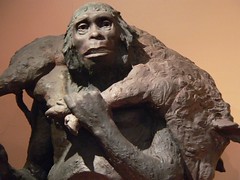
Model of Neandertal Man whose skeleton was fir...Image by mharrsch via Flickr As I look at her reconstruction of Neanderthal, I am amazed at how much the science of reconstruction has progressed since a model of Neanderthal was prepared for the Panama-California Exposition in 1915 (image left).  I photographed the 1915 model on a visit to the Museum of Man in San Diego in March 2006.

I think Daynès reconstruction or one very much like it must have been used in an exhibit on early man I saw at the Oregon Museum of Science and Industry some years ago.  One display had a Neanderthal  dressed in modern clothes and, as the signboard pointed out, if we passed a Neanderthal on the street we probably wouldn't even pay him much notice.  He definitely did not look like the Geico caveman!

I see Daynès was also involved with the reconstruction  of the bust of Tutankhamen for the “The New Face of King Tut” exhibition about six years ago.  Although some people commented that Tut was not particularly handsome, I thought he looked very interesting.
Using CT data from scans of Tut, a French team worked with National Geographic magazine to create a model of Tut's skull, which then was turned into an accurate, likelife face by one of the world's leading anthropological sculptors, Elisabeth Daynes of Paris. Her flesh-toned silicone cast was embellished with realistic glass eyes, hair, eyelashes and even the eye makeup that adorned the king as he was in life. French, American and Egyptian teams, under the director of Zahi Hawass of Egypt's Supreme Council of Antiquities, each created a separate reconstruction of Tut's face. (Credit: Supreme Council of Antiquities, Egypt and National Geographic Magazine, June 2005) - The Fresh Face of King Tut, Science Daily

The Humans Who Went Extinct: Why Neanderthals Died Out and We Survived   Ancient Mysteries: The Fate of the Neandertals   Neanderthal: Neanderthal Man and the Story of Human Origins
Enhanced by Zemanta
If you enjoyed this post, never miss out on future posts by following me by email!

Thursday, July 08, 2010

Norfolk Cannibals First UK Settlers?

This early model of Neanderthal, created for  the Panama-California
Exposition in 1915 probably more closely resembles the humans
who first settled Britain 950,000 years ago than Neanderthals
who are thought to have appeared in Europe as early as
600,000–350,000 years ago.  Photographed at the Museum of
Man in San Diego, California by Mary Harrsch.
Mammoths, rhinos, elephants, sabre-toothed cats, horses, elks, deer, voles, and hyenas as big as lions roamed the banks of the Thames almost a million years ago when the first humans settled in Britain near the modern village of  Happisburgh according to archaeologists who found on a treasure trove of flint tools and animal and plant remains there.  The earliest date obtained from the find appears to be 950,000 years old which is over 200,000 years earlier than remains found at Pakefield in Suffolk, once thought to be the cradle of civilization on the British Isle.


British Museum archaeologist Dr Nick Ashton said: "The new flint artefacts are incredibly important because, not only are they much earlier than other finds, but they are associated with a unique array of environmental data that gives a clear picture of the vegetation and climate".

"This demonstrates early humans surviving in a cooler climate than that of the present day," he said.

The climate was similar to that of modern-day southern Scandinavia. Summer temperatures were like those of modern Britain — but winters were long and harsh, with average temperatures of between 0C and minus 3C.

Fossilised remains of "Norfolk Man" have yet to be unearthed. But scientists said it was likely he was related to Pioneer Man — hailed as Europe's oldest inhabitant when his remains were uncovered in northern Spain in 1994. - More: Gulf News.com

 Early Man in Britain and His Place in the Tertiary Period   Prehistoric Britain (Blackwell Studies in Global Archaeology)   Prehistoric Britain (Routledge World Archaeology)
If you enjoyed this post, never miss out on future posts by following me by email!

Tuesday, August 12, 2008

DNA Analysis Suggests No Interbreeding With Neanderthals


"The mystery of what killed off the Neanderthals about 30,000 years ago comes a step closer to being solved with a study suggesting that they formed a tiny population that had been teetering on the brink of extinction.

Neanderthals first appeared in Europe at least 300,000 years ago but they disappeared after the arrival of anatomically modern humans, Homo sapiens, who first arrived in Europe 50,000 years ago. This has led to speculation about whether the Neanderthals interbred with the new arrivals to form a hybrid population that became submerged in the human gene pool, or were instead wiped out by them, either through competition for resources or by violence.

The latest evidence, an analysis of DNA recovered from a 38,000-year-old fossilised thigh bone, suggests the Neanderthals did not interbreed with modern humans but were eradicated by them.

DNA extracted from an adult Neanderthal man who lived near caves in what is now Croatia also revealed that the Neanderthals in Europe probably never numbered more than 10,000 individuals at any one time – a precariously small population size.

The new evidence about the demise of the Neanderthals comes from the complete sequence of DNA within tiny cellular structures known as mitochondria. This mitochondrial DNA is maternally inherited and is easier to isolate from ancient bones than the conventional DNA found within the cell nucleus.

The scientists repeatedly decoded the mitochondrial DNA from the 38,000-year-old Neanderthal bone 35 times to make sure that they had the correct genetic sequence, so that they could use it as an accurate comparison against the mitochondrial DNA of modern humans and chimpanzees – man's closest living relative

"For the first time, we've built a sequence from ancient DNA that is essentially without error," said Richard Green, who led the investigation at the Max Planck Institute for Evolutionary Anthropology in Leipzig, Germany.

"It is still an open question for the future whether this small group of Neanderthals was a general feature, or was this caused by some bottleneck in their population size that happened late in the game," said Dr Green.

Archaeological evidence shows that Neanderthals and anatomically modern humans, known as Cro-Magnon man, occupied the same habitats and sites at overlapping periods of time but there is no hard evidence that there was any direct contact between the two last species of humans to share living space.

"There's no proof that they saw each other, only that they inhabited the same place at about the same time but I think it's likely that they came across one another," said Adrian Briggs, a researcher at the Max Planck Institute, who was part of the study.

"What we've done is confirm that the mitochondrial DNA of Neanderthals and modern humans was so different that it forms powerful evidence that there was very little if any interbreeding between the two species," said Dr Briggs.

"We have also got tantalising evidence that the Neanderthals formed a small population and we can only speculate as to what happened to them. Small population sizes are always more prone to extinction and they have a greater chance of something going wrong."

Speculation about who the Neanderthals were, and what happened to them, has raged ever since the first Neanderthal skull was excavated from the Neander Valley, near Düsseldorf, in 1856.

It is now generally agreed that they were not the direct ancestors of modern humans but a side-branch on man's extensive family tree. However, some anthropologists have clung to the belief that they must have interbred with humans at some stage in their history, which means that there is a little bit of Neanderthal in us all.

However, a number of DNA studies, including the latest published in the journal Cell, have found little to support that theory. Whenever it has been possible to analyse the sequence of heavily degraded DNA fragments extracted from Neanderthal bone, it shows that the genetic variation lies well outside the variation seen in modern humans.

The latest study suggests, for instance, that the Neanderthals last shared a common ancestor with modern humans some 660,000 years ago – long before the emergence in Africa of Homo sapiens as a distinct species about 100,000 years ago.

However, the scientists who carried out the study emphasised that their work cannot as yet completely rule out the possibility that there was some limited, small-scale interbreeding between Neanderthals and modern humans, at some place between the Caucasus and western Europe – the geographic range of the Neanderthals.

One of the best bits of evidence in support of that idea emerged about a decade ago when scientists found the skeleton of a young boy who had died about 25,000 years ago in what is now Spain. His thick-set features suggested he was hybrid of Neanderthal and Cro-Magnon – but other scientists believed he was just an unusually stocky lad."...More

If you enjoyed this post, never miss out on future posts by following me by email!

Monday, November 05, 2007

Oldest UK skeleton even older than previously thought


Scientists say more accurate tests date the earliest human burial found in the UK to just over 29,000 years ago.

The skeleton of the Red Lady - actually a young male - was discovered at Goat's Hole Cave at Paviland on Gower in 1823 by William Buckland, then a geology professor at Oxford University. It owes its name to the red ochre covering the bones. When discovered the bones were thought to be around 18,000 years old, but were later redated to between 25,000 and 26,000. The remains were found along with a number of artefacts including ivory wands, bracelets and periwinkle shells.

"The remains and artefacts were previously difficult to date accurately," said Dr Higham.

"Many of the bones were treated with preservations in the 19th Century and some of this contamination is often difficult to remove."

He said their analysis was the bones were "just over" 29,000 years old.

It would mean The Red Lady lived in an age when the climate was much warmer than it would have been 4,000 years later.

If you enjoyed this post, never miss out on future posts by following me by email!