Showing posts with label prehistoric. Show all posts

Monday, July 20, 2009

Neanderthal wound from thrown spear points to Cro- Magnon homicide


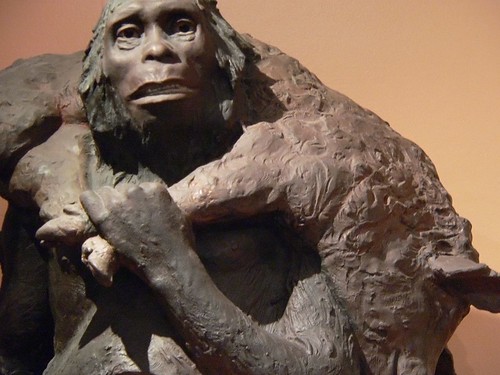
For years the debate has raged over whether modern humans may have actually killed off Neanderthals. Finally, it looks like, at least in this one case, scientists may have come up with enough evidence to conclude that the remains of a Neanderthal known to the scholarly community as Shanidar 3, discovered in the Zagros mountains of northeastern Iraq in the late 1950s, was the victim of an attack by a spear-throwing Cro-Magnon rather than a hunting accident or intratribal dispute.

[Image - Model of Neanderthal at the Museum of Man, San Diego, California. Photo by Mary Harrsch]

The wound that ultimately killed a Neanderthal man between 50,000 and 75,000 years was most likely caused by a thrown spear, the kind modern humans used but Neanderthals did not, according to Duke University-led research.

Drawing from studies aimed at improving police and prison guard protection, the researchers concluded that the downward sweep of a knife could have the correct trajectory to produce Shanidar 3's rib injury. "Knife attacks generally involve a relatively higher kinetic energy," the report said. However, "whatever created that puncture was carrying fairly low kinetic energy at a low momentum," said Steven Churchill, an associate professor of evolutionary anthropology at Duke. "That's consistent with a spear-thrower delivered spear."

The investigators rigged up a special crossbow to fire stone-age projectiles, using calibration marks on the crossbow to tell them how much force they were delivering with each launch.

Those tests revealed the delivered energy needed to create similar wounds in the ribs of pig carcasses, which the researchers used as an approximation of a Neanderthal's body.

The researchers also used measurements from a 2003 study to estimate the impact of using a thrusted rather than thrown spear, the kind of jabbing that Neanderthals are thought to have employed. That produced higher kinetic energies and caused more massive rib damage than Shanidar 3 sustained.

Another clue was the angle of the wound. Whatever nicked his rib entered the Neanderthal's body at about 45 degrees downward angle. That's consistent with the "ballistic trajectory" of a thrown weapon, assuming that Shanidar 3 -- who was about 5 feet, 6 inches tall -- was standing, Churchill said. - More: ScienceBlog.com


If you enjoyed this post, never miss out on future posts by following me by email!

Saturday, November 08, 2008

12000-year-old-grave-a-shaman-shares-her-tomb-with-animal-totems/

shaman graveIn a dusty cave in Israel, archaeologists have unearthed a 12,000-year-old grave that they say may be the resting spot of one of the earliest known shamans. The grave contains the artfully arranged bones of a roughly 45-year-old woman as well as a collection of animal and human body parts, including a complete human foot, 50 tortoise shells, and bones from a wild boar, an eagle, and a leopard.

“What was unusual here was there were so many different parts of different animals that were unusual, that were clearly put there on purpose,” said researcher Natalie Munro…. This care along with the animal parts point to the grave belonging to both an important member of the society and possibly a healer called a shaman…. Such healers mediate between the human and spirit worlds, often summoning the help of animal spirits along their quests, according to the researchers [LiveScience].

In the study, published in the Proceedings of the National Academy of Sciences [subscription required], researchers describe the cemetery of a prehistoric Natufian settlement. The Natufian culture, which lasted from roughly 15,000 to 11,500 years ago, played a central role in the transition from foraging to farming and was the first known society to live in year-round settlements. Burials of the dead increased dramatically in number among the Natufians, indicating that these people assigned much symbolic importance to treatment of the dead [Science News].

The woman’s skeleton was separated from the other 26 burial sites found in the cave, and her grave was the only one lined with slabs of limestone. Ten large stones had been placed on her head, arms, and pelvis, perhaps to hold her body in a particular position, or because the community was trying to keep the shaman and her spirit inside the grave, [study coauthor Leore] Grosman said. It is likely that the 50 tortoises were brought live to the site and were eaten as part of a feast surrounding the burial, according to the researchers [Bloomberg].

- Compiled by Eliza Strickland


Technorati Tags: , , , , ,
If you enjoyed this post, never miss out on future posts by following me by email!

Tuesday, August 12, 2008

Did cooking food improve cognitive processes?


"For a long time, we were pretty dumb. Humans did little but make "the same very boring stone tools for almost 2 million years," he said. Then, only about 150,000 years ago, a different type of spurt happened - our big brains suddenly got smart. We started innovating. We tried different materials, such as bone, and invented many new tools, including needles for beadwork. Responding to, presumably, our first abstract thoughts, we started creating art and maybe even religion.

"To understand what caused the cognitive spurt, Khaitovich and colleagues examined chemical brain processes known to have changed in the past 200,000 years. Comparing apes and humans, they found the most robust differences were for processes involved in energy metabolism.

The finding suggests that increased access to calories spurred our cognitive advances, said Khaitovich, carefully adding that definitive claims of causation are premature.

The research is detailed in the August 2008 issue of Genome Biology.

The extra calories may not have come from more food, but rather from the emergence of pre-historic "Iron Chefs;" the first hearths also arose about 200,000 years ago.

While other theories for the brain's cognitive spurt have not been ruled out (one involves the introduction of fish to the human diet), the finding sheds light on what made us, as Khaitovich put it, "so strange compared to other animals." - More

If you enjoyed this post, never miss out on future posts by following me by email!

Monday, November 05, 2007

Oldest UK skeleton even older than previously thought


Scientists say more accurate tests date the earliest human burial found in the UK to just over 29,000 years ago.

The skeleton of the Red Lady - actually a young male - was discovered at Goat's Hole Cave at Paviland on Gower in 1823 by William Buckland, then a geology professor at Oxford University. It owes its name to the red ochre covering the bones. When discovered the bones were thought to be around 18,000 years old, but were later redated to between 25,000 and 26,000. The remains were found along with a number of artefacts including ivory wands, bracelets and periwinkle shells.

"The remains and artefacts were previously difficult to date accurately," said Dr Higham.

"Many of the bones were treated with preservations in the 19th Century and some of this contamination is often difficult to remove."

He said their analysis was the bones were "just over" 29,000 years old.

It would mean The Red Lady lived in an age when the climate was much warmer than it would have been 4,000 years later.

If you enjoyed this post, never miss out on future posts by following me by email!

Friday, October 26, 2007

Silbury Hill Found to be "Sterile"

"The dank chill tunnel slopes down through 4,400 years of history into the heart of a mystery. The ground is slippery underfoot with sodden chalk dug as the pyramids were rising in Egypt. Archaeologists have reached the core of Silbury Hill in Wiltshire - and still have no idea what the most enigmatic prehistoric monument in Europe was for.

They know now there is no burial chamber for a Celtic king, no treasure hoard, nothing but a shallow bed of gravel, over which three ever larger mounds were raised until 35m baskets of chalk later, the monument stood 40 metres high, dominating the surrounding landscape, the largest artificial hill in Europe...

What they have found is treasure only to archaeologists: blades of grass still green after almost 5,000 years from the turf sods which covered the original mound, evidence of a pit which may have been the earliest ritual activity on the site, the chalk boulders used to strengthen the heaps of chalk rubble, and a huge ditch which was carefully filled before the final phase was built. The most enigmatic find is sarsen stones, the same stone as in nearby Avebury and Stonehenge, carefully incorporated in every stage, some which would have taken two men to drag up to the very top of the mound.

The distinctive flat top of the hill has led to some of the wildest theories, that it was an observatory or a platform for ritual sacrifice. In fact it now appears to be comparatively modern, carved flat to take a massive timber Saxon or Norman building - one posthole was a metre in diameter - presumed to be a military lookout."
If you enjoyed this post, never miss out on future posts by following me by email!