Monday, September 12, 2005

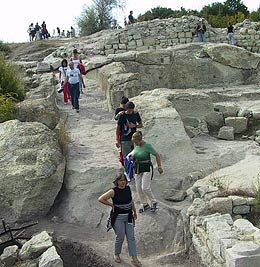
Church Pulpit Unearthed in Thracian Sanctuary of Perperikon


Church Pulpit Unearthed in Thracian Sanctuary of Perperikon: .

Archaeologists have found a church pulpit at the peak of the Thracian rock sanctuary Perperikon.

This is the first of the kind finding in Bulgaria, the team's chief Nikolay Ovcharov said. According to him, the pulpit was built at the end of the 4th century AD or the early 5th century during the reign of Byzantine Emperor Honorius and coincided with the period of the christening the Thracians in the Rhodopes area.

It has the form of one-ship basilica of 16.5 m length, which is the most typical form of an early christen religious temple.

The pulpit, which is almost untouched by time, is richly decorated with stone-carved ornaments. An eagle with largely spread wings is clearly seen on the rock."
If you enjoyed this post, never miss out on future posts by following me by email!

Michelangelo's Source for David Marble Identified


"In a study carried out for the Galleria dell'Accademia in Florence, where Michelangelo's naked David attracts 1.2 million visitors a year, Donato Attanasio, head of the research team at the Istituto di Struttura della Materia in Rome, analyzed three tiny samples from the second toe of David's left foot.

The fragments were retrieved in 1991, when the statue was damaged in act of vandalism.

It emerged that fine grain size is the most distinct property of David's marble, Attanasio and colleagues report in the current issue of the Journal of Archaeological Science.

The researchers then compared the fragments with samples from a database that included all the quarrying sites known to yield fine-grained marbles.

The comparison involved samples from the Turkish marbles of Afyon and Altintas, the Greek marbles of Mt. Hymettos and Mt. Pentelicon, and Italian marbles from Serravezza and Carrara, where more than one hundred quarries produce over one million tons of marble blocks per year.

Spectroscopic, isotopic and petrographic analysis narrowed down the search to the Fantiscritti site in Carrara, ruling out a previous theory that the David's marble might have come from a quarry in Seravezza, in the Apuan Alps.

"Finding the precise origin of David's marble block can help greatly in the conservation and restoration work," Attanasio observed."
If you enjoyed this post, never miss out on future posts by following me by email!

Tuesday, September 06, 2005

New artifacts from the intermediate Philistine period unearthed in Israel

"An important archaeological discovery made in Israel could shed more light on the ancient culture of the Philistines, a seafaring people that left the area of Greece in about 1200 BCE and landed on Israel's shores. At a dig in late July at Tell es-Safi, a site approximately halfway between Jerusalem and Ashkelon, a young woman found a pottery shard inscribed with what appear to be ancient Hebrew letters, though it also records a Greek name.

While the initial stage and later stage of Philistine settlements are well-represented in the field of archaeology, the middle stages - in which the Grecian Philistines began to assimilate with the local Semitic people and customs - remain more of a mystery. The find at Tell es-Safi may illuminate that intermediary period."
If you enjoyed this post, never miss out on future posts by following me by email!