Showing posts with label Achaemenid. Show all posts

Friday, February 12, 2021

Cypriot gold spiral earrings: Local fashion or the result of Achaemenid influence?

 According to the Metropolitan Museum of Art, spirals with ornate animal-head terminals are frequently found in Cypriot tombs of the Classical period. Terracotta and limestone votive statues illustrate that from the Archaic through the Classical period it was customary for Cypriot men and women to wear such ornaments in large holes pierced through their earlobes.

When I saw these earrings, I wondered if this Cypriot practice of making large holes in their earlobes to accommodate these ornaments was a local fashion or adopted as a result of Persian rule beginning in 545 BCE, especially since most examples I have seen  are dated between the late 6th century to the 5th century BCE. I managed to find images of Achaemenid bracelets similarly made of gold tubing but each example of similar earrings I found in my research were all labeled Cypriot. Since the Cypriots were ruled by the Assyrians and even the Egyptians for a short time, I researched the jewelry of those cultures as well but found nothing similar. 


Cypriot Earrings or spiral with lion-griffin terminals, Gold and Silver, 400-350 BCE and Lion headed spirals from mid-5th century BCE, at the Metropolitan Museum of Art


Cypriot Gold and copper alloy spiral with lion-head terminal, 2nd half of the 5th century B.C.E. at the Metropolitan Museum of Art. The lion-head is made in two halves (left and right) from sheet gold.


Cypriot Earrings or spiral with lion-griffin terminals, Gold and Silver, 400-350 BCE, at the Metropolitan Museum of Art.


Cypriot Earrings or spiral with lion-griffin terminals, Gold and Silver, 400-350 BCE, at the Metropolitan Museum of Art.

Pair of gold spiral earrings with terminals in the form of a crested griffins head. Cypriot, 475-400 B.C.E. British Museum

Gilt bronze spiral with griffin terminal. Period: Classical. Date: ca. 400–350 B.C.E. Culture: Cypriot. Medium: Gold, bronze. British Museum

Cypriot Gold allow spiral earings with Griffin terminals 5th century BCE at the British Museum courtesy of Wikimedia Commons contributor Paul Hudson. (digitally enhanced and recomposed)

Cypriot Gold alloy spiral earring with horned mythological creature terminal and floret, 5th century BCE, at the Antikensammlung Museum in Berlin courtesy of Wikimedia Commons contributor Marsupium

Achaemenid Gold Bracelet with Inlaid Termini in the Form of Duck's Heads, Gold with lapis lazuli, agate, and carnelian inlay, mid-6th-4th century B.C.E. at the Miho Museum in Kyoto, Japan. The ducks are reduced to protomes with their heads turned back in a typical Achaemenid fashion. The bracelet is constructed of hollow gold tubing, and the duck protomes were formerly elaborately inlayed with colored stones. One duck bill is made of agate, the other of carnelian. The ducks were both made separately and were in all likelihood originally joined together at their breasts. In order to put on the bracelet, the birds could be separated from the circlet by removing the rivets.

The bracelet type is preserved in much simpler versions of bronze or golden wire, and details like the turned heads resting on the animals' backs seem truly Achaemenid, but a certain naturalistic tendency along with the concept of a removable part may point to a later period and attribute this piece to the circle of Achaemenizing art fashioned in the Hellenistic period. It must be stressed, however, that at the moment, this is nothing but a hypothesis. - Miho Museum, Kyoto, Japan

Achaemenid Gold Bracelet with Inlaid Termini in the Form of Seated Ducks, Gold with lapis lazuli, turquoise, onyx, and rock crystal inlay, mid-6th-4th century B.C.E. at the Miho Museum in Kyoto, Japan. The jeweler of this bracelet chose ducks as terminal figures and combined them with a rather heavy looking circlet that can be opened. The ducks were fashioned separately, and all the feathers and the eyes were originally characterized by inlays. The ducks' bills are not preserved. The birds are fixed to a single massive tubular circlet, which originally had colored inlays at the junction between the ducks. The use of colored inlays for the details of the feathering is a feature of Egyptianizing tendencies in Achaemenid craftsmanship. Though the "Great Kings" are known to have employed Egyptian craftsmen, the use of this technique does not necessarily imply that the jeweler was an Egyptian, because the technique was widely used on objects of truly Achaemenid style. 
If you enjoyed this post, never miss out on future posts by following me by email!

Wednesday, January 27, 2021

Phoenician mortuary practices of the Achaemenid period

The Phoenicians as a politically, religiously, and perhaps even ethnically distinct entity on the Levantine coast emerged at the end of the Late Bronze Age about 1200 BCE, as one of the successor cultures to the Canaanites.  From their homeland on the coast of the Levant, the Phoenicians spread throughout the Mediterranean and its islands including Cyprus, Sicily and Malta. Some scholars have observed that Iron Age Phoenicia was not a nation, but rather a collection of cities built around natural harbors along the coast. While they shared a common culture, these small states remained independent, competing with each other in the international marketplace. 

"Depending on how evidence is weighed [based on Ugaritic texts and classical sources], Phoenician religion might be presented on the one hand as inclusive and diverse – a “conservatively” polytheistic society easily able to incorporate or syncretize new deities, customs and traditions or on the other hand as highly place-specific – a model in which Phoenicians were devoted to city-gods only, with little shared pantheon above the local or regional scale," Helen Dixon, University of Michigan, observes.

This variety in religious practices initially resulted in the use of both cremation and inhumation in mortuary practices and funerary art often expressed influences by non-Phoenician ruling administrations like New Kingdom Egyptians, Assyrians, and Achaemenid Persians.  By the Achaemenid period, however, adult cremation abruptly disappears from sites in the Phoenician cultural sphere.  This corresponds with the increasing importance of Zoroastrianism in the 5th century BCE. In Zoroastrianism, water (aban) and fire (atar) are agents of ritual purity, and the associated purification ceremonies are considered the basis of ritual life. A corpse is considered a host for decay. Consequently, scripture enjoins the safe disposal of the dead in a manner such that a corpse does not pollute the good creation.

For inhumation burials, the use of sarcophagi during the Achaemenid period along with epigraphic evidence points to a consistent and insistent emphasis on the integrity of the burial. Deities, including Astarate, are invoked to assist with the procurement of blessings and to enforce curses and righteousness is defined by political accomplishments or the building of religious shrines.  Although Egyptian iconography persisted, it was supplemented by Persian iconography. A paucity of grave goods was referenced in inscriptions as a deterrent to grave robbing and what few ceramic vessels have been found in Phoenician burials have been ceremonially broken. Wealthier burials, though, apparently included the use of expensive resins such as myrrh to anoint, perfume or preserve the body and the deceased were dressed in special garments with head ornaments, particularly royal women whose head ornament was described as a gold bridle. However, there apparently were no extensive preparations for a “next life,” no large quantities of food or drink on which to survive or any biographical depictions or texts to accompany the dead. With the exception of the occasional appearance of amulets or other possibly apotropaic items, there was no preparation for an encounter with an underworld deity or space or expectation of  a future meeting one's deceased ancestors.

Read more about it in Dixon's dissertation, "Phoenician Mortuary Practice in the Iron Age I – III (ca. 1200 – ca. 300 BCE) Levantine “Homeland”:

https://deepblue.lib.umich.edu/handle/2027.42/99972

Sarcophagus made from Greek marble. burial grounds of Antarados, northern Lebanon. 480-450 BCE courtesy of Wikimedia Commons contributor McLeod

Anthropoid sarcophagi, from Sidon, 5th century BCE, National Museum of Beirut, Lebanon courtesy of Carole Raddato.


Phoenician sarcophagus of the fifth century BCE, from the Carthaginian colonization of Sicily. Discovered in Palermo. Regional Archaeological Museum of Palermo, courtesy of Wikimedia Commons contributor Giovanni Dall'Orto.


Sarcophagus of Eshmunazar II, king of Sidon, Phoenicia, ca first quarter of the 5th century BC.E. at The Louvre courtesy of Wikimedia Commons contributor Fred Romero.

Marble anthropoid sarcophagus, last quarter of the 5th century B.C.E., Graeco-Phoenician found on Cyprus at the Metropolitan Museum of Art.


Phoenician sarcophagus of the fifth century BCE, from the Carthaginian colonization of Sicily. Discovered in Palermo. Regional Archaeological Museum of Palermo, courtesy of Wikimedia Commons contributor Giovanni Dall'Orto.


Marble anthropoid sarcophagus, last quarter of the 5th century B.C.E., Graeco-Phoenician found on Cyprus at the Metropolitan Museum of Art.

Phoenician marble sarcophagus found in Cádiz. Spain, 5th century BCE, courtesy of Wikimedia Commons contributor Professor Ángel M. Felicísimo, University of Mérida.

Phoenician marble sarcophagus found in Cádiz. Spain, 5th century BCE, courtesy of Wikimedia Commons contributor Professor Ángel M. Felicísimo, University of Mérida.


If you enjoyed this post, never miss out on future posts by following me by email!

Wednesday, October 07, 2020

The contentious relationship between ancient Cyprus and Persia

 The early documented history of Cyprus begins with an inscribed stele commemorating a victory by Sargon II (722–705 BCE) of Assyria there in 709 BCE.  Assyrian domination of Cyprus appears to have begun earlier than this, though, during the reign of Tiglath-Pileser III (744–727 BCE), and ended with the fall of the Neo Assyrian Empire in 609 BCE, whereupon the city-kingdoms of Cyprus gained independence once more. Following a brief period of Egyptian domination in the sixth century BCE, Cyprus fell under Persian rule. Royal palaces excavated on Cyprus resemble the architecture of Achaemenid examples like Persepolis, with audience chambers, open courtyards, bathhouses, and stores.  Town fortifications and houses were built of mudbrick walls on stone foundations.

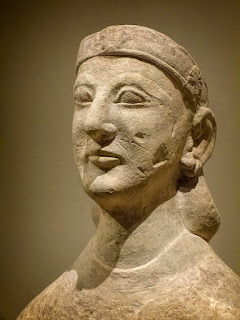
Early Greek influence is reflected in Cypriot sculpture, however.  Archaic Greek art with its attractive smile on the face of the statue is found on many ritual pieces dating between 525–475 BCE although portrait sculptures began to exhibit more realism.  Ionian influence on sculptures intensified and copies of Greek korai appear, as well as statues of men in Greek dress. Naked kouroi, however, although common in Greece, are extremely rare in Cyprus, while women are always presented dressed with rich folds in their garments. The pottery in Cyprus retained its local influences, although some Greek pottery was imported at this time.

Cyprus supplied armies and ships for Persia's foreign campaigns including Xerses' invasion of Greece in 480 BCE where Cyprus contributed 150 ships to the expedition. Despite this, Cyprus took part in the Ionian Revolt in 499 BCE led by the brother of the king of Salamis.  But the Persians crushed the Cypriot armies after a five-month siege. 

However, when Evagoras I of Salamis dominated Cypriot politics for forty years,  he favored Athens during the closing years of the Peloponnesian War, elicited Persian support for the Athenians against Sparta and urged Greeks from the Aegean to settle in Cyprus. At the beginning of the 4th century BCE, he took control of the whole island of Cyprus and within a few years was attempting to gain independence from Persia with Athenian help. 

Following resistance from the kings of Kition, Amathus and Soli, who fled to the great king of Persia in 390 BC to request support, Evagoras received less help from the Athenians than he had hoped for and in about 380 BCE, a Persian force besieged Salamis and Evagoras was forced to surrender. In the end, though, he remained king of Salamis until he was murdered in 374 BCE, but only by accepting his role as a vassal of Persia. Together with Egypt and Phoenicia, Cyprus rebelled against Persian rule again in 350 BCE, but the uprising was crushed by Artaxerxes III in 344 BCE. 

Cyprus finally gained political independence  when, hearing of Alexander's great victory over the Persians at Issus, the Cypriots rose up against their Persian overlords yet again and made available to Alexander the fleet of ships formerly in the service of Persia.  These ships and Cypriot engineers were instrumental in Alexander's successful siege of Tyre in 332 BCE.

When I saw these portraits of Cypriot men at the Metropolitan Museum of Art, I thought their faces reflected this independent nature.  

Terracotta head of a man wearing a wreath Cypriot Late Classical 4th century BCE photographed at the Metropolitan Museum of Art

Male Head Cypriot Hellenistic period 3rd-2nd centuries BCE Limestone photographed at the Legion of Honor Museum in San Francisco, California.

Closeup of a limestone grave marker depicting men reclining at a banquet Cypriot Classical Period 4th century BCE photographed at the Metropolitan Museum of Art

Limestone figure of a young beardless man of high rank probably in service to a deity Cypriot Archaic early 6th c. BCE photographed at the Metropolitan Museum of Art

Closeup of limestone male figure in Egyptian dress Cypriot Archaic 3rd quarter of the 6th century BCE photographed at the Metropolitan Museum of Art

Limestone head of a bearded man wearing a conical cap indicating high rank Cypriot Archaic early 6th century BCE photographed at the Metropolitan Museum of Art

Colossal votive terracotta head of a man with full beard and helmet with upturned cheekpieces 600-500 BCE from the sanctuary of Salamis-Toumpa excavated in 1890 Cyprus photographed at the Ashmolean Museum in Oxford, England.


If you enjoyed this post, never miss out on future posts by following me by email!

Thursday, August 06, 2020

Exercise your leadership as a helper rather than a master

 Be willing to treat our allies just as we would our friends and not to grant them independence in words, while in fact giving them over to our generals to do with as they please, and not to exercise our leadership as masters but as helpers.  Isocrates.  On The Peace.  Section 134.


Images: Greek and Achaemenid warriors during the Greco-Persian wars from the exhibit "Democracy and the Battle of Marathon in Athens, Greece in 2010 courtesy of Wikimedia Commons contributor Tilemahos Efthimiadis.


If you enjoyed this post, never miss out on future posts by following me by email!