Showing posts with label Amazon. Show all posts

Friday, December 19, 2014

Audible offering free dramatic production "Christmas Eve, 1914"

A history resource article by  © 2014

I've been a member of Audible since the site premiered over a decade ago and continue to enjoy their wide variety of audiobooks now as a subsidiary of Amazon.com.  Their recorded dramas have helped me add value to hundreds of hours of commuting and exercise.  

Today I received an email from them announcing the free release of an original, one-hour audio drama that vividly imagines and reenacts the famous, impromptu Christmas Eve truce declared by rank-and-file British and German soldiers in 1914. What a thoughtful Christmas gift to the public (you don't even have to be a member to download it!)

Written exclusively for Audible by two-time Emmy Award-winning screenwriter and journalist Charles Olivier, Christmas Eve, 1914 features a full cast of accomplished actors including Xander Berkeley, Damon Herriman, Cody Fern, Nate Jones and Cameron Daddo. Christmas Eve, 1914 is available as a free download at http://www.audible.com/christmas
"The Christmas Eve truce of 1914 remains an incredibly poignant and inspiring moment in our collective history, when men even in the midst of battle agreed to stop fighting for a few hours," said Audible EVP and Publisher Beth Anderson. "The performance by this talented ensemble of actors takes listeners right into the trenches, bringing this remarkable story to life for a new generation. We’re happy to make this transporting, beautifully produced recording available free." 
"You wouldn’t think that a story from WWI would be either joyous or tender. And yet, it was here that one of the most remarkable moments in human history occurred," said Olivier. "It’s one of those events that defy a writer’s imagination, and having the opportunity to tell a bit of this story has been a gift." 
Olivier added, "We created audio cinema with our story—this is a movie for your imagination." Olivier and his films have been recognized at the Sundance Film Festival, the Berlin Film Festival and the Tribeca Film Festival, among others. Christmas Eve, 1914 was produced for Audible Studios by Dawn Prestwich, most recently executive producer of AMC’s The Killing. 
Christmas Eve, 1914 also features a bonus track at the end of the story, the traditional French carol Il est NĂ© performed by Tom Tom Club. 

If you enjoyed this post, never miss out on future posts by following me by email!

Sunday, September 05, 2010

New research indicates Amazon supported advanced civilization

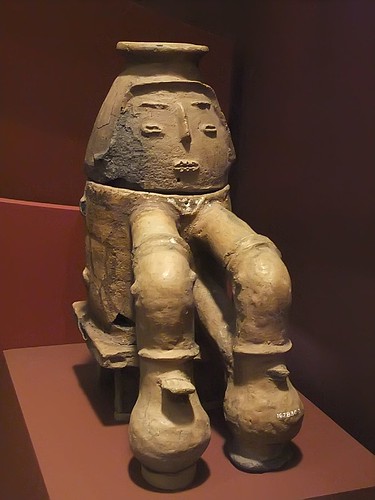
Amazonian Ceramic Figure from the state of
Amapa in Brazil 1200-1600CE.  Photographed at
the Field Museum in Chicago by Mary Harrsch.
New excavations and soil core analysis in Peru indicate that the Amazon ecosystem supported an advanced civilization at least as far back as 800 CE.  It always struck me as strange that an area that could support such a lush rainforest with its myriad of lifeforms could have been viewed as so unsuitable for human habitation in ancient times!

Along the Xingu, an Amazon tributary in Brazil, Michael Heckenberger of the University of Florida has found moats, causeways, canals, the networks of a stratified civilization that, he says, existed as early as A.D. 800. In Bolivia, American, German and Finnish archaeologists have been studying how pre-Columbian Indians moved tons of soil and diverted rivers, major projects of a society that existed long before the birth of Christ.

Many of these ongoing excavations follow the work of Anna C. Roosevelt. In the 1980s on Marajo Island, at the mouth of the Amazon, she turned up house foundations, elaborate pottery and evidence of an agriculture so advanced she believes the society there possibly had well over 100,000 inhabitants.

In some ways, the theory that the Amazon may have been a wellspring of civilization should come as no surprise in the 21st century. In a long perilous journey along Ecuador's Napo River in 1541, Spanish friar Gaspar de Carvajal, a chronicler of the European conquest, wrote of "cities that gleamed white," canoes that carried dozens of Indian warriors, "fine highways" and "very fruitful land."

Bits of colorful ceramics - matching that found elsewhere in the Amazon - seem to show that those who lived here were the Omaguas, the same people Gaspar de Carvajal encountered nearly 500 years before.  - Scientists find evidence discrediting theory Amazon was virtually unlivable by Juan Forero for the Washington Post

 Most of our documentation about the Omaguas was compiled by 17th century missionary Samuel Fritz.  By his time, the average Omagua settlement had been reduced to, on average, 28 plank houses with palm-thatched roofs where about 330 individuals, most members of an extended family, lived.


Men and women wore cloth garments. The men wore long sleeveless shirts that reached down to their knees. Women wore short wraparound skirts. The men usually left their shirts off because they got in the way. The clothes were usually painted with multicolor designs. Due to the Omaguas flattened foreheads they are easily distinguished from other Amazonian tribes. Fritz observed that shaping was done in infancy by “ applying to the [babies’] forehead a small board or wattle of reeds tied with a little cotton so as not to hurt them, and fastening them by the shoulders to a little canoe, which serves them for a cradle” (Meggers 125).

The spearthrower was the principle weapon for hunting, fishing, and gathering. It took the form of a flat board about 40 inches long and three fingers wide with a bone hook at the upper end to secure the projectile. The spear or arrow was about six feet long and had a point of bone or very hard wood which was sometimes detachable, permitting it to remain in the victim. To shoot the arrow is taken in the right hand, with which the spearthrower is held by its lower end, and placing the arrow against the hook, they launch it with such force and accuracy that they do not miss at fifty paces” ( Meggers 127). The shields used in warfare were the height of a man and made of basketry covered with cayman, manatee, or tapir hide. If there was no stone, turtle shells were used for axes and adzes.

Each village had a chief and all the villages in a province were united under one high chief who was described as “ a very great over lord.” - Nick Willaert, Minnesota State University at Mankato
 Smithsonian Atlas of the Amazon   Amazon (IMAX)   Ancient South America (Cambridge World Archaeology)  Empires in the Americas: A Journey Back in Time (Lost Treasures of the Ancient World)  
If you enjoyed this post, never miss out on future posts by following me by email!