Showing posts with label Cambyses. Show all posts

Monday, November 30, 2020

Egypt and Cyprus in the Late Archaic Period

Cyprus, the third largest island in the Mediterranean, located north of Egypt and west of the Levant, was considered a strategic site  in the ancient world and subsequently occupied by the Assyrians, Egyptians, Persians, Greeks, and Romans.  During the Cypriot Archaic Era (c. 750 BCE to 475 BCE), the island was ruled by Sargon II of Assyria, starting in 709 BCE when the Assyrians extorted taxes from Cyprus in exchange for their independence.  But, by 699 BCE the Assyrians withdrew because of conflicts elsewhere and the Egyptian Pharaoh Amasis II (also known as Ahmose II) claimed the island around 560 BCE.

According to Herodotus, Amasis was of common origins and originally an officer in the Egyptian army. He campaigned in Nubia under the Pharaoh Psamtik II in 592 BCE and rose to the rank of general. 

Psamtik II was succeeded by his son, Apries (also known as Waphres of Manetho). Apries led an expedition in an attempt to protect Libya from incursions by Dorian Greek invaders but his forces were badly mauled.  When the defeated army returned home, a civil war broke out in the Egyptian army between the indigenous troops and Greek mercenaries Apries had secured. The Egyptians threw their support to General Amasis who quickly declared himself pharaoh in 570 BCE. Apries fled Egypt and sought refuge in Babylon. When Apries marched back to Egypt in 567 BC with the aid of a Babylonian army to reclaim the throne of Egypt, he was likely killed in battle with Amasis' forces. Herodotus, however, claims Apries survived the battle and was captured and treated well by the victorious Amasis, until the Egyptian people demanded justice against Apries, whereby he was placed into their hands and strangled to death. Amasis, however, reportedly treated Apries' mortal remains with respect and observed the proper funerary rituals by having Apries' body carried to Sais and buried there with "full military honors." Amasis then  married Apries' daughter, Chedebnitjerbone II, to legitimise his accession to power.

Herodotus reports Amasis cultivated a close relationship with Greece and under his prudent administration, Egypt reached a new level of wealth. Amasis even married a Greek princess named Ladice daughter of King Battus III and made alliances with Polycrates of Samos and Croesus of Lydia.  In the fourth year of his reign, Amasis defeated an invasion of Egypt by the Babylonians under Nebuchadnezzar II but when Cyrus the Great ascended the Persian throne in 559 BCE, Amasis had no major Near Eastern allies to counter the Persian threat.  The final assault by the Persians did not come until shortly after Amasis had died in 526 BCE. His son, Psamtik III, though, ended up reigning for only six months before his defeat in 525 BCE.

Amasis II was buried in the royal necropolis of Sais, like other pharaohs of the 26th dynasty, but he was not left undisturbed to rest in peace. According to Herodotus, Cambyses gave orders that Amasis' body was to be taken and beaten with whips, stuck with goads, and have its hair plucked.  When the embalmed body would not fall to pieces, Cambyses finally ordered it burned.


Image: Limestone male figure in Egyptian dress, mid-6th century BCE, Cypriot, courtesy of the Metropolitan Museum of Art in New York. The figure wears the double crown of Egypt, a three-row pectoral, a baldric perhaps for a quiver, bracelets, and a kilt that is embellished with winged uraei, a head of the Egyptian god Bes or of the Gorgon Medusa, and an eye. Whether this individual represents Amasis II or Psamtik III, though, is unknown.


If you enjoyed this post, never miss out on future posts by following me by email!

Friday, January 08, 2010

Possible Discovery of Lost Army of King Cambyses II Makes Top Ten List of 2009


I see the possible discovery of the lost army of King Cambyses II of Persia made the Brit's top ten list of archaeological discoveries of 2009.  I truly hope the brothers Castiglioni are able to prove their claim.  It would be almost as exciting as Schliemann's  discovery of Troy!  The Castiglioni shouldn't be too discouraged by scholarly naysayers.  They didn't believe Schliemann either!!

 [Image:  Cambyses at Pelusium]


The complete list:

1.  The Staffordshire Hoard  (7th century Anglo Saxon stash of gold weapons, jewelry, etc.)
2.  Bone Flute and Erotic Figurine at Hohle Fels (Germany)
3.  Bronze Age Burial Cist at Forteviot (Scotland)
4.  The Lost City of Bathonea (Turkey)
5.  The Stirling Hoard (of gold neck torcs - Scotland)
6.  World's Oldest Flax Fibres (Republic of Georgia)
7.  Earliest Evidence of Chemical Warfare (Dura Europos, Syria)  
8.  Ida - the 47-million-year-old fossil thought to be the missing link in human evolution (Germany) 
9.  The Emperor's Private Amphitheatre at Portus (Italy)
10. The Lost Army of Cambyses II of Persia (Siwa Oasis, Egypt) 

The Lost Army of Cambyses   The Staffordshire Hoard   The Discovery of Dura-Europos 
 
If you enjoyed this post, never miss out on future posts by following me by email!

Wednesday, November 11, 2009

Cambyses Lost Persian Army Found In The Sahara!


What a wonderful discovery! Two Italian archaeologist have found what appears to be the lost army of Persian King Cambyses in the Sahara desert. I learned about this cataclysmic event when I listened to Professor Elizabeth VanDiver's Teaching Company lecture series on Herodotus: The Father of History. It was the first lecture series from the Teaching Company that I had ever heard and I was mesmerized! I now have dozens of their lectures under my belt and about a dozen on my "to be heard" shelf in my library.

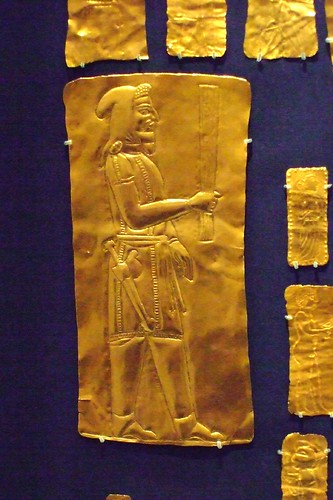
[Image: Gold ornaments from the Oxus Treasure depicting Persian warrior 5th-4th century BCE. Photographed at the British Museum by Mary Harrsch]

The article compared the discovery with Schlieman's discovery of Troy and I would have to agree and it is so exciting to have it occur in my own lifetime! How gratifying to culminate 13 years of research with such a marvelous discovery!

"A pair of Italian archaeologists have uncovered bronze weapons, a silver bracelet, an earring and hundreds of human bones in the vast desolate wilderness of the Sahara desert. Twin brothers Angelo and Alfredo Castiglioni are hopeful that they've finally found the lost army of Persian King Cambyses II.

According to the Greek historian Herodotus, Cambyses II and his armies were buried by a cataclysmic sandstorm in 525 B.C. He wrote, "a wind arose from the south, strong and deadly, bringing with it vast columns of whirling sand, which entirely covered up the troops and caused them wholly to disappear."

Now the discovery of these artifacts points towards an answer to this millennias-old mystery: The Castiglioni brothers studied ancient maps and came to the conclusion that Cambyses' army did not take the caravan route most archaeologists believe they used." - More: New American

If you enjoyed this post, never miss out on future posts by following me by email!