Showing posts with label civil war. Show all posts

Friday, December 12, 2014

Congress enacts landmark legislation to preserve Revolutionary War and War of 1812 battlefields

A history resource article by  © 2014

After visiting a number of America's Civil War battlefields back in 1993 (Andersonville, Chattanooga, Chickamauga, Shiloh and Stone's River), I decided to financially support the Civil War Preservation Trust and continue to do so to this day.  Today I received an email from them to let me know that Congress has now enacted legislation to improve the national military parks of Gettysburg and Vicksburg and establish preservation initiatives for battlefields of the Revolutionary War and the War of 1812 as well:

Legislation expands successful federal Civil War battlefield grant program to include preservation of Revolutionary War and War of 1812 battlefields
(Washington, D.C.) – The Civil War Trust today applauded members of U.S. Senate and House of Representatives for enactment of landmark legislation to preserve America’s endangered battlefields.  The legislation, part of an omnibus lands package included in the Fiscal Year (FY) 2015 National Defense Authorization Act (H.R. 3979), reauthorizes a highly successful federal matching grant program for the preservation of Civil War battlefields.  In addition, the bill expands that existing program to provide grants for the acquisition of land at Revolutionary War and War of 1812 battlefields.
“This is a historic moment for the battlefield preservation movement,” remarked Civil War Trust president James Lighthizer.  “For 15 years, the Civil War Battlefield Preservation Program has been an invaluable tool for protecting the hallowed battlegrounds of the Civil War.  Now, for the first time, battlefields associated with America’s other formative conflicts, the Revolutionary War and the War of 1812, will also benefit from this public-private partnership.”

The legislation, originally introduced in 2013 as the American Battlefields Protection Program Amendments Act (H.R. 1033), reauthorizes the Civil War Battlefield Preservation Program, a matching grants program that encourages private sector investment in historic battlefield protection.  Since the program was first funded by Congress in FY 1999, it has been used to preserve more than 23,000 acres of battlefield land in 17 states.  The battlefields protected through the program include some of the most famous in the annals of America, including Antietam, Md., Chancellorsville and Manassas, Va.; Chattanooga and Franklin, Tenn.; Gettysburg, Pa.; Perryville, Ky.; and Vicksburg, Miss.

The bipartisan bill was sponsored by U.S. Senators Tim Kaine (D-Va.) and Thad Cochran (R-Miss.) and Congressmen Rush Holt (D-N.J.) and Rob Wittman (R-Va.) in their respective chambers.  In addition, the bill was championed by Senate Energy and Natural Resources Chair Mary Landrieu (D-La.) and House Natural Resources Chairman Doc Hastings (R-Wash.).  A complete list of House and Senate cosponsors can be found on the Congress.gov website (Senate and House).

“We owe our Congressional champions in the House and Senate an enormous debt of gratitude for believing in this program and guiding it through an often complicated legislative process,” Lighthizer noted.  “Thanks to their tireless efforts, thousands of acres of genuine American history that might have been lost to development can still be preserved for future generations.”

In addition to reauthorizing the existing Civil War matching grants program, the bill expands the program’s authority to provide grants to protect Revolutionary War and War of 1812 battlefields.  Similar to the Civil War grants, which are awarded for priority battlefield land identified in a 1993 government report on Civil War battlefields (updated in 2011), funding for Revolutionary War and War of 1812 battlefields will target sites listed in a 2007 study by the American Battlefield Protection Program.

Among the battlefields that could potentially benefit from the expanded program are:  Bennington, N.Y. and Vt.; Brandywine, Pa.; Cowpens, S.C.; Caulk’s Field, Md.; Guilford Courthouse, N.C.; Princeton, N.J.; River Raisin, Mich.; Saratoga, N.Y.; and Yorktown, Va. 

In his remarks, Lighthizer also noted that this legislation, by encouraging the protection of battlefield land, also honors the courage and sacrifices of all who served in America’s military.  “Preserved battlefields are living monuments – not just to the soldiers who fought in those hallowed fields – but to all Americans who have worn our nation’s uniform.  There are no better places to learn about the human cost of the freedoms we enjoy today.”

The combined Civil War, Revolutionary War and War of 1812 matching program is authorized at $10 million a year for seven years, through the end of FY 2021.  The FY 2015 Omnibus Appropriations Act (H.R. 83) currently under consideration by the Congress includes $8.9 million for the program. 

In addition to the American Battlefields Protection Program Amendments Act, the lands package in the National Defense Authorization Act (NDAA) also included other important battlefield preservation initiatives, including modest expansions of the national military parks at Gettysburg and Vicksburg, as well as legislation to explore adding Mill Springs Battlefield in Kentucky to the National Park System.  President Obama is expected to sign NDAA into law later this month.

The Civil War Trust is the principal nonprofit advocate for federal battlefield preservation programs and legislation.  Although primarily focused on the protection of Civil War battlefields, through its Campaign 1776 initiative, the Trust also seeks to save the battlefields connected to the Revolutionary War and War of 1812.  To date, the Trust has preserved more than 40,000 acres of battlefield land in 20 states.

The Civil War Preservation Trust has a four-star rating with Charity Navigator.  I hope you will join me in supporting their important historical preservation activities!

For more information about the Civil War Trust visit them at at www.civilwar.org.


If you enjoyed this post, never miss out on future posts by following me by email!

Tuesday, April 22, 2014

DVD Review: Civil War: The Untold Story (of the western theater)

A history resource article by  © 2014

Next week RLJ Entertainment will be releasing the new DVD series "Civil War: The Untold Story".  I know many of you Civil War buffs may be wondering how there could be anything about the Civil War that hasn't been told before, but this series, unlike a lot of others I have seen, focuses on the battles of the "west" which the producers claim actually led to the ultimate Union victory.

Now as someone from Oregon, I hardly think of Tennesssee as "the west" but it was, as far as the scope of the Civil War was concerned.  This series closely examines the battles of Shiloh, Stone's River, Vicksburg, Chattanooga and Chickamauga as well as Sherman's infamous march across Georgia that wasn't as one sided as many other programs have led us to believe.

These conflicts were particularly interesting to me because back in 1993 when my husband and I were helping my daughter move to the east coast, we visited almost all of the national military parks where these battles occurred on our way home, although we visited the sites in reverse, starting our journey at Fort Sumpter then traveling south to Savannah before swinging east to the site of the Confederate prisoner-of-war camp at Andersonville.  Then we drove on to Atlanta then Chatanooga, stopping at the Chickamauga National Battlefield, probably the largest military park on our trip.  Pressing on we drove to Stone's River then Franklin and finally visited our last Civil War cemetery at Shiloh.  The visitor's centers had excellent presentations about the battles, particularly at Chickamauga where the Park Service had just installed a new multimedia theater-in-the-round-type exhibit.  So receiving a review copy of this DVD set was like reliving that unforgettable trip!

The series begins with a discussion of the economic history of slavery.  I didn't realize that slavery was on the decline in the late 18th century until Eli Witney invented the cotton gin.  I remembered how, as a girl, I studied famous inventors like Eli Witney and his cotton gin.  Back in the 50s, though, school teachers did not point to the cotton gin as one of the primary reasons for the outbreak of the Civil War.
The documentary explains that, although the cotton gin was a labor-saving device, it made the cotton cleaning process so efficient that it made the growth of cotton far more profitable than almost any other crop.  Cotton exports jumped from 500,000 pounds in 1793 to 93 million pounds in 1810.  Cotton became as important to the U.S. economy as oil is today.

So, there was a land rush to develop more and more acres into cotton fields.  This corresponded to the increasing acquisition of land during the "manifest destiny" period of U.S. growth.  But, politically, there were sharp differences in opinion about whether newly admitted states would then have to legally sanction slavery viewed by some as necessary for cotton development.

The program was quite candid in pointing out that northerners, with the exception of a few passionate abolitionists, had no real objections to slavery as a labor strategy.  Researchers stated simply that white northeners didn't appreciate the racial "pollution" slavery introduced.   Apparently, successful black individuals in the north,  like Solomon Northup portrayed in "12 years a slave", were an extremely rare exception.

19th century Caricature of the so-called Hottentot
Venus.  Image courtesy of Wikipedia.
I had never heard about the so-called Hottentot Venus, a rather large African woman named Saartje Baartman, who was sold into slavery.  She was exhibited by showmen in London and Paris because of large fatty deposits on her buttocks.  After her death in 1815, famous French anatomist Georges Cuvier, performed an autopsy on her body, claiming it clearly showed that Africans were more closely related to such primates as orangutans and monkeys, than humans.  These types of studies not only reinforced attitudes of racial superiority in the north but the opinion that slavery actually served to civilize such unfortunate individuals in the south.

I was also surprised to learn that four slave states actually stayed with the Union throughout the Civil War.  Slavery was still legally recognized by the federal government and the Emancipation Proclamation only applied to the states in rebellion as a war measure intended to cripple the Confederacy.

The other military goal accomplished by the Emancipation Proclamation was that it successfully prevented the involvement of foreign nations in the struggle.  Britain and France actually considered supporting the Confederacy, since they imported most of the American cotton crop that was sold for export. But, many Europeans opposed slavery as an institution so Lincoln's directive along with a significant Union victory at Antietam successfully influenced foreign powers to maintain a "hands off" policy.

The series then shifts to an examination of military objectives of the Civil War.

From a military standpoint, reclamation of the important economic highway of the Mississippi River was paramount to defeating the Confederacy.  Yet, it appeared to me that Confederate leaders seemed to think there was more importance in victory at the high profile battles along the eastern seaboard (the Civil War version of winning hearts and minds) than in protecting the vital commerce artery of the Mississippi River in the west.  The most famous Confederate generals such as Robert E. Lee and Stonewall Jackson were assigned to those eastern theaters of war, while the battle for control of the Mississippi was relegated to Generals Albert Sidney Johnston, Braxton Bragg and John Bell Hood, names much less familiar to people like me that have not studied the Civil War as intensely as I have battles of the ancient world.

Confederate General Albert Sidney Johnston.
Image courtesy of Wikipedia
I use the word relegated as if Johnston, Bragg and Hood were lesser commanders but that was not necessarily the case.  Johnston was an experienced combat veteran, fighting and directing engagements in the Texas War of Independence, the Mexican-American War, the Utah War and the American Civil War.  Johnston was actually considered to be the finest general officer in the Confederacy by Confederate President Jefferson Davis.  But this did not prevent Davis from distributing most of the Confederate resources to the eastern front.

Johnston had to supply his troops by conducting raids and engaging in maneuvers that made it appear that he had larger forces than he actually did.  My additional research revealed that this was compounded by the assignment of support staff that were either incompetent or frequently intoxicated.

Despite all of these obstacles, Johnston still managed to pull off a massive surprise attack against Ulysses S. Grant on the first day at the battle of Shiloh, despite being delayed for three days by adverse weather.  Grant just couldn't imagine Johnston would leave his well fortified position at Corinth to confront Grant in the field.  The surprise maneuver almost worked, with Confederates overcoming bitter Union opposition at the "Peach Orchard" and the "Hornet's Nest".  But, Johnston, charging back and forth ahead of the advancing Confederate line, was shot behind the right knee, possibly by one of his own soldiers .  The bullet cut a major artery and Johnston, seemingly unaware of the seriousness of the wound, bled to death.  The three days lost to bad weather would also prove fatal.

The epic struggle at the "Hornet's Nest" on the first day of the battle of  Shiloh.
Image courtesy of the Library of Congress

By the second day, Grant, with control of the vital Tennessee River,  received reinforcements bringing total Union troops to 45,000 men to the Confederates'  remaining viable troops estimated at only about 20,000.  To make matters worse, Confederate General Beauregard, unaware of the Union reinforcements, pressed Grant, only to be driven back.  Later counterattacks were eventually repulsed as well. So, Confederate forces finally had to fall back to the heavily defended railroad center at Corinth.

It makes you wonder if Grant had faced the more formidable Johnston on the second day and the battle had occurred on schedule, if the outcome would have been different.

Later in the series as the researchers discussed the campaigns of Sherman in Atlanta, I was surprised to learn about the Confederate successes at Kennesaw Mountain and the more aggressive resistance in Atlanta after command was given to General John Bell Hood.  As my husband and I did not visit any Civil War museums in Atlanta, I only remember Hood as a Confederate general who had suffered severe casualties at the battle of Franklin (where we did stop) in an action sometimes known as the "Pickett's Charge of the West".

Confederate General Braxton Bragg.  Image
courtesy of Wikipedia.
The other Confederate general I enjoyed learning more about was Braxton Bragg.  When I first saw a picture of him at the Chickamauga National Battlefield Visitors' Center, I thought he looked a lot like John Brown with his bushy brows and rather wild look in his eyes.  But this surly officer orchestrated what has been called the greatest Confederate victory in the Western Theater, defeating Union General William S. Rosecrans at the battle of Chicamauga.

As for other political issues of the Civil War, I had never read about George McClellan's run against Abraham Lincoln for president or that if Sherman had not taken Atlanta at the time he did, Lincoln may have lost to powerful and vocal northern supporters in favor of a truce that would have ended in two separate nations.  So I found all of this background information fascinating.

As for the production quality of the DVD set, I thought the reenactment sequences were very well done with very life-like special battle effects and the cinematography was excellent.  Elizabeth McGovern's narration was articulate and quite empathetic.  I much preferred her voice to the rather harsh newsbroadcaster voiceovers I have heard in other presentations.

The series will premiere tonight (April 22, 2014) on a number of public television channels and the DVD set will be available for purchase next week.  I highly recommend it!

Related articles
Enhanced by Zemanta
If you enjoyed this post, never miss out on future posts by following me by email!

Saturday, September 11, 2010

"Pillars of the Earth" a hallmark of Medieval History in Film

I was sent a link to an interesting post about 15 outstanding films that have been produced over the last half century about various aspects of medieval life.  I was gratified to see that several of my favorites were featured including "El Cid", "The War Lord" and "A Knight's Tale" (hey, I, too, enjoy a little rock music with my knight movies!)
To this list we could add the film adaptation of Ken Follett's marvelous novel  "Pillars of the Earth" recently broadcast on Starz.

You would think that a film about the construction of a cathedral would not be particularly action packed but Follett has set his story amid the violent turmoil of the period of English history known as The Anarchy. 
I actually knew very little of the contention between Queen Maude and her cousin Stephen, both grandchildren of the famous (or infamous depending on your point of view) William the Conqueror.   "Pillars of the Earth" did an excellent job of bringing me up to date on the treachery, betrayals and murders that earmarked their struggle for the throne of England.
The main plot of our story swirls around a conspiracy that involved the death of King Henry I's son, William, who drowned when the "White Ship" sank on a voyage between France and England.  Although Follett's conspiracy is fictional, it does not contradict historical events as little is known about the cause of the sinking except speculation about a drunken crew and a race to catch up to the King's ship that disembarked earlier in the day:
Presumably the prospect of sailing aboard the latest and fastest addition to the Norman navy was a thrilling prospect, so William and his friends broke open a few casks of wine to celebrate. And then a few more. By the time the ship was ready to leave most of the passengers and crew were reasonably drunk. The bishop of Coutance who turned up with his entourage to bless the ship was greeted with derision and abuse and left in a hurry. It was at this point that Henry's nephew Stephen of Blois, made his excuses and left, either because a) he had an attack of diarrhoea or b) because of moral outrage at the shenanigans on board, a decision for which he was no doubt later extremely thankful.
Sometime before nightfall Henry left harbour leaving the White Ship behind. There is no clear evidence as to why the White Ship was delayed and did not leave with the rest of the fleet, but is likely that the inebriated state of the crew had something to with it. But by all accounts, it was a relatively calm night and ideal condition for the short seventy mile journey to Portsmouth when the White Ship finally left on the evening tide.
Now the passage out from Barfleur harbour was relatively straightforward so long as the pilot steered to the south, as to the north there were a series of dangerous rocks that became submerged at high tide. However, the fastest and most direct route home to Portsmouth was north and it seems that in his eagerness to catch up with the king, Fitz Stephen piloted the ship northwards and tried to 'cut the corner' a little too lightly, sailed too close to land and struck a rock, in all likelihood the rock known as the 'Quilleboeuf'.
Now fatally holed the White Ship sank, eventually becoming completely submerged with only her masts visible above the water. Although the Quilleboeuf rock stands only half a mile offshore, there was no medieval equivalent of the lifeboat or coastguard service, most of those aboard were drunk, it is very unlikely that any of them could swim and of course it was dark and there was naturally a general panic.
There was only one survivor, a butcher from Rouen named Berold who managed to climb up one of the masts and clung there all night until he was rescued the next morning by some fishermen. - The Tragedy of the White Ship
 Follett takes this incident and weaves a totally plausible scenario around it complete with slighted bishop and single survivor.
 King Henry I, a rather virile monarch who fathered at least twenty illegitimate sons, is left with only a legitimate daughter Maude to assume the throne upon his death.  But, as one of the characters in the film so concisely rails "A bastard cannot inherit the throne and a woman is almost as bad!"
Henry dies in 1135 according to legend from eating a "surfeit of Lampreys" - eels - as he does in Follett's tale.  The film makes it appear that Henry died almost immediately following the birth of his daughter's son, Henry II.  In fact, he died two years later.  The official cause of death was recorded as food poisoning but not of the intentional variety.  I know when I saw the obvious poisoning in the film I wondered about the royal taster and if he was compromised by the plotters as well.
Terence Scully tells us in "The Art of Cookery in the Middle Ages" that a noble estate was hardly ever without a unicorn horn to assay both dining accouterments and prepared food for the presence of poison.  Obviously the horn came from an elephant or a narwhal but was deemed invaluable so much so that it was recognized as a particularly thoughtful gift between noblemen. 
"Before the prince came to table, the Linen-Keeper and Hall Porter had to do an assay for poison on the tablecloths by passing the unicorn horn over them.  Both the tapestry which the Hall-Usher unrolled onto the prince's bench and the cushion on which he was to sit were similarly tested." - The Art of Cookery in the Middle Ages
The unicorn horn test was followed by tastings of all food, sauce and condiments in a highly ritualized procedure involving the Cook, the Saucer, the Hall Usher, the Hall Porter, the Pantler, the Carver, the Serving Valet, the First Master of the Household and finally the First Chamberlain.
"The Pantler then covered over all the dishes again, and a procession consisting of Usher, Master Pantler, the Princes Pages and Serving Valets (all of them bareheaded) formed up to bear the dishes safely into the hall.  The Usher cleared the way to the prince's buffet and high table; the Master of the Household, from his post at the end of the table near the buffet, vigilantly watched that none of the dishes was tampered with." - The Art of Cookery in the Middle Ages
So, if Henry died as a result of intentional poisoning the plotters must have outright purchased the king's entire household!  In any case, Stephen, with the support of the chauvinistic nobles and the church, seizes the throne and our characters are soon immersed in civil war.
We are not given much background on Maude in the film and she briefly appears first as an adoring child then later as a young mother determined to protect her son and secure his rightful inheritance. 
Although referred to as Maude throughout the film, this "Empress of the Holy Roman Empire", granddaughter of William the Conqueror.  So much royal blood flowed through her veins that its a wonder she wasn't purple, since through her mother's mother, she was descended from Edmund II "Ironside," Ethelred II "the Unready," Edgar "the Peaceable," Edmund I "the Magnificent," Edward I "the Elder" and Alfred "the Great."
Although Stephen sides often with the villains in this story, Maude is not necessarily a kind and merciful monarch either.  (spoiler alert!) At one point when she discovers that Stephen has sent her a mere peasant boy as a hostage instead of his own son , she orders the innocent child slain anyway when Stephen breaks the truce and once more gathers his forces to oppose her.  Her somewhat greedy nature also surfaces when she demands gold for granting market rights to Kingsbridge causing problems for Prior Phillip and his dedicated hard-working cathedral construction crew.
The historical Maude's penchant for gold is illustrated by the list of precious objects that she left to the Abbey at  Bec-Hellouin :
Among the gifts Matilda gave to the Abbey at Bec-Hellouin were the above mentioned crowns and also another golden cross decorated with precious stones, two gospel books bound in gold and studded with gems, two silver-gilt censers, a silver incense box and spoon, a gold dish and a gold pyx for the Eucharist. There were three silver flasks, a ewer for holy water and a silver basin. Add to this two portable altars of marble mounted in silver and an ebony chest filled with relics. There were more textiles in the forms of holy vestments - chasubles, dalmatics, copes, and an imperial cloak belonging to herself, besprinkled with gold. All of the above list was donated in her lifetime. After she died, the abbey also received the ornaments she had used in her own private chapel. These included service books, a gold chalice and spoon, four chasubles, two tunics, two dalmatics, six copes, two of which were interwoven with silver, two silver censers and two boxes which were described as 'eggs of griffins'. The legs and claws gripping these 'eggs' were fashioned of silver.- Elizabeth Chadwick, Living the History
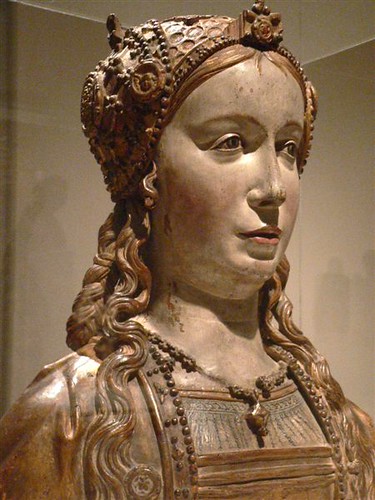
Chadwick points out that one of the most odd treasures that Maude acquired while married to the Holy Roman Emperor was a religious relic - purportedly the hand of Saint James.
A beautiful 16th century reliquary bust from
Flanders.  Photographed at the Los Angeles
County Museum of Art by Mary Harrsch.
Thought to have originated with the Roman ancestor worship, the worship of relics - little bits of saints or other artifacts thought to be connected to Christ or his apostles - is documented as far back as the second century.
After the martyrdom of Polycarp, bishop of Smyrna, the Christians "took up his bones which are more valuable than refined gold and laid them in a suitable place where, the Lord willing, ...we may gather together in gladness and celebrate the anniversary of his martyrdom." During Diocletian's persecutions (303-311) relics of the martyrs were collected by their followers. 
 
The cult of the relics was criticized from its inception by purists who regarded it as pagan. Vigilantius in a dispute with St Jerome condemned the veneration of all inanimate objects such as the bodies of saints. Jerome responded by saying that the relics themselves were not worshipped but were an aid to the veneration of martyrs of undoubted holiness whose lives were a model to later generations. This debate between Vigilantius and Jerome is summarized by Thomas Aquinas in his Summa theologica:
Thomas Aquinas, Summa Theolgiae , 3a, 25, 6:
Now it is evident that we are bound to hold in veneration the saints of God as being members of Christ, sons and friends of God and our advocates with him. We are equally bound, therefore, memory of them, to accord due honor to any of their relics; and this is primarily true of their bodies, which were the temples and instruments of the Holy Spirit, dwelling and acting within them, and which are to be made like the body of Christ by glorious resurrection. It is for this reason that God himself grants honors to their relics by performing miracles when they are present....
...This was the argument of Vigilantius, cited by Jerome, "We are observing the introduction, under the guise of religion, of something not very different from a pagan ritual. These people can be seen kissing and adoring little piles of some kind of dust in tiny bottles, wrapped up in precious cloth." In rebuttal Jerome writes, "We do not venerate, by latria, that is, either the sun or moon or the angels; far less the relics of the martyrs. We pay honor to the martyr's relics only so that we may venerate him whose martyrs they are; we pay honor to the servants only so that the servants' honor may glorify their Lord." Accordingly, when we honor the relics of the saints we do not fall into the error of those pagans who offered divine worship to the dead. - Cult of the Relics, State University of New York, College at Oneonta.
The worship of relics was particularly virulent in England where it was used by Christian missionaries to replace veneration of the pagan pantheon:
The cult of the relics played a critical role in the missionary activities. The missionaries who converted northern Europe were dealing with people whose religion was fundamentaly pantheistic. To them it seemed that the entire world was inhabited and controlled by unseen powers; every tree had its own spirit, every pool its devil, every mountain its god. There was no distinction between the laws of nature and the laws of God. In accepting Christianity, pagans believed Christ's powers to be more potent than those their former gods. The converts expected the new God to intervene as often and as powerfully in nature as the old, and if He failed to do so they would frequently revert to their old beliefs. Gregory the Great recommended to Augustine of Canterbury that the cult of the saints and martyrs be presented to the English as the rival to pagan pantheism. - Cult of the Relics, State University of New York, College at Oneonta.
Like many other aspects of medieval life, author Ken Follett weaves relic worship into his plot revealing that the (fictional) Priory of Kingsbridge derives its income from pilgrims who come to worship its relic, the skull of St. Adolphus.  (spoiler alert) When a fire destroys the priory and crushes the relic, the original is replaced with a skull plucked from the crypt to prevent loss of revenue, of course with a lot of soul searching by Prior Phillip.  The substitute is later crushed when the new cathedral's first stone dome collapses but the novel's hero Jack comes up yet another object for pilgrims to lavish their meager savings upon.
Follett also portrays realistically how noble violence was a real and present danger that overshadowed peasant life during this period.  The villains of the story, masterminded by the evil bishop Waleran Bigod, manipulate King Stephen into awarding the lands of Shiring Castle to them then attack Kingsbridge where the former Earl of Shiring's daughter and son have taken refuge.
People watching the program may wonder why King Stephen would permit one of his nobles to terrorize residents of another town.  The bottom line is that the nobles maintained private armies that the king could call upon when needed.   The king would not, therefore, interfere in a noble's business if it did not directly impact the king because the king, himself, did not control a standing army at that time.
Furthermore, medieval society gradually accepted and even honored violence as the church embraced violence in its prosecution of the Crusades:
After the fall of the Roman Empire, violence quickly became a main part of medieval society, used primarily to threaten and to gain land.  However, as time went on this violence began to be understood in a different light, linking it to religion.  Initially the only acceptable view of violence was when it was committed by saints upon those who would transgress the church, this view soon changed, with the advent of the Crusades.  These series of wars transformed the image of violence into something positive, both in regards those who committed the violent acts and those who the acts were committed upon.
The connection between religion and violence changed dramatically with the start of the Crusades.  Instead of separating the two, Pope Urban II called for knights who were violent for the sake of violence to channel their ways into violence for a greater cause, primarily fighting to take back Holy Land from the Muslims who had originally taken it from the Byzantines.  Immediately people began to see violent knights in a new light, and knights themselves began to change in regards to how they lived and how people understood their duties. - Religion and Violence in the Middle Ages by M. Rinn
A slideshow of armor I have photographed at museums around the world:

Professor Philip Daileader discusses noble violence at length in his excellent lecture series on the Middle Ages available from The Teaching Company.  Sadly, things have not changed that much in the last thousand years.  The powerful still enrich themselves at the expense of the powerless, although in a much more civilized guise!  But back to our story...
Light streams into the nave of Yorkminster Cathedral
illuminating its beautifully vaulted ceiling.  Photograph
by Mary Harrsch.
Of course, the cathedral is finally built despite all of these setbacks as well as various love triangles, and the villains are eventually subjected to their just rewards - a little more violently in the film than in the book. The cathedral is as beautiful as Tom Builder dreamed it would be.  Although Kingsbridge is an imaginary structure, it was based on the real cathedral at Salisbury.  I have not had the privilege of seeing that cathedral but was truly awestruck by Yorkminster in York, also built to admit as much light as possible, and it truly is the light that makes all the difference.  I have seen St. Peter's in Rome, St. Paul's and Westminster Abbey in London and, of course, the famous cathedral of Notre Dame. But, although a spectacular example of the use of flying butresses, Notre Dame's interior is actually quite dark.  With the light streaming into Yorkminster, it truly seemed to be an anteroom to heaven.
The end seems to come a little too swiftly in the final episode but maybe it only seemed that way because I did not want to relinquish my emotional connection to these marvelous characters.  I think my favorite character in the series was actually Prior Phillip played magnificently by Matthew MacFadyen.  His character was a fascinating blend of intelligence and piety with an honest recognition that he, too, suffered from a certain degree of ambition.
I was unfamiliar with Matthew MacFadyen's earlier work, as most of it has been in productions for UK audiences, although I see by his filmography on IMDB that he played the Sheriff of Nottingham in the new 2010 version of Robin Hood.  Apparently, I'll have to watch it much more carefully when I get it on DVD next month!  I wondered if Matthew was related to another of my favorite actors, Angus MacFadyen (Robert the Bruce in Braveheart) but apparently not.
Of course Rufus Sewell as Tom Builder was another favorite.  I've been a big fan of Sewell since his outstanding portrayal of Agamemnon in the USA miniseries "Helen of Troy".  Although that was seven years ago, Sewell's maturity has only increased his screen presence and sexual magnetism.
Ian McShane as the Bishop Waleran Bigod and Sarah Parish as Regan Hamleigh made truly despicable villains and the younger actors can look back on this project with just pride as their careers are sure to flourish in the future.
As for the list of outstanding films about the Middle Ages, though, I would add not only "Pillars of the Earth" but several more as well.
I was very surprised that the original list did not include at least one production of Sir Walter Scott's "Ivanhoe" that has been source material for a number of film productions including my favorite, a 1982 television mini-series starring Anthony Andrews, Sam Neill, James Mason and Olivia Hussey.  I had been watching for it to come out on DVD for some years.  Then last Christmas I finally saw it at a local discount store.

Although it does not deal directly with historical events, it does present the concepts of courtly love that developed during this period.  I must admit, though, that I was totally mesmerized by Sam Neill as, I guess you would say, the villain Brian de Bois-Guilbert.  If I had been Rebecca (Olivia Hussey), I would have accepted his proposal to run away with him! 
I would also definitely add Ridley Scott's "Kingdom of Heaven" based on the siege of Jerusalem that took place during the Crusades of the 12th century.  After all what nobler commandment has been issued from the silver screen but "Safeguard the helpless - even if it leads to your death!"

This year we were also treated to Ridley Scott's remake of "Robin Hood".  I appreciated the inclusion of references to the Crusades and a reminder about the true nature and fate of Richard the Lionhearted as opposed to the glamorized legend portrayed in other versions of this classic tale.  It's just too bad that there wasn't more screen chemistry between Russell Crowe and Cate Blanchette who played Marian the widow (not the Maid!)

 If you don't subscribe to Starz but have a Netflix membership, you can watch "Pillars of the Earth" as an instant download using your computer, one of a half dozen different game consoles including the Wii and XBox, or a Roku internet streaming device.
An enhanced e-book edition of Ken Follett's novel is also available for the iPad on iTunes.  The enhanced edition includes an interactive Character Tree, contextual video and still images blending into the ebook from the corresponding section of the Starz television series, Follett’s Multimedia Diary which contains his on-set impressions of bringing the book to the screen, interviews with the actors, director and producers, and music from the series.
If you enjoy listening to audio books on your commute or while exercising like I do, you can get an audio version of "Pillars of the Earth" from http://www.audible.com.
 The Pillars of the Earth   Pillars of the Earth   The Middle Ages: An Illustrated History (Oxford Illustrated Histories)   Arms & Armor of the Medieval Knight: An Illustrated History of Weaponry in the Middle Ages   The English Church & the Papacy in the Middle Ages (Sutton Illustrated History Paperbacks)  The Gothic Cathedral: The Architecture of the Great Church 1130-1530  The Construction of Gothic Cathedrals: A Study of Medieval Vault Erection   The Gothic Enterprise: A Guide to Understanding the Medieval Cathedral  Ivanhoe (1982)   Kingdom of Heaven - The Director's Cut (Four-Disc Special Edition) Robin Hood (Blu-ray/DVD Combo + Digital Copy)
Enhanced by Zemanta
If you enjoyed this post, never miss out on future posts by following me by email!