Friday, September 03, 2010

Maori mere (war club) stolen from tomb recovered

When I first saw the news alert about this theft of a mere, I thought someone who had tried to translate a foreign news release into English had simply misspelled mirror but when I checked the article I learned that a "mere" is a Maori war club:

"A priceless greenstone mere stolen from the tomb of one of the founders of Parihaka Pa in Taranaki has been recovered.

The mere, which belonged to the revered Maori peace prophet Te Whiti O Rongomai, was stolen last week after thieves smashed through a glass casing which protected the mere within the tomb. A mere is a traditional Maori hand club." - New Zealand Herald

I found this very interesting and informative site about Maori weapons that further describes the weapon and its ritual symbolism:

"A short flat club usually made from wood, bone, or greenstone. Also know as a Patu or Waihaka. Used in hand to hand combat. Typical strike zones for warriors included the temple, the jaw and the ribs. The greenstone mere was particularly highly prized as it requires an incredible amount of work to make one. Warriors who carried a greenstone mere were considered to posses great strength and honor. Today the mere represents the facing and overcoming the challenges life presents." - Maori Source

I was surprised to see that the Maori seemed to prefer clubs of various types rather than bladed weapons even though their typical strategy was to kill all enemies in an engagement to prevent revenge attacks.  The single weapon illustrated on the web site that included a greenstone blade was said to be for ceremonial purposes only. 

I found another very good summary of Maori warfare that mentioned they did, at times, use a thrusting spear but never developed the bow and arrow and typically did not throw spears.  Killing at close range appeared to be preferred to impart the appropriate honor on successful warriors.

The summary also described cannibalism that was a common practice during Maori warfare:

Cannibalism was the regular practice in Maori wars. Human flesh was an important part of the food supply of war parties. The bodies were cut up with obsidian flakes and then cooked on heated stones which were laid in pits in the ground. Sometimes, flesh was kept as a supply for the journey. Such meat would first be boned, then dried and packed in flax baskets; alternatively, it was potted in fat in gourds. Prisoners were sometimes taken alive, tied together with flax ropes and kept on the hoof for future slaughter and use...

Mortality in Maori wars must have been considerable in spite of the small forces usually engaged. No quarter was given in battle so that life could only be saved by flight, but it was during flight that the pursuers killed most of their enemies. Not many war parties were completely exterminated but more than a few lost a very large percentage of their members. Most captives were killed and eaten; some—especially women and children—were enslaved. But often these also were eaten.

Some of the bones of the slain were saved, as further indignity, for making flutes, heads of bird spears, fish hooks, rings for captive parrots, pins and needles. Heads were sometimes thrown on a heap in a grisly ball game, occasionally they were impaled on the stockades of a pa. Heads of both friend or enemy, if belonging to great chiefs, were at times taken home and preserved. - National Library of New Zealand
Maori warrior photographed at the
Polynesian Culture Center on the
island of Oahu, Hawaii by Mary Harrsch
This made me wonder if the brain disease "kuru" (similar in symptoms to mad cow disease) was ever a recorded problem among the Maori but I could not find any definitive references.  I did find a post that said researchers are now questioning cannibalism as the cause of kuru in the Fore culture in Papua New Guinea anyway.  It seems that further research indicates kuru was apparently not present before contact with Europeans even though the Fore had practiced mortuary cannibalism for centuries. However, scientists point out that after the kuru epidemic reached a high point in the 1960s, kuru among the Kore pretty much vanished after cannibalism was eliminated.  So there appears to be at least some connection although the two factors may have been a simple coincidence. 

I had the opportunity to meet a Maori warrior when I visited the Polynesian Culture Center on Oahu, Hawaii in 1982.  Maybe someday I'll be able to visit New Zealand to learn more about this fascinating culture.


*Image of mere war club courtesy of the Maori Source

Maori   Maori myths & legendary tales   New Zealand Maori Culture Traditions and History   The Illustrated Encyclopedia of Maori Myth and Legend   An Intellectual History of Cannibalism   A History of Cannibalism: From Ancient Cultures to Survival Stories and Modern Psychopaths   Eat Thy Neighbour: A History of Cannibalism
If you enjoyed this post, never miss out on future posts by following me by email!

Wednesday, August 11, 2010

Cao Cao's tomb to open to visitors in September 2010

I see that the Chinese are planning a new exhibit around the newly discovered tomb of the Chinese warlord Cao Cao (Three Kingdoms Period (208-280 CE)

The planned area for the temporary exhibition is 787 square meters, and the floor space is about 700 square meters, with the total length of the visitors' corridor standing at 291 meters, according to Xu Huiqian, governor of Anyang County.  - People's Daily Online
I became really interested in the Han Dynasty while researching an article for Heritage Key, "Mad, Bad and Dangerous Women of the Han: The Shocking Story of Lady Dai".  I was even more intrigued after watching John Woo's classic epic "Red Cliff" (the full length international version).


"Red Cliff" is based on the 800,000 word Chinese historical epic "Romance of the Three Kingdoms".  Although it is a novel, it is said to be about 70% history, 30% fiction.  Written during the early Ming Dynasty when Cao Cao was viewed unfavorably, "Romance of the Three Kingdoms" portrays him as the novel's villain.  Cao Cao actually accomplished a number of favorable achievements, however.  He not only united northern China but implemented agricultural and education programs that helped the people recover from a devastating famine brought on by a plague of locusts in 194 CE.  His programs also raised the standard of living for many people and supported the development of intellectually gifted individuals.  Cao Cao himself was skilled in poetry and martial arts and considered quite strategically astute.  He authored a number of military manuals.

Although the discovery of Cao Cao's tomb was reported by archaeologists in December 2009, the tomb had been discovered and robbed by tomb raiders quite some time before then.  Authorities only learned of its location after tablets surfaced in the antiquities market bearing inscriptions of "King Wu of Wei", the title conferred on Cao Cao after his death.

At least by the time the authorities were led to the site, it still contained 250 artifacts including weapons, armor, and pottery, the remains of a man in his 60s, and the bones of two women in their 50s and 20s, thought to be Cao Cao's wife and her female servant. Some scholars fear that some of the artifacts found within the tomb may have been planted by enterprising antiquities dealers, however.

I hope to travel to China in the next few years so, although I won't be able to see the current exhibit opening next month, hopefully I will be able to at least visit the tomb site.

The Establishment of the Han Empire and Imperial China (Greenwood Guides to Historic Events of the Ancient World)   The Early Chinese Empires: Qin and Han (History of Imperial China)   Red Cliff International Version - Part I & Part II
If you enjoyed this post, never miss out on future posts by following me by email!

Sunday, August 01, 2010

Wreck from Ming Treasure Fleet Sought Off Kenya Coast

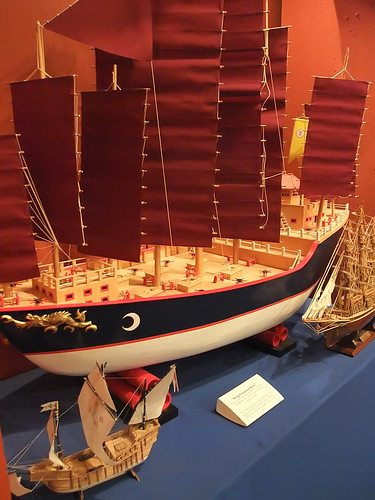
A Model of a 15th century Ming Dynasty Treasure Ship
dwarfs models of Columbus' Santa Maria and the later
clipper ship Cutty Sark built with the same scale. 
Photographed at the Ventura County (CA) Maritime Museum
by Mary Harrsch.

In a joint project of the National Museum of Kenya and Peking University, a team of 11 Chinese archaeologists will begin a £2m joint project to explore the Kenyan communities of  Lamu and Malindi for evidence of commerce with China dating back to the early 15th century.  Chinese marine archaeologists will also search for a rumored ancient ship wreck offshore.

"The sunken ship is believed to have been part of a mighty armada commanded by Ming dynasty admiral Zheng He, who reached Malindi in 1418. According to Kenyan lore, reportedly backed by recent DNA testing, a handful of survivors swum ashore. After killing a python that had been plaguing a village, they were allowed to stay and marry local women, creating a community of African-Chinese whose descendants still live in the area." - More: guardian.co.uk

Like many people (including many Chinese), I had never heard of this adventurous 7-foot-tall Chinese admiral before I read a fascinating article about his explorations in National Geographic in 2005 when the Chinese were celebrating the 600th anniversary of his voyages.  More and more evidence of the extent of his explorations continues to come to light and there is even speculation he reached the western shores of North America and/or South America, most notably in extremely controversial books published by retired British submarine commander, Gavin Menzies entitled 1421: The Year China Discovered the World and 1434: The Year a Magnificent Chinese Fleet Sailed to Italy and Ignited the Renaissance.

Chinese scientists have conducted DNA tests on Swahili inhabitants of Siyu village in Africa that indicated the people there had traces of Chinese ancestry thereby documenting the African connection.  Whether evidence that Zheng He ventured as far east as he did west remains to be seen.  It will be exciting, though, if they can find one of the actual ships that was part of Zheng He's fleet.

A couple of months ago I visited the Ventura County Maritime Museum down in Ventura, California and there I saw a scale model of a Ming treasure ship like those in Zheng He's fleet.  Beside the model were models built in the same scale of Christopher Columbus' ship the Santa Maria and the later clipper ship, "Cutty Sark" and they were tiny compared to the massive Chinese vessel.

When I read the National Geographic article, I was intrigued by the man himself as well.  Zheng He was born into a Muslim family in Kunyang in Yunnan province in 1371 C.E.  His father was descended from a Persian administrator of the Mongol Empire who was appointed governor of Yunnan during the early Yuan Dynasty.


In 1381 C.E. the Ming army attacked Kunyang and eleven year-old Zheng He, then called Ma He, was captured, castrated and sent to the Imperial Court.  His father was executed.  Yet, despite the murder of his father and his own mutilation, Zheng He, who still grew to towering height of 7 feet-tall, became a trusted adviser of the Yongle Emperor (r. 1403-1424) after Zheng He helped to overthrow the Jianwen Emperor.

National Geographic produced an excellent video about Zheng He and his voyages that I found on YouTube.  It is divided into ten parts.  As each video nears the end of its 9+minutes a link appears in the lower right hand corner to click to access the next part:


When China Ruled the Seas: The Treasure Fleet of the Dragon Throne, 1405-1433  Zheng He (Discovery)   The Great Voyages of Zheng He  1421: The Year China Discovered America (P.S.)
If you enjoyed this post, never miss out on future posts by following me by email!