The Chinese
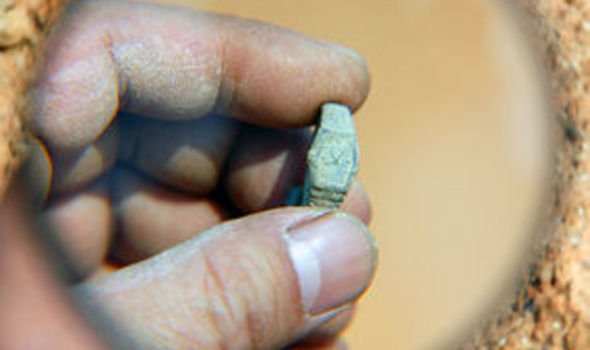
National Cultrual Relics Bureau presented overwhelming evidence that an ancient tomb discovered in Anyang, Henan Province must have contained the remains of third century warlord Cao Cao.
[Image: Cao Cao in the 84-episode television serial Romance of the Three Kingdoms played by Bao Guoan. Courtesy of Wikipedia.]
Cao Cao was born in 155 CE to the foster son of one of Emperor Huan's favorite eunuchs. A gifted but precocious child, he was frequently at odds with his family for engaging in hunting and musical pursuits with the son of one of the household maids, Yuan Shao. As fate would have it, both boys would grow up to become fierce generals who fought for control of the crumbling Eastern Han Dynasty.
At the age of 20, Cao Cao became first a district captain of Luoyang then governor of Dunqiu County. However, when the Yellow Turban Rebellion broke out, he got a chance to demonstrate his natural military skills when he was appointed as a cavalry commander and sent to Yingchuan to suppress the rebels. His success brought yet another promotion to Governor of Dong Commandery.
During this period, the rule of China went through a series of puppet emperors while the real power lay with the Dowager Empress He supported by an imperial court full of powerful eunuchs. (If you're interested in reading more about women and power politics in the Han Dynasty check out my article,
Mad, Bad and Dangerous Women of the Han Dynasty at Heritage Key!) Cao Cao's childhood friend, Yuan Shao, now a nobleman because his mother had become a court concubine, joined forces with another powerful aristocrat, He Jin, in an attempt to rid the court of the eunuchs and wrest power from the Dowager Empress. He Jin summoned yet another powerful governor, Dong Zhuo, for assistance but before the armies of Dong Zhuo arrived, the eunuchs succeeded in assassinating He Jin, leaving the imperial court in chaos and Yuan Shao fighting for his life.
When Dong Zhuo's armies arrived, they quickly defeated the opposition and Dong Zhuo placed his own puppet emperor on the throne. But Dong Zhuo had a reputation for cruelty and outrageous behavior, including the audacity to sleep in the emperor's own bed and forcing himself on palace maids. He was prone to temper tantrums and threw weapons even at his own adoptive son who served as his personal bodyguard.
Cao Cao could not abide the tyrant and refused a court appointment, choosing instead to raise an army near his hometown and join with Yuan Shao to root out the new cancer in the imperial court. In 192 CE, the adoptive son of Dong Zhuo couldn't bear the abuse any longer and assassinated his father. This act plunged the country into civil war that raged for over four years. In 196 CE, Cao Cao, who had continued to expand his power, convinced then Emperor Xian to move the capital to Xuchang, a city under Cao Cao's military control. Cao Cao was appointed to the post of Chancellor then Commander-In-Chief. But this appointment infuriated Cao Cao's old friend, Yuan Shao. In an effort to keep the peace between them, Cao Cao offered his position as Commander-In-Chief to Yuan Shao who accepted it. But, Yuan Shao's ambition would not be subdued and in 200 CE, Yuan Shao raised an army of 100,000 men and marched on the capital to "rescue" the emperor from the clutches of his old friend Cao Cao.
Cao Cao responded, although fielding a force of only 20,000 men. He carefully selected the battlefield, though, at a strategic point on the Yellow River named Guandu where Yuan Shao would be unable to engage all of his manpower in a frontal assault. The result was a standoff for a time until a deserter from Yuan Shao's forces told Cao Cao of the location of Yuan Shao's supply depot. Cao Cao ordered a clandestine attack on the depot that destroyed most of Yuan Shao's supplies and delivered a nearly impossible victory to Cao Cao. Shortly after, Yuan Shao sickened and died. His two sons carried on his battle against Cao Cao but Yuan Shao had named his younger son rather than his older son as his clan successor, causing the two to feud incessantly. Cao Cao was able to eventually defeat them without much effort, making Cao Cao the de facto ruler of northern China. His armies also subdued Northern Korea and lands south to the Han River.
Cao Cao's military brilliance along with his talent for administration and literary achievements reminded me of Julius Caesar, especially since, like Caesar, his life was played out against a backdrop of civil war. Although unlike Caesar, Cao Cao was a short, rather plain looking man. I smiled when I read the following anecdote:
"Once when Cao Cao was to receive an envoy from the Huns, he had some misgivings lest his short stature and rather plain features would cause the Huns to despise the State of Wei. So he had a handsome-looking minister with a long beard and a deep resounding voice sit on the throne in his place, while he himself stood by the side of the "emperor" with a broad sword in hand. After the reception, Cao Cao secretly sent someone to ask the Hun envoy, "What do you think of the King of Wei?" The envoy replied, "He looks distinguished indeed, but the man who stood beside him seems to be a true hero!" -
The Three Kingdoms, Chinavoc.com
This apparent lack of self esteem seemed to have plagued Cao Cao all of his life. Despite being urged by others within the imperial court, Cao Cao repeatedly refused to usurp the throne, considering it a point of honor. I was also impressed that he tried to reconcile with his childhood friend, Yuan Shao, offering him Cao Cao's own position as Commander-In-Chief. He even instructed his subjects stationed on the frontiers not to abandon their posts just to attend his funeral when death overtook him.
Therefore, I am puzzled why Cao Cao was so vilified in the classic Chinese novel "Romance of the Three Kingdoms" written by Luo Guanzhong in the 14th century. Yes, I know Cao Cao allegedly ordered the massacre of thousands of people (including their dogs and poultry!) to avenge his father's death. But he also instituted far-reaching agricultural programs to stabilize the food supply after a famine so severe, following a locust infestation, that the people had turned to cannibalism. He also promoted education and established a system to identify and develop gifted students.
One website pointed to Confucianists blaming Cao Cao's character flaws for his inability to unite all of China. But, the more likely reason was it was more politically correct during the Ming dynasty of the 14th century to glorify Liu Bei, King of Hanzhong, than acknowledge legitimacy of the Wei dynasty, founded when Cao Cao's son usurped the throne after Cao Cao's death.
Perhaps someday, Cao Cao's reputation will be restored. At least the evidence found in his tomb seemed to support the sources that claimed Cao Cao requested a relatively modest burial. Although the tomb was large, it was unsealed with earth and unadorned. Cao Cao had asked to be buried in normal clothes without precious jewels and the items found within the tomb were typical items for daily use. Skeptics could raise the issue that the tomb had been looted but looters would not have been able to destroy evidence of any elaborate murals if they had been present. It's as if the tomb itself bears testament to a man no more evil than the next and ultimately worthy of a respectful place in Chinese history.


 If you enjoyed this post, never miss out on future posts by following me by email!