Sunday, September 05, 2010

Citing a need for new theoretical perspectives, Hodder lowers the boom on researchers at Çatalhöyük

My avatar examines murals in the dwellings of virtual Çatalhöyük in
Second Life.
After writing a comprehensive article about virtual Çatalhöyük in Second Life for Heritage Key, I was naturally drawn to the following article and surprised by Dr. Hodder's announcement:

Researchers finishing the dig season at Turkey’s Çatalhöyük—a 9500-year-old site famed for its art and symbolism at the dawn of agriculture—got a big shock last week. Stanford University archaeologist Ian Hodder, who has directed excavations since 1993, told the heads of the dig’s specialty labs that they would be asked to step down beginning in 2012, when publication of current work will be completed.

“It has been a really remarkable team,” Hodder says. But, “I have felt over recent years that the project was getting comfortable with itself and so not challenging each other or me or the assumptions that we were all taking for granted.”  - Science Insider
The Leopard's Tale: Revealing the Mysteries of Catalhoyuk   The Goddess and the Bull: Catalhoyuk--An Archaeological Journey to the Dawn of Civilization   Çatalhöyük 'TRT Arsiv Serisi' (DVD)   The Neolithic Revolution in the Near East: Transforming the Human Landscape
If you enjoyed this post, never miss out on future posts by following me by email!

New research indicates Amazon supported advanced civilization

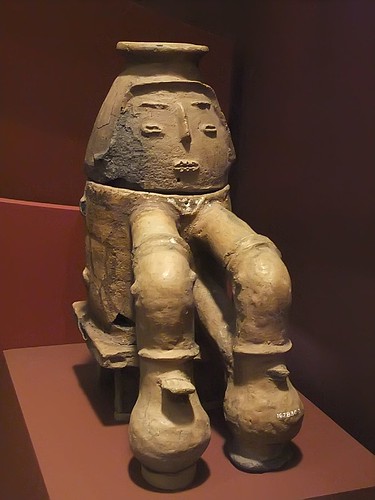
Amazonian Ceramic Figure from the state of
Amapa in Brazil 1200-1600CE.  Photographed at
the Field Museum in Chicago by Mary Harrsch.
New excavations and soil core analysis in Peru indicate that the Amazon ecosystem supported an advanced civilization at least as far back as 800 CE.  It always struck me as strange that an area that could support such a lush rainforest with its myriad of lifeforms could have been viewed as so unsuitable for human habitation in ancient times!

Along the Xingu, an Amazon tributary in Brazil, Michael Heckenberger of the University of Florida has found moats, causeways, canals, the networks of a stratified civilization that, he says, existed as early as A.D. 800. In Bolivia, American, German and Finnish archaeologists have been studying how pre-Columbian Indians moved tons of soil and diverted rivers, major projects of a society that existed long before the birth of Christ.

Many of these ongoing excavations follow the work of Anna C. Roosevelt. In the 1980s on Marajo Island, at the mouth of the Amazon, she turned up house foundations, elaborate pottery and evidence of an agriculture so advanced she believes the society there possibly had well over 100,000 inhabitants.

In some ways, the theory that the Amazon may have been a wellspring of civilization should come as no surprise in the 21st century. In a long perilous journey along Ecuador's Napo River in 1541, Spanish friar Gaspar de Carvajal, a chronicler of the European conquest, wrote of "cities that gleamed white," canoes that carried dozens of Indian warriors, "fine highways" and "very fruitful land."

Bits of colorful ceramics - matching that found elsewhere in the Amazon - seem to show that those who lived here were the Omaguas, the same people Gaspar de Carvajal encountered nearly 500 years before.  - Scientists find evidence discrediting theory Amazon was virtually unlivable by Juan Forero for the Washington Post

 Most of our documentation about the Omaguas was compiled by 17th century missionary Samuel Fritz.  By his time, the average Omagua settlement had been reduced to, on average, 28 plank houses with palm-thatched roofs where about 330 individuals, most members of an extended family, lived.


Men and women wore cloth garments. The men wore long sleeveless shirts that reached down to their knees. Women wore short wraparound skirts. The men usually left their shirts off because they got in the way. The clothes were usually painted with multicolor designs. Due to the Omaguas flattened foreheads they are easily distinguished from other Amazonian tribes. Fritz observed that shaping was done in infancy by “ applying to the [babies’] forehead a small board or wattle of reeds tied with a little cotton so as not to hurt them, and fastening them by the shoulders to a little canoe, which serves them for a cradle” (Meggers 125).

The spearthrower was the principle weapon for hunting, fishing, and gathering. It took the form of a flat board about 40 inches long and three fingers wide with a bone hook at the upper end to secure the projectile. The spear or arrow was about six feet long and had a point of bone or very hard wood which was sometimes detachable, permitting it to remain in the victim. To shoot the arrow is taken in the right hand, with which the spearthrower is held by its lower end, and placing the arrow against the hook, they launch it with such force and accuracy that they do not miss at fifty paces” ( Meggers 127). The shields used in warfare were the height of a man and made of basketry covered with cayman, manatee, or tapir hide. If there was no stone, turtle shells were used for axes and adzes.

Each village had a chief and all the villages in a province were united under one high chief who was described as “ a very great over lord.” - Nick Willaert, Minnesota State University at Mankato
 Smithsonian Atlas of the Amazon   Amazon (IMAX)   Ancient South America (Cambridge World Archaeology)  Empires in the Americas: A Journey Back in Time (Lost Treasures of the Ancient World)  
If you enjoyed this post, never miss out on future posts by following me by email!

Friday, September 03, 2010

Maori mere (war club) stolen from tomb recovered

When I first saw the news alert about this theft of a mere, I thought someone who had tried to translate a foreign news release into English had simply misspelled mirror but when I checked the article I learned that a "mere" is a Maori war club:

"A priceless greenstone mere stolen from the tomb of one of the founders of Parihaka Pa in Taranaki has been recovered.

The mere, which belonged to the revered Maori peace prophet Te Whiti O Rongomai, was stolen last week after thieves smashed through a glass casing which protected the mere within the tomb. A mere is a traditional Maori hand club." - New Zealand Herald

I found this very interesting and informative site about Maori weapons that further describes the weapon and its ritual symbolism:

"A short flat club usually made from wood, bone, or greenstone. Also know as a Patu or Waihaka. Used in hand to hand combat. Typical strike zones for warriors included the temple, the jaw and the ribs. The greenstone mere was particularly highly prized as it requires an incredible amount of work to make one. Warriors who carried a greenstone mere were considered to posses great strength and honor. Today the mere represents the facing and overcoming the challenges life presents." - Maori Source

I was surprised to see that the Maori seemed to prefer clubs of various types rather than bladed weapons even though their typical strategy was to kill all enemies in an engagement to prevent revenge attacks.  The single weapon illustrated on the web site that included a greenstone blade was said to be for ceremonial purposes only. 

I found another very good summary of Maori warfare that mentioned they did, at times, use a thrusting spear but never developed the bow and arrow and typically did not throw spears.  Killing at close range appeared to be preferred to impart the appropriate honor on successful warriors.

The summary also described cannibalism that was a common practice during Maori warfare:

Cannibalism was the regular practice in Maori wars. Human flesh was an important part of the food supply of war parties. The bodies were cut up with obsidian flakes and then cooked on heated stones which were laid in pits in the ground. Sometimes, flesh was kept as a supply for the journey. Such meat would first be boned, then dried and packed in flax baskets; alternatively, it was potted in fat in gourds. Prisoners were sometimes taken alive, tied together with flax ropes and kept on the hoof for future slaughter and use...

Mortality in Maori wars must have been considerable in spite of the small forces usually engaged. No quarter was given in battle so that life could only be saved by flight, but it was during flight that the pursuers killed most of their enemies. Not many war parties were completely exterminated but more than a few lost a very large percentage of their members. Most captives were killed and eaten; some—especially women and children—were enslaved. But often these also were eaten.

Some of the bones of the slain were saved, as further indignity, for making flutes, heads of bird spears, fish hooks, rings for captive parrots, pins and needles. Heads were sometimes thrown on a heap in a grisly ball game, occasionally they were impaled on the stockades of a pa. Heads of both friend or enemy, if belonging to great chiefs, were at times taken home and preserved. - National Library of New Zealand
Maori warrior photographed at the
Polynesian Culture Center on the
island of Oahu, Hawaii by Mary Harrsch
This made me wonder if the brain disease "kuru" (similar in symptoms to mad cow disease) was ever a recorded problem among the Maori but I could not find any definitive references.  I did find a post that said researchers are now questioning cannibalism as the cause of kuru in the Fore culture in Papua New Guinea anyway.  It seems that further research indicates kuru was apparently not present before contact with Europeans even though the Fore had practiced mortuary cannibalism for centuries. However, scientists point out that after the kuru epidemic reached a high point in the 1960s, kuru among the Kore pretty much vanished after cannibalism was eliminated.  So there appears to be at least some connection although the two factors may have been a simple coincidence. 

I had the opportunity to meet a Maori warrior when I visited the Polynesian Culture Center on Oahu, Hawaii in 1982.  Maybe someday I'll be able to visit New Zealand to learn more about this fascinating culture.


*Image of mere war club courtesy of the Maori Source

Maori   Maori myths & legendary tales   New Zealand Maori Culture Traditions and History   The Illustrated Encyclopedia of Maori Myth and Legend   An Intellectual History of Cannibalism   A History of Cannibalism: From Ancient Cultures to Survival Stories and Modern Psychopaths   Eat Thy Neighbour: A History of Cannibalism
If you enjoyed this post, never miss out on future posts by following me by email!