Wednesday, April 24, 2013

Review: She-Wolves: England's Early Queens (DVD series)


Women throughout history who have expressed any inkling of ambition have traditionally been disparaged by the world's predominantly paternalistic societies as either harlots or traitors to their own sex.  Britain's women who would rule were no different and branded as she-wolves by the men who sought to claim sovereignty even without the prerequisite royal blood line.  It is the lives of these women of Britain that are explored in Acorn Media's series "She-Wolves: England's Early Queens" based on a book of the same name by medieval scholar Dr. Helen Castor.  Castor produced the series for the BBC and serves as its host throughout the program.

In opening remarks, Castor points out that men rose to power by demonstrating their superiority in military leadership and prowess as warriors.  But women in the royal line of succession were often ignored or married off to males deemed unfit because of fragile health or mental instability so other powerful men could assert their rights to the royal succession.  To press their own claim or the claim of their offspring to the throne, queens were often forced to forge alliances with men who could just as easily thrust them aside once a battle was won.


Episode 1 examines the struggles of Matilda, daughter of Henry I, and Eleanor of Aquitaine, first a queen of France then wife of Henry II of England.  I was somewhat familiar with at least a basic outline of the events that transpired in the lives of these two women.

The war between Matilda and her usurping cousin Stephen of Blois has been the backdrop for a number of theatrical productions including the excellent miniseries "Pillars of the Earth" based on Ken Follett's book by the same name.  In fact the death of Matilda's brother aboard the infamous White Ship is the ultimate secret harbored by the evil villain of the story, Bishop Waleran Bigod, played superbly by Ian McShane.

Likewise, Eleanor of Aquitaine has been the subject of countless books and theatrical productions including the award-winning "Lion In Winter" with Eleanor played by none other than the legendary Katherine Hepburn.  Eleanor has been portrayed so heroically for centuries that I was surprised Castor approached her biography more matter-of-factly.

Based on the life sketched by Castor, I got the impression Eleanor may have been more personally ambitious than the ultimate romantic she is often portrayed to be.  Perhaps describing her as passionately ambitious would be a good combination instead.  When you examine her possible tryst with her warrior uncle in Antioch while on Crusade and married to King Louis VII of France,  then her aggressive pursuit of Henry II after she successfully obtains a dissolution of marriage, she hardly comes across as an icon of courtly love.
Then you learn she essentially betrays Henry when her sons (including Richard the Lionheart and the infamous King John of Robin Hood legend), tired of waiting for him to die so they can rule, revolt against their father.  How could I characterize her but to recognize that she appears to be someone who desired power above love (she virtually ruled England while her son Richard The Lionheart was away on Crusade) and was supremely opportunistic - much more deserving of the term she-wolf than I initially thought.


I found Episode 2 about Isabella of France and Margaret of Anjou even more fascinating.

As Castor detailed the unfortunate marriage of Isabella of France and Edward II, I couldn't help but picture the beautiful image of Sophie Marceau who played the role of Isabella in Mel Gibson's production of "Braveheart".  Of course this theatrical version of the Queen was rife with "creative license" since historians say Isabella and Edward II married three years after Braveheart was captured and executed. Isabella was also only 12 at the time of their marriage so she couldn't possibly have been a secret lover of William Wallace.  But it was the face of Marceau that I continued to envision as I listened to the trials of her difficult marriage.  Her husband, who preferred male companionship, gave his attentions, first, to Piers Gaveston, the first Earl of Cornwall, then Hugh Despenser the Younger.  In spite of this, Isabella somehow managed to produce four children (although there were rumors of queenly affairs).  Isabella's eldest, Edward III, ultimately became King of England.

The barons of England were as appalled by Edward's behavior as Isabella and were in constant plots to end his rule.  These efforts increased in earnest when Edward advanced his favorite Hugh Despenser the Younger.

Increasingly Edward had to rely on Isabella's French relatives to keep him in power.  But Edward's lover Despenser the Younger used his influence to confiscate Isabella's lands in England and even her household staff.  Then, when tensions rose between France and England and Isabella was sent to France to negotiate a settlement, she finally found love with Roger Mortimer, the first Earl of March, who had been exiled to France.  Together they raised and army, invaded England and deposed Edward II.  But, in a cruel twist of fate, Isabella's son did not like Mortimer and resented his influence so the prince ordered Mortimer's execution.  Edward III did not execute his mother but, like many noble women who displeased the men in power, Isabella ended her days in a nunnery.

I thought the biography of Isabella would be the most poignant but the story of Margaret of Anjou was even more heart rending.  Margaret was married to the son of the famous warrior king Henry V when she was only 15.  But unlike his warrior father, Henry VI was not only bookish and lacking a forceful personality, he suffered from severe and incapacitating mental illness -  hardly the warrior king needed for the ensuing War of the Roses.  So Margaret had to seek help from other powerful nobles to try to retain the throne for Henry so her son could ultimately inherit it.

Castor did not elaborate much about Henry VI's mental condition but I was intrigued so I researched it further.  Here are some of the speculations about the cause that I found:

"In 1453, at the age of 32, Henry VI began to exhibit signs of serious mental illness. By means of a "sudden fright" he entered into a trance-like state reacting to and recognising no one. Catatonic schizophrenia or depressive stupor have been suggested as a likely diagnosis. This was probably an inheritance from his grandfather, Charles VI of France, who himself suffered from bouts of schizophrenia, which is reported to have come on suddenly in 1392 when he was then aged 24, into which he then suffered relapses for the next 30 years. Charles VI's mother, Joanna de Bourbon, also exhibited signs of mental illness, as did various ancestors of hers, including Louis I, Duke of Bourbon, Peter I, Duke of Bourbon, Louis II, Duke of Bourbon." - English Monarchs

A physician from Albert Einstein College of Medicine agrees with the diagnosis of schizophrenia:

"At 31 he [Henry VI] had a sudden, dramatic mental illness in which he was mute and unresponsive. Before, he had been paranoid, grandiose, and indecisive. After, he was apathetic with deterioration of ability, drive, interest and self-care, and hallucinations and religious delusions. This illness, which is consistent with a diagnosis of schizophrenia, robbed Henry of his personality, his crown, his wife, his only son, and his life. It led to three decades of brutal fighting for the crown (the 'Wars of the Roses') that resulted in a new dynasty with a dramatic impact on the country: the Tudors, Henry VIII, and Elizabeth I and their descendants. - N. Bark, Did schizophrenia change the course of English history? The mental illness of Henry VI, abstract

During this period, though, Margaret gave birth to a son she named Edward.

"When the baby was shown to Henry, he remained immobile like a statue, looking upon the Prince only once, immediately casting down his eyes again; he took no notice and said no word. He didn’t even recognise his wife. The Royal physicians tried a series of drugs, purgatives, baths and bleedings, but their patient remained impassive. He wouldn’t wash or dress of his own account. Potions, syrups, laxatives, clysters and bloodletting followed. Henry’s head was shaved and purged “to rid the brain of its black bile and so restore the balance of the humours”. Still, Henry remained passive, and found difficulty in moving about without assistance." - J.N.W. Bos, Mad Monarchs: Henry VI of England,

When Henry began to fully recover in January 1454, he declared his son must have been conceived by the Holy Ghost, which did little to quell the rumors of his queen's unfaithfulness.  Things went from bad to worse when the king's regent, Richard Plantagenet, 3rd Duke of York, began organizing allies that would support his own, rather than the king's, right to the throne.  With the King essentially incompetent to defend himself, Margaret resorted to intrigue to put an end to this threat, conspiring to assassinate the duke on two different occassions.  Castor did not get into this much detail however.

Failing to put an end to her husband's rival, Margaret found herself at the head of the Lancastrian faction in her husband's stead at the First fateful Battle of St. Alban's where the Yorkists succeeded in routing the King's forces and imprisoned Henry VI.

Margaret's forces retaliated at the Battle of Wakefield and a Second Battle of St. Alban's where her husband was freed.  But other Lancastrian defeats followed and Margaret fled to France where she sought help from her cousin Louis XI.  Louis suggested an alliance with the Earl of Warwick and the Earl offered his daughter's hand in marriage to Margaret's son to seal the bargain.  But, upon returning to England, Warwick, although initially successful, fell at the Battle of Barnet leaving Margaret alone to lead the Lancastrian army at the Battle of Tewkesbury.  There, her forces were not only defeated but her beloved 17-year-old son was killed.

Her husband, Henry VI, upon hearing of his son's death died soon after.  Although the official story was Henry died of grief many suspected foul play.  To end all doubt, King George V had Henry's body exhumed in 1910.  A patch of light brown hair matted with blood was found still attached to his skull, confirming a violent end to his life.

Broken and defeated, Margaret was imprisoned until ransomed by Louis XI four years later.  She spent her remaining seven years as a poor relation to the King of France.  When I researched her biography, I noticed that this courageous "she-wolf"  suffered a final indignity during the French Revolution when rebels ransacked her tomb in Angers Cathedral and scattered her remains.


The last episode of "She-Wolves" focuses on the accesion of Lady Jane Grey, Mary Tudor (Mary I) and Elizabeth I following the death of Henry VIII.  I have watched quite a few films on the Tudors as well as studied the life of Henry VIII so I was familiar with most of the information Castor provided here.  However, I was under the assumption that Henry VIII's only son, Edward VI, was a sickly child eventually succumbing to a respiratory ailment at the tender age of  15 so had contributed little during his reign.  Castor pointed out that Edward was quite directly responsible for numerous Protestant reforms and personally developed a "devise of succession" that skipped over his half-sisters, the very Catholic Mary as well as Elizabeth, and granted ruling authority to his cousin, a very reticent 16-year-old Lady Jane Grey.  I had assumed all of this manipulation was the result of the influence of the King's regent, the  Duke of Northumberland.  But I guess that line of thinking was abandoned back in the 1970s.
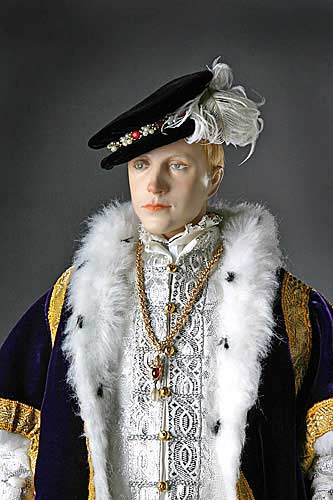
Mixed media portrait sculpture of Edward VI
by George Stuart.  Image courtesy of the
Historical Figures Foundation.

"For centuries, the attempt to alter the succession was mostly seen as a one-man-plot by the Duke of Northumberland. Since the 1970s, however, many historians have attributed the inception of the "devise" and the insistence on its implementation to the king's initiative Diarmaid MacCulloch has made out Edward's "teenage dreams of founding an evangelical realm of Christ", while David Starkey has stated that "Edward had a couple of co-operators, but the driving will was his". Among other members of the Privy Chamber, Northumberland's intimate Sir John Gates has been suspected of suggesting to Edward to change his devise so that Lady Jane Grey herself—not just any sons of hers—could inherit the Crown. Whatever the degree of his contribution, Edward was convinced that his word was law and fully endorsed disinheriting his half-sisters: "barring Mary from the succession was a cause in which the young King believed." - Edward VI, Wikipedia with citations 161-167

"She-Wolves" brought much needed attention to the role women have played in the history of Britain, even before the much glamorized rule of "Gloriana" (Elizabeth I).  Dr. Castor is to be applauded for the development of this series and its straightforward presentation that makes these women come alive for a 21st century audience.


Enhanced by Zemanta
If you enjoyed this post, never miss out on future posts by following me by email!

Monday, April 08, 2013

Review: The Ultimate Guide to the Presidents (History Channel documentary)


When I was asked to review this new DVD series from the History Channel I thought it would be a collection of biographies of the men that have held the office of President of the United States since George Washington assumed the office on April 30, 1789.  Although, it began with George Washington and worked its way through each successive office holder, it quickly became clear to me that the focus of this new 2013 production was directed toward each man's presidential politics and how the policies of each administration ultimately shaped the role of government in its citizens lives and in the world community of nations.

Perhaps the best way to illustrate the difference in this new production is to compare it to an earlier award-winning series produced in 2005 for the History Channel entitled simply "The Presidents" since they appear to cover the same material.

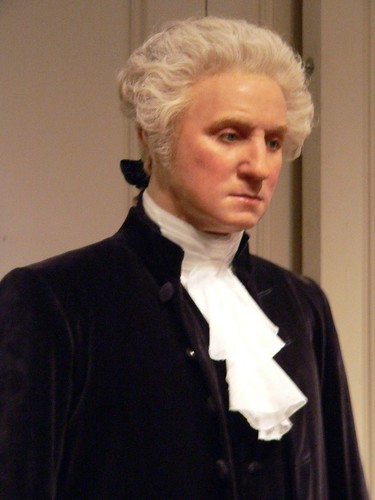
George Washington sculpted in wax at
Madame Tussaud's in London.  Photo by
Mary Harrsch.


Of course both series start with George Washington.  The 2005 documentary begins by telling us interesting little facts about George Washington, the man.  We learn he loved to dance the minuet and collect American landscape paintings.  He enjoyed interior decoration, personally decorating the interiors of his home at Mount Vernon.  He also dabbled in fashion design and designed various military uniforms.  Thomas Jefferson said he was the best horseman he had ever known and Washington's white horse was named Nelson.

We learn Washington was considered a good judge of character and not someone who simply wanted "yes men" advisors.  He selected the first cabinet and it was composed of really talented and experienced men including Thomas Jefferson who served as Secretary of State and Alexander Hamilton who became the first Secretary of the Treasury.  Washington met with them regularly and seriously considered their advice when making decisions.  Then, one of the professional historians interviewed for this segment very tactfully mentioned that Washington was "accustomed to command."  We also learn that Washington did not like to shake hands but one of the historians again tactfully explained that Washington simply felt it was beneath the dignity of the office of President.

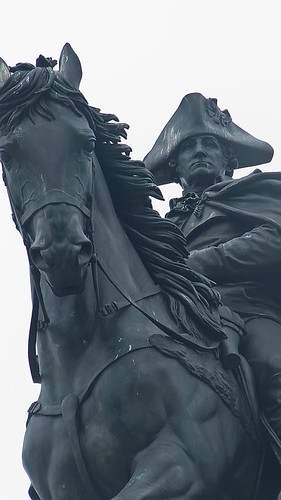
An equestrian statue of George Washington
by Rudolf Siemering Bronze 1897 CE
atop the Washington Monument in Eakins
Oval outside the Philadelphia Museum of Art.
Photo by Mary Harrsch.
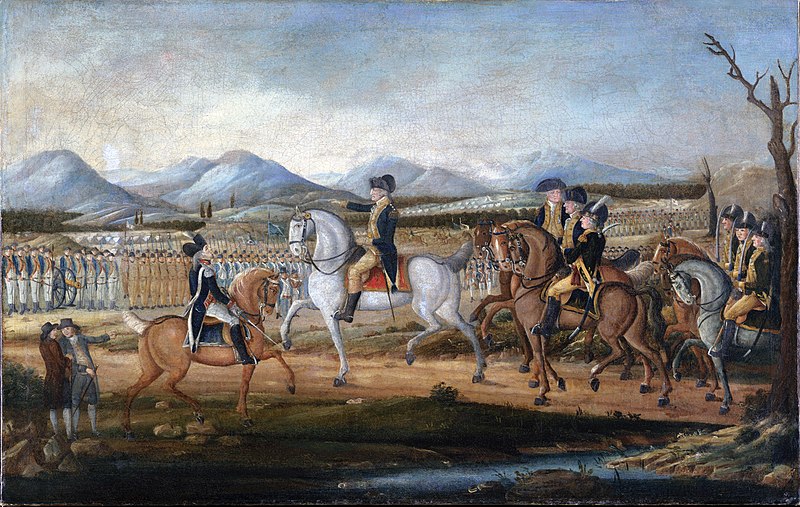
The older program went on to tell us that Washington personally selected the site for the new capital and even personally surveyed the site.  Then we learn about Washington's declaration of neutrality when Great Britain went to war with France and, when a large number of citizens violently objected to a whiskey tax enacted by Congress, Washington led a force of 12,000 volunteers to put down the rebellion.  Lastly, much is made of Washington's willingness to lay down the responsibilities of president and peacefully return to Mount Vernon like an American Cinncinattus.

Interesting what a difference eight years makes in historical perceptions!  The new series first spends quite a bit of time explaining the context of the office of president at that time.  Congress considers itself the most important governing body and also imparts substantial strength to the judicial branch.  But the position of chief executive is viewed as someone who essentially will rubber stamp whatever legislation is ultimately sanctioned by the Congress.  Members of Congress did not initially consider giving the president veto power or control of government in any way, wishing to avoid the problems of hereditary monarchies or military-controlled empires.

As the first person to hold the office, Washington set a number precedents, including the appointment of a cabinet.  As mentioned in the first series, it is pointed out that he dislikes shaking hands but this time the historian is more frank about Washington's attitude that he felt the custom was beneath him.

The differences between the two documentaries becomes especially obvious in the discussion of Washington's second term.  When Great Britain and France declare war and Washington decides to sign a neutrality agreement, people are outraged.  Some people call Washington a traitor and Washington is burned in effigy.  Furthermore, Congress questions Washington's right to sign such an agreement since the president cannot declare war.  That is the perogative of Congress.  Washington becomes very angry because he is not only "accustomed to command" as it was so delicately stated in the first documentary, but he is not used to criticism or having his viewpoint challenged.

George Washington leading 12,000 volunteers to suppress the Whiskey Rebellion.  Image courtesy of Wikipedia.


As the second term wore on, the 2013 program points out Washington became tired of the job and longed to retire to Mount Vernon.  He often appeared bored at state dinners.

His selection of the site of the new nation's capital was not without challenge either.  Several of the colonies, now states, had incurred large debts during the revolution and wanted the central government to now assume them.  Other colonies that had paid their own debts were opposed.  Washington felt strongly that if the central government was to exercise authority over all of the states, it should assume the war debts.   But to overcome the opposition he developed a compromise.  One of the largest debtors was New York, the location of the capital at that time.  The majority of colonies that did not have large war debts was in the south.  So Washington proposed that in exchange for assuming the war debts of the mostly northern colonies, the new government capital would be relocated south to its present location on the Potomac River.  I thought this was an interesting example of early political compromise.

So, I came away from my comparison wishing the History Channel had integrated these documentaries to truly produce an "Ultimate Guide to The Presidents".  The 2013 documentary also included more live action reenactments and tack sharp visuals as well as a more dramatic score.  At least I can recommend both productions as complementary to each other and not duplicative in scope or focus.


Enhanced by Zemanta
If you enjoyed this post, never miss out on future posts by following me by email!

Thursday, January 03, 2013

Impressionism - Technology sparks an evolution in art

Acorn Media sent me a fascinating series they recently released on DVD entitled "Understanding Art: Impressionism."  Not only did I find the details of the groundbreaking artists' lives covered in the series  interesting, but, being a technologist, I was surprised that this revolutionary change in art was partially brought about by several technological advances in artists' equipment.

Impressionism is foremost an effort to capture the real world in natural light (en plein air).  But before the invention of a portable easel, artists had been pretty much shackled to an indoor studio because of the bulky nature of their painting platform.  According to the series, this changed dramatically with the development of a compact, collapsible easel and  the mid-18th century introduction of premixed paints in lead tubes (resembling modern toothpaste tubes), which allowed artists to work more spontaneously, both outdoors and indoors. Previously, painters made their own paints individually, by grinding and mixing dry pigment powders with linseed oil, which were then stored in animal bladders.

[J. M. W.] Turner was one of the first artists in Britain to use synthetic colours as they gradually became available, with chromium yellow becoming his favourite. 
The transition from archaic alchemy to modern chemistry during the nineteenth century would mean that new metallic elements, such as Chromium, could be treated with different acids and combined with various other metals to provide a much wider range of colours for artists. 
Chromium yellow, chromium orange and chromium red, as well as a completely new range of chromium greens became available. 
These pigments made in a laboratory setting were found to have all the properties, including durability and permanence, of their natural counterparts. - Carolyn McDowall, Turner from the Tate - A Major Art Show for Australia 2013

 Although Turner painted before the full-blown Impressionist movement began in earnest, the video points out that he inspired later Impressionists like Monet.  Turner is of particular interest to my own family because we think Joseph Mallord William Turner may possibly be one of our ancestors. Our grandfather, Joseph William Turner, was born near Maidstone, England where J.M.W. Turner lived.  When my sister Jane and I were in England, we were told J.M.W. Turner was a notorious womanizer as well as a great painter and we can't help but wonder at the close similarity in names.  My grandfather (or his father) could have been named after J.M.W. Turner because of the painter's celebrity, but it does make you wonder due to the proximity to their family homes.  Since J.M.W. Turner lived from 1775 - 1851, he couldn't have been my grandfather's father but he could have been his grandfather.  Anyway, we enjoy viewing his art and like to think he may have been part of our extended family. Jane and I toured the Turner gallery at the Tate when we were in London in 2006 and later I saw more of Turner's work on exhibit at the Kimbell Art Museum in Fort Worth, Texas.

But, back to the Impressionist revolution.  Another technological improvement introduced in the mid-1800s was  the development of the ferrule, the metal portion of the brush covering the attachment of the bristles to the wooden shaft.  Prior to the development of the ferrule, bristles were attached to the brush by thread bindings that held the bristles in a circular clump.  Although the ends of the bristles could be clipped to alter the shape, the application of paint was still circumscribed by the overall circular shape of the brush.  With the invention of the ferrule, the shape of the entire array of bristles could be flattened to varying degrees by flattening the metal of the ferrule.  This enabled artists to apply paint in short, thick strokes (termed "impasto") that became typical of many Impressionists' works.

This closeup of "Woman in a Garden" by Berthe Morisot,
(1882/1883) illustrates the thicker application of paint
employed by Impressionists.  Photographed at the Art
Institute of Chicago by Mary Harrsch.


As I watched the series, I was also surprised by another pragmatic detail adopted by the Impressionists.  The narrator pointed out that Impressionists typically wore dark smocks so the reflected color of their clothing would not pollute the colors reflected by the natural light they were attempting to capture.  I had to smile at this as that is exactly the reason I wear dark, non-reflective clothing when I photograph artwork in a natural light setting.  I learned this the hard way by wearing bright red on one of my first photoshoots and discovering after I got back to my office that all of my images had a rosy glow that I then had to spend hours in Photoshop to remove.  If I had studied the Impressionists first, I might have saved myself a lot of work!

Other interesting details I learned from the video series included the fact that syphilis was rampant in 19th century France.  Upon researching this point on Wikipedia, I learned that syphilis is thought by some scholars to have been carried back to Europe by crewmen returning from Christopher Columbus' voyages to the New World since it was not diagnosed in Europe until 1494.  The Columbian theory is rejected by those who think syphilis was simply not recognized until then but had existed previously in the Old World for many years.   I had thought it had been around since the world's oldest profession but apparently not.  I had heard for many years about Small pox and measles brought by European colonists to the New World being a tragic consequence to the Native American peoples here.  But maybe they inadvertently got a little payback afterall. Unfortunately, though, syphilis took its toll on some of the most gifted of the Impressionists, including Edouard Manet.

"Artists throughout history have led lives worthy of tabloid headlines. What makes the artistic temperament so susceptible to notorious and off-the-wall conduct? "Artists in general are unusual people," says Kevin Stayton, chief curator of the Brooklyn Museum. "Great artists push boundaries, have new ways of seeing and thinking, and do things no one has done before. This energy is not going to be confined to their work. It spills over to how they live." But the legend of an artist never outshines the art itself. Says Stanton, "Tons of people throughout history have tried to be artists, and lived outrageous lives. But if the art doesn't make them immortal, their behavior certainly won't." - Artists Behaving Badly by Courtney Jordan, Smithsonian Magazine

However, this was not necessarily the case with Edouard Manet.  The video explained that some scholars think that Manet married his father's mistress, Suzanne Leenhoff, out of duty and actually contracted syphilis from his own father through her.  Although Edouard treated Leenhoff's son as his own, some think Leon could have actually been his half brother.  I thought it was ironic that his stodgy traditionalist father who was a highly respected judge in "polite" society may have led more of a secret lifestyle like that ascribed to artists while his artist son was far more conservative.  To learn more about Edouard Manet check out Artsy's Edouard Manet page.
A self-portrait by Frédéric Bazille.
Photographed at the Art Institute of Chicago
by Mary Harrsch.

I was also saddened to learn that one of the artists was killed at the tender age of only 28 in the Franco-Prussian War.  On November 28, 1870, Frédéric Bazille was with his unit at the Battle of Beaune-la-Rolande when, his officer having been injured, he took command and led an assault on the German position. He was hit twice in the failed attack and died on the battlefield.  Bazille was not only a gifted artist in his own right but used his wealth to support the other less fortunate Impressionists, providing them with a studio and often materials as well.

I have been fortunate in my travels to view a number of Impressionists exhibits.  The first was an exhibit at the Walters Art Museum in Baltimore in 2004. The Musee d'Orsay in Paris is one of the world's largest facilities that permanently houses many Impressionist works.  I was fortunate enough to visit the museum in 2008 when I was in Paris and recommend it as a "must see" for anyone traveling to France.

The Art Institute of Chicago has some really exceptional Impressionists works in their collection too, including several from one of my favorite Impressionists, Pierre-Auguste Renoir.  I spent two enjoyable days exploring their galleries in 2009.

Young Woman Sewing by Pierre-Auguste Renoir, 1879
Photographed at the Art Institute of Chicago by
Mary Harrsch.


Then this year the Portland Art Museum hosted an exhibit of both historical and modern impressionism.  One of Monet's famous lily ponds of Giverny, part of their permanent collection, shared the limelight with works by Renoir, Manet, Gaugin, Degas, Van Gogh and Impressionist pioneer Camille Pissaro.

Closeup Detail of "Waterlillies" (1914-1915) by Claude Monet.
Photographed at the Portland Art Museum by Mary Harrsch.

"Young Girls Reading" (1891) by Pierre-Auguste
Renoir.  Photographed at the Portland Art Museum
by Mary Harrsch.

Born on the island of St. Thomas in the Danish West Indies,
Jewish artist Camille Pissarro preferred to paint quiet country
scenes rather than the raucous social life of Paris. "The Red House"
 (1873) Photographed at the Portland Art Museum by Mary Harrsch.
Watching Acorn Media's "Understanding Art: Impressionism" really made these artists come alive for me and the lush imagery and humorous recreations of famous paintings with live models allowed me to savor their work like a fine glass of wine.  I think you'll find it just as captivating.

Enhanced by Zemanta
If you enjoyed this post, never miss out on future posts by following me by email!