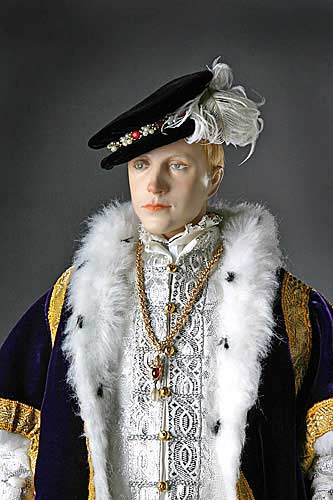
A history resource article by Mary Harrsch © 2014

 The producers of the excellent history DVD "She-Wolves: England's Early Queens", Athena Learning in association with RLJ Entertainment, have released another fascinating look at life in the Middle Ages entitled "Medieval Lives: Birth, Marriage, Death". Once again, Cambridge professor Helen Castor guides us through a wealth of information based on first person accounts from such sources as the Paston letters, a collection of over 1,000 documents kept as a family archive by three generations of the Paston family of Norwich.
In the first episode, I was surprised to learn that if a woman died in childbirth before the infant had emerged, the child was removed from the mother before burial because, although the mother had been baptized, the child had not and with the taint of Original Sin could not be buried in sanctified ground. I had never heard this before and Dr. Castor was quick to point out that this requirement was often ignored whenever possible.
For this reason, the church actually granted midwives the authority to baptize a child in the birthing chamber. If the midwife thought there was a real possibility the child would imminently die, they could perform the rite as soon as the head emerged in a last ditch effort to save the child's soul. If the mother died first, midwives were supposed to cut open the woman and extract the baby so it could be baptized, even if it would not ultimately survive.
Medieval paintings and books, like the 12th century Trotula texts, based in part on the research of the ancient Greco-Roman physician, Galen, as well as newer Arabic medicine, illustrated the practice.
But between the 6th and 13th centuries the literate midwife of antiquity disappeared and the task of aiding women in childbirth was relegated to neighbors and kinswomen, most without any training except experience. This changed somewhat when the church, concerned about the need for emergency baptism of a newborn, initiated a formal licensing process, first in France, then spreading throughout northern Europe and England.
When I looked up the Trotula texts, I found that, although the original texts were produced in Latin, by the 13th century, editions in Anglo-Norman and Old French were circulating. By the 14th and 15th centuries, there were translations in Middle English, German, Irish and Italian as well. If the popularity of these texts was not all attributable to purient male interest, this would indicate women must have been among the literate practitioners using the manuals since male physicians were not generally allowed in medieval birthing chambers until late in the 15th century.
Dr. Castor also mentioned that, in addition to the church-licensed midwives, objects made of black jet, amber or coral that were thought to have mystical properties were used in the birthing chamber, including parchment birthing girdles (belts) embellished with prayers.
In episode two, Dr. Castor moved to the next significant life event, marriage. Dr. Castor pointed out that medieval marriages before the 13th century amounted to little more than a declaration between a man and a woman that could occur anywhere, often in taverns or even out in the countryside. Witnesses were not required, although if one of the participants might want to contest the validity of the marriage at a later date, witnesses would make such a task easier.
Parents of prospective brides and grooms would often negotiate the exchange of property if a marriage should take place and would arrange for couples to formally meet with the intention that a marriage was deemed suitable between them but parents could not force a marriage.
Royal marriages were usually arranged by diplomats so I was surprised to learn that the famous poet, Geoffry Chaucer, actually arranged the marriage between King Richard II and Anne of Bohemia. The negotiations took five years which was probably a good thing since Richard II was only ten years old when he ascended the throne.
The informal nature of marriages became a real problem in 1066 when William the Bastard, later known as William the Conqueror, was recognized as the son and heir of Robert I, Duke of Normandy, even though his mother, Robert's mistress, was a daughter of a tanner. When William's first cousin once removed, Edward the Confessor, died childless, William became a claimant to the throne of England. Of course, William invaded England and became King after defeating King Harold II at the battle of Hastings.
Although legates from Pope Alexander II ceremonially crowned William during the Easter court of 1070, giving the church's "seal of approval" to William's reign, the church recognized the danger in having such important matters as succession reliant upon such a casual relationship. By the 12th century, the church produced and distributed missales that prescribed correct marriage rituals including the practice of calling the banns, a proclamation about an impending marriage so anyone could raise issues of canonical or civil legal impediments to the marriage. The banns had to be announced on three successive holy days with at least one weekday in between. The binding of women's hands during the marriage ceremony was also prohibited and the ceremony itself had to be one of reverence - obviously not a bawdy affair in a tavern!
As consumation of a marriage was grounds for disputing its legitimacy, the church implemented the "putting to bed" ceremony whereby a priest would proceed with the couple to the site of the marriage bed and sanctify the bed before the couple was left to "perform their duty".
At this point, the church's position of sex being a necessary evil for procreation transformed into a viewpoint where sex was considered a compulsory requirement of marriage. The church declared that neither partner in a marriage could withhold sex if it was requested. Hmmm...I wonder how they enforced that!
The producers of the excellent history DVD "She-Wolves: England's Early Queens", Athena Learning in association with RLJ Entertainment, have released another fascinating look at life in the Middle Ages entitled "Medieval Lives: Birth, Marriage, Death". Once again, Cambridge professor Helen Castor guides us through a wealth of information based on first person accounts from such sources as the Paston letters, a collection of over 1,000 documents kept as a family archive by three generations of the Paston family of Norwich.In the first episode, I was surprised to learn that if a woman died in childbirth before the infant had emerged, the child was removed from the mother before burial because, although the mother had been baptized, the child had not and with the taint of Original Sin could not be buried in sanctified ground. I had never heard this before and Dr. Castor was quick to point out that this requirement was often ignored whenever possible.
For this reason, the church actually granted midwives the authority to baptize a child in the birthing chamber. If the midwife thought there was a real possibility the child would imminently die, they could perform the rite as soon as the head emerged in a last ditch effort to save the child's soul. If the mother died first, midwives were supposed to cut open the woman and extract the baby so it could be baptized, even if it would not ultimately survive.
 |
| Childbirth in the Middle Ages often involved the use of a birthing stool. |
Medieval paintings and books, like the 12th century Trotula texts, based in part on the research of the ancient Greco-Roman physician, Galen, as well as newer Arabic medicine, illustrated the practice.
"In Antiquity, midwives (called, in Greek, maiai, and in Latin, obstetrices or more generically medicae) were the normative caretakers of both the gynecological and obstetrical needs of Greek and Roman women. Medical writers from at least the third century BCE to the sixth century CE composed texts specifically for midwives’ use, and there is ample evidence (such as inscriptions and artwork) that midwifery was professionalized in larger urban communities. Ancient writings on gynecology and obstetrics conceived of the ideal midwife as not simply literate and competent in medical theory, but as responsible for all disorders of the reproductive organs as well as routine assistance in childbirth. In the scope of her practice, at least, she was fully the equivalent of modern obstetrician/gynecologists and not simply a birth attendant." - Women and Gender in Medieval Europe, An Encyclopedia
But between the 6th and 13th centuries the literate midwife of antiquity disappeared and the task of aiding women in childbirth was relegated to neighbors and kinswomen, most without any training except experience. This changed somewhat when the church, concerned about the need for emergency baptism of a newborn, initiated a formal licensing process, first in France, then spreading throughout northern Europe and England.
When I looked up the Trotula texts, I found that, although the original texts were produced in Latin, by the 13th century, editions in Anglo-Norman and Old French were circulating. By the 14th and 15th centuries, there were translations in Middle English, German, Irish and Italian as well. If the popularity of these texts was not all attributable to purient male interest, this would indicate women must have been among the literate practitioners using the manuals since male physicians were not generally allowed in medieval birthing chambers until late in the 15th century.
Dr. Castor also mentioned that, in addition to the church-licensed midwives, objects made of black jet, amber or coral that were thought to have mystical properties were used in the birthing chamber, including parchment birthing girdles (belts) embellished with prayers.
In episode two, Dr. Castor moved to the next significant life event, marriage. Dr. Castor pointed out that medieval marriages before the 13th century amounted to little more than a declaration between a man and a woman that could occur anywhere, often in taverns or even out in the countryside. Witnesses were not required, although if one of the participants might want to contest the validity of the marriage at a later date, witnesses would make such a task easier.
 |
| Weddings in the Middle Ages were often a raucous affair held in the local tavern. A Peasant Wedding by Pieter Bruegel the Elder, 1566-1569. Image courtesy of Wikimedia Commons. |
Parents of prospective brides and grooms would often negotiate the exchange of property if a marriage should take place and would arrange for couples to formally meet with the intention that a marriage was deemed suitable between them but parents could not force a marriage.
 |
| Parents of prospective couples would negotiate the property that was to be contributed to the bride and groom to help them establish their new household. |
The informal nature of marriages became a real problem in 1066 when William the Bastard, later known as William the Conqueror, was recognized as the son and heir of Robert I, Duke of Normandy, even though his mother, Robert's mistress, was a daughter of a tanner. When William's first cousin once removed, Edward the Confessor, died childless, William became a claimant to the throne of England. Of course, William invaded England and became King after defeating King Harold II at the battle of Hastings.
 |
| William the Conqueror was able to overcome his illegitimate birth to become the King of England because his father, the Duke of Normandy formally recognized him as his son. Image courtesy of Wikimedia Commons. |
As consumation of a marriage was grounds for disputing its legitimacy, the church implemented the "putting to bed" ceremony whereby a priest would proceed with the couple to the site of the marriage bed and sanctify the bed before the couple was left to "perform their duty".
 |
| 15th century woodcut depicting a bishop blessing the marriage bed of a newly married couple. Image courtesy of Wikipedia. |
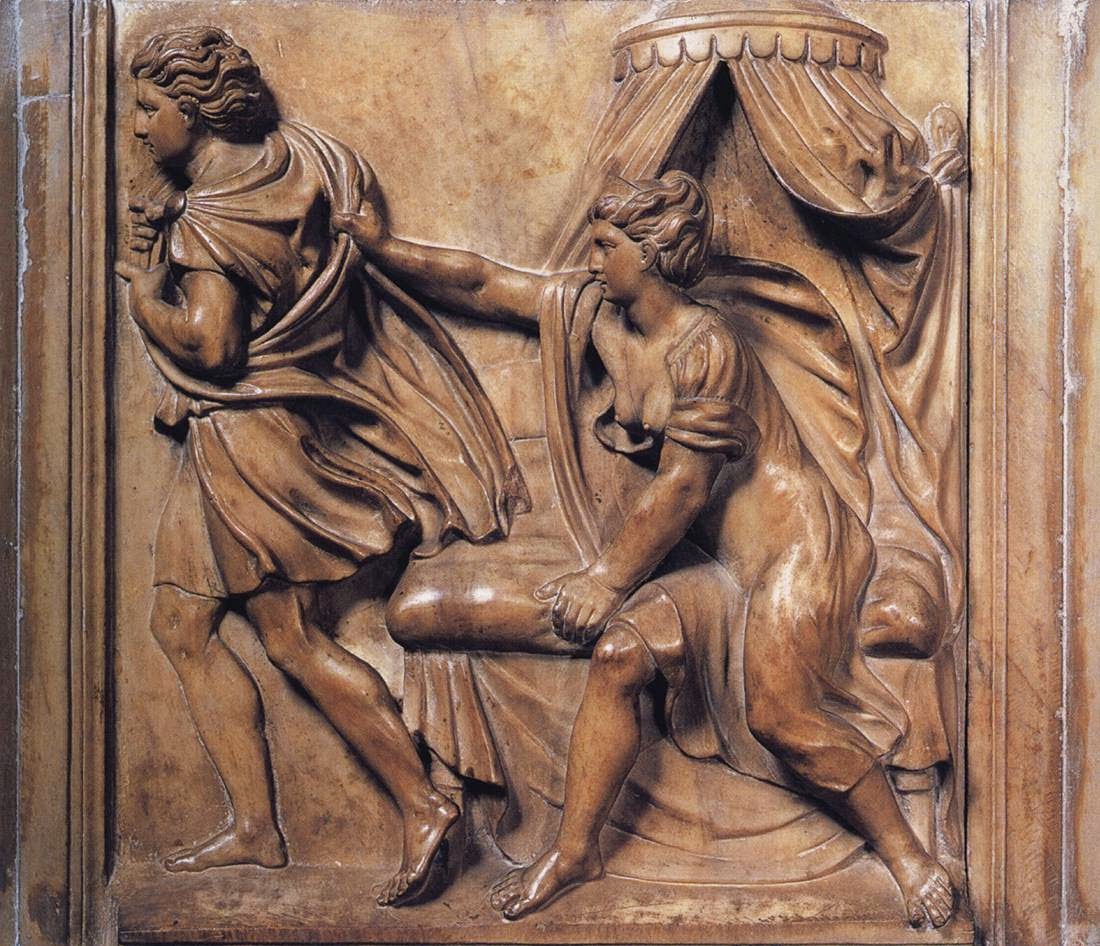 |
Where the church once viewed sex as a necessary evil, in the
12th century the church proclaimed sex as compulsory for
married couples. Sculpture by Properzia de Rossi, female
Renaissance artist.
|
Castor also described the medieval marriage ceremony in which both the groom and bride were covered with a veil. After the ceremony the priest would kiss the groom who was then allowed to kiss the bride.
Again the Paston letters provided insight into the actual practice of marriage in an upper class family. Margaret Paston, a member of the first generation of the nouveau riche family, had a daughter named Marjorie who fell in love with the son of one of their estate bailiffs (overseers). Of course this marriage was considered totally inappropriate to Margaret who banished Marjorie's love interest from the estate. But Marjorie claimed the couple were married having privately pledged their love to each other. Margaret appealed to the bishop of Norwich. I was surprised to learn that the bishop actually sided with the couple despite Margaret's wealthy influence.
 |
| Fresco depicting a bedroom scene circa 1320 CE |
 |
After 17 years of marriage, Henry VIII asked for an
annulment from his first wife, Catherine of Aragon, claiming
the marriage was invalid because he had married his brother's
widow. In medieval law, a marriage extended the familial
relationship to all family members of both marriage partners.
Therefore Catherine would have been viewed as Henry's
sister. Catherine claimed her first marriage was never
consumated so such a relationship had never existed.
Multimedia sculptures by artist George S. Stuart.
Photographed at the Museum of Ventura County by
Mary Harrsch © 2006.
|
Surprisingly, adultery was not grounds for annullment. Dr. Castor explains the case of Edward IV's physician who was a blatant (and public) philanderer. Although the wife called witness after witness, many soldiers and physicians on campaign with the adulterer, the church granted only a decree granting the wife the right to live apart from him and, I assume, obtain financial support from him for her separate household. They were still considered married and could not officially marry anyone else.
The last episode of the series dealt with what constituted a "good death" in the medieval world. Much of this segment discusses the ramifications of the official introduction of the concept of purgatory in the 12th century. Although prayers to assist the dead in their journey to the afterlife have been performed since ancient times, the recognition of a more formalized practice that includes provisions in wills for the cost of ongoing prayer performance was a doctrinal innovation at that time.
 |
| A medieval vision of assisting souls in purgatory with indulgences |
I was aware of the sale of indulgences, a document granting a petitioner a defined period of forgiveness of sin, as a means for the Church to obtain wealth in the late Middle Ages. But I was unaware that the introduction of the concept of purgatory led to the wealthy leaving huge bequests to establish and/or maintain chantries where clerics would officially perform the prescribed prayers to aid the deceased wealthy in the newly defined transitory location.
I was also surprised to learn that King Henry VII, known as a tight-fisted miser, left huge sums in his will to the college of priests at Westminster Abbey to say masses "forever" for his soul. This massive transfer of wealth eventually triggered King Henry VIII's dissolution of the monasteries to recapture much of his kingdom's treasure.
At least one beneficial development followed, however. Hospitals were built as part of this effort to ensure that one's soul would speed through purgatory. Medieval hospitals not only cared for the sick but fed the poor as well and gave the common people an opportunity to demonstrate their piety. One loaf of bread given to the poor was equivalent to helping one soul in purgatory.
 |
At Henry VII's funeral a nobleman dressed in
the king's armor rode into Westminster Abbey
and right up to the high altar. There he dismounted
and removed the armor then dedicated it to god.
This armor is that of the king's son, Henry VIII.
Photographed at the Tower of London by
Mary Harrsch © 2006
|
As in the episode on marriage, Dr. Castor described medieval funerary rites. The most dramatic funeral service again involved King Henry VII. Dr. Castor said a nobleman dressed in Henry VII's finest armor rode into Westminster Abbey right up to the high altar. There he removed the armor and offered it to god. Henry VII may have ruled through fear and blackmail but he definitely knew how to make a classy exit!
The DVD is lavishly illustrated with beautiful closeups of stained glass, paintings, tapestry and sculpture and is definitely a valued addition to my collection of history DVDs. It is scheduled for general release on August 26, 2014.
|
|
 
|
 
|
 
|