Showing posts with label Mary Harrsch. Show all posts

Saturday, February 27, 2016

Henry VIII: Did History lose a true prince of the Renaissance to traumatic brain injury?


An armored Henry VIII and his charger at the Tower of London
in London, England.  Photo by Mary Harrsch © 2006
A history resource article by  © 2015

Note:  This is a cross-post from my blog "History's Medical Mysteries".

Today, I read an interesting paper by Muhammad Qaiser Ikram, Fazle Hakim Sajjad, Arash Salardini published in the Journal of Clinical Neuroscience proposing that Henry VIII's erratic behavior, particularly after 1536, was the result of repeated traumatic brain injuries.  Furthermore, the researchers propose that his dramatic weight gain and even his leg ulcers could have been the result of post-traumatic growth hormone deficiency, one of the many afflictions that accompany traumatic brain injury.

They begin their examination of the historical record by pointing to a report by the Spanish ambassador in 1507 pronouncing “There is no finer youth in the world than the Prince of Wales”. A 16-year-old Henry was "lighthearted, merry, and easily given to laughter.” One could say this was long before Henry had experienced the heavy weight of kingship.  But eight years later in 1515, despite suffering a bout of smallpox the previous year, Henry meets with the Venetian ambassador who says of Henry he was “prudent and wise and free from every vice.”

With Henry's love of often dangerous medieval sports, especially jousting, however, his easy-going personality would not last.

"In March 1524 the king was unseated after a jousting lance found its way into his open visor and broke into many splintered pieces. Henry was de-horsed and dazed, although he continued to joust for the rest of the day. He is said to have had recurrent headaches after this point." - Muhammad Qaiser Ikram, et al, The head that wears the crown: Henry VIII and traumatic brain injury


Henry VIII's blackened, etched and gilt Italian field armor
at the Metropolitan Museum of Art in New York.
Photo by Mary Harrsch © 2007
Then, in 1525, while hawking, Henry, attempting to vault over a hedge with a pole, plunged head first into a water-filled ditch.

"He may have been dazed or unconscious because it is said of the incidence that if Edmund Mody had not pulled him out of the ditch, legs first, he may have drowned." - Muhammad Qaiser Ikram, et al, The head that wears the crown: Henry VIII and traumatic brain injury


An avid outdoorsman, Henry VIII enjoyed hunting.  Here he hunts deer with Anne Boleyn in this 1903
painting by William Powell Frith.  Image courtesy of Wikimedia Commons.
Although now plagued with headaches and having suffered two bouts of malaria, Henry still seemed amiable to court visitors.  Desiderius Erasmus, a noted Dutch Renaissance humanist, while visiting the Tudor court in 1529, described Henry as "… a man of gentle friendliness, and gentle in debate; he acts more like a companion than a king".

Then on January 24, 1536, the king was unseated while charging at full speed in a joust and his steed fell upon him.  Henry was said to be unable to speak for two hours which the researchers attribute to a loss of consciousness.

Members of Henry's court began to notice the king appeared to be suffering from significant memory problems. In July 1536, Henry's illegitimate son Henry FitzRoy, Duke of Richmond, died of tuberculosis.

"He was buried in near-secret in the presence of his father-in-law the Duke of Norfolk, and two other personages, by the king’s own instructions. Yet in a few days Henry appears to have forgotten his own role in the funeral and was accusing the Duke of Norfolk of inappropriate behavior towards FitzRoy." - Muhammad Qaiser Ikram, et al, The head that wears the crown: Henry VIII and traumatic brain injury

The researchers explain, "Traumatic brain injury disproportionately damages white matter tracts  [the cells in the brain that transmit signals from one region to another] which may manifest as amnesia, apathy and loss of initiative, executive dysfunction [executive processes include goal formation, planning, goal-directed action, self-monitoring, attention and response inhibition] as well as impulse and emotional dysregulation [radical mood swings including angry outbursts, behavior outbursts such as throwing objects or destroying things and aggression]."

In fact, his possible loss of impulse control may have led to his beheading of Queen Anne Boleyn in May 1536 and his, increasingly brutal, dissolution of the monasteries from 1535-1540. (My observation not theirs) He also married three more times during this period although the death of Jane Seymour from childbirth complications could not be attributed to Henry's mental illness.

Anne Boleyn in the Tower by Edouard Cibot, 1835.

The researchers point out that Henry began to demonstrate explosive and murderous anger that was relatively easily provoked.

"The irascibility and changeability of Henry was a source of constant anxiety for Tudor courtiers. Several ambassadors noted the unpredictability of Henry, who was often furious for reasons not immediately obvious to his ministers and advisers. The French ambassador for example speaks of his 'lightness and inconstancy' in 1540. His explosive anger could often end in the execution of an unsuspecting courtier or friend. The king was unable to control other impulses, whether these were related to his unreasonable suspicions or his lust for other peoples’ property."  - Muhammad Qaiser Ikram, et al, The head that wears the crown: Henry VIII and traumatic brain injury

Henry also suffered from depression and extended periods of self-pity.  After executing Thomas Cromwell in July 1540, Henry fell into a deep depression and in 1541, claiming to mourn Cromwell, confined himself to Hampton Court for a long period.

One of the ornate towers and Tudor-era chimneys at
Hampton Court Palace, East Molesey, England.
Photo by Mary Harrsch © 2008
Another result of traumatic brain injury that is often overlooked is damage to the pituitary gland. Such damage may result in growth hormone deficiency and hypogonadotrophic hypogonadism.  In an adult, growth hormone deficiency may result in loss of strength, stamina, and musculature, poor bone density, diminished lean body mass and visceral obesity. So Henry's ballooning weight may not have been entirely attributable to a gargantuan appetite.

Closeup of a portly Henry VIII by American miniaturist
George S. Stuart at the Museum of Ventura County, CA.
Photo by Mary Harrsch © 2006
Psychological symptoms include poor memory, social withdrawal, and depression which also coincide with reports we have already examined.

Symptoms of hypogonadism in an adult include low libido, and infertility.  You may think with court tales of countless sexual liasons and the king married six times, Henry surely must not have suffered from a diminished libido.  But, in fact, the researchers find repeated references to Henry's inability to perform in the bedroom.

"Anne and George Boleyn were accused of ridiculing the king. Anne appears to have told her sister-in-law that Henry 'was not adept in the matter of coupling with a woman and that he had neither vertu [skill] nor puissance [vigour]'." - Muhammad Qaiser Ikram, et al, The head that wears the crown: Henry VIII and traumatic brain injury

They also point to his inability to consummate his marriage to Anne of Cleves in 1540.

"Various excuses were made from 'misliking of her body for the hanging of her breast and the looseness of her flesh', to the charge that the king was duped by an unnecessarily complimentary portrait of Anne." - Muhammad Qaiser Ikram, et al, The head that wears the crown: Henry VIII and traumatic brain injury


Anne of Cleves by Bartholomäus Bruyn the Elder 1540s

The researchers also suspect Henry's disastrous marriage to Catherine Howard, a young woman who took many lovers while Henry's lack of extra-marital activity was attributed to his fidelity.  They say this seems highly unlikely in view of his long history of youthful virility and sexual indiscretions.

I find it particularly tragic that Henry's own traumatic brain injury may have been ultimately responsible for the lack of an heir he so desperately craved all of those years.

By the late 1540s, Henry's symptoms had reached catastrophic proportions affecting both his personal life and ability to lead his country.

In 1544, Henry declared war on France and besieged the town of Boulogne.  At one point he simultaneously ordered fortification of the city while issuing an oral order to demolish it.

His sixth and final wife, Catherine Parr, was not spared from his irrational tirades either.

"...the king loved religious debates and during one acrimonious argument between Catherine Parr and Gardiner [in 1546] he unreasonably ordered the transportation of the queen to the Tower of London. The next day he appears to have forgotten about the incident and was consoling his distraught wife. When the soldiers arrived to take her away, he could not remember the original orders he had given and had to be prompted to remember the episode. When he remembered he flew into another fit of rage." - Muhammad Qaiser Ikram, et al, The head that wears the crown: Henry VIII and traumatic brain injury


A miniature portrait of Catherine Parr circa 1543
by Lucas Horenbout
Within months, Henry VIII was dead.

Since his death there has been a flurry of diagnoses proposed to account for Henry's physical symptoms and erratic behavior.

 "One of the hypotheses regarding the health of Henry VIII is that he had Cushing’s syndrome [a condition with symptoms that include high blood pressure, abdominal obesity but with thin arms and legs, reddish stretch marks, a round red face, a fat lump between the shoulders, weak muscles, weak bones, acne, and fragile skin that heals poorly]. There appears to be a temporal relationship between Henry’s documented head injuries and the stepwise worsening of his health which this hypothesis cannot explain. Another older hypothesis is that Henry had syphilis but this is now largely abandoned. Other hypothesized mechanisms for Henry’s change include diabetes and hypothyroidism, neither of which can account for the whole picture. Another recent hypothesis regarding Henry’s health is that he had McLeod syndrome [a genetic mutation with symptoms of peripheral neuropathy, cardiomyopathy and hemolytic anemia along with late-onset dementia and behavioral changes usually not noticed until the individual is in their 50s] with infertility and psychosis. Henry, however, is not reported to have had choreiform movements [irregular muscular movements that make walking difficult] or dystonic reactions [twisting and repetitive movements caused by sustained muscle contractions]." - Muhammad Qaiser Ikram, et al, The head that wears the crown: Henry VIII and traumatic brain injury

So, the researchers conclude, "We know of at least three major head injuries in Henry’s life. He may have had headaches and more subtle changes to his personality after his first head injury, but there is a marked stepwise change in him after 1536. It is entirely plausible, though perhaps not provable, that repeated traumatic brain injury lead to changes in Henry’s personality. This is not to discount the complex time in which he lived or the impact of events on him. Whether some of the metabolic problems he faced later in life can be explained in terms of his head injury is a longer bow to draw but not outside the realms of possibility."


New Feature! Kindle Preview:


Other suggested readings:

If you enjoyed this post, never miss out on future posts by following me by email!

Wednesday, December 30, 2015

Knole House receiving needed TLC

A history resource article by  © 2015

Knole House served as a country palace and hunting lodge for English Kings Henry VIII
and James II.  Photograph by Mary Harrsch © 2008

I was really pleased to see in the Jan/Feb 2016 issue of Archaeology Magazine that Knole House, a country palace once enjoyed by Henry VIII after wresting it from Archbishop of Canterbury Thomas Cramner, is getting some sorely needed restoration.  I first visited this sprawling complex back in 2008.  A friend who lives in Kent stopped there on the way to dropping me off at my hotel in Sevenoaks (I decided to stay in the country rather than in London on that particular trip).  Unfortunately, it was late in the afternoon and the English Heritage people were just closing up the 365-room complex.  So I contented myself with photographing the grounds and the fallow deer that graze the 1,000 acre park on which the house sits.  Thankfully, they are no longer hunted by the royals!

Then in 2013, I had another opportunity to see the house.  We purchased our tickets then watched a very interesting introductory film before finally entering the complex.  I was disappointed that photography was prohibited although this may have changed.  An internet friend recently uploaded images he had taken inside at Hampton Court, another wonderful palace complex I have visited and was prohibited from taking pictures indoors.  I emailed him and he said the restrictions there have been lifted so perhaps, after the English Heritage restoration at Knole House, the restrictions will be lifted there as well.  Photography will be a challenge, though, as the house is paneled extensively with dark English oak and the lighting is very dim.

Anyway, inside, I found a lot of royal and noble portrait paintings including some by the famous artist Joshua Reynolds as well as King Henry VIII's official court painter Hans Holbein the Younger. One painting was a portrait of a beautiful young woman with the iconic red hair of the Stuart line wearing a tunic that looked very much like one a man would wear under a breastplate. Apparently the English Heritage Folks weren't sure who it was but there was speculation it was a young Mary Queen of Scots. She looked every inch the warrior queen. Perhaps Elizabeth I's counselors were right to convince Elizabeth to execute her!

Furnishings included a lavishly gilded bed used by Queen Elizabeth I, another used by King James II and a very early billiards table.  Sadly, the furnishings were in pretty bad nick as my English friends often say.  Hopefully the National Trust restoration will include a few funds to restore some of the furnishings as well.  Although I was not allowed to photograph the interior there are some early 20th century monochrome images on Wikimedia Commons.

Here are more of my images of the exterior though:

Bouchier's Tower at Knole House in Sevenoaks, Kent with the Borghese Gladiator in the foreground.  Photograph by
Mary Harrsch © 2013

Closeup of the Borghese Gladiator at Knole House in
Sevenoaks, Kent.  Photograph by Mary Harrsch © 2013
Closeup of the clocktower on Bouchier's Tower at Knole House
in Sevenoaks, Kent.  Photograph by Mary Harrsch © 2013

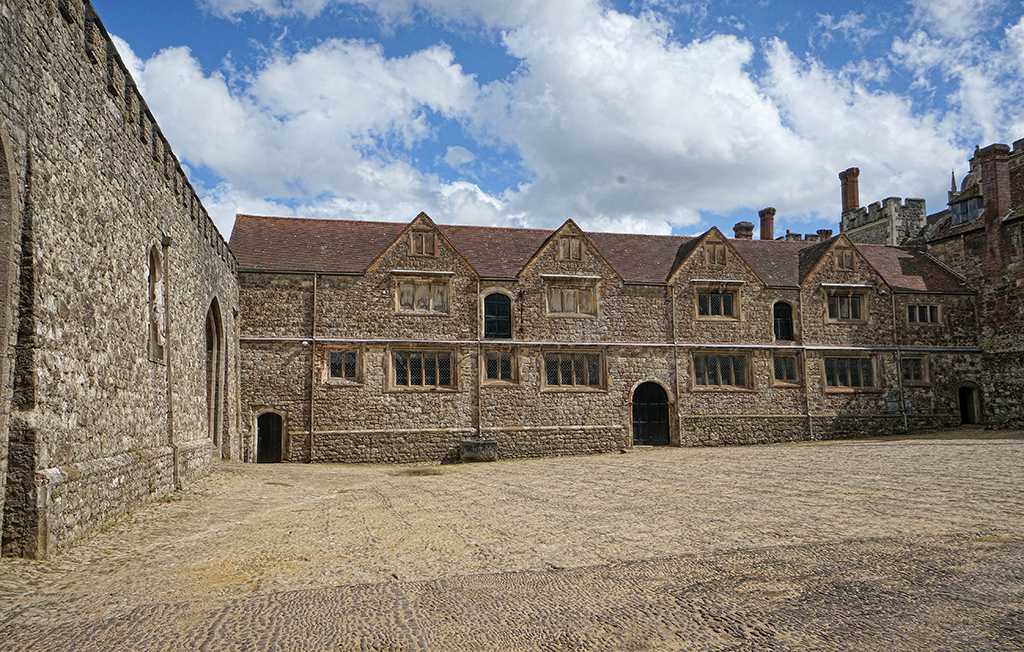
The stone court at Knole House in Kent.  Photograph by Mary Harrsch © 2013

Another view of the stone court at Knole House in Kent.  Photographed by Mary Harrsch © 2013
Some structural details:

Tudor-era hardware at Knole House in Kent.
Photographed by Mary Harrsch © 2013


To see more of my images of Knole House check out my Knole House album on Flickr.

Knole House also has a cozy cafe back by the carriage house offering sandwiches, hot soup and pastries as well as a very well-stocked gift shop.

If you enjoyed this post, never miss out on future posts by following me by email!

Sunday, March 22, 2015

Acorn TV to feature "World War One: The People's Story"

A history resource article by  © 2015

Today I received an email about the upcoming release of "World War One: The People's Story".  The documentary aired in the UK last August and will now be released on DVD on April 14, 2015. It will also be available on Acorn TV, the British streaming service available on Roku devices, iPads and iPhones, smart Samsung TVs or through your web browser on your computer.

Through original diaries, letters, and memoirs, this unforgettable documentary tells how the lives of regular British men and women were transformed by the Great War. A reservist leaves for the front determined to write to his mother every few days. A newlywed says goodbye to his pregnant wife. A young woman fears that when her fiancé sails for France, her hopes of marriage will disappear. For parents and children, soldiers and factory workers alike, life and love go on but never again as they did before. Few could imagine the horrors ahead: hundreds of thousands would never return, and those who did would carry wounds—physical, emotional, psychological—that would change their lives forever.

Along with historical footage, an outstanding cast of actors reenact first-hand accounts uncovered from attics, archives, and libraries across Britain. Narrated by Olivia Colman, this four-part series re-creates the extraordinary stories of ordinary people, told in their own words.

The DVD includes a 12-page viewer’s guide with a map of the western front; an overview of WWI; and articles on trench warfare, the suffragist movement, and the WWI poets.
If you enjoyed this post, never miss out on future posts by following me by email!

Tuesday, February 24, 2015

Typhus, Typhoid Fever or Avian Influenza? What plague killed the father of the Parthenon?

A history resource article by  © 2015


Portrait of Pericles 1st century BCE Roman
copy of 5th century BCE Greek original from
Lesbos.  Image courtesy of Wikimedia Commons
Note: this is a crosspost from one of my other history blogs, History's Medical Mysteries.

"Fever, headache, sore throat, and vomiting developed in a 65-year-old man.  He had been in excellent health until approximately 1 week earlier, when he had sudden onset of headache, ocular erythema, and halitosis.  On the third day of illness, he began to sneeze and cough, and noted bilateral pleuritic chest pain.  On the sixth day, he developed projectile vomiting of dark, bilious fluid.  At this time, he complained of fever so intense that he would not allow himself to be covered with even the lightest clothing.  He also complained repeatedly of intense thirst.  Although he drank copious amounts of water, his thirst persisted, worsened by frequent vomiting."

Thus begins a study to determine what may have caused the death of the famous Athenian stateman, Pericles, as a clinical exercise at a 2000 clinical pathologists' conference at the University of Maryland School of Medicine. Each year, a team of practicing pathologists and historical consultants select a famous individual from the past whose manner of death remains speculative and attempts to derive a definitive cause of death.

The death of Pericles is examined by Drs. David T. Durack, MD, Robert J. Littman, PhD, R. Michael Benitez, MD and Philip K. Mackowiak, MD. Their paper, Hellenic Holocaust: A Historical Clinico-Pathologic Conference was published in the American Journal of Medicine in 2000 (Volume 109: pages 391-397).

Phidias showing the Parthenon frieze to Pericles, Aspasia, Alcibiades and Friends
by Sir Lawrence Alma-Tadema, 1868.  Image courtesy of Wikimedia Commons.

Thucydides reported that desperate patients racked with thirst and fever plunged into cisterns and wells seeking relief. Of the few survivors, some lost fingers and toes from peripheral gangrene, others suffered blindness, and there were also reports of survivors experiencing a complete loss of memory.
Bust of the Greek general and
historian, Thucydides at the
Royal Ontario Museum.  Image
courtesy of Wikimedia Commons.

Research indicates the disease originated in Africa then spread to the Persian Empire and ultimately to a beseiged Athens via the port of Piraeus where it attacked a population of almost 400,000 condensed into 4 square miles. But which variety of plague was it?

What do the experts say? (PDF of original article reprinted with permission)

Update: In 2006, a research group led by Manolis Papagrigorakis of the University of Athens extracted pathogen DNA from three teeth recovered from skeletal remains found in the ancient necropolis of Kerameikos dated to approximately 430 BCE and assumed to be victims of the great plague.  The only pathogen Papagrigorakis and his team could identify was a strain resembling Salmonella enterica serovar Typhi (typhoid fever).  Papagrigorakis' report that appeared in May 2006 in Volume 10, Issue 3, Pages 206–214 of the International Journal of Infectious Diseases entitled DNA examination of ancient dental pulp incriminates typhoid fever as a probable cause of the Plague of Athens (full text) was immediately refuted by Beth Shapiro and Andrew Rambaut of the Henry Wellcome Ancient Biomolecules Centre at Oxford University as well as M. Thomas P. Gilbert of the Niels Bohr and Biological Institutes, University of Copenhagen in a letter (full text) to the same journal.

Shapiro points out, "The authors’ diagnosis is based on a similarity score, resulting from BLAST comparisons between their amplified fragments and published sequences. Specifically, the authors report a 7% divergence between their sequences and S. enterica serovar Typhi, and 8% divergence between their sequence and the next most closely-related Salmonella strain, S. typhimurium. Based on the closer match to S. enterica, the authors conclude that ‘‘[if] another, yet unknown pathogen... was the actual cause of the Plague of Athens, it would have to be closely related to S. enterica and definitely closer than S. typhimurium.’’

Greek warriors depicted on a 5th century BCE gravestone.
Permanent collection of the British Museum.
Photographed by Mary Harrsch © 2012
"This statement, however, is simply not true. Although the Athens sequence is indeed slightly more similar to S. enterica, the two cited Salmonella species are actually much more closely related to each other, with less than 1% divergence for the sequenced gene. In fact, if a simple phylogenetic analysis is performed, the ancient sequence is shown to fall outside both S. enterica and S. typhimurium, as well as several other Salmonella species (Figure 1). While this analysis confirms that the Athens sequence is possibly Salmonella, it demonstrates clearly that it is not typhoid (97% bootstrap value). Based on the evolutionary timescale inferred for Salmonella and E. coli, the Athens sequence and typhoid would have shared a common ancestor in the order of millions of years ago."

Then, in 2013, a thesis, entitled A novel offering of Avian Influenza as the causative agent of the Plague of Athens: contextual and paleopathological analysis of the 5th century BCE Plague of Athens via primary resources and modern DNA sequence-based identification strategies of dental pulp from a mass grave at Kerameikos, was published by Karen Spence.  Although Spence was less critical of the Papagrigorakis team's conclusions, she pointed out that the sequencing procedure used would not have identified any RNA-based pathogens.  She acknowledged the Maryland pathologists' conclusions that human-to-human communicated influenza would not have had a high enough mortality rate to be a good match for the Athens pathogen (which had an estimated mortality rate of 25%).  But, she proposes that zoonotic avian influenza passed from domestic poultry to humans would have.  Spence points out that when refugees from the surrounding countryside flooded into Athens, they probably brought smaller animals with them like pigs and chickens.  She proposes that some of the poultry were carriers and quickly infected other birds in the confined quarters.  The animals then passed the disease to their human caregivers.  Birds often carry the pathogen without succumbing to the disease themselves.  Even if some of the birds died, they were probably eaten, due to the conditions of the siege.  She postulates that an infected reservoir of birds would have retained the pathogen over a long period of time accounting for several years of plague rather than a flare up that would quickly die down as in the case of human-to-human transmitted influenza.

Roman mosaic of doves drinking from a bowl from 2nd century BCE
Greek original by Sosos recovered from Pompeii.
Photographed at the Capitoline Museum in Rome, Italy by Mary Harrsch
© 2009 
Although Spence makes a convincing case, she indicates in her table comparing symptoms of  the Athenian plague with Typhoid Fever and Avian Flu that neither pathogen usually results in the survivor pathologies described by Thucydides.  It is the survivor pathologies that are carefully addressed by the Maryland pathologists in their conclusion that the most likely causative pathogen was typhus and why I find the Maryland analysis most convincing.

Since avian flu cannot be transmitted from human to human, I was also skeptical that Pericles, a wealthy statesman, would have had contact with chickens, other than to eat one.  Likewise, I would doubt his household steward would resort to obtaining a dead chicken from a lower class meat market that may have procured diseased carcasses. I also question why the disease would first appear in Piraeus, the port, as most refugees came from the surrounding countryside. The affliction was also reported as previously occurring in Ethiopia and Persia.  Neither location suffered from siege concentrations where poultry may have been in particularly close contact with humans.

Of course there is the possibility the besieged Athenians imported poultry as a protein food source since they no longer had access to cattle that were left behind in the fields. But it is more likely that being a seafaring people, they would have relied upon fish instead.

However, I appreciated the comparative table Spense uses to clearly demonstrate typhoid fever's lack of many of the attributes of the plague described by Thucydides.  I would have liked to have seen such a table covering all 29 pathogens that have been proposed over the last 150 years of study.

In my research I also found an interesting article about new DNA extraction techniques developed in just the last five years that were used on victims of the Justinian plague at the Ancient DNA Centre of McMaster University in Hamilton, Canada.  It made me wonder if the new method would be more successful with the Athenian samples.  I would also like to see an attempt made specifically on adult females from the Kerameikos remains. Thucydides recorded that caregivers suffered an extremely high rate of infection and mortality and in ancient Athens, as today, most caregivers would have been female. There did not seem to be any reference to gender in the Papagrigorakis report. If gender was not considered I think this could be a significant barrier to more conclusive results.

The idealized Spartan warrior, Leonidas
Image courtesy of Wikimedia Commons.  Edited by Mary Harrsch.
At the time of the plague, Athens was besieged by Sparta and male corpses from the ongoing conflict could have been included in the mass burial. Some historians would disagree on this point because death in battle would have a significant element of honor involved and mass burial of such individuals would have been particularly impious. But, a community in the grip of a severe plague where there were large accumulations of unburied corpses and a shortage of able bodied men to dispose of corpses, could have resorted to mass burial of at least some war casualties.  Thucydides said the population of Athens was so morally distressed by the plague that funerary rituals were "universally violated" (History of the Peloponnesian War - 2.52.3) - clearly supporting the possibility of mass burial, even of war casualties. Also, the Papagrigorakis study was conducted on only three teeth from randomly chosen victims apparently without regard to gender.  I would feel much more confident in the results if more victims were sampled.

Of course, we cannot even be sure the mass burial at Kerameikos was even a result of the so-called Athenian plague. Although excavators dated the burial fairly precisely to 430 - 426 BCE, dating methodologies are not so precise. The burial could be from an epidemic occurring before, concurrent with, or after the plague onset. The crowded siege conditions could have easily resulted in several concurrent diseases that would not necessarily include the pathogen responsible for the symptoms reported by Thucydides and observed in Pericles.

If you enjoyed this post, never miss out on future posts by following me by email!

Monday, August 11, 2014

Review: Medieval Lives: Birth, Marriage, Death (DVD)

A history resource article by  © 2014


The producers of the excellent history DVD "She-Wolves: England's Early Queens", Athena Learning in association with RLJ Entertainment, have released another fascinating look at life in the Middle Ages entitled "Medieval Lives: Birth, Marriage, Death".  Once again, Cambridge professor Helen Castor guides us through a wealth of information based on first person accounts from such sources as the Paston letters, a collection of over 1,000 documents kept as a family archive by three generations of the Paston family of Norwich.

In the first episode, I was surprised to learn that if a woman died in childbirth before the infant had emerged, the child was removed from the mother before burial because, although the mother had been baptized, the child had not and with the taint of Original Sin could not be buried in sanctified ground.  I had never heard this before and Dr. Castor was quick to point out that this requirement was often ignored whenever possible.
For this reason, the church actually granted midwives the authority to baptize a child in the birthing chamber.  If the midwife thought there was a real possibility the child would imminently die, they could perform the rite as soon as the head emerged in a last ditch effort to save the child's soul.  If the mother died first, midwives were supposed to cut open the woman and extract the baby so it could be baptized, even if it would not ultimately survive.

Childbirth in the Middle Ages often involved the use of
a birthing stool.

Medieval paintings and books, like the 12th century Trotula texts, based in part on the research of the ancient Greco-Roman physician, Galen, as well as newer Arabic medicine, illustrated the practice.

"In Antiquity, midwives (called, in Greek, maiai, and in Latin, obstetrices or more generically medicae) were the normative caretakers of both the gynecological and obstetrical needs of Greek and Roman women.  Medical writers from at least the third century BCE to the sixth century CE composed texts specifically for midwives’ use, and there is ample evidence (such as inscriptions and artwork) that midwifery was professionalized in larger urban communities.  Ancient writings on gynecology and obstetrics conceived of the ideal midwife as not simply literate and competent in medical theory, but as responsible for all disorders of the reproductive organs as well as routine assistance in childbirth.  In the scope of her practice, at least, she was fully the equivalent of modern obstetrician/gynecologists and not simply a birth attendant." - Women and Gender in Medieval Europe, An Encyclopedia

But between the 6th and 13th centuries the literate midwife of antiquity disappeared and the task of aiding women in childbirth was relegated to neighbors and kinswomen, most without any training except experience.  This changed somewhat when the church, concerned about the need for emergency baptism of a newborn, initiated a formal licensing process, first in France, then spreading throughout northern Europe and England.

When I looked up the Trotula texts, I found that, although the original texts were produced in Latin, by the 13th century, editions in Anglo-Norman and Old French were circulating.  By the 14th and 15th centuries, there were translations in Middle English, German, Irish and Italian as well.  If the popularity of these texts was not all attributable to purient male interest, this would indicate women must have been among the literate practitioners using the manuals since male physicians were not generally allowed in medieval birthing chambers until late in the 15th century.

Dr. Castor also mentioned that, in addition to the church-licensed midwives,  objects made of black jet, amber or coral that were thought to have mystical properties were used in the birthing chamber, including parchment birthing girdles (belts) embellished with prayers.

In episode two, Dr. Castor moved to the next significant life event, marriage.  Dr. Castor pointed out that medieval marriages before the 13th century amounted to little more than a declaration between a man and a woman that could occur anywhere, often in taverns or even out in the countryside.  Witnesses were not required, although if one of the participants might want to contest the validity of the marriage at a later date, witnesses would make such a task easier.
Weddings in the Middle Ages were often a raucous affair held in the local
tavern.  A Peasant Wedding by Pieter Bruegel the Elder, 1566-1569.  Image
courtesy of Wikimedia Commons.

Parents of prospective brides and grooms would often negotiate the exchange of property if a marriage should take place and would arrange for couples to formally meet with the intention that a marriage was deemed suitable between them but parents could not force a marriage.

Parents of prospective couples would negotiate the property that was to be
contributed to the bride and groom to help them establish their
new household.
Royal marriages were usually arranged by diplomats so I was surprised to learn that the famous poet, Geoffry Chaucer, actually arranged the marriage between King Richard II and Anne of Bohemia.  The negotiations took five years which was probably a good thing since Richard II was only ten years old when he ascended the throne.

The informal nature of marriages became a real problem in 1066 when William the Bastard, later known as William the Conqueror, was recognized as the son and heir of Robert I, Duke of Normandy, even though his mother, Robert's mistress, was a daughter of a tanner.  When William's first cousin once removed, Edward the Confessor, died childless, William became a claimant to the throne of England.  Of course, William invaded England and became King after defeating King Harold II at the battle of Hastings.

William the Conqueror was able to overcome his illegitimate
birth to become the King of England because his father,
the Duke of Normandy formally recognized him as his son.

Image courtesy of Wikimedia Commons.
Although legates from Pope Alexander II ceremonially crowned William during the Easter court of 1070, giving the church's "seal of approval" to William's reign, the church recognized the danger in having such important matters as succession reliant upon such a casual relationship.  By the 12th century, the church produced and distributed missales that prescribed correct marriage rituals including the practice of calling the banns, a proclamation about an impending marriage so anyone could raise issues of canonical or civil legal impediments to the marriage.  The banns had to be announced on three successive holy days with at least one weekday in between.  The binding of women's hands during the marriage ceremony was also prohibited and the ceremony itself had to be one of reverence  - obviously not a bawdy affair in a tavern!

As consumation of a marriage was grounds for disputing its legitimacy, the church implemented the "putting to bed" ceremony whereby a priest would proceed with the couple to the site of the marriage bed and sanctify the bed before the couple was left to "perform their duty".

15th century woodcut depicting a bishop blessing the marriage
bed of a newly married couple.
 Image courtesy of Wikipedia.
At this point, the church's position of sex being a necessary evil for procreation transformed into a viewpoint where sex was considered a compulsory requirement of marriage.  The church declared that neither partner in a marriage could withhold sex if it was requested.  Hmmm...I wonder how they enforced that!

Where the church once viewed sex as a necessary evil, in the
12th century the church proclaimed sex as compulsory for
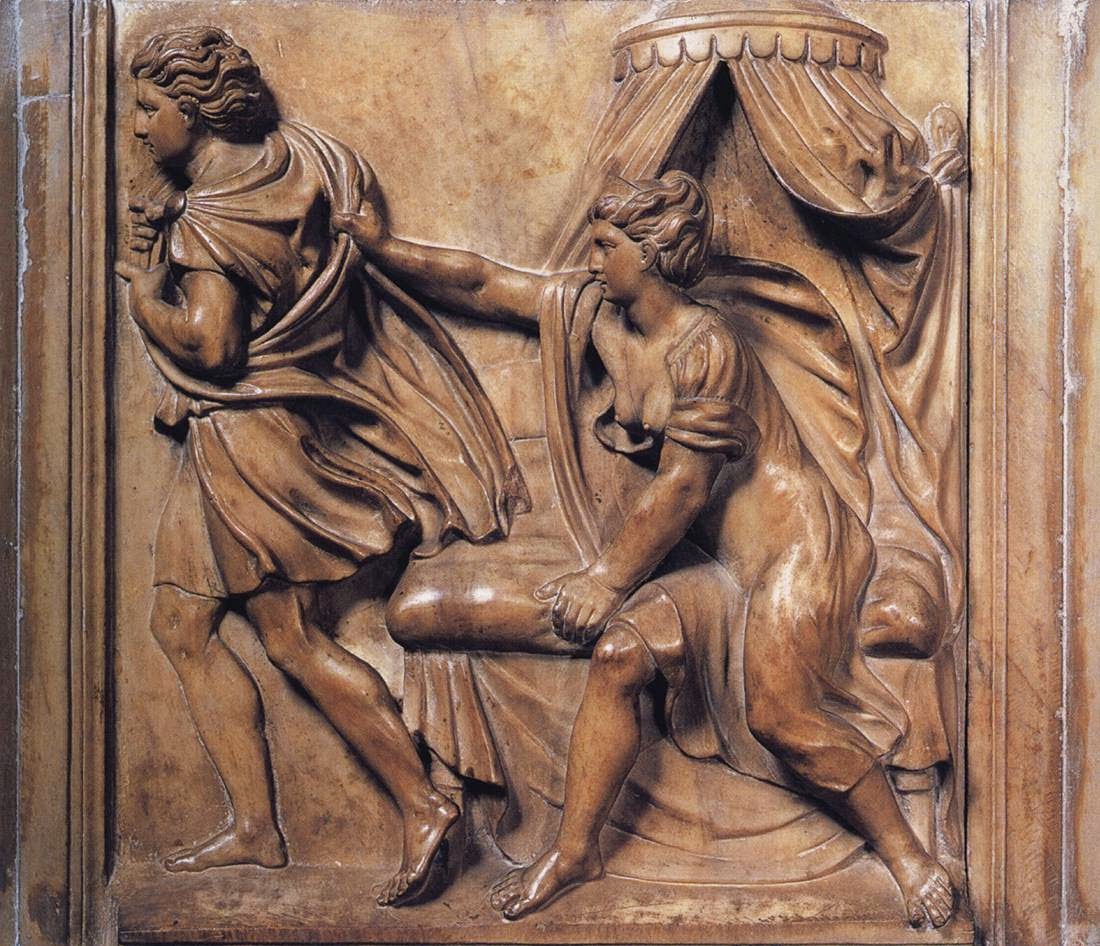
married couples.  Sculpture by Properzia de Rossi, female
Renaissance artist.


Castor also described the medieval marriage ceremony in which both the groom and bride were covered with a veil.  After the ceremony the priest would kiss the groom who was then allowed to kiss the bride.
Again the Paston letters provided insight into the actual practice of marriage in an upper class family. Margaret Paston, a member of the first generation of the nouveau riche family, had a daughter named Marjorie who fell in love with the son of one of their estate bailiffs (overseers).  Of course this marriage was considered totally inappropriate to Margaret who banished Marjorie's love interest from the estate.  But Marjorie claimed the couple were married having privately pledged their love to each other.  Margaret appealed to the bishop of Norwich.  I was surprised to learn that the bishop actually sided with the couple despite Margaret's wealthy influence.

Fresco depicting a bedroom scene circa 1320 CE
So if marriage was so easy to declare, how easy was it to dissolve?  Not very, apparently.  Dr. Castor gives a number of examples from the historical record, not the least included the attempts of the exasperated King Henry VIII in his quest for a male heir.  Although Henry VIII tried to prove his marriage to Queen Catherine of Aragon, his brother Arthur's widow, was invalid because he was too closely related, the list of reasons the church would consider also included a finding that one of the two partners in a marriage was already married (due to an informal declaration), was insane or that the husband was impotent.  Husbands who were charged with impotency had to submit to the ministrations of a court appointed panel of prostitutes.

After 17 years of marriage, Henry VIII asked for an 
annulment from his first wife, Catherine of Aragon, claiming
the marriage was invalid because he had married his brother's
widow.  In medieval law, a marriage extended the familial 
relationship to all family members of both marriage partners.  
Therefore Catherine would have been viewed as Henry's 
sister.  Catherine claimed her first marriage was never 
consumated so such a relationship had never existed.
Multimedia sculptures by artist George S. Stuart.
Photographed at the Museum of Ventura County by 
 © 2006.  
 

Surprisingly, adultery was not grounds for annullment.  Dr. Castor explains the case of Edward IV's physician who was a blatant (and public) philanderer.  Although the wife called witness after witness, many soldiers and physicians on campaign with the adulterer, the church granted only a decree granting the wife the right to live apart from him and, I assume, obtain financial support from him for her separate household.  They were still considered married and could not officially marry anyone else.

The last episode of the series dealt with what constituted a "good death" in the medieval world.  Much of this segment discusses the ramifications of the official introduction of the concept of purgatory in the 12th century. Although prayers to assist the dead in their journey to the afterlife have been performed since ancient times, the recognition of a more formalized practice that includes provisions in wills for the cost of ongoing prayer performance was a doctrinal innovation at that time.

A medieval vision of assisting souls in purgatory with indulgences 


I was aware of the sale of indulgences, a document granting a petitioner a defined period of forgiveness of sin, as a means for the Church to obtain wealth in the late Middle Ages.  But I was unaware that the introduction of the concept of purgatory led to the wealthy leaving huge bequests to establish and/or maintain chantries where clerics would officially perform the prescribed prayers to aid the deceased wealthy in the newly defined transitory location.

I was also surprised to learn that King Henry VII, known as a tight-fisted miser, left huge sums in his will to the college of priests at Westminster Abbey to say masses "forever" for his soul.  This massive transfer of wealth eventually triggered King Henry VIII's dissolution of the monasteries to recapture much of his kingdom's treasure.

At least one beneficial development followed, however.  Hospitals were built as part of this effort to ensure that one's soul would speed through purgatory.  Medieval hospitals not only cared for the sick but fed the poor as well and gave the common people an opportunity to demonstrate their piety.  One loaf of bread given to the poor was equivalent to helping one soul in purgatory.


At Henry VII's funeral a nobleman dressed in
the king's armor rode into Westminster Abbey
and right up to the high altar.  There he dismounted
and removed the armor then dedicated it to god.  
This armor is that of the king's son, Henry VIII.
Photographed at the Tower of London by 
 © 2006


As in the episode on marriage, Dr. Castor described medieval funerary rites.  The most dramatic funeral service again involved King Henry VII.  Dr. Castor said a nobleman dressed in Henry VII's finest armor rode into Westminster Abbey right up to the high altar.  There he removed the armor and offered it to god.  Henry VII may have ruled through fear and blackmail but he definitely knew how to make a classy exit!

The DVD is lavishly illustrated with beautiful closeups of stained glass, paintings, tapestry and sculpture and is definitely a valued addition to my collection of history DVDs.  It is scheduled for general release on August 26, 2014.


If you enjoyed this post, never miss out on future posts by following me by email!