|
| An armored Henry VIII and his charger at the Tower of London in London, England. Photo by Mary Harrsch © 2006 |
Note: This is a cross-post from my blog "History's Medical Mysteries".
Today, I read an interesting paper by Muhammad Qaiser Ikram, Fazle Hakim Sajjad, Arash Salardini published in the Journal of Clinical Neuroscience proposing that Henry VIII's erratic behavior, particularly after 1536, was the result of repeated traumatic brain injuries. Furthermore, the researchers propose that his dramatic weight gain and even his leg ulcers could have been the result of post-traumatic growth hormone deficiency, one of the many afflictions that accompany traumatic brain injury.
They begin their examination of the historical record by pointing to a report by the Spanish ambassador in 1507 pronouncing “There is no finer youth in the world than the Prince of Wales”. A 16-year-old Henry was "lighthearted, merry, and easily given to laughter.” One could say this was long before Henry had experienced the heavy weight of kingship. But eight years later in 1515, despite suffering a bout of smallpox the previous year, Henry meets with the Venetian ambassador who says of Henry he was “prudent and wise and free from every vice.”
With Henry's love of often dangerous medieval sports, especially jousting, however, his easy-going personality would not last.
"In March 1524 the king was unseated after a jousting lance found its way into his open visor and broke into many splintered pieces. Henry was de-horsed and dazed, although he continued to joust for the rest of the day. He is said to have had recurrent headaches after this point." - Muhammad Qaiser Ikram, et al, The head that wears the crown: Henry VIII and traumatic brain injury
 |
| Henry VIII's blackened, etched and gilt Italian field armor at the Metropolitan Museum of Art in New York. Photo by Mary Harrsch © 2007 |
"He may have been dazed or unconscious because it is said of the incidence that if Edmund Mody had not pulled him out of the ditch, legs first, he may have drowned." - Muhammad Qaiser Ikram, et al, The head that wears the crown: Henry VIII and traumatic brain injury
 |
| An avid outdoorsman, Henry VIII enjoyed hunting. Here he hunts deer with Anne Boleyn in this 1903 painting by William Powell Frith. Image courtesy of Wikimedia Commons. |
Then on January 24, 1536, the king was unseated while charging at full speed in a joust and his steed fell upon him. Henry was said to be unable to speak for two hours which the researchers attribute to a loss of consciousness.
Members of Henry's court began to notice the king appeared to be suffering from significant memory problems. In July 1536, Henry's illegitimate son Henry FitzRoy, Duke of Richmond, died of tuberculosis.
"He was buried in near-secret in the presence of his father-in-law the Duke of Norfolk, and two other personages, by the king’s own instructions. Yet in a few days Henry appears to have forgotten his own role in the funeral and was accusing the Duke of Norfolk of inappropriate behavior towards FitzRoy." - Muhammad Qaiser Ikram, et al, The head that wears the crown: Henry VIII and traumatic brain injury
The researchers explain, "Traumatic brain injury disproportionately damages white matter tracts [the cells in the brain that transmit signals from one region to another] which may manifest as amnesia, apathy and loss of initiative, executive dysfunction [executive processes include goal formation, planning, goal-directed action, self-monitoring, attention and response inhibition] as well as impulse and emotional dysregulation [radical mood swings including angry outbursts, behavior outbursts such as throwing objects or destroying things and aggression]."
In fact, his possible loss of impulse control may have led to his beheading of Queen Anne Boleyn in May 1536 and his, increasingly brutal, dissolution of the monasteries from 1535-1540. (My observation not theirs) He also married three more times during this period although the death of Jane Seymour from childbirth complications could not be attributed to Henry's mental illness.
 |
| Anne Boleyn in the Tower by Edouard Cibot, 1835. |
The researchers point out that Henry began to demonstrate explosive and murderous anger that was relatively easily provoked.
"The irascibility and changeability of Henry was a source of constant anxiety for Tudor courtiers. Several ambassadors noted the unpredictability of Henry, who was often furious for reasons not immediately obvious to his ministers and advisers. The French ambassador for example speaks of his 'lightness and inconstancy' in 1540. His explosive anger could often end in the execution of an unsuspecting courtier or friend. The king was unable to control other impulses, whether these were related to his unreasonable suspicions or his lust for other peoples’ property." - Muhammad Qaiser Ikram, et al, The head that wears the crown: Henry VIII and traumatic brain injury
Henry also suffered from depression and extended periods of self-pity. After executing Thomas Cromwell in July 1540, Henry fell into a deep depression and in 1541, claiming to mourn Cromwell, confined himself to Hampton Court for a long period.
 |
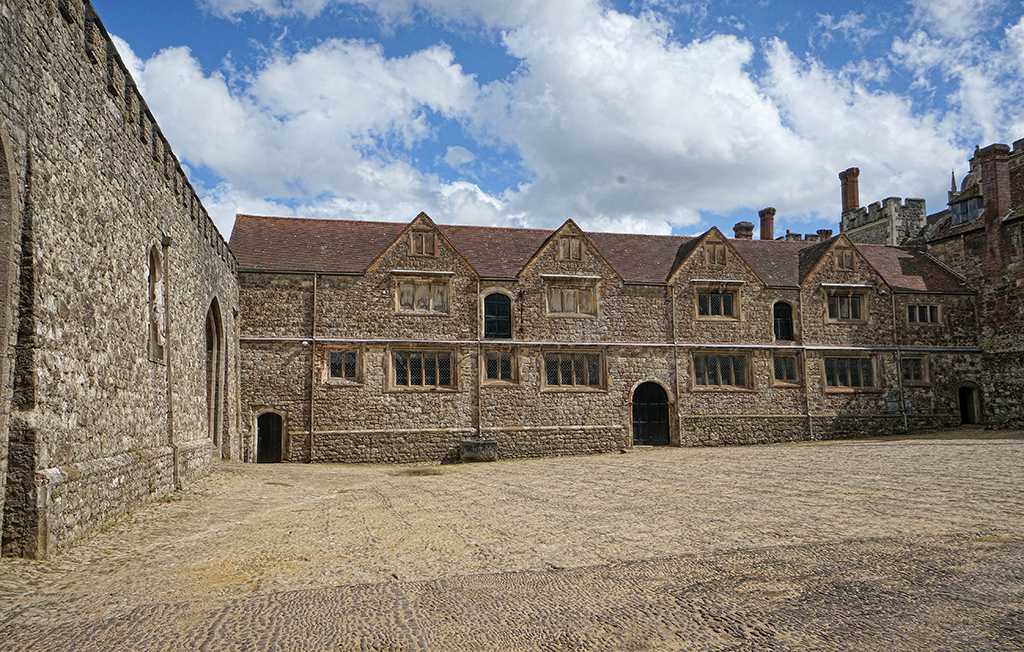
| One of the ornate towers and Tudor-era chimneys at Hampton Court Palace, East Molesey, England. Photo by Mary Harrsch © 2008 |
 |
| Closeup of a portly Henry VIII by American miniaturist George S. Stuart at the Museum of Ventura County, CA. Photo by Mary Harrsch © 2006 |
Symptoms of hypogonadism in an adult include low libido, and infertility. You may think with court tales of countless sexual liasons and the king married six times, Henry surely must not have suffered from a diminished libido. But, in fact, the researchers find repeated references to Henry's inability to perform in the bedroom.
"Anne and George Boleyn were accused of ridiculing the king. Anne appears to have told her sister-in-law that Henry 'was not adept in the matter of coupling with a woman and that he had neither vertu [skill] nor puissance [vigour]'." - Muhammad Qaiser Ikram, et al, The head that wears the crown: Henry VIII and traumatic brain injury
They also point to his inability to consummate his marriage to Anne of Cleves in 1540.
"Various excuses were made from 'misliking of her body for the hanging of her breast and the looseness of her flesh', to the charge that the king was duped by an unnecessarily complimentary portrait of Anne." - Muhammad Qaiser Ikram, et al, The head that wears the crown: Henry VIII and traumatic brain injury
 |
| Anne of Cleves by Bartholomäus Bruyn the Elder 1540s |
The researchers also suspect Henry's disastrous marriage to Catherine Howard, a young woman who took many lovers while Henry's lack of extra-marital activity was attributed to his fidelity. They say this seems highly unlikely in view of his long history of youthful virility and sexual indiscretions.
I find it particularly tragic that Henry's own traumatic brain injury may have been ultimately responsible for the lack of an heir he so desperately craved all of those years.
By the late 1540s, Henry's symptoms had reached catastrophic proportions affecting both his personal life and ability to lead his country.
In 1544, Henry declared war on France and besieged the town of Boulogne. At one point he simultaneously ordered fortification of the city while issuing an oral order to demolish it.
His sixth and final wife, Catherine Parr, was not spared from his irrational tirades either.
"...the king loved religious debates and during one acrimonious argument between Catherine Parr and Gardiner [in 1546] he unreasonably ordered the transportation of the queen to the Tower of London. The next day he appears to have forgotten about the incident and was consoling his distraught wife. When the soldiers arrived to take her away, he could not remember the original orders he had given and had to be prompted to remember the episode. When he remembered he flew into another fit of rage." - Muhammad Qaiser Ikram, et al, The head that wears the crown: Henry VIII and traumatic brain injury
 |
| A miniature portrait of Catherine Parr circa 1543 by Lucas Horenbout |
Since his death there has been a flurry of diagnoses proposed to account for Henry's physical symptoms and erratic behavior.
"One of the hypotheses regarding the health of Henry VIII is that he had Cushing’s syndrome [a condition with symptoms that include high blood pressure, abdominal obesity but with thin arms and legs, reddish stretch marks, a round red face, a fat lump between the shoulders, weak muscles, weak bones, acne, and fragile skin that heals poorly]. There appears to be a temporal relationship between Henry’s documented head injuries and the stepwise worsening of his health which this hypothesis cannot explain. Another older hypothesis is that Henry had syphilis but this is now largely abandoned. Other hypothesized mechanisms for Henry’s change include diabetes and hypothyroidism, neither of which can account for the whole picture. Another recent hypothesis regarding Henry’s health is that he had McLeod syndrome [a genetic mutation with symptoms of peripheral neuropathy, cardiomyopathy and hemolytic anemia along with late-onset dementia and behavioral changes usually not noticed until the individual is in their 50s] with infertility and psychosis. Henry, however, is not reported to have had choreiform movements [irregular muscular movements that make walking difficult] or dystonic reactions [twisting and repetitive movements caused by sustained muscle contractions]." - Muhammad Qaiser Ikram, et al, The head that wears the crown: Henry VIII and traumatic brain injury
So, the researchers conclude, "We know of at least three major head injuries in Henry’s life. He may have had headaches and more subtle changes to his personality after his first head injury, but there is a marked stepwise change in him after 1536. It is entirely plausible, though perhaps not provable, that repeated traumatic brain injury lead to changes in Henry’s personality. This is not to discount the complex time in which he lived or the impact of events on him. Whether some of the metabolic problems he faced later in life can be explained in terms of his head injury is a longer bow to draw but not outside the realms of possibility."
New Feature! Kindle Preview:
Other suggested readings:
 
|
 
|
 
|