Dr Bunchar said he was directing a tsunami relief operation in Krabi's Khlong Thom district when a villager came across the tiny object and handed it to him for examination.
"The engraved script on the pendant was made in a dialect called Brahmin that was used from the reign of King Ashoka [c 265 to 238 BC] up to the 5th century of the Buddhist Era [1st to 2nd century BC]," said Dr Bunchar.
Even though the meaning of the script remains a mystery, he said, it is potential evidence to mark the arrival of Buddhism in this region at that period.
"That may tell something about Suvarnabhumi. We know that Buddhism arrived in the region at that time but archaeological evidence that has been found in the country dates back only to the 9th century. But this bead dates farther back, to the 5th century."
He also found several other ancient signs used by Buddhists before the creation of Buddha images, including a tiny bead called Tri Rattana.

HISTORY: Beads of various origins and periods at the exhibition. They were loaned by Dr Bunchar Pongpanich of the Suthee-Rattana Foundation.
The bead, despite its importance, remains largely unknown to Buddhists, he said.
"Due to its peculiar, shoulder-like design, some villagers call it a 'doll bead'. I called it a 'frog bead' which did not make any sense," he said.
It was not until he met a French archaeologist who studied beads in Khao Sam Kaeo in Chumphon in 2007, that he realised that the bead, which is made of several kinds of stones including rock crystal and carnelian, signified the Three Gems of Buddhist beliefs.
"People don't recognise it largely because they look at it upside down. The round design at the bottom is a lotus, which is dhamma, the middle part is dharmachakra, the wheel of law, and the flame at the top is the spread of Buddhism."
Dr Bunchar said he then returned to the Suan Mokkh sanctuary and went through a note written by Phra Buddhadasa during his trip to India in 1955. "His note showed that the revered monk had seen this type of bead in that country and already knew of its meanings. I noticed also that the Tri Rattana sign is a motif of some of the walls of Suan Mokkh buildings."
Sunday, February 15, 2009
Ancient Bead with Brahmin script points to 5th century BC Buddhism in Thailand


Thursday, December 18, 2008
Has "Timeline" been realized at some point in the future?
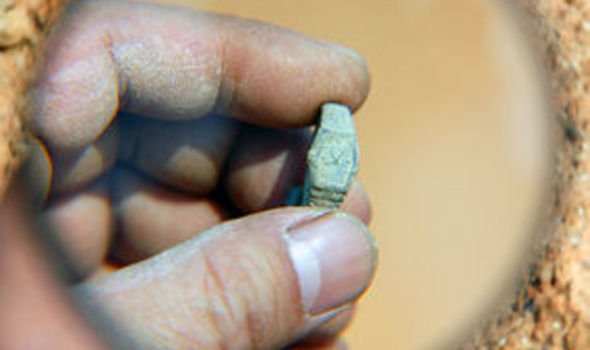 This article caught my attention. I enjoyed the late Michael Crichton's book "Timeline" and liked the movie as well although it could have been improved by casting someone besides Paul Walker in one of the leading roles. At least Gerard Butler pretty much made up for that. I considered it purely science fiction though. But this discovery of a 100-year old watch in a 400-year old sealed tomb makes one pause. Perhaps we are going to crack the time travel mystery in the future after all!
[Photo by Europics]
The real-life tomb raiders were the first visitors to the Ming dynasty grave in Shangsi, southern China, since its occupant's funeral.ARCHAEOLOGISTS are stumped after finding a 100-year-old Swiss watch in an ancient tomb that was sealed more than 400 years ago.
Inside they discovered a miniature watch encrusted in mud and rock in the shape of a ring marked 'Swiss', as reported by the Austrian Times.
Jiang Yanyu, former curator of the Guangxi Museum, said: "When we tried to remove the soil wrapped around the coffin, suddenly a piece of rock dropped off and hit the ground with metallic sound.
"We picked up the object, and found it was a ring. After removing the covering soil and examining it further, we were shocked to see it was a watch."
Saturday, November 08, 2008
Ramses III's linen girdle centerpiece of new Liverpool World Museum Egyptian gallery
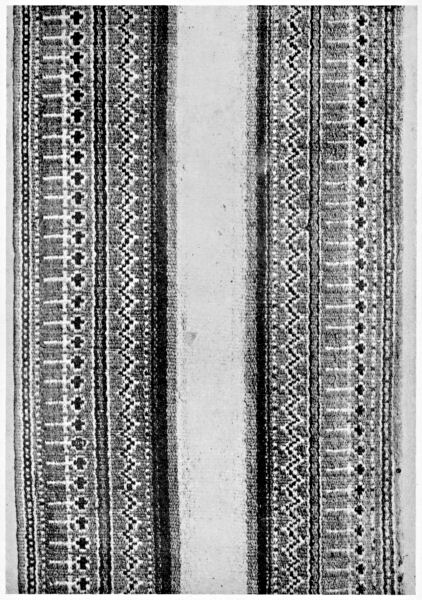
The battle girdle worn by the last of Egypt’s great battling pharaohs, Rameses III, is delicately coiled on a bed of layered tissues: a 3,000-year- old gem as priceless as our own crown jewels.
The five-metre exquisitely embroidered multi-coloured linen belt will form the centrepiece of Liverpool World Museum’s new Egyptian gallery.
The girdle would have been donned by Rameses as he proudly rode his war chariot on campaigns against invaders.
It is an item, held in Liverpool since the 1860s, but known to scholars the world over.
The belt is among 1,500 items that go on display from December 5.
Among the others likely to vie for attention are five mummies, including one of a female contemporary of Cleopatra, who inspired a classic novel from the celebrated Victorian writer Henry Rider Haggard.
The new permanent exhibition covers life in Egypt from the time of Menes, the first king, who reigned 3000 years BC, through to the time of the pharaohs, and on to the periods of the Greek and Roman occupations...
Technorati Tags: museum, exhibit, Egypt, Ramses III, girdle, belt, woven,
Saturday, December 29, 2007
Elamite-era artifacts languishing in vermin-infested Shush Castle

How terrible! This is a prime example of a cache of ancient art that needs to be at least photographed and indexed before these priceless items are lost to the world forever!
"About 90,000 archaeological artifacts are being stored in appalling conditions in the underground storerooms of Shush Castle which is located in Shush, near the ancient sites of Susa in Khuzestan Province.
“The storerooms are not only humid but are inhabited by snakes, scorpions, and insects such as termites,” an informed source, who preferred to remain anonymous, told the Persian service of IRNA on Tuesday. “The artifacts belong to various periods of Iran’s history,” the informer added. According to the report, many of the items have never been on public display.
Artifacts which were discovered by the French archaeologist Roman Ghirshman in the 1940s are among the relics languishing in the gloomy cellars. A large number of the secreted objects had been carefully salvaged from the Elamite-era sites of Khuzestan over the past decades. The only action that has been taken for the protection of the relics was carried out by ancient inscriptions expert Abdolmajid Arfaei, who sprayed the storerooms with insecticide last year. "
Image: Kneeling Bull Figure, Proto-Elamite, 3000-2800 BCE, southwest Iran (Courtesy Bostonia, Summer 2004, Boston University)
Saturday, December 22, 2007
Afghan Art Exhibit begins trip around the world in Amsterdam

The article says this wonderful exhibition of Afghanistan Art will be travelling to other locations in Europe then on to the U.S. I hope it comes to a museum I can visit!
Some of Afghanistan's rich history is temporarily on display in Amsterdam. Hundreds of archaeological treasures provide clear proof that the ancient Greeks and Romans, the Chinese and the Indians all put their mark on this region. For years, these treasures were hidden to keep them out of the hands of the Russians and the Taliban. But now they are on display for the whole world to see.New Church Director Ernst Veen shows us a few of the hundreds of artefacts.
"Here you can clearly see influences from the Roman and Greek era. And this coloured glass is unique. And so is this: a painted goblet, also from the first century A.D".
Iraqi loot saved from Ebay

The looters are really active in Iraq too!
A 4,000-year-old clay tablet authorities suspect was smuggled illegally from Iraq was pulled from eBay just minutes before the close of the online auction, authorities said Tuesday.
A German archaeologist had spotted the tablet bearing wedge-shaped cuneiform script on the online auctioneer's Swiss web site, a government official said.
The archaeologist alerted German authorities, who passed the tip onto their Swiss counterparts, said Yves Fischer, who directs the Swiss Federal Office of Culture's department on commerce in cultural objects.
Monday, December 17, 2007
Newly Reopened Pushkin Museum of Fine Arts showcases Priam's Gold and masterworks by Cranach and Tiepolo

The Pushkin Museum of Fine Arts is hauling hidden masterworks by Cranach and Tiepolo out of storage and dusting off the golden treasures of Troy to mark tonight's gala re-opening of its main Moscow exhibition space.
Over the past year, the museum, the Russian capital's leading collection of Western European art, has revamped the display of its permanent collection -- modern lighting has been installed, artworks have been better arranged on walls and rarely seen masterpieces spruced up and put on display.
The project ties in with plans by U.K. architect Norman Foster, approved on Nov. 22, to add 110,000 square meters (1.2 million square feet) to the museum's current 40,000 square meters. The Pushkin aims to mark its centenary in 2012 with four new buildings on adjacent land within sight of the Kremlin, and the renovation of several decrepit czarist-era structures.
``The role of the museum in the world is changing,'' said museum director Irina Antonova, 85, in an interview in her office last week. ``The collection is growing, the number of personnel is growing, as is the number of visitors. The lack of space for exhibits and storage is an enormous problem.''
The remodeled permanent exhibition includes paintings never before displayed by the museum, such as ``Calvary'' (1515) by Lucas Cranach the Elder, and ``The Madonna Attended by St. Anthony, St. Louis, and St. Francis of Assisi'' by 18th-century Italian artist Giovanni Battista Tiepolo.
Rembrandt and his school now have their own room, as does the gold of Troy dug up by German archaeologist Heinrich Schliemann, which was looted by Soviet troops in 1945. There's a new room for Ancient Greece, including items excavated in the Crimea by the Pushkin's own archaeologists.
Restored Works
Experts have skillfully restored many European paintings to reveal their original bright blues and reds, including ``The Virgin Suckling the Child Jesus,'' by 17th-century Spanish painter Francisco de Zurbaran. Two works by 17th-century French artist Claude Lorrain also have been returned to their original bright colors.
The Pushkin, which owns about 650,000 items and is visited by about 1 million people a year, has one of the finest collections of French Impressionist and post-impressionist paintings, with works by Monet, Van Gogh, Matisse and Picasso. These have their own gallery, opened in August 2006, next to the museum's central building.
The new space planned by Foster will go toward conservation laboratories, state-of-the-art storage, more exhibition space, a library and rooms for classical-music concerts.
Monday, November 05, 2007
Oldest UK skeleton even older than previously thought

Scientists say more accurate tests date the earliest human burial found in the UK to just over 29,000 years ago.
The skeleton of the Red Lady - actually a young male - was discovered at Goat's Hole Cave at Paviland on Gower in 1823 by William Buckland, then a geology professor at Oxford University. It owes its name to the red ochre covering the bones. When discovered the bones were thought to be around 18,000 years old, but were later redated to between 25,000 and 26,000. The remains were found along with a number of artefacts including ivory wands, bracelets and periwinkle shells.
"The remains and artefacts were previously difficult to date accurately," said Dr Higham.
"Many of the bones were treated with preservations in the 19th Century and some of this contamination is often difficult to remove."
He said their analysis was the bones were "just over" 29,000 years old.
It would mean The Red Lady lived in an age when the climate was much warmer than it would have been 4,000 years later.
Friday, October 26, 2007
Iran objects to Christie's plans to auction Persepolis bas relief

"Following Christie's announcement regarding its intention to sell a Persepolis artifact, the [Iranian] embassy voiced its objection in an official letter.
The letter says the bas-relief is a part of Iran's cultural heritage, and was stolen from Persepolis 30 years before the Islamic Revolution.
All Persepolis artifacts are part of the national cultural heritage of Iran; international conventions have banned stealing or illegally transferring items of a country's cultural heritage to other nations, the letter adds.
The Iranian embassy in London called on Christie's managers not to auction the Achaemenid bas-relief and to negotiate with Iran on the subject.
A stone carving of the head of a soldier belonging to ancient Persia's Apadana palace in Persepolis was scheduled to be auctioned in London on October 25th with the estimated value of 800,000 British pounds."
Followup:
"Initial investigations revealed that the relief is part of the stairway of Apadana Palace in Persepolis complex which was sold in 1974 in an auction in New York and was bought by a private owner and kept for 30 years in her private collection in France. Later Iran was asked to provide the Court with the mold of the exact location of the Achamenid soldier bas-relief of Persepolis.
Yet in its latest session, the Court of London was not convinced by the documents presented by Iran and referred the case to the Appeal Court for a final verdict. " - Persian Journal
I think the refusal of the British court to recognize Iran's claim to the artifact is quite inappropriate. I guess I should have expected as much since the British are steadfastly refusing to return the Elgin Marbles to the Greeks either. The Persepolis relief is very much a part of Iran's cultural heritage and I would hate to see it sold again to another wealthy private collector to be used only to impress their friends!
Wednesday, August 29, 2007
Whole Villages in Bulgaria Turn To Tomb Raiding
Sofia News Agency, Novonite.com: "Tens of thousands of tomb raiders are systematically stripping Bulgaria. In some parts of the country, whole villages have taken up tomb-raiding and many of the digs are organised by the local mafia.
Volodia Velkov, the head of the police unit that combats organised crime, said tomb-raiding was now generating about £4 billion a year for the crime syndicates.
Mr Velkov and a team of 30 officers are trying to track looted antiquities and stop them leaving the country.
"Since last October, when we started the new department, we have seized 16,000 artefacts," he said.
"More than 30,000 people are involved in tomb-raiding. The business is very well-organized and the expeditions are financed by rich Bulgarians living in the US, Britain and Germany."
Last Friday, a 43-year-old man was caught trying to smuggle more than 100 items into Germany in special compartments within the floor of a lorry. Police found antiquities dating back to 300BC, worth £345,000.
"The main route is through Germany, where there are huge warehouses full of our antiquities," said Mr Velkov.
Thursday, June 14, 2007
Cache of Pre-Columbian artifacts returned to Peru

More than 400 pre-Columbian artifacts believed to have been taken from ancient graves in Peru were given back to that country here today in what was described by officials as the largest such recovery since the 1970s, when Peru and the United States agreed to import restrictions on the cultural artifacts.
The cache of artifacts, briefly on display here, was described by experts as "priceless."
There was a stylish clay pot, inscribed with a monkey-like figure. A feathered royal poncho. A child's woven tunic. A snuff holder carved from bone. The pieces had been buried in Peruvian graves 1,000 years ago or more, experts said, with some items as old as 3,500 years.
Ugo Bagnato, an elderly Italian man, was discovered keeping the items at a suburban warehouse here in September 2005. He sold two pieces to an undercover agent, one a clay pot approximately 3,500 years old and the other a statue with a gold ringed nose that is about 1,800 years old. The price for each was $2,000, agents said.
But according to his attorney, Bagnato is an archaeologist without any criminal record and had legitimately acquired the collection from a Venezuelan acquaintance who, in turn, had long ago acquired them through inheritance.
Thursday, July 28, 2005
New King Tut exhibit explores Tut's lineage
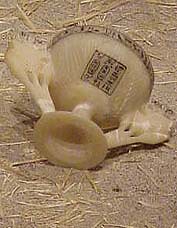
I was also gratified to note that the replicas of some of the artifacts I had seen in Las Vegas at the Luxor Hotel looked nearly identical to the real things - the double-handled alabaster lotus cup pictured at left, a tall alabaster unguent vase, and a cartouche-shaped storage chest among them.