Showing posts with label Oresteia. Show all posts

Wednesday, January 15, 2014

Classic Trial of Orestes for Matricide slated for January 29 in Chicago

An ancient history resource article by  © 2013
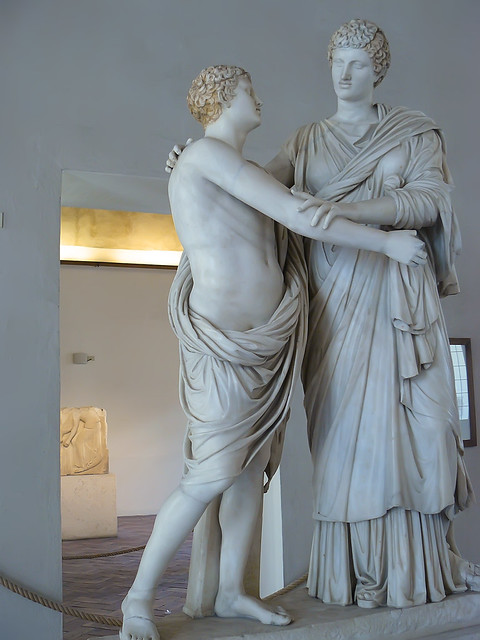
Orestes and Elektra by Menelaus after Praxiteles
1st century CE.
 Photographed at the Palazzo Altemps
in Rome, Italy 
by  © 2009

I see that a group of attorneys in Chicago are planning to put Orestes on trial for matricide on January 29th, 2014.  They're only a few thousand years late!  Talk about how slow the wheels of justice turn!

Following the tremendous success of the National Hellenic Museum’s Trial of Socrates in January 2013, Patrick Fitzgerald, Dan Webb, Patrick Collins & Bob Clifford take on another ancient Greek in the Trial of Orestes, son of Agamemnon, of the cursed House of Atreus. 
The Trial will take place at the UIC Forum – 725 West Roosevelt Road, Chicago, IL 60607, Wednesday, January 29th, 2014 from 6 to 9pm. Reception to follow immediately after the trial. Tickets available through TicketMaster: $100 per ticket; student tickets: $50 (must present valid Student ID). 
Judges Richard A. Posner, Presiding, Charles P. Kocoras, William J. Bauer, and a jury of distinguished citizens of Chicago, will decide the validity of these charges. Orestes will be defended by Dan K. Webb (Winston & Strawn) and Robert A. Clifford (Clifford Law Offices). Counsel for the prosecution will be Patrick J. Fitzgerald (Skadden, Arps, Slate, Meagher & Flom LLP) and Patrick M. Collins (Perkins Coie). 
A bronze sculpture of Aeschylus from the
Archaeological Museum of Florence, Italy.
Image courtesy of Wikimedia Commons

The trial is based on The Oresteia, by Greek playwright Aeschylus (525-456 BC), a foundational literary work that examines the crucial place of law in society, depicting the movement from primitive retaliatory vengeance to civilized justice and a hopeful new order under the rule of law. 
Consisting of Agamemnon, The Libation Bearers, and The Eumenides, the trilogy constitutes a deeply affecting study of crime and punishment, probing such irresolvable and vexatious issues as the nature of justice, the frequent conflicts between love and duty, the torments of moral decision making, our obligations to the gods, society, and ourselves, and the spiritual consequences of irremediable actions. Above all, the Oresteia shows us the burdens of a culture based on the lex talionis—an eye for an eye—and the blessings of a jury trial in a court of law.

Enhanced by Zemanta
If you enjoyed this post, never miss out on future posts by following me by email!

Friday, May 16, 2008

Epilepsy as a writing device in Historical Literature

I ran across this interesting article on the use of epilepsy as a literary device in ancient literature when I was looking for a picture of Julius Caesar. Caesar supposedly suffered from epilepsy later in life. I happen to think there is a very good chance that his seizures were caused by a head wound he received at the battle of Munda:

Epilepsy as a theme in literature (I)

"The description and interpretation of suffering in the form of pain, illness and disability have an important role in the aesthetic literature of numerous cultural-historical epochs.This aspect of human existence has, for the most part, been made use of by individual authors in very different ways – whether as a directing factor within a plot structure, as a metaphor or as a moment of catharsis. "Suffering makes humans clear-sighted and the world transparent." This interpretation, which was formulated by the psychiatrist and psychotherapist Victor Emil Frankl in the previous century, may be a conscious or unconscious motivation for some poets and writers to use the concept of suffering in their works.

It is astonishing how often the chronic disease of epilepsy enters into poetry.


There are probably two decisive reasons for this surprisingly frequent presence of the theme of epilepsy. On the one hand, the prevalence (frequency) of this disease (which today is 0.5-1% worldwide, and was surely not smaller in earlier centuries); on the other, the impressive symptomatology of the prototypical epileptic event, the tonic-clonic (grand mal) seizure.


Fyodor M. Dostoevsky


References to epilepsy can already be found in written reports from the pre-Christian era, thus, for example, in the Old Testament – in the fourth book of the Pentateuch (Numbers [9th/8th centuries BC], amongst others, when Balaam the seer is repeatedly characterised as "falling; or in the Oresteia of Aeschylus (c. 500 BC), when Cassandra's prophetic sayings are accompanied by the phenomena of frothing at the mouth, convulsion and spitting blood. It is actually remarkable how frequently in literature epilepsy is brought into the vicinity of prophecy (divination - soothsaying - was a synonym for epilepsy in ancient Rome; this relationship has been retained in a French term for epilepsy: mal des prophètes). This connection – between epileptic symptoms and prophecy – is still being made in modern literature; e.g. in Thomas Mann's Joseph and His Brothers (1933); Christa Wolf's Cassandra (1983); in Dostoevsky's epilepsy-contoured Myshkin (The Idiot [1868/69] and Murin (A Young Woman [1847]); in Isabel Allende's Of Love and Shadows (1984) or in the novel by Amoz Oz, To Know a Woman (1989).


“The treatment of epilepsy” in the New Testament: Christ heals the ‘moonstruck’ boy


In the ancient literature, not only in Aeschylus, but, for example, also in Plautus, in his comedy The Prisoners (from 200 BC) we come across grand mal epilepsy brought into connection with frenzy, in Xenophon of Ephesus, who in the love story Habrocomes and Anthea, the Lovers of Ephesus (2nd century AD) describes a simulated epileptic fit, and in Apuleius of Madaura in his Apologia (157/158 AD), who gives the first detailed description of the sensitivity to light (photosensitivity) experienced by some epileptics. In the New Testament of the Bible, the disease symptoms described by the three synoptic evangelists (Matthew, Mark, Luke) leave no doubt that the moonstruck boy healed by Christ exorcising a demon refers to a boy with epilepsy. The theme of epilepsy is also occasionally found in mediaeval literature, e.g. in the Old French love story of Aucassin and Nicolette by an anonymous author (13th century), in which the sight of the beautifully formed leg of a young woman is able to cure a seizure-prone pilgrim of his illness; or in Dante's Divine Comedy (1307), in which the 24th canto of the Inferno compares the condition of the sinner with an atonic seizure caused by the devil and the subsequent disorientation. Moreover, Dante himself, in his journey through Hell and Purgatory falls suddenly to the ground at least three times and is unconscious for a short period – not least these scenes let Dante be seen as one (by no means proven) example from the host of prominent epileptics.


Gaius Julius Caesar – described by Shakespeare as a statesman with epileptic seizures.

Shakespeare also used the theme of epilepsy at the threshold of the modern era; the best known being the description of the epileptic fit of the protagonist in the drama Julius Caesar (1599). Less known is a scene from Othello (1604), in which the dark-skinned Venetian general falls to the ground while listening to a distressing report and the a witness standing close by (Iago) terms this an epileptic event.
If you enjoyed this post, never miss out on future posts by following me by email!