An online magazine featuring articles about current archaeology and research into the art, literature, politics, warfare, entertainments, music, religion, cuisine and daily lives of inhabitants of the past other than those of the Greco-Roman period edited by a history enthusiast and technologist who is particularly interested in integrating technology and history education. For those who interacted with the Roman world, see "Roman Times."
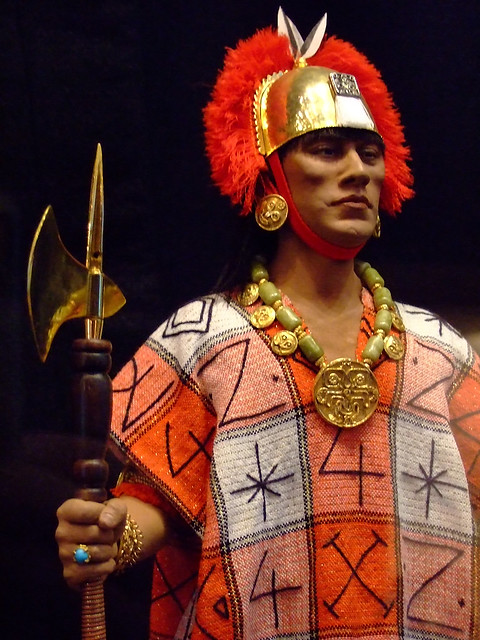
Machu Picchu and the Golden Empires of Peru featuring 192 Artifacts, Including the "most-impressive collection of Andean gold ever to travel the world", is coming to the Boca Raton Museum of Art, Boca Raton, Florida, October 16, 2021. Artifacts in the exhibition are on loan from Museo Larco in Lima, Peru, and Museo de Sitio Manuel Chávez Ballón, in Aguas Calientes, Peru. Objects that belonged to noble Andean lords, include a fully intact gold attire of a Chimú Emperor that dates to 1300 CE. Said to be rivaled only by Ancient Egypt in longevity and by the Roman Empire in engineering, Andean societies dominated a substantial segment of South America for over 3,000 years until the fall of the Incan Empire in the 16th century CE.
Guests will be taken to the mysterious city in the sky, Machu Picchu, built and abandoned within a century. They will continue on a journey through the vast expanse of Andean history, traveling alongside the mythical hero Ai Apaec, and discovering the mysteries of Andean cosmology.
Gold headdress depicting feline head with feathers, bird-beak nose, and stepped designs with volutes, 1300-1532 CE, courtesy of Museo Larco, Peru
Image: 1 - 800 CE 14-karat gold allow headdress depicting human head with half-moon headdress and zoomorphic figures (dragons) with feline heads, courtesy of Museo Larco, Peru.
Gold and turquoise nose ornament depicting figure with half-moon and club-head headdress, circular ear ornaments and loincloth, holding a rattle, 1 - 800 CE, courtesy of Museo Larco, Peru
Ear ornament of gold, shell, and stone (turquoise or malachite), depicting eight iguanas. Four of the iguanas are gold and four are turquoise, 1-800 CE, courtesy of Museo Larco, Peru
Copper funerary mask with applications of shell and stone, depicting an anthropomorphic visage with feline fangs, 1 - 800 CE, courtesy of Museo Larco, Peru
If you enjoyed this post, never miss out on future posts by following me by email!
After looking at the images, I do think the formation looks man-made but how they connected this find with Atahualpa is a mystery to me.
The article points to "artifacts" that have been recovered but there was no explanation about their purpose, how they were determined to be Incan or any attempt at dating them. Looking at the pictures of the "artifacts" included with the article,they appear to be extremely primitive in nature - more neolithic looking than pre-Columbian.
Stone formation found in in the Llanganates National Park in Ecuador proposed to be Atahualpa's lost tomb. Image
courtesy of KNS.
I'm also wondering what sources they are using that may have claimed Atahualpa's body was stolen by his followers and whisked off to the highlands of Ecuador. According to Spanish sources, Atahualpa's body was partially burned then interred in a "Christian" burial after he was strangled by a garrote following a mock trial at Cajamarca in the Peruvian highlands in 1533. Of course I must admit Atahualpa is thought to have been born in what is now present day Quito, Ecuador so it is at least plausible that remaining clan members may have sought to return his body to the region of his birth.
If the structure is a tomb, it is of such monumental size that you would think it would have had to have been built before the Spanish conquest then repurposed as I doubt the activity needed to quarry and transport the stone then build a structure of the size reported would have gone unnoticed by the Spanish. Perhaps it was the tomb of Atahualpa's father, Huayna Capac, who engaged in a number of monumental building projects before he contracted smallpox and died in the epidemic of 1527. Maybe it is one of Huayna Capac's food storage silos that he purportedly built around his empire. I've got to admit, as someone who lives in the Pacific Northwest who has frequently visited Idaho, the structure sort of resembles a big potato cellar!