Showing posts with label worship. Show all posts

Sunday, July 18, 2021

The Storm God of the Hatti then Hittite

During the early Bronze Age the Hatti, who were neither Semitic nor Indo-European, inhabited central Anatolia. They were actually distinct from the Hittite but as the Hittite expanded beginning about 2000 BCE, the Hatti were gradually absorbed into the Hittite political and social order. 

The Hatti were organized in monarchical city-states. These states were ruled as theocratic kingdoms or principalities. Hatti regions of Anatolia came to be influenced by mighty Mesopotamian polities, in the form the Akkadian Empire (24th-22nd century BCE) and the succeeding Old Assyrian Empire (21st-18th century BCE), both of which set up trading colonies called karum, located throughout eastern and central Anatolia. During the first centuries of the 2nd millennium BCE, an Assyrian trade colony existed in the city of Hattush, and several Assyrian inscriptions mention the existence of local rulers (kings) of Hattush, also referring to their relations with other city-states in the region.

Fortunately, a few fragments of text in the language of the Hatti were discovered among the Hittite archives. Their language  is now believed by some scholars to be related to the Northwest Caucasian language group.

The Hatti worshiped a mother goddess Kattahha (or Hannahanna) who gave birth to the storm-god Taru represented by a bull. The Hittites subsequently adopted much of the Hatti pantheon.  Taru was adopted as Tarhunt and referred to as 'The Conqueror', 'The king of Kummiya', 'King of Heaven', and 'Lord of the land of Hatti.'  His image was paraded through the streets at the festivals of Puruli in the spring, the Nuntarriyashas festival in the autumn, and the Ki Lam festival of the gate house.

The Puruli festival celebrates the battle between the dragon Illuyanka and the Storm God. Initially the Storm God is defeated by the serpent. The Storm God then goes to the Hatti goddess Inaras for advice. Having promised to sleep with a mortal named Hupasiyas in return for his help, she devises a trap for the dragon. She goes to him with large quantities of food and drink and entices him to drink his fill. Once drunk, the dragon is bound by Hupasiyas with a rope. Then the Storm God appears with the other gods and kills the dragon.

In an alternative version of the myth, the dragon takes the Storm God's eyes and heart when he initially vanquishes the Storm God. To avenge himself upon the dragon, the Storm God marries the daughter of a poor man. They have a son, who grows up and marries the daughter of the dragon Illuyanka. The Storm God tells his son to ask for the return of the Storm God's eyes and heart as a wedding gift and he does so. His eyes and heart restored, the Storm God goes to face the dragon Illuyanka once more. At the point of vanquishing the dragon, the Storm God's son finds out about the battle and realizes that he had been used for this purpose. He demands that his father take his life along with Illuyanka's and so the Storm God is forced to kill them both.

Standard with two long-horned bulls, 2300-2000 BCE, Hattian, now in the collections of the Metropolitan Museum of Art in New York City, image courtesy of the museum.

Vessel terminating in the forepart of a bull, Hittite, 14th-13th century BCE, Silver, now in the collections of the Metropolitan Museum of Art, image courtesy of the Museum and Wikimedia Commons.

Silver bull figure from Alacahöyük, 2300 BCE, now in the collections of the British Museum, image courtesy of Wikimedia Commons contributor Ollios.

Vase with bull protome, first quarter of 2nd millenium, now in the collections of the Museum of Anatolian Civilizations, courtesy of Wikimedia Commons contributor Homonihilis.


Ceremonial vessels in the shape of a team of sacred bulls made of baked clay, called Hurri (Day) and Seri (Night), Hittite Old Kingdom, 16th century BCE, Museum of Anatolian Civilizations, Ankara, Turkey, image courtesy of Wikimedia Commons contributor Georges Jansoone.

Depiction of the myth of the Sky God (in human form) killing the dragon Illuyankas, Neo-Hittites, 850-800 BCE, from the Lions Gate at Malitiya, now in the collections of the Museum of Anatolian Civilizations, Ankara, Turkey, image courtesy of Wikimedia Commons contributor Georges Jansoone.


If you enjoyed this post, never miss out on future posts by following me by email!

Thursday, May 13, 2021

The use of color on early Mesopotamian sculpture

Researchers using ultraviolet-visible spectroscopy have discovered ancient Mesopotamian art, like classical art of Greece and Rome, was often brightly colored although studies have shown the number of colors used appears to be limited to shades of red and black.  

"Red pigments consist almost entirely of haematite, black is either bitumen or a carbonized product. White is almost non-existent (white lead, gypsum), apart from rare cases where it is used as color lightener for the skin. We did not find either blue or green. It is difficult to judge whether this lack reflects an ancient reality or not. On statues, as well as in most wall paintings, pigments were hardly ever mixed. This seems to be a conscious choice, as mixing pigments is not technically difficult." - Astrid Nunn, Adjunct Professor for Near Eastern Archaeology (retired) at the University of Würzburg.

However, scholars noted distinct shifts in color intensity over time.  Skin color in the third millennium was depicted as orange, yellowish brown, red brown, and brown but in the second millennium, there was a general change to bright red and red brown.  By the first millennium, skin color became notably darkened.

Reading this, I couldn't help but wonder about any correlation between changes in skin tone depictions and recorded migrations and conquests by different groups.  However, Professor Nunn does not mention any studies of that nature.  However, she does point out that skin color was derived from a combination of realism mixed with artistic conventions and social determinants, which in turn are subject to symbolic meaning.

This is further complicated by the ancients descriptions of color including textures and other characteristics.

"Taking the materiality of colors (and not simply their hue and chroma) as a starting point enables us to understand why ancient terms that are translated as dazzling, shining, lustrous, brilliant and translucent, or, inversely, dark, poorly lit, dim and dull, must be considered a – positive or negative – color category," Nunn observes. "In Akkadian literature, red on the body, especially on the face, was very positive...However, in Sumerian and Akkadian texts, gods (in particular the sun god Utu), heroes and kings sport beards referred to as lapis lazuli. Thus these words also mean bright and shiny. Despite the reference to lapis lazuli (blue) being conceivable, the shininess of the beard was just as important as its hue."

Of course I have seen objects such as the bull-headed lyres recovered from the royal cemetery of Ur, dated to 2550-2450 CE, with beards literally made of lapis lazuli so describing beards in this way could have been quite precise if the statues of the gods were thought to represent the gods themselves.

Surprisingly, researchers found that even sculpture crafted of expensive, imported stone like diorite was often painted over, despite the lustrous beauty of the stone itself.

Read more about it:  https://www.asor.org/anetoday/2021/05/mesopotamian-sculpture 


Millenium, Gypsum, that I photographed at University of Pennsylvania Museum of Archaeology and Anthropology in Philadelphia


Reconstructed color on the statue of a man with similar garment now in the Staatliche Museen zu Berlin, courtesy of Astrid Nunn.

Bull-headed lyre recovered from the royal cemetery of Ur, Iraq, 2550-2450 BCE, Gold, with Lapis Lazuli beard that I photographed at University of Pennsylvania Museum of Archaeology and Anthropology in Philadelphia
If you enjoyed this post, never miss out on future posts by following me by email!

Monday, February 22, 2021

Spotted cats: Mythological beasts of both the Old World and the New

 This unusual vase shows a human head of which all but the area of the eyes, nose, and mouth is enclosed in the head of an animal. The softness of the pelt is indicated by the way in which it tightly fits the human head. The small ears and spots are further animal attributes. It is difficult to identify the figure. It may possibly be a very Egyptianized interpretation of Herakles wearing the lion skin. - Metropolitan Museum of Art

This vessel caught my attention because it reminded me very much of ancient pre-Columbian American art.  All major Mesoamerican civilizations prominently featured a jaguar god, and for many, such as the Olmec, the jaguar was an important part of shamanism. The jaguar's formidable size, reputation as a predator, and its evolved capacities to survive in the jungle made it an animal to be revered. The Olmec and the Maya witnessed this animal's habits, adopting the jaguar as an authoritative and martial symbol, and incorporated the animal into their mythology. 

In the surviving Olmec archaeological record, jaguars are rarely portrayed naturalistically, but rather with a combination of feline and human characteristics. These feline anthropomorphic figures may range from a human figure with slight jaguar characteristics to depictions of shamanistic transformations in the so-called transformative pose, kneeling with hands on knees, to figures that are nearly completely feline.

One of the most prominent, distinctive, and enigmatic Olmec designs to appear in the archaeological record has been the "were-jaguar". Seen not only in figurines, the motif also may be found carved into jade "votive axes" and celts, engraved onto various portable figurines of jade, and depicted on several "altars".  The were-jaguar figure is characterized by a distinctive down-turned mouth with fleshy lips, and almond-shaped eyes.

The Maya, whose territory spanned the Yucatán Peninsula all the way to the Pacific coast of Guatemala, depicted gods with jaguar attributes as well.  The jaguar is said to have the ability to cross between worlds, and for the Maya daytime and nighttime represented two different worlds.  The living and the earth are associated with the day, and the spirit world and the ancestors are associated with the night. As the jaguar is quite at home in the nighttime, the jaguar is believed to be part of the underworld. Thus, Maya gods with jaguar attributes or garments are thought to have represented underworld gods. One such god is Xbalanque, one of the Maya Hero Twins who descended to the underworld, and whose entire body is covered with patches of jaguar skin. Another is God L, who is the primary lord of the underworld and often is shown with a jaguar ear or jaguar attire, and atop a jaguar throne.

This reverence for the jaguar carried forward to the much later Aztec civilization where their military elite were inducted into a unit dressed in jaguar regalia. To become a jaguar warrior, a member of the Aztec army had to capture a total of four enemies from battles. This was said to honor their gods in a way far greater than killing enemy soldiers on the battlefield. They also used spears and atlatls and fought with a wooden club studded with obsidian volcanic glass blades, called a macuahuitl. 

Jaguars, of course, were not known in the ancient Mediterranean world but the First Dynasty Egyptian deity Mafdet was often depicted wearing the skin of a cheetah.  She was associated with the protection of the king's chambers and other sacred places, and with protection against venomous animals, which were seen as transgressors against Maat.  She also represented the personification of legal justice.  It was said that Mafdet ripped out the hearts of wrong-doers, delivering them to the pharaoh's feet like cats that present humans with rodents or birds they have killed or maimed. During the New Kingdom, Mafdet was seen as ruling over the judgment hall in Duat where the enemies of the pharaoh were decapitated with Mafdet's claw.

During the reign of Tutankhamun, leopards were highly prized as symbols of royalty and divinity.  A leopard skin mantle or a cloth imitation of one was worn by the high priest during the opening of the mouth ceremony at royal burials.

Although a panther is often referred to as an attribute of the god Dionysus, the god was also depicted wearing leopard skin and using leopards as a means of transportation. In one myth, the god was captured by pirates but two leopards appear and rescue him.  

I find it interesting that cultures so far removed from each other wove their reverence for their respective spotted cats into their myths and religious practices. I can't help but wonder if the leopard-shrouded Greek figure of the 6th century BCE may have presided over one of the mystery religions as a similar priest in ancient America did.


Faience aryballos (oil flask) in the form of a head wearing an animal skin, 6th century B.C.E., East Greek, at the Metropolitan Museum of Art. 


An Aztec jaguar warrior created by GodotDraws on DeviantArt

Aztec jaguar warriors based on codex illustrations created by American miniaturist George S. Stuart. Photograph by Peter D'Aprix.

Aztec jaguar warriors based on codex illustrations created by American miniaturist George S. Stuart. Photograph by Peter D'Aprix.
If you enjoyed this post, never miss out on future posts by following me by email!

Saturday, February 13, 2021

Bust of a Priest with Silver Inlaid Eyes: Roman or Sasanian?

While I was researching the Cypriot ear spirals yesterday, I noticed this bronze bust of a priest with silver inlaid eyes dated from the 3rd - 4th century CE at the Miho Museum.  The museum identified it as late Roman but the museum's image had been shared on Flickr and I noticed that someone with the username eternal persia commented on the piece and insisted it was Sasanian.  He/she pointed to the monogram on the hat, clothes, hair design and leaves that decorate the bust and insisted these are Sasanian elements.

Intrigued, I researched the item a little further.  At first, most Sasanian portrait sculptures I reviewed were all bearded.  Then I saw an image of a relief depicting Kartir, a high priest and vizier serving during the reigns of Shapur I, Hormizd I, Bahram I, and Bahram II. Not only is Kartir clean shaven, he sports the corkscrew curls and crested hat worn by the priest of the bust at the Miho Museum.

Some scholars think Kartir may have been a eunuch, due to being depicted without a beard in the Sasanian reliefs. He first appears in historical records in Shapur I's inscription at the Ka'ba-ye Zartosht, which was most likely created between 260–262 CE. Kartir is the only religious bureaucrat mentioned in the inscription. Shapur I, termed a "lukewarm Zoroastrian", was known for his tolerance towards other religions. Although admiring the teachings of his own religion and encouraging the Zoroastrian clergy, Shapur I allowed the Jews, Christians, Buddhists, and Hindus to freely practice their religion. He was also friendly towards the founder of Manichaeism, Mani, whom he allowed to preach freely and even to be an escort in his military expeditions.

Shapur I's religious practices seems to have been somewhat unusual, though, with animal sacrifice being made for the soul of the kings and queens of the Sasanian family. Kartir, who "abhorred animal sacrifice" was unable to stop Shapur I from performing them. Shapur I died in 270 CE, and was succeeded by Hormizd I, who gave Kartir clothes that were worn by the upper class including the cap and belt (kulāf ud kamarband) and appointed him as the chief priest (mowbed).

Hormizd I died the following year and Bahram I, who was never considered a candidate for succession of the throne by his father, ascended the throne with the aid of Kartir, whose authority and influence had greatly increased. Bahram I then made a settlement with his brother Narseh who he asked to give up his entitlement to the throne in return for the governorship of the important frontier province of Armenia, which was constantly the subject of war between the Roman and Sasanian Empires.  Although Narseh held the title of Vazurg Šāh Arminān ("Great King of Armenia"), scholars think he probably still viewed Bahram I as a usurper.

Although previous Sasanian shahs had pursued a policy of religious tolerance towards the non-Zoroastrian minorities in the empire, with Bahram I's accession to the throne, and the rise of the authority of the Zoroastrian priesthood under the leadership of Kartir, this changed. When Mani, still the leader of the Manichaeists, arrived in the city of Gundishapur, Kartir and his cadre of Zoroastrian priest protested, viewing Mani as a threatening heterogeneous philosopher who presented an obscure perception of Zoroastrianism tainted by Jewish, Buddhist, and Christian ideas. Kartir pressured Bahram I to have Mani imprisoned and sentenced to death in 274 CE. Mani's death was followed by the persecution of his followers by Kartir and the Zoroastrian clergy, who used the persecution of religious minorities as a method to increase and spread their vast influence.  With the backing of Bahram I, Kartir laid foundations for Zoroastrianism's adoption as the state religion.

When Bahram I died, his son viewed Kartir as a mentor and granted him the rank of grandee (wuzurgan), and appointed him as the supreme judge (dadwar) of the whole empire.  Thereafter, Zorastrian priests were given the office of judge. Kartir's intolerance continued and his inscription at  Ka'ba-ye Zartosht boasts that he "struck down" non-Zoroastrian minorities, although modern scholars point out that Jewish and Christian sources makes no mention of persecutions during this period.

When Bahram III succeeded his father, Bahram II, something changed, however, in Kartir's relationship with the royal family.  Kartir inexplicably threw in his lot with Narseh and, along with a group of Sasanian nobles, supported Narseh's overthrow of Bahram III. But Narseh's reign  marked the return to the policy of religious tolerance which had been practiced by his father, Shapur I, all those years ago, and Kartir finally fades from history. 

Bust of a Priest with Silver Inlaid Eyes, Bronze and sliver, 3rd-4th century C.E., courtesy of the Miho Museum in Kyoto, Japan.


Relief of Kartir, the Zoroastrian high priest at Naqsh-e Rajab courtesy of Wikimedia Commons contributor درفش کاویانی.


If you enjoyed this post, never miss out on future posts by following me by email!

Thursday, January 21, 2021

Primitive Cypriot figurines of the Archaic Period

Despite rule by artistically sophisticated cultures including the Assyrians and the Egyptians, some Cypriots of the Archaic Period produced simple handmade figurines with crude faces, cylindrical bodies and plain clay trail or pellets to form hats, eyes, ears, etc., known as the snowman technique. Predominantly found in a sanctuary context, these models included not only priestesses and worshipers, but scribes, actors, musicians, mythological creatures, animals, and scenes of rural life.

"Male figurines (soldiers, horsemen, charioteers, worshipers) are usually associated with sanctuaries of male divinities. A characteristic example is the sanctuary of Ayia Irini on the northwest coast of Cyprus. Here, a huge number of terracotta figurines of various sizes (even life-size) were found placed around the altar. Dated in the Cypro-Archaic period (7th-6th c. BCE), they are considered dedications associated with a male divinity that seems to have been worshiped in more than one capacity."

"Female figurines were usually related to the cult of the Great Mother Goddess. The worship of a female fertility deity, possibly identified with Astarte (Ishtar), is attested in Cyprus dating from the Bronze Age. During the Geometric and Archaic periods, the Near Eastern Astarte merged with the local Aphrodite, who was venerated in Cyprus in large temples, such as those at Kition and Palaepaphos, as well as in numerous rural sanctuaries. There are several iconographic types, all related to ritual activities associated with the cult of a fertility deity: priestesses with hieratic garments, frequently holding powerful symbols of fertility, such as birds, flowers or fruits, worshippers with uplifted arms, musicians (tambourine and flute players), and  ceremonial dancers. There is also a number of nude female figurines. This type had been extensively used in North Syria to depict Astarte but was rather strange to Cyprus, where female figures were almost always shown dressed. Female figurines are frequently found in graves, too, suggesting that the fertility goddess was also a symbol of regeneration." - Museum of Cycladic Art, Athens

Terracotta statuette of a man riding a donkey, ca. 600–480 B.C.E., Cypriot at the Metropolitan Museum of Art in New York. The man steadies two large jars that are fastened in front of him on either side of the animal's back. The jars are types that would hold wine or olive oil. The statuette captures what would have been a frequent sight, not only in ancient Cyprus but also for centuries thereafter. 

Terracotta group: making flour, ca. 600–480 B.C.E., Cypriot, at the Metropolitan Museum of Art. The figure at the right is grinding grain in a quern with an elliptical stone. Her companion stands over a sieve that is probably set on a low wicker tray or basket. At the left end is a large shallow scoop. Vignettes of daily life, particularly the preparation of bread, are common among Cypriot terracottas of the Archaic period. They have come to light mainly in tombs. Courtesy of the Metropolitan Museum of Art. 

Terracotta woman baking bread, ca. 600–480 B.C.E. Cypriot, , at the Metropolitan Museum of Art. In a representation known from only two examples, a woman is shown leaning over an oven and throwing the disks of dough onto the hot walls. The oven has a hole at the bottom for air to enter and a wide mouth at the Metropolitan Museum of Art.
Terracotta figurine tomb gift of a woman coverying her mouth 600-500 BCE, Cypriot, that I photographed at the Ashmolean Museum in Oxford. 


Terracotta horse and rider tomb gift, Cypriot, 600-600 BCE, that I photographed at the Ashmolean Museum in Oxford.
If you enjoyed this post, never miss out on future posts by following me by email!

Wednesday, December 05, 2007

Study of Ancient Indian Sphnixes Reveals Trade Routes


Indian scholar, Raja Deekshithar M.A. Managing Trustee Shri Sabhanayaka Temple (Shri Shiva Nataraja Temple) emailed me about his fascinating research into the origins of sphinxes in Indian art.

"The earliest textual reference to the sphinx of India is found in the Yajur Veda. The earliest known depictions in stone of sphinxes are found in central and north-west India and date to the 1st century BCE till the 2nd century CE. They are found among the decorations of Hindu, Buddhist and Jain shrines. And they show distinct Hellenistic influences especially in that they often have wings of the type typical of Greek sphinxes.

The earliest dated example of a sphinx in southern India is found among the sculpture in Mamalapuram. In the 6th and 7th century kings of the Pallava dynasty experimented in the vicinity of this ancient port with various architectural and sculptural forms.

The domination of the Pallavas was eclipsed in the 9th century by the Chola kings, whose centre of power lay in the delta of the Kaveri river. The Cholas dominated southern India for over four centuries and made generous contributions towards the temples and towards the arts, generating some of the greatest treasures of human civilization. It was in the temples constructed and supported by them that we find many of the early sphinx sculptures.

In this period the main characteristics of the purushamriga are lion bodies, with mane, and only a human face, with elongated ears. A few are depicted crouching, and in pairs. Most are striding or jumping. During this period we also see occasionally purushamriga that have the lower body of a lion, with the upper body of a human being, and are shown half up-right. Often they are engaged in the worship of the Shiva Linga with a lamp and a bell. Many of the depictions are narrative panels relating the story of the chase of Bhima by the purushamriga from the Mahabharata.

After the fall of the Chola dynasty various dynasties dominated different parts of Southern India, till the kings of Vijayanagara, modern Hampi in Karnataka, became the emperors of the South. In temple architecture of this period we also find many depictions of the purushamriga. By this time most scultures show the Indian sphinx with the lower body of a lion and the upper body of a human being. They are depicted as rishis or seers, as described in the Mahabharata story. With long matted hair knotted on top of their head. Moustaches and long beards, elongated ears with disks. Many are shown worshipping the Shiva Linga.

The final phase of artistic development in southern India took place under the Nayakas. This was a dynasty that owed alliance to the emperors in Vijayanagara, but ruled from Madurai. Their sculptors developed the concept of the sphinx-human beast into a fully upright man with lion’s hips, legs and claws. These imposing life-size sphinxes are also depicted as rishis. "

I have always found sphinxes to be marvelous depictions of beings with muliple aspects. I found similarities in the Indian sphinxes depicted on this website and those I have seen of ancient Greece quite unmistakable. Obviously these cultures exchanged trade goods and the influence of Alexander The Great's conquest is quite apparent as well.
If you enjoyed this post, never miss out on future posts by following me by email!

Sunday, November 04, 2007

Search continues for temple of Artemis Amarysia


"Near Amarynthos (Euboea, Greece), a joint excavation by the Swiss School and the 11th Greek Ephorate brought to light the foundations of a large building, possibly belonging to the renowned sanctuary of Artemis Amarysia.

In September, a team of Swiss and Greek archaeologists led by Denis Knoepfler and Amalia Karapaschalidou discovered the massive foundation of an edifice that could belong to the most renowned -yet still unlocated- sanctuary on the island of Euboea, dedicated to Artemis Amarysia.

Deep trenches opened at the foot of the Paleoekklisies hill, near modern Amarynthos (10 kilometres east of Eretria), unearthed a foundation composed of two courses of large tuff blocks. Excavated on a length of 6 meters, the line of the wall extends in the neighbouring fields, making impossible at this stage to ascertain the exact shape and function of the building to which it belonged. Hundreds of crushed fragments of marble were also recovered; they once belonged to the elevation of the buidling, whose marble parts were later used for lime production. This is confirmed by the discovery of an old limekiln just a few meters from the foundation. The preliminary study of the stratigraphy and the pottery suggests that the first course of blocks was laid in the second half of the fourth century BC; the second course belongs to a later phase, dated to the second century BC.

The foundation cuts a large wall from the Late Geometric period (around 700 BC), excavated at a depth of 3 meters from the surface."

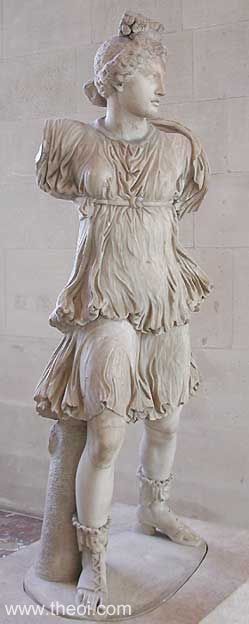
"ARTEMIS was the goddess of hunting, wild animals and wilderness, and the protectress of girls and women.

She was widely worshipped in ancient Greece, with numerous shrines and temples throughout the countryside. This page describes her cult in the southern and eastern regions of the Peloponnese. Here her most celebrated shrines were that of the bear-goddess of Brauron in Attika, and the Lakedaimonian shrine of Artemis Karyai (of the Walnut-Trees).

Artemis was portrayed in classical Greek sculpture as a young woman or girl, with her hair tied back, and usually armed with bow and arrows. Sometimes she was attended by a hunting dog or stag, the so-called Artemis Agrotera (Huntress) type...Artemis Cult

If you enjoyed this post, never miss out on future posts by following me by email!