An online magazine featuring articles about current archaeology and research into the art, literature, politics, warfare, entertainments, music, religion, cuisine and daily lives of inhabitants of the past other than those of the Greco-Roman period edited by a history enthusiast and technologist who is particularly interested in integrating technology and history education. For those who interacted with the Roman world, see "Roman Times."
When the so-called "Griffin Warrior" was discovered near the Palace of Nestor in Pylos, the young man who died around 1500 BCE was buried with some 2,000 objects, including silver cups, beads made of precious stones, ivory combs, a sword and four intricately decorated solid gold rings. Archaeologists Shari Stocker and Jack Davis from the University of Cincinnati that excavated the warrior's burial think these grave goods provided evidence that Mycenaean culture recognized and appreciated Minoan culture more than previously believed, especially the gold rings. Made of multiple sheets of gold, the rings depict detailed scenes including bull leaping and iconography such as sun symbols and mythological genii creatures from Minoan mythology.
Originally the rings were thought to have probably been crafted on Crete where they were used to seal documents or indicate ownership of goods or other objects and pillaged in warfare. But, after extensive study, Stocker and Davis have expressed their opinion that these items were probably not plunder but examples of exchanged ideas and the adoption of certain aspects of Minoan culture including religious concepts and symbols of political power.
Cynthia W. Shelmerdine of the University of Texas, an expert on the Bronze Age in the Aegean, observes, "These things clearly have a power connection…[and] fits with other evidence that the elites on the mainland are increasingly closely connected to the elites on Crete whether or not the rings were used in the Minoan way for sealing objects.”
"The elite of Pylos at this time knew what these symbols and objects meant. The Griffin Warrior was not simply imitating the Minoan world but he was a part of it, just as he was a part of the Mycenaean world. His burial serves as a testimony that the transition between the two eras was neither abrupt nor concrete, but that the process was much more complex. There was a time, at least in Pylos, where the two cultures seemingly blended and coexisted." - Uncovering Pylos, The Archaeological Institute of America.
Gold Mycenaen Seal Ring with two female figures with raised arms praying by a shrine or altar. The branches on either side of the central structure may indicate that the ritual is related to seasonal cycles and fertility, end of 15th century BCE, now in the NAM Athens. I photographed this ring at "The Greeks: From Agamemnon to Alexander the Great" exhibit at the Chicago Field Museum.
Mycenaean gold signet ring depicting a man with a branch approaching a building with a goat behind him intended for sacrifice 1500 BCE NAM Athens. I photographed this ring at "The Greeks: From Agamemnon to Alexander the Great" exhibit at the Chicago Field Museum.
Gold ring from grave IV of grave circle A at Mycenae 1500-1200 BCE courtesy of Wikimedia Commons contributor Schuppi
National Archaeological Museum of Athens, NAMA 240: Gold ring from grave IV of grave circle A at Tiryns, 1500-1200 BCE courtesy of Wikimedia Commons contributor Schuppi.
Archea Nemea, Corinthia, Greece: Mycenaean Gold Signet Ring MN 1005 showing a chariot. Part of the Repartriated Mycenaean Treasure of the Mycenaean cemetery of Aidonia in the Archaeological Museum of Nemea courtesy of Wikimedia Commons contributor Schuppi.
Archea Nemea, Corinthia, Greece: Mycenaean Gold Signet Ring MN 1006 showing two woman holding flowers. Part of the Repartriated Mycenaean Treasure of the Mycenaean cemetery of Aidonia in the Archaeological Museum of Nemea courtesy of Wikimedia Commons contributor Schuppi
Mycenaean gold seal ring, two lions tied to a pillar, said to be from Mycenae, 1700-1400 BCE, Ashmolean Museum, Oxford, courtesy of Wikimedia Commons contributor Zde
A ring with a hunting scene from the Minoan and Mycenaean culture, around 1400 BCE. Gold, Historical Museum of Serbia. Inv. No. 50/A, courtesy of Wikimedia Commons contributor M Todorovic
Gold ring with relief: Sitting Goddess and procession of seahorses. Mycenaean Late Bronze Age. Tiryns, 15th cent. BCE. National Archaeological Museum of Athens N 6208, courtesy of Wikimedia Commons contributor Zde.
If you enjoyed this post, never miss out on future posts by following me by email!
Despite rule by artistically sophisticated cultures including the Assyrians and the Egyptians, some Cypriots of the Archaic Period produced simple handmade figurines with crude faces, cylindrical bodies and plain clay trail or pellets to form hats, eyes, ears, etc., known as the snowman technique. Predominantly found in a sanctuary context, these models included not only priestesses and worshipers, but scribes, actors, musicians, mythological creatures, animals, and scenes of rural life.
"Male figurines (soldiers, horsemen, charioteers, worshipers) are usually associated with sanctuaries of male divinities. A characteristic example is the sanctuary of Ayia Irini on the northwest coast of Cyprus. Here, a huge number of terracotta figurines of various sizes (even life-size) were found placed around the altar. Dated in the Cypro-Archaic period (7th-6th c. BCE), they are considered dedications associated with a male divinity that seems to have been worshiped in more than one capacity."
"Female figurines were usually related to the cult of the Great Mother Goddess. The worship of a female fertility deity, possibly identified with Astarte (Ishtar), is attested in Cyprus dating from the Bronze Age. During the Geometric and Archaic periods, the Near Eastern Astarte merged with the local Aphrodite, who was venerated in Cyprus in large temples, such as those at Kition and Palaepaphos, as well as in numerous rural sanctuaries. There are several iconographic types, all related to ritual activities associated with the cult of a fertility deity: priestesses with hieratic garments, frequently holding powerful symbols of fertility, such as birds, flowers or fruits, worshippers with uplifted arms, musicians (tambourine and flute players), and ceremonial dancers. There is also a number of nude female figurines. This type had been extensively used in North Syria to depict Astarte but was rather strange to Cyprus, where female figures were almost always shown dressed. Female figurines are frequently found in graves, too, suggesting that the fertility goddess was also a symbol of regeneration." - Museum of Cycladic Art, Athens
Terracotta statuette of a man riding a donkey, ca. 600–480 B.C.E., Cypriot at the Metropolitan Museum of Art in New York. The man steadies two large jars that are fastened in front of him on either side of the animal's back. The jars are types that would hold wine or olive oil. The statuette captures what would have been a frequent sight, not only in ancient Cyprus but also for centuries thereafter.
Terracotta group: making flour, ca. 600–480 B.C.E., Cypriot, at the Metropolitan Museum of Art. The figure at the right is grinding grain in a quern with an elliptical stone. Her companion stands over a sieve that is probably set on a low wicker tray or basket. At the left end is a large shallow scoop. Vignettes of daily life, particularly the preparation of bread, are common among Cypriot terracottas of the Archaic period. They have come to light mainly in tombs. Courtesy of the Metropolitan Museum of Art.
Terracotta woman baking bread, ca. 600–480 B.C.E. Cypriot, , at the Metropolitan Museum of Art. In a representation known from only two examples, a woman is shown leaning over an oven and throwing the disks of dough onto the hot walls. The oven has a hole at the bottom for air to enter and a wide mouth at the Metropolitan Museum of Art.
Terracotta figurine tomb gift of a woman coverying her mouth 600-500 BCE, Cypriot, that I photographed at the Ashmolean Museum in Oxford.
Terracotta horse and rider tomb gift, Cypriot, 600-600 BCE, that I photographed at the Ashmolean Museum in Oxford.
If you enjoyed this post, never miss out on future posts by following me by email!
One of the most remarkable paintings to survive from ancient Egypt, this depiction of the noblewoman Tjepu came from a tomb built for her son Nebamun and a man named lpuky. Egyptian artists usually did not depict individuals as they truly looked, but rather as eternally youthful, lavishly dressed, and in an attitude of repose. Tjepu was about forty years old when this painting was executed, but she is shown in what was the height of youthful fashion during the reign of Amunhotep III: a perfumed cone on her heavy wig, a delicate side tress, and a semitransparent, fringed linen dress. - Brooklyn Museum
Image: Portrait of the noblewoman Lady Tjepu, painted gesso on limestone, New Kingdom, Dynasty 18, reign of Amunhotep III (1390-1352 BCE) from tomb no. 181 at Thebes that I photographed at the Brooklyn Museum.
If you enjoyed this post, never miss out on future posts by following me by email!
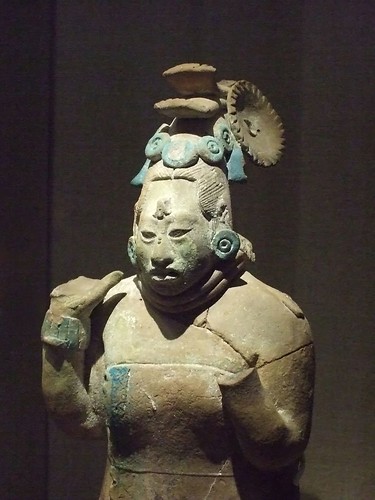
Traces of Mayan Blue can be seen on this
ritual earthenware whistle depicting a standing
female dignitary from the Late Classical Period
600-900 C.E. Photographed at the DeYoung
Museum of Fine Arts in San Francisco, CA by
Mary Harrsch.
Eric Dooryhee and a team of French physicists at the Brookhaven National Laboratory in Upton, N.Y.have used X-rays from a synchrotron machine to study the atomic structure of ancient Mayan blue pigment. Using the information they obtained from their studies they have been able to synthesize the basic properties of Mayan Blue by combining indigo with a porous substance called zeolite, a commercial additive to cement, laundry detergents, nutritional supplements, and cat litter, to make a new synthetic long-lasting blue pigment.
The Mayans made the original pigment by burning incense made from tree resin and using the heat to cook a mixture of indigo plants and a type of clay called palygorskite.
"As the mixture was heated, indigo molecules filled a network of tiny channels inside the clay. Some of these bits of indigo plugged the pores on the surface, preventing the color from escaping over time. The clay, in turn, protected the indigo from the environment." - More: FoxNews.com
The research team hopes to use the new synthetic material to restore paintings and is considering other applications such as colored cement.
This painting of the construction of the Tower
of Babel by Juan Gerson created in 1652 was one
of the few colonial period paintings that
incorporated Mayan Blue. (oil on paper)
"Maya blue" first appeared around the 800 A.D. [some researchers claim 300 A.D.] and it was still used in the 16th century in several Convents of Colonial Mexico, notably in the paintings of the Indian Juan Gerson in Tecamachalco. These paintings are a clear example of the combination of Indian and European techniques sometimes known as Arte Indocristiano. After that, the techniques for its production were lost in Mexico but in Cuba there are examples from 1830." - Wikipedia
Research on Maya Blue's composition began as early as the 1950s when chemists used powder diffraction to discover its basic components.
"The actual recipe to reproduce Maya Blue pigment was published in 1993 by a Mexican Historian and Chemist, Constantino Reyes-Valerio. The combination of different of clays: palygorskite, montmorillonite, together with the use of the leaves of the añil and the actual process is described in Reyes-Valerio (1993).[6] Reyes-Valerio's contributions were possible due to his combined background of History and Chemistry, through a thorough revision of primary texts (Sahagun, Hernandez. Jimenez and others), microscopic analysis of the mural paintings and Fourier Transform Infrared Spectroscopy. " - Wikipedia
The Maya used the blue pigment for funerary murals and other art objects as well as in their rituals of human sacrifice. In the following scene from Mel Gibson's Apocalypto we see victims coated with blue paint walking past murals depicting human sacrifice on their way to the sacrificial altar.
Of course Mel Gibson's film was panned by historians because it depicted the wholesale slaughter of captives. Some anthropologists [National Geographic video clip] claim that sacrifices were usually restricted to special ceremonies like the induction of a new ruling king or festivals to honor the god of rain intended to bring rain at propitious times to guarantee a bountiful harvest.
Other researchers, including Mari Carmen Serra Puche, have discovered that a number of sacrifices involved women and children [Discovery Magazine video clip]. In either case, it is a far cry from what I was taught as a school girl in the 1950s - that unlike the bloodthirsty Aztecs, the Maya were a peaceful civilization of scholars who studied mathematics and astronomy!
I found a website that said Mayan Blue in digital terms is the color #73C2FB. I don't think using it as a background color for your web page is going to guarantee that it won't fade away (at least in the public consciousness) over time though!!
If you find the Mayan civilization as interesting as I do you may enjoy viewing a slideshow of Mayan art objects I have photographed at the Deyoung Museum of Fine Art in San Francisco, California, the University of Utah Museum of Fine Art in Salt Lake City, Utah, the Field Museum and the Chicago Art Institute in Chicago, Illinois, the Dallas Museum of Fine Arts in Dallas, Texas, the Museum of Man in San Diego, California, and the Metropolitan Museum of Art in New York City.
I have even more images of Mayan art that I will be uploading to Flickr as time permits so you may wish to check back from time to time.
If you enjoyed this post, never miss out on future posts by following me by email!
The burial treasures of a 2300-year-old Egyptian noblewoman named Meretites, which means "beloved of her father", is the centerpiece of the newly reopened Egyptian gallery at the Nelson-Atkins Museum of Art in Kansas City. Robert Cohon, curator of art of the ancient world at the Nelson-Atkins points out that the arrangement of the art and subtle lighting is intended to give the impression of a tomb without being frightening.
"We want children to come in here, and want to know more," Cohon said. They will see the inner coffin painted with a huge golden-faced, blue-haired Meretites, as well as the myriad Egyptian gods and goddesses there for her journey into the afterworld."
"Egyptian art has been a surreptitious pleasure for so many," Cohon continues. "This may also be a child's first exposure to death."
I was so excited to read about the Nelson-Atkins $1.7 million renovation. They sound like they have a wonderful ancient art collection that spans over 4,000 years and there is a chance I may be going to Kansas City in July.
[Image courtesy of the Nelson-Atkins Museum of Art]
My husband expressed his wish to go to the Military Vehicles Preservation Association national conference that is being held in Kansas City this year. Its still a little iffy, though, with the gas prices climbing towards $4 a gallon again. If there wasn't a possibility that he would buy some vehicle or large part, we could take my little fuel-efficient Scion but if we're attending a MVPA event, we'll probably need to take my husband's truck in case he wants to drag something back to Oregon. At least now I have as much motivation to go as he does!
In addition to the funerary art of Meretites that was purchased from a German collection back in 2007, the Egyptian galleries includes stone portraits of famous kings and queens from Sesostris III to Ramses II, from Nefertiti to the Ptolemies. The museum's website points out that none of their recent purchases are contested by Egypt so they won't be in danger of repatriation.
Their Near Eastern collection includes grave goods from kings and queens of Ur and sculptures from the Palace of Ashurnasirpal II in Nimrud as well as the ceremonial center of the Persian Empire, Persepolis. It will be interesting to compare their artifacts to those on display at the Oriental Institute at the University of Chicago.
The museum's Roman collection apparently centers on works of art from the second century CE created during the reigns of the emperors Hadrian and Severus. Their Greek collection mentions a sculpture of a young athlete. I couldn't find an image of it but wonder if it is engaged in a particular sport or is more of a representation of a victorious youth?
If you enjoyed this post, never miss out on future posts by following me by email!
This discovery sounds exciting and very unique. I wish the article had included some pictures. The discovery of the gold chest plate embossed with a sun is particularly interesting. I wonder if the sun resembles the so-called Vergina sun found on a gold casket in the royal tombs discovered by Manolis Andronikos.
This YouTube video includes images of several Macedonian tomb sites and artifacts discovered within them including the gold casket embossed with the Vergina sun. It gets a little political towards the end though. My inclusion of it here is merely for illustrative purposes and does not imply any agreement with any political statements made within it.
Macedonian archaeologists have discovered 17 tombs dating from the 5th century BC in Ohrid, southwestern Macedonia, local media reported Monday. In one tomb, archaeologists found bones of a 15-year-old girl with a unique funeral mask made up of thin gold eye-covers, gold plate for the mouth and a plaque with an engraved sun placed on her chest. "This kind of a mask is unique for the Balkans. Several gold plates were found in Aegean region, but this kind of combination in one grave is unknown," Pasko Kuzman, head of the Macedonian Department for Cultural Heritage, was quoted as saying. Jewelry, golden chains and objects made from amber were also found in the graves. - More: EarthTimes
If you enjoyed this post, never miss out on future posts by following me by email!




![Apocalypto [Blu-ray]](https://lh3.googleusercontent.com/blogger_img_proxy/AEn0k_sPNi0EnyQhQUkM_Q2D0Ajv_R0APy3tmANK15d-FlzVFUYqh1Pc3-UlpSGhHV3qdzzjNWWkvxKcafloMyhW4sMZI00ba1qkv5E1G-ImGLhiqId8XPy2XFfXNts8-cg5LT-yuyY3Dh6bsAVK9ns73XIAKNOUxAC6ZSYK0nzzNDCWMcKk0IP0Ms9N7-0qB2xS-3ntNfpZeEswgTyGgvk9jewTtT7-jiTiLBw=s0-d)


